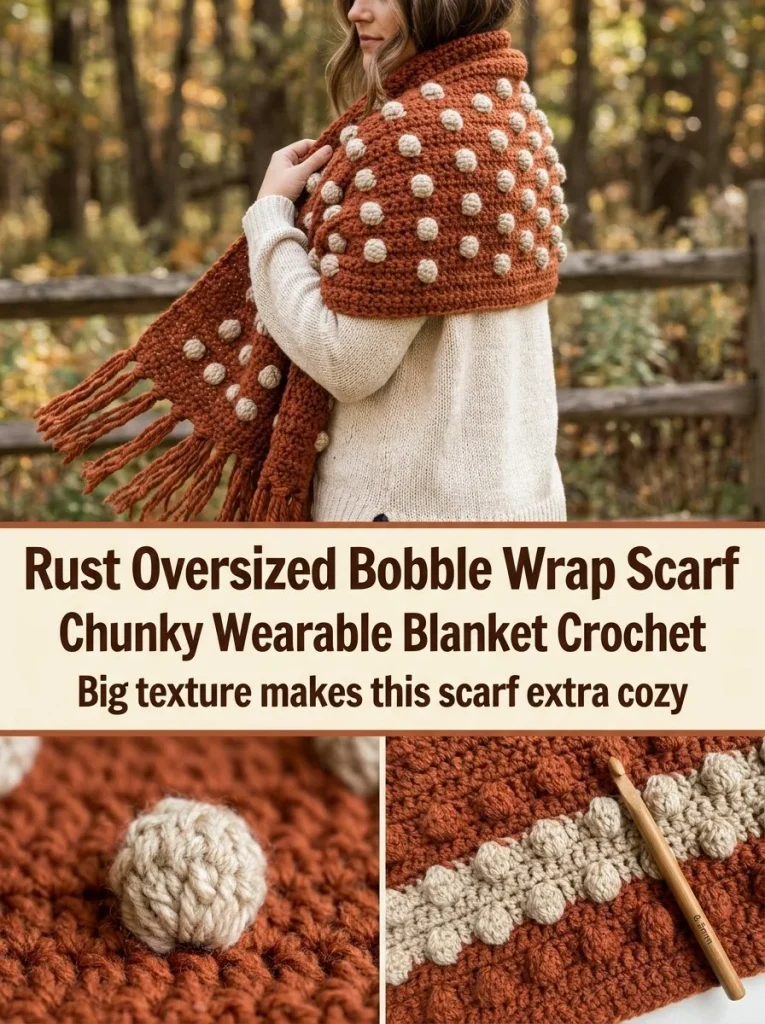
Crafting a cozy, oversized wrap scarf packed with texture and warm hues creates a perfect accessory for chilly days and stylish layering. This project showcases an elegant balance of rustic tones with a delightful play of bobbles and smooth stitches, forming a fabric that is both visually intriguing and comforting to wear. The scarf is worked flat in rows, using a simple yet dynamic combination of single crochet stitches and a distinctive bobble stitch pattern that alternates positions to create a staggered, "brick-like" effect.
The main technique centers around crocheting with bulky weight yarn, which gives the wrap substantial warmth and an appealing heft without feeling too cumbersome. Using two colors—a rich rust and a soft oatmeal—adds a subtle but sophisticated contrast that highlights the dimensional bobble details. This balance of texture and color makes the wrap not only a practical winter essential but also a stylish statement piece.
The design is accessible for those familiar with basic crochet stitches but includes a special bobble stitch technique to elevate the final texture. The finished piece measures approximately 17 inches wide and 69 inches long, ideal for wrapping comfortably around shoulders or layering over coats. Additionally, the hand-twisted fringe at each end enhances the wrap’s boho-chic vibe and provides a polished finishing touch. For those interested in complementary projects with a similar rustic color palette, this wrap pairs beautifully with designs such as the Rust Racer Wrap, offering a cohesive winter wardrobe collection.
Pattern at a Glance
Skill level: Intermediate (due to bobble stitch and color changes)
Terminology: US crochet terms
Construction: Flat panel worked in rows, alternating colors
Finished size: Approximately 17 inches wide by 69 inches long
Yarn weight: Bulky (#5)
Hook: 6.5 mm
Main stitch: Single crochet combined with 4-dc bobble stitch
Gauge: Approximately 17 inches wide (43-47 chains)
Motifs: None (textured stitch pattern)
Layout: Single rectangular wrap
Joining: None (worked in one continuous piece)
Border: None beyond the fringe
Seaming: Not applicable
Materials
To crochet this oversized bobble wrap scarf, you will need:
- Bulky weight (#5) yarn: About 1000-1100 yards in rust color for the majority of the wrap, plus 150-200 yards of oatmeal colored yarn for the bobble accents. Bulky yarn provides warmth and the texture needed for the bobble stitch to really stand out.
- Crochet hook: Size 6.5 mm (K-10.5) is recommended to achieve the appropriate gauge and drape for the scarf.
- Tapestry needle: For weaving in yarn ends and tidying up the finish.
- Scissors: For cutting yarn ends and creating the fringe.
Using good quality bulky yarn with some softness and durability will make the scarf comfortable and long-lasting. Wool, wool blends, or lofty acrylics can all work well depending on your preference for warmth and feel.
Yarn and Color Notes
The rust color serves as the primary background color throughout the scarf, lending a warm, earthy tone that is especially suitable for fall and winter wear. The oatmeal color is used strategically for the bobble accents, providing a subtle contrast that accentuates the stitch texture without overwhelming the piece. When selecting yarn, choose skeins that maintain consistent weight and thickness to ensure the stitch pattern remains even.
Smooth and plied yarns will create more defined bobbles and an overall neater fabric, while hairy or textured yarns may soften the definition of the bobble stitch but add a rustic charm. Solid colors work best to showcase the stitch pattern; variegated yarns may mask the bobbles’ visibility.
For color alternatives, consider other contrasting neutrals or a complementary palette with similar tonal values to keep the design balanced.
Finished Measurements
The completed scarf measures approximately 17 inches in width and 69 inches in length. The width corresponds to roughly 43–47 foundation chains, depending on your yarn and tension, to achieve the designated gauge. The generous length makes the scarf suitable for wrapping multiple times or draping loosely for added warmth and style.
Because bulky yarn adds loft and drape, the measurements may vary slightly based on individual tension and yarn choice. Always make a gauge swatch first to confirm your stitch density before starting.
Gauge
The gauge target is approximately 17 inches in width from a loosely crocheted foundation chain of 43 to 47 chains (odd number), depending on your personal tension and yarn thickness.
Gauge is measured across the foundation chain and the first rows of single crochet stitches to ensure the fabric width is consistent. Maintaining gauge is important for this project because the stitch count sets the foundation for the staggered bobble pattern placement.
- If gauge is too tight: The scarf will be narrower and the fabric stiffer, potentially reducing the wrap’s drape and comfort.
- If gauge is too loose: The scarf may be wider and less structured, with bobbles that don’t hold their shape as well.
Check your gauge before beginning and adjust hook size if necessary. Swatching also helps familiarize you with the bobble technique, ensuring even stitch formation.
Abbreviations
- ch – chain
- sc – single crochet
- dc – double crochet
- st(s) – stitch(es)
- tog – together
- RS – right side (public facing side)
- WS – wrong side (back side)
Note: This pattern follows standard US crochet terminology.
Important Pattern Notes
- Starting chain should be an odd number to work evenly with the stitch pattern.
- The turning chain counts as the first stitch in the subsequent rows.
- Color changes occur within rows to alternate between rust and oatmeal yarns specifically during bobble stitches.
- The bobble stitch is worked across multiple double crochet steps that are partially completed and finished together to create the raised bump.
- Rows are worked flat with turning chains; right side and wrong side rows alternate as you go.
- The bobble pattern alternates every four rows in an A/B rhythm to stagger the bobbles, creating a "brick" effect visually.
- The fringe finishing is essential to add weight and a neat end to the wrap.
Special Stitches and Techniques
4-dc Bobble Stitch
The main texture feature is the 4-double crochet bobble stitch:
- Work 4 double crochet stitches into the same stitch.
- For each partial double crochet, pause before completing the final yarn over and pull through (leaving the last loop on the hook).
- After the fourth partial double crochet, yarn over and pull through all 5 loops on the hook at once.
- This creates a pronounced bobble or bump on the fabric surface.
Color Changing Within Rows
To achieve the color contrast effect:
- Begin the row with rust yarn.
- Switch to oatmeal yarn for the bobble stitch.
- Immediately switch back to rust yarn to continue single crochet stitches.
- Ensure color changes are clean by finishing the previous stitch completely before switching.
- Carry the yarn loosely along the row’s back to avoid tightness.
Understanding the Construction
This crochet wrap is constructed entirely in one flat rectangular piece worked back and forth in rows. The width is set by the starting chain, which is adjusted to achieve a fabric approximately 17 inches wide.
The stitch pattern works on a 4-row repeat cycle:
- Rows 1 & 2: Rust color, single crochet all stitches across.
- Row 3 (Bobble Row A): Starts with rust sc stitches, then alternating bobbles in oatmeal and rust sc groups, centered so that bobbles are aligned.
- Rows 4 & 5: Rust single crochet.
- Row 6 (Bobble Row B): Bobbles offset by several rust sc before first bobble, repeating the alternating pattern across.
- Rows 7 & 8: Rust single crochet.
Each 4-row set is repeated, alternating between Bobble Rows A and B to create the staggered, brick-like alignment of bobbles.
The wrap is worked until it reaches about 69 inches in length, making it long enough for generous wrapping and stylish draping.
The ends are finished with a hand-applied fringe combining strands of rust and oatmeal yarn, approximately 11 inches long before twisting or knotting to the finished length of around 5 inches.
Foundation
Begin by loosely chaining an odd number of stitches to measure approximately 17 inches wide. Depending on the yarn thickness and your tension, this will be about 43 to 47 chains. Do not chain too tightly to maintain good drape and ease in the fabric.
Row 1
- Using the rust yarn, work a single crochet (sc) in the second chain from the hook.
- Continue sc in each chain stitch across the row.
- Turn your work.
Row 2
- Chain 1 (counts as turning chain).
- Single crochet across all stitches to the end.
- Turn.
Bobble Row A
- Chain 1, sc in the first 3 stitches with rust.
- Switch to oatmeal yarn.
- Work a 4-double crochet (dc) bobble stitch in the next stitch by:
- Yarn over, insert hook into stitch, yarn over, pull up a loop (partial dc), yarn over, pull through two loops—stop before final yarn over.
- Repeat 3 more partial dc in the same stitch, leaving each final loop on the hook.
- Yarn over, pull through all 5 loops at once to complete bobble.
- Switch back to rust yarn.
- Single crochet in each of the next 5 stitches.
- Repeat this bobble and 5-sc pattern across, centering the final repeat so the bobbles align evenly.
- Turn.
Next 2 Rows
- With rust yarn, chain 1 and single crochet across each row.
- Turn at the end of each row.
Bobble Row B
- Chain 1.
- Begin with about 5 to 6 rust single crochet stitches.
- Switch to oatmeal yarn and work a 4-dc bobble stitch.
- Switch back to rust yarn and sc in next 5 stitches.
- Repeat this bobble and 5-sc sequence across the row.
- Turn.
Continuing the Pattern
Continue this 4-row rhythm:
- Bobble row (alternating between Bobble Row A and Bobble Row B to stagger the bubbles)
- Followed by 1 or 2 plain rust single crochet rows
Repeat until your scarf measures about 69 inches in length. The alternating bobble positions give the fabric a charming staggered textured effect, like bricks in a wall.
Fringe
- Cut strands of rust and oatmeal yarn about 11 inches long.
- Group 3-4 strands for each bundle.
- Fold bundles in half and pull doubled bundles through evenly spaced stitches along both short ends of the scarf.
- Twist or knot strands to create final fringe length of approximately 5 inches.
- Trim fringe evenly.
The fringe adds movement and a polished finishing touch, enhancing the overall rustic allure.
Pattern Checkpoint
At various intervals, check the following:
- Gauge width is about 17 inches.
- Stitch count remains consistent without unintentional increases or decreases.
- Bobble stitches are centered properly and staggered as expected.
- Length after repeating the main pattern reaches about 69 inches.
Keeping track of these checkpoints helps ensure the finished wrap looks as intended and fits comfortably.
How to Resize
To adjust the size of the wrap:
- Width: Add or remove foundation chains in odd numbers to maintain the stitch multiple and keep the bobble pattern balanced. Keep the ratio so the fabric width is proportional, but be mindful the bobble placement pattern may require slight adjustment to center bobbles properly.
- Length: Work more or fewer 4-row pattern repeats to lengthen or shorten the wrap.
- Adjust the amounts of yarn accordingly; bulky yarn projects can use quite a bit of fiber if extended.
Because the stitch pattern is consistent across rows, resizing mainly involves changing the starting chain and/or total number of rows.
Useful Variations
- One-color version: Work the entire wrap in rust or oatmeal for a monochromatic textured effect.
- Reversed color usage: Swap the main and accent colors for a lighter or darker dominant tone.
- Longer or shorter scarf: Extend or reduce the length to create a shawl or a shorter neck wrap.
- Alternate stitch patterns: Substitute the single crochet rows with half double crochet rows for a softer texture (keeping bobble rows the same).
- Fringeless finish: Omit fringe and instead finish with a simple single crochet border for a tidier edge.
Exploring these variations allows you to customize the wrap to your personal style or specific occasions.
Troubleshooting
Why Is My Scarf Wider or Narrower Than Expected?
Check your gauge and starting chain tension. A tight chain reduces width; a loose chain increases it. Adjust hook size or tension before continuing.
Why Are My Bobbles Uneven?
Ensure you stop at the right point when working each partial double crochet, leaving loops on the hook before finishing together. Consistent yarn tension during bobble creation helps evenness.
How Do I Manage Color Changes Cleanly?
Complete the last stitch with the old color fully before switching yarns. Change colors at stitch boundaries, carry yarn loosely along wrong side to prevent tightness or holes.
What If My Edges Curl?
Single crochet stitch is relatively stable but wild tension variations or skipping stitches can cause curling. Maintain consistent tension and stitch count on edges.
How Do I Keep the Bobble Rows Centered?
Follow the instruction to center the repeats carefully; count stitches accurately and adjust starting sc count as needed to ensure bobbles do not drift off the intended placement.
Frequently Asked Questions
Can I use a different yarn weight for this pattern?
Bulky (#5) yarn is recommended to achieve proper texture and drape. Using lighter or heavier yarn will change the size and fabric feel drastically. If using a different weight, adjust hook size and foundation chain count accordingly but note that the pattern proportions will alter.
Can beginners make this scarf?
This pattern is suitable for intermediate crocheters comfortable with basic stitches and color changes. The bobble stitch technique requires some patience but is well-explained and manageable with practice.
Is the scarf reversible?
The fabric has a distinct right side and wrong side due to the bobble stitch’s 3D texture and color changes, so it is not fully reversible.
How should I block the finished scarf?
Hand wash gently and lay flat to dry, shaping the fabric to smooth edges and even out the stitch pattern. Bulky yarn often does not require aggressive blocking, but light stretching can improve final drape.
Can I add a border to the wrap?
You may add a simple single crochet or ribbed border if you prefer a framed look. Keep borders light to avoid pulling on the stretch of the bobble fabric.
How do I maintain yarn continuity during bobble color changes?
Carry the yarn not in use loosely along the back side to avoid thick spots and ensure clean edges.
Related Project Ideas
This bobble stitch texture lends itself well to other warm accessories such as cowls, hats, or blankets. For a gentle variation of textured wraps, explore the Soft Garter Wrap Scarf which offers a cozy alternative with a distinct stitch pattern in a similarly warm palette.
Final Thoughts
This oversized wrap scarf mixes practicality with textured elegance through its carefully balanced use of rustic colors and the distinctive bobble stitch. Working the scarf in a flat panel allows for straightforward construction while achieving a sophisticated staggered bobble effect reminiscent of brickwork. With generous length and a cozy bulky yarn, it is a perfect winter companion that invites both warmth and tactile interest.
The project boils down to managing the color changes smoothly and mastering the bobble stitch rhythm to maintain the brick-like staggered pattern throughout its length. Finishing with a twined fringe adds that final artisan touch, making it a garment as eye-catching as it is comforting. Whether gifted or kept for personal use, this wrap scarf is a rewarding crochet project that showcases the beauty of texture and color working together in harmony.



