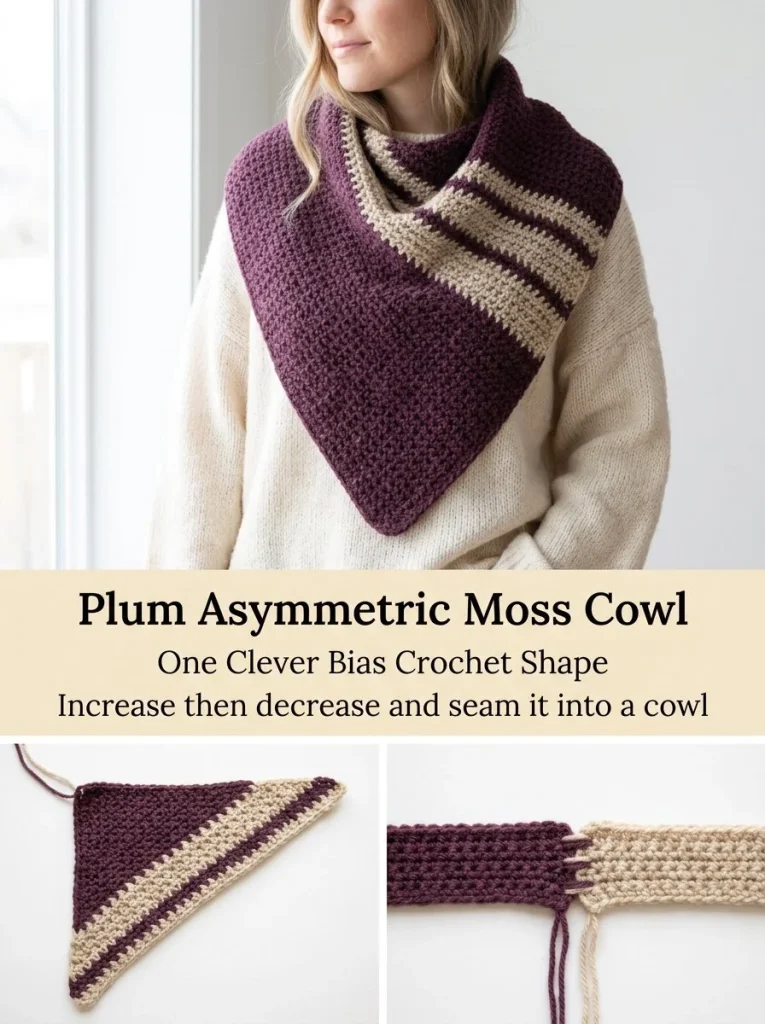
The asymmetric cowl created with a moss stitch texture offers a beautifully understated accessory that combines texture, color play, and interesting shaping to enhance any outfit. This deep plum and oatmeal colored piece is designed to be worn wrapped comfortably around the neck, with an elegant long pointed front that creates visual interest and flattering drape. The unique triangular shaping achieved through gradual increases and decreases in combination with alternating moss stitch repeats delivers a fabric that is both substantial and supple.
Constructed flat and seamed later, the cowl’s design allows for precise shaping control during the crochet process. The use of DK/light-worsted weight yarn in two coordinated colors paired with a 5 mm hook creates a balanced gauge that provides warmth without bulk. The alternating half double crochet and single crochet stitches interspersed with chain spaces establish the popular moss stitch texture, offering a subtle but rich surface pattern ideal for layering in cooler weather.
Incorporating occasional diagonal four-row stripe bands in oatmeal adds a gentle contrast that breaks the solid plum sections with a touch of movement and softness. This project is an excellent opportunity to develop skill in working moss stitch, managing color changes, and mastering shaping techniques. It is a practical yet stylish item that can enhance a casual or dressier ensemble.
Pattern at a Glance
Skill level: Intermediate (requires understanding of increases, decreases, color changes, textured stitch pattern)
Terminology: US crochet terms
Construction: Worked flat in three distinct shaping sections and seamed afterward
Finished size: Approximate short sides 9.5 inches; long shaped edge 26–27 inches
Yarn weight: DK/light worsted (#3-4)
Hook size: 5 mm (approx. H-8)
Main stitch: Moss stitch (alternating hdc, sc, and ch1 spaces)
Gauge: Not explicitly stated, but gauge is governed by yarn and hook choice for approximate sizing
Motifs: None; texture stitch pattern only
Layout: Triangular cowl with asymmetric shaping
Joining: Mattress stitch seaming of short ends
Border: Single crochet finishing row
Materials
To create this cowl, you will need:
- Approximately 400 yards of DK/light-worsted weight yarn in a deep plum color, which makes up the main body of the cowl. This darker, rich tone forms the elegant backdrop for the design.
- Approximately 150 yards of DK/light-worsted weight yarn in oatmeal color to create gentle diagonal stripe accents. The lighter oatmeal provides contrast without overpowering.
- A 5 mm crochet hook, suitable for DK/light worsted yarn, providing a balanced fabric tension and comfortable stitch definition.
- A tapestry needle for weaving in ends and assembling the pieces with mattress stitch seaming after blocking.
These materials create a cowl that balances cozy warmth, softness, and visual texture. The yarn amounts and hook size align to achieve the indicated finished dimensions.
Yarn and Color Notes
Choosing yarn fibers with a bit of elasticity or memory, such as wool blends or certain acrylic blends, will help maintain the cowl’s shape. Smooth yarns work best for the moss stitch texture since they highlight the alternating single crochet and half double crochet stitches and the chain spaces that define the pattern. Avoid overly fuzzy or novelty yarns as they can obscure the moss stitch’s distinct texture.
The two-color combination of deep plum and oatmeal plays a key role in the cowl’s aesthetic. The plum serves as a rich, warm base, while the oatmeal introduces visual breaks through diagonal striping. This small color contrast enhances the organic geometric shaping of the piece without interfering with the cowl’s versatile styling. When executing color changes, be sure to switch colors only at row edges to maintain clean stripes and avoid color bleeding.
This textured moss stitch construction is somewhat reminiscent of the broken moss stitch used in other projects, which you can explore further for inspiration in your colorwork choices, such as in the Aaron Phone Bag pattern that features similar moss stitch texture but applied in knitting techniques. For more crochet-related projects featuring intriguing textured stitch patterns, consider the Alias Bandana Cowl pattern that also plays with stitch texture and shaping.
Finished Measurements
The cowl is shaped as an asymmetric triangle with the following approximate dimensions:
- The two shorter sides measure about 9.5 inches each. These edges become the ends that are joined together during assembly.
- The longest shaped edge measures approximately 26 to 27 inches, providing a dramatic, elongated point at the center front.
The resulting dimensions make a comfortable neck accessory that sits snugly without constriction and creates a visual focal point with its asymmetric tip. The size is suitable for most adults and can be worn layered with coats or sweaters.
Gauge
While the original pattern does not state a formal gauge, maintaining consistent tension with DK/light worsted yarn and a 5 mm hook will ensure the piece achieves the correct dimensions. It is advisable to:
- Work a small swatch in the established moss stitch pattern, measuring the width and height after blocking to approximate your stitch and row gauge.
- Aim for the short sides to measure roughly 9.5 inches when you reach the end of Part 1 and Part 3 sections.
- Adjust hook size slightly if your tension is too tight or loose to match these dimensions.
Because this is a wearable accessory where fit and drape matter, achieving the approximate gauge through consistent tension is important. If your gauge is larger, the cowl will have looser fabric, potentially affecting the sharp shaping. If smaller, the cowl may be too tight or stiff.
Abbreviations
- ch: chain
- sc: single crochet
- hdc: half double crochet
- st(s): stitch(es)
- skip: omit one or more stitches or spaces
- rep: repeat
- tog: together (used in decreases)
All abbreviations use US crochet terminology throughout.
Important Pattern Notes
- The cowl is worked flat, beginning with a very small triangular foundation.
- Each row begins with the appropriate turning chain(s) consistent with half double crochet or single crochet.
- Edges are kept neat with a half double crochet stitch to maintain structure.
- The moss stitch pattern alternates single crochet and chain 1 spaces, which creates a subtle texture and slight openness.
- Increases and decreases are introduced only along the edges to shape the triangle asymmetrically, guided by precise counts of moss stitch repeats.
- Color changes happen only at row edges to keep diagonal stripes clean.
- Assembly is done using mattress stitch to seam the short ends without twisting the fabric.
- Blocking flat is essential to smooth and shape the piece before seaming.
Special Stitches and Techniques
- Moss Stitch (Linen Stitch): Created by alternating single crochet stitches and chain 1 spaces, worked so that sc are offset in each row. This produces a fabric with a subtle grid-like texture.
- Half Double Crochet (hdc): Used on the edges to keep structure firm and provide sturdy sides.
- Increasing Moss Stitch Repeats: Involves adding an extra sc/ch1 pair near edges to grow the width of the work in specified rows for shaping.
- Decreasing Moss Stitch Repeats: Achieved by skipping the first sc/ch1 pair at an edge to reduce width symmetrically.
- Color Change at Row Edges: For clean striping, colors are changed at the end of rows, never in the middle of a row.
- Mattress Stitch Seaming: A neat seaming method for joining the short ends flat so the seam is nearly invisible and lies on the inside.
Understanding the Construction
The cowl is constructed flat in three distinct shaping phases:
-
Part 1 – Symmetric Increases: The work starts as a small triangle established by hdc and sc stitches in the third chain of a 3-ch foundation. Each row increases at both edges by adding an extra moss stitch repeat adjacent to the interior moss stitch spaces. This symmetrically widens the triangle until both short sides reach approximately 9.5 inches. Oatmeal color is introduced here for diagonal 4-row stripe bands, creating visual interest.
-
Part 2 – Asymmetric Increases: In this phase, increasing stops at one edge but continues at the opposite edge, shifting the shape into a diagonal expansion. This causes the piece to grow longer without getting wider on one side, resulting in a long shaped edge roughly 26-27 inches in length.
-
Part 3 – Decreases to Shape: The previously stationary edge remains unchanged, while the shaped edge narrows by decreasing one moss stitch repeat on each row (skipping the first sc/ch1 pair). This decreases the width back down so that the final short side again measures about 9.5 inches.
A finishing row of solid single crochet stabilizes the final edge before blocking and assembly. After blocking flat to open the moss stitch texture and shape the fabric, the two short ends are joined by mattress stitch without twisting, allowing the long asymmetric point to hang attractively at the center front.
This three-part shaping combined with the moss stitch texture creates a garment-like accessory that flows naturally when worn.
Full Pattern Instructions
Foundation
Begin with a chain of 3.
Row 1
Into the 3rd chain from the hook, work:
- 1 half double crochet (hdc)
- 1 single crochet (sc)
- 1 half double crochet (hdc)
This forms a tiny initial triangle.
Establish the moss stitch pattern by maintaining a half double crochet edge stitch at both sides of rows in all subsequent work.
Moss Stitch Pattern
The moss stitch here is formed by alternating single crochet stitches and chain 1 spaces between the hdc edge stitches at either side of each row.
Work this pattern consistently, ensuring the edge always begins and ends with an hdc stitch, which keeps the fabric neat.
Part 1: Increase Both Edges
For every row in this section:
- Increase at both edges by adding one additional moss stitch repeat near the first interior moss stitch space at the start of the row and near the last interior space at the end.
- This means each row will grow wider by two moss stitch repeats total.
Continue this increasing process until the two short sides of the triangle measures approximately 9.5 inches.
In this section, alternate colors by introducing oatmeal yarn for diagonal stripe bands that last for 4 rows, always changing colors at the edge of a row to keep the stripe crisp.
These diagonal stripes introduce subtle contrast and visual interest against the deep plum background.
Part 2: Increase One Edge Only
At this stage:
- Stop increasing at one edge (make it stationary).
- Continue increasing only at the opposite edge by adding one moss stitch repeat per row there.
This causes the work to travel diagonally and grow in only one direction rather than widening symmetrically, resulting in the longest shaped edge of the triangle measuring approximately 26 to 27 inches.
Part 3: Decrease One Edge
In this phase:
- Keep the previously stationary edge unchanged.
- Decrease the shaped edge by skipping the first sc/ch1 pair in each row before continuing the moss stitch pattern. This eliminates one moss stitch repeat per row on this edge.
Continue decreasing until the final short side again measures about 9.5 inches.
Finishing Row
Work one solid row of single crochet (sc) evenly across the last edge to protect the edge and provide a clean finish.
Blocking
Block the piece flat to smooth the texture stitches and set the shaping, ensuring the cowl lies neatly.
Assembly
Bring the two short ends (each about 9.5 inches) together without twisting.
Using the tapestry needle and yarn tails, seam using mattress stitch from top to bottom. This method produces a nearly invisible seam on the right side of the finished cowl.
Turn the seam toward the back.
The long asymmetric pointed edge is designed to hang at the center front when worn, making the unique shape a focal point of the accessory.
Checkpoints
- After Part 1, verify that both short edges measure roughly 9.5 inches before moving to Part 2.
- During Part 2, measure the shaped long edge intermittently to confirm it grows to about 26-27 inches.
- At the end of Part 3, ensure the last short side returns to approximately 9.5 inches.
- Before seaming, confirm the moss stitch texture is consistent, and color changes are neat.
These checkpoints help maintain accuracy and ensure the cowl’s final shape is as intended.
Assembly and Joining
The asymmetric cowl is completed by joining its two shorter edges with a mattress stitch seam:
- Position the two short edges right sides together with no twist to preserve fabric orientation.
- Use matching yarn and tapestry needle to sew from one end to the other, working carefully to align moss stitch repeats to keep the seam flat and subtle.
- Pull yarn evenly to avoid puckering while keeping flexibility.
- Once seamed, turn the seam to the inside (the back side) so it is hidden when worn.
This finishing step ensures the cowl is comfortable to wear with a smooth seam and perfect asymmetric hang.
Finishing
Weave in all loose yarn ends securely with the tapestry needle.
Block again lightly if needed after seaming to encourage even drape and finalize the shape.
The single crochet border row forms a sturdy edge, but blocking relieves any slight rolling.
How to Resize
To modify the cowl size while maintaining its asymmetric triangle shape:
- Adjust the number of increases in Part 1 to create short sides longer or shorter than 9.5 inches. Add or omit moss stitch repeats symmetrically on both edges.
- In Part 2, increase one edge to lengthen or shorten the diagonal edge accordingly.
- Use Part 3 decreases to re-balance the final triangle shape.
Because the stitch pattern is based on moss stitch repeats, resizing must respect the stitch multiple of one moss stitch repeat (usually sc + ch1 or equivalent).
Keep in mind, any sizing change will affect the overall yardage used and may require recalculating color stripe placement for balanced stripes.
Useful Variations
- Create a one-color version for a monochrome, classic look.
- Increase the number of oatmeal stripe bands or adjust stripe width for different color contrast.
- Use different DK/light worsted colors for seasonal variations or to match specific outfit palettes.
- Adjust the length of the long edge in Part 2 for a longer or shorter asymmetric point.
- Fashion a coordinating hat or gloves using the same moss stitch texture.
Such variations provide maximum creativity using the same fundamental technique.
Troubleshooting
Why is my moss stitch pattern irregular or uneven?
Ensure you are consistently alternating single crochet stitches and chain 1 spaces. Missing a chain or miscounting a stitch will cause pattern shifts.
Why are my increases not producing correct shaping?
Check that increases are added as full moss stitch repeats near the edge (consisting of both sc and ch1 pairs). Partial increases may cause uneven edges.
Why do my color changes look messy?
Always switch colors at the end of a row, finish the last stitch completely with the old color, and carry yarn neatly along the edge. Do not change colors mid-row for crisp diagonal stripes.
Why does my seam look lumpy or twisted?
When mattress stitching, align stitches precisely and avoid twisting edges before seaming. Keep tension even and check alignment frequently as you sew.
Why is the cowl edge curling after blocking?
The half double crochet edge stitches help prevent curling. Make sure the finishing row of single crochet is worked evenly. If curling persists, longer blocking or lightly steaming may help ease the edge flat.
Frequently Asked Questions
Can I use a different yarn weight?
The pattern is designed for DK/light worsted (#3-4) yarn to achieve the right drape and size. Using heavier yarn will require larger hook and adjustment for gauge and sizing.
Can I use cotton yarn?
Yes, but cotton lacks elasticity compared to blends with wool or acrylic, so the cowl may be less stretchy and hold shape differently. Consider weighing the feel and drape.
Can beginners make this project?
This piece is best suited for an adventurous beginner with experience in half double crochet, single crochet, and basic shaping. The moss stitch technique is straightforward once the pattern is understood.
How do I handle yarn color changes for the stripes?
Change colors only at row ends. Fasten off or carry the yarn loosely along the edge if preferred. Avoid knotting in the middle of rows.
Is the cowl reversible?
Because the seam lies on one side and the moss stitch texture is directional, the cowl is best worn with the seam at the back and the long point front for the intended look.
How should I block this cowl?
Block flat by pinning the piece to open moss stitch spaces and establish shaping, using steam or wet blocking method suitable for your yarn fiber.
Optional Related Uses
The moss stitch texture and shaping method are versatile. Similar stitch patterns and asymmetric shaping approaches can be adapted for other projects such as:
- Scarves with diagonal edges
- Textured phone bags or pouches with moss stitch panels
- Cozy bandana cowls with moss stitch accents
For instance, exploring the Aaron Phone Bag knitting pattern using broken moss stitch provides inspiration on moss stitch in other crafts, while the Alias Bandana Cowl offers a crochet bandana-style cowl that also features intriguing texture.
Final Thoughts
This asymmetric moss stitch cowl combines elegant shaping with textured sophistication that elevates a simple accessory into a statement piece. The three-part flat construction provides precision in shaping for a unique triangular design accented with diagonal stripe bands. Working the moss stitch pattern in two colors showcases gentle color play without detracting from the fabric’s supple drape.
With careful attention to increases, decreases, and consistent moss stitch tension, this project provides rewarding progress for crocheters ready to explore shaping techniques beyond rectangles. The assembly by mattress stitch and subtle finishing row ensure a polished look with comfortable wearability.
The resulting garment piece is a stylish addition that stands out through its asymmetric design and textured sophistication, perfect for layering in chilly weather or gifting to a friend who appreciates subtle but distinctive handmade accessories.



