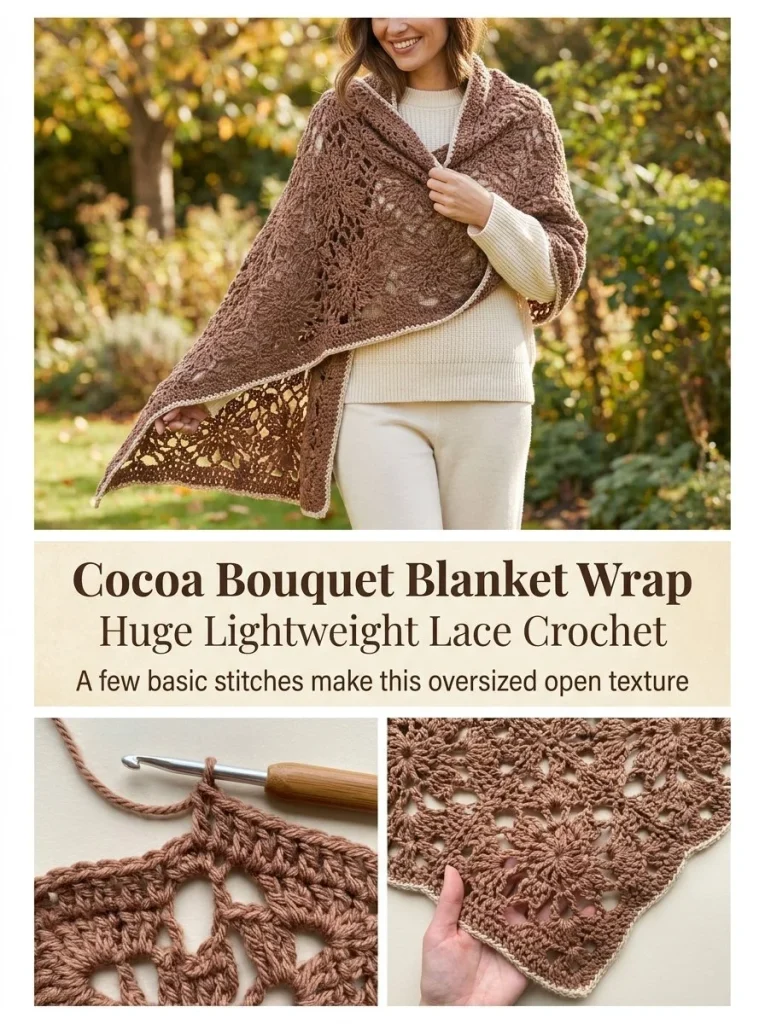
This elegant wrap features an open lacework design that creates a delicate and airy fabric reminiscent of blooming flowers. Worked in a rectangle using a softly muted cocoa hue with a subtle oatmeal border, this accessory offers both warmth and visual lightness—perfect as a sophisticated layering piece for cool evenings or transitional seasons. The lightweight DK yarn and lace texture provide drape and subtle breathability, making the wrap versatile for year-round wear.
The construction is straightforward yet rewarding, utilizing a four-row repeating lace pattern adapted from Velora’s signature open-lace rectangle technique. This project lends itself well to wearers who appreciate texture and pattern complexity without overwhelming bulkiness. Its elongated rectangular shape recalls classic wraps but adds delicate interest through the intricate stitch architecture.
The foundation chain and subsequent row repeats build a rhythmic pattern of arches and fans punctuated by double crochet decreases, producing an elegant floral motif. Precision in stitch counts and careful blocking are essential to highlight the pattern’s full effect and maintain straight edges. For those who enjoy exploring lace crochet, this piece serves as an excellent introduction that balances challenge and approachability.
The interplay of the two yarn colors—the rich cocoa main body with a contrasting oatmeal edge—adds a finishing touch that frames the lace exquisitely. This subtle bi-color element brings a refined polish, elevating the piece from a simple wrap to a design statement. If you have fallen in love with this texture and color contrast, you may also appreciate the similarly harmonious style found in the Cocoa Two-Tone Poncho Wrap design.
Pattern at a Glance
Skill level: Intermediate lace crochet
Terminology: US crochet terms
Construction: Worked flat in rows as a rectangular panel
Finished size: Approximately 84–90 inches long × 21–23 inches wide after blocking
Yarn weight: DK (Light #3)
Hook: 5.5 mm (I/9) crochet hook
Main stitch: Four-row open-lace repeat featuring single crochet, chain arches, and double crochet decreases (dc2tog)
Gauge: Fixed by foundation chain count rather than specific stitch/gauge, but final width adjusted by blocking
Motifs: Repeating lace units across each row, each unit spanning 10 stitches
Layout: Single rectangular piece
Joining: None required (worked in one piece)
Border: Optional loose single crochet edging in contrasting oatmeal color around entire rectangle
Seaming: None
Materials
- DK #3 yarn: Approximately 1100–1200 yards in the main cocoa color, which forms the body of the wrap
- Contrast DK #3 yarn: About 80 yards in oatmeal, reserved for the delicate edging border
- Crochet hook: Size 5.5 mm (I/9), chosen to provide a balance between stitch definition and lace openness
- Tapestry needle: For weaving in ends securely after finishing crochet
- Blocking supplies: Pins and blocking mat to shape the lace fabric evenly and achieve the target dimensions
The DK weight yarn offers lightweight warmth and drape suitable for a wrap, emphasizing stitch pattern visibility without becoming heavy or stiff. The choice of a 5.5 mm hook here is key to achieving the correct fabric density and openness; smaller hooks will make the fabric tighter and less drapey, while larger hooks might cause excessive looseness.
Yarn and Color Notes
Using smooth DK yarns in solid colors enhances stitch definition, especially for lace patterns that rely on structure and negative space. Fibers like soft merino blends, cotton-acrylic mixes, or fine superwash wool are excellent choices for texture and ease of care. Avoid fuzzy or highly textured yarns that can obscure stitch details.
The cocoa main color provides a warm, earthy base that complements the nature-inspired lace motif. The oatmeal border, worked at the final stage, softly frames this warmth with a gentle neutral shade, giving a refined edge without overpowering the body. This two-tone approach adds quiet visual interest and sophistication.
For projects wanting a more dramatic effect, substituting variegated yarns could alter the lace visibility, so keep that in mind. Experimenting with analogous or complementary color pairs in the same weight can also yield lovely variations while respecting the design ethos.
Finished Measurements
The wrap finishes at approximately 84–90 inches (213–229 cm) in length and 21–23 inches (53–58 cm) in width after blocking. These dimensions refer to the full rectangular piece laid flat and blocked to its final shape and size.
Before blocking, expect the piece to measure closer to 18–19 inches in width due to natural fabric contraction post-crochet. The length is primarily controlled by completing the required number of four-row repeats (typically 43–47 repeats), while the width is set by the foundation chain multiple and the blocking stretch.
Accurate blocking is critical as the lace pattern depends heavily on even tension and stretch to open the stitchwork into its intended floral arches and fans, with crisp edges and even width.
Gauge
This pattern does not provide a direct stitch gauge because the foundation is determined by multiples of 10 plus 2 chains to maintain the stitch repeats and edge integrity. The recommended foundation chain count is 302 chains for the Velora version.
Gauge here relates more to the blocking and tension consistency across the fabric rather than a specific stitches-per-inch measurement. However, it is important to crochet at a tension that allows the lace pattern to develop with clarity while keeping the work manageable to block to the recommended 21–23 inches (53–58 cm) width.
If your finished piece is notably narrower before blocking, the fabric may be too tight; if it is much wider, tension is likely loose. In both cases, adjust hook size or tension accordingly in future projects.
For garments or fitted pieces, such strict gauge control is crucial, but for an accessory like this wrap, slightly varying gauge affects drape and size without compromising wearability.
Abbreviations
- ch – chain
- sc – single crochet
- dc – double crochet
- dc2tog – double crochet two stitches together (decrease)
- st(s) – stitch(es)
- turn – turn the work to begin the next row
Important Pattern Notes
- The pattern is worked flat in rows, starting with a foundation chain that must be a multiple of 10 + 2 for proper lace repeats and edge stitches.
- The starting chain for this wrap is 302 chains, conforming to the multiple rule (10 × 30 + 2 = 302).
- The four-row pattern repeat creates an elegant lace motif that builds vertically with each repeat cycle.
- Edges are kept solid with single crochet to maintain neat borders and prevent curling.
- The pattern includes deliberate chain spaces, arches, and decreases that form the lace flowers, so precise stitch placement is key.
- The turning chains mostly act as tall stitches or turning height, often counting as a stitch in the row.
- The two-color edging in oatmeal is worked loosely to avoid impacting the lace stretch and should be added only if desired and if it does not restrict lace openness.
Special Stitches and Techniques
This lace pattern incorporates several foundational crochet skills enhanced by attention to spacing and decreases:
- Double Crochet Two Together (dc2tog): This is a typical decrease worked by partially completing two double crochets and joining their tops. It shapes the lace by pulling stitches together creating the open, fan-like motifs reminiscent of flowers.
- Chain arches: Chaining multiple stitches between solid anchors to form delicate open spaces and curved shapes for texture and lightness.
- Fans: Groups of stitches worked into the same stitch or opening to form a fan shape, lending volume and pattern depth.
- Edge single crochets: Solid sc stitches on edges maintain structure and prevent curling.
Mastering these stitches and how they interplay in the pattern will bring the lace motif to life.
Understanding the Construction
This piece is constructed as a single rectangular panel worked in rows from one foundation chain. The overall size is achieved by working a fixed width (determined by the foundation chain of 302 stitches) and repeating the four-row lace sequence until reaching the target length—roughly 43 to 47 repetitions of the pattern.
The foundation count is designed to accommodate 30 repeats of the 10-stitch lace motif plus 2 additional chains that form stable edges. This setup creates both a balanced pattern repeat and a neat, even edge.
Each four-row repeat builds the lace vertically, developing the iconic open arches, fans, and strategically placed decreases. The symmetry and consistency of the repeat are paramount to visual harmony.
The piece can be blocked after finishing to the desired dimensions. If chosen, the contrasting oatmeal yarn is then joined to work a gentle single crochet border, adding definition without restricting the efficiency of the lace pattern’s stretch or softness.
Complete Pattern Instructions
Foundation
Chain 302 loosely. This number follows the multiple of 10 + 2 rule for the lace repeat and edges.
Row 1
- Starting in the 2nd chain from the hook, work 1 single crochet (sc).
- Then begin repeating the lace unit across the row:
- sc, ch 3, skip 2 foundation chains,
- work a dc2tog (double crochet two together) over the next two chains,
- ch 1,
- work a second dc2tog over the following two chains,
- ch 3, skip 2 foundation chains, sc.
- Repeat this entire 10-stitch unit across the length of the foundation, always using the final skipped chain as a separator between units, which keeps both edges of the blanket solid and straight.
- End the row with a single crochet in the last chain to finish the edge.
Row 2
- Chain 4 and turn your work. The turning chain acts as a double crochet (dc).
- Work 1 dc into the edge stitch from the previous row.
- Then, across the row, alternate:
- chain 3 arches,
- single crochet anchoring points,
- and fans composed of 3 double crochets each, separated by chain 1 spaces.
- These stitches are placed into the openings created in Row 1, creating the fan and arch lace pattern.
Row 3
- Chain 3 and turn. This counts as the first dc.
- Above each 3-dc fan from Row 2, work a dc2tog into the outer chain 1 spaces to narrow the stitch count and maintain the lace shape.
- Chain 3 to reach the single crochet anchor.
- Then chain 1 across the center space.
- Chain 3 back to the next dc2tog. This join maintains symmetry across the row.
Row 4
- Chain 1 and turn.
- Single crochet in the edge stitch to start the row.
- Alternately work:
- chain 3 arches,
- fans made up of (dc, ch 1, dc, ch 1, dc) into each central chain 1 opening from the previous row,
- and single crochets into the next anchor space.
- This completes the floral lace motif with alternating fans and arches in a structured repeat.
Repeat
Repeat Rows 1 through 4, building the lace vertically, until the piece reaches approximately 43–47 total rows, or about 18–19 inches wide before blocking.
Blocking and Finishing
Carefully wet or steam block the finished piece, gently stretching the lace evenly to a width of about 21–23 inches (53–58 cm) and to the desired length, approximately 84–90 inches (213–229 cm).
Once blocked and dry, join the oatmeal yarn color at any corner and work one very loose round of single crochet stitches around the entire rectangle. This border should be loose enough not to restrict the lace’s stretch and openness.
Blocked fabric will highlight the intricate lacework, open the floral motifs, and give the wrap a polished flat appearance.
Checkpoints
- After completing the foundation chain and the first row, confirm you have 302 stitches.
- Upon finishing Row 4 for the first complete repeat, the fabric should start to reveal a regular pattern of fans and arches.
- After approximately 43–47 repeats of the four-row pattern, the panel should measure close to 18–19 inches wide before blocking.
- After blocking, confirm the width stretches evenly to 21–23 inches, and length to 84–90 inches.
Assembly
No assembly is necessary as this wrap is worked in one continuous rectangular panel. Edging is added last with contrasting yarn, but no seams or joins must be sewn.
Border and Finishing
The optional oatmeal single crochet edging frames the piece softly. Work this border very loosely to prevent pulling the lace together and avoid puckering.
Weave in all ends securely with a tapestry needle.
Finally, block the piece again if the border distorts the shape.
How to Resize
To change the width, adjust the foundation chain in multiples of 10 + 2 to maintain the repeat structure and solid edges. For example, increasing by 10 chains adds one more lace repeat unit across the width.
Length changes are achieved by adjusting the number of four-row repeats worked. Each repeat adds approximately 4 rows vertically, allowing fine control over final wrap length.
Keep in mind that blocking will affect final dimensions, so plan to work slightly smaller than target size before blocking.
Useful Variations
- Single-Color Version: Work the entire piece in one color for a more understated effect.
- Color Gradient: Use ombré or gradient yarn for gradual color changes without yarn joins.
- Shorter Wrap or Scarf: Reduce the number of repeats for a scarf-style length or a smaller shoulder wrap.
- Longer Shawl: Add a few extra repeats for a generous shawl size.
- Scrap Yarn Mosaic: Integrate strips or blocks of the two tones in alternate rows for a patchwork look.
For an alternative cozy layering piece with a similar cocoa and oatmeal theme, consider the Autumn Horizon Moss Blanket pattern for inspiration.
Troubleshooting
Why Is My Lace Pattern Not Aligning?
Ensure the foundation chain is a multiple of 10 plus 2. Any deviation disrupts the repeat and misaligns the arches and fans.
Why Are My Edges Curling?
Edges curling may indicate tension is too tight or edge stitches are not solid sc. Maintaining solid single crochets along edges helps keep the fabric flat.
Why Is My Wrap Narrower Than Expected Before Blocking?
Check your hook size and tension. A too-tight gauge results in a denser fabric. Looser tension or a slightly larger hook can help the lace open.
Why Does My Border Pull in on the Fabric?
Work the oatmeal sc border very loosely. If crocheted tightly, the border constricts the lace, causing puckering and distortion.
How Can I Avoid Losing Stitch Counts During Row Repeats?
Count stitches per repeat carefully and use stitch markers at the start/end of each 10-stitch unit. Carefully track skipped chains during lace sections.
Frequently Asked Questions
Can I use a different yarn weight?
This pattern is designed for DK (#3) yarn. Using a heavier yarn will alter gauge, size, and lace openness. If substituting, adjust hook size and foundation chain accordingly, but be aware the fabric characteristics will change.
Can I use a cotton yarn?
Cotton works but may result in a firmer, less drapey lace fabric. Consider cotton blends for softness and elasticity.
Is this pattern suitable for beginners?
An adventurous beginner comfortable with chain, single crochet, double crochet, and decreases can attempt this project. The lace pattern requires attention to stitch counts but is well-explained.
How should I block the finished wrap?
Wet or steam block by pinning the piece flat on a blocking mat with blocking pins, gently stretching width and length evenly. Allow to fully dry before removing pins.
Can I make the wrap wider or narrower?
Yes, adjust the foundation chain in multiples of 10 plus 2 to change width. Keep stitch counts consistent for lace pattern stability.
Does the lace pattern work in the round?
This design is intended for flat rows. Working in rounds would disrupt the lace motif and edging foundation.
Is the wrap reversible?
The pattern is worked flat and both sides are attractive, but one side will be slightly more textured. Wear it with either side showing.
Optional Related Uses
The four-row lace pattern here can inspire other projects such as scarves, lightweight shawls, or table runners using the same stitch repeat and construction style. Its versatility allows adaptation to various accessory shapes that benefit from decorative openwork.
Final Thoughts
This wrap is a lovely example of how a simple rectangle combined with a thoughtfully designed lace repeat creates an elegant accessory that is both practical and visually striking. With its carefully controlled stitch pattern, balanced edge shaping, and soft two-tone palette, it epitomizes the beauty of lace crochet.
Working in a fixed width set by multiples of ten plus two foundation chains ensures the lace motifs line up perfectly and the edges remain smooth. The four-row repeat establishes a harmonious sequence of arches, fans, and decreases, unfolding row by row to produce a stunning floral-inspired fabric.
Once blocked, this wrap is a graceful and versatile addition to any wardrobe, balancing warmth and delicacy with ease. Whether enjoyed for its texture, its drape, or its classic colors, it is a rewarding project for any crochet enthusiast interested in lacework and wearable art.



