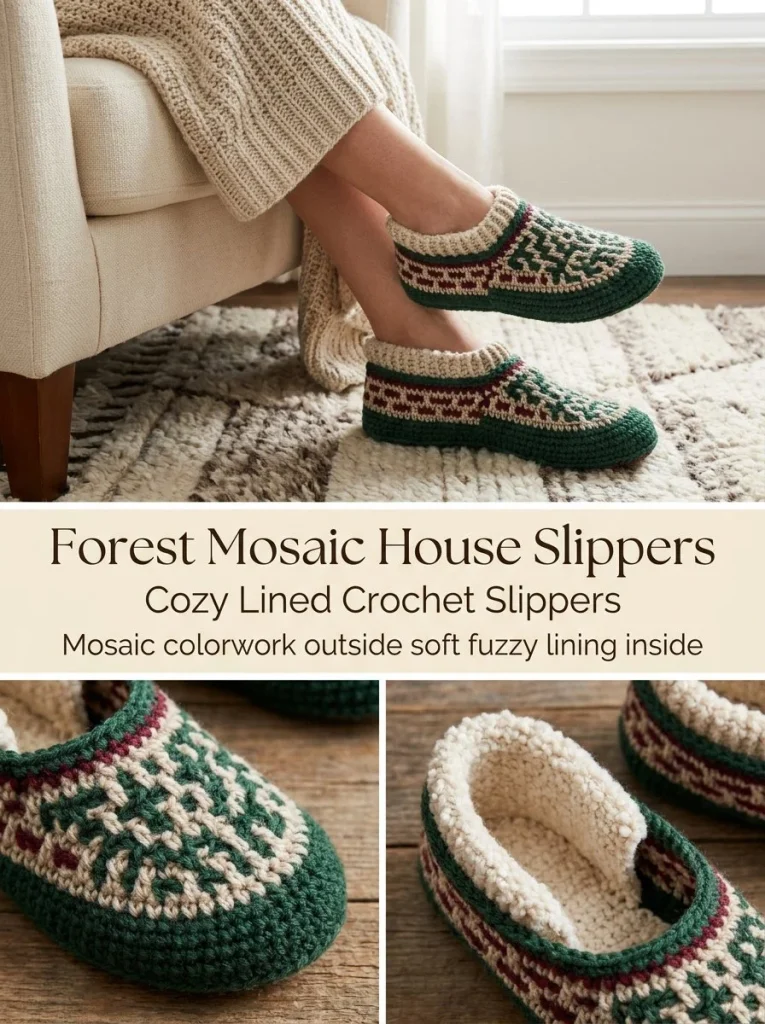
This cozy crochet project offers a pair of house slippers featuring a rich mosaic stitch pattern inspired by natural forest hues. Crafted with a blend of forest green, oatmeal, and burgundy yarns, these slippers combine warmth, texture, and style, making them perfect for indoor comfort with a handcrafted aesthetic. The slippers are constructed using worsted weight yarn and utilize both single crochet and half double crochet stitches, with a distinctive mosaic overlay technique that gives the fabric a subtle geometric flair.
The construction method begins with shaping the toe using a magic ring foundation, gradually increasing stitches to form a rounded front. The mosaic stitch rounds alternate two colors and incorporate front and back loop working to create a textured design reminiscent of mosaic tiling. This pattern also includes a practical lined interior made from soft cream-colored boucle yarn for added coziness and durability.
The design is functional with an ergonomically shaped heel flap worked back and forth to cup the heel naturally and a snug ribbed ankle cuff to ensure a secure fit. For added safety on slippery floors, the slippers can be outfitted with commercial non-slip sole patches. The project offers an engaging balance of colorwork, stitch variation, and assembly techniques, ideal for intermediate crocheters seeking a wearable accessory combining artistry and utility. The use of overlay stitches echoes subtle motifs that enhance the visual charm, similar in mosaic complexity to patterns such as the Chartreuse Mosaic Coin Charm Geometric Crochet Pattern.
Pattern at a Glance
Skill level: Intermediate
Terminology: US crochet terms
Construction: Worked in continuous rounds for the outer portion; heel shaped in rows; lined slipper inserted after assembly
Finished size: Women’s medium
Yarn weight: Worsted #4 for outer; soft aran bouclé for lining
Hook: 4.5 mm (outer), 5 mm (lining)
Main stitch: Half double crochet (hdc), single crochet (sc), mosaic overlay double crochet (overlay dc)
Gauge: Not explicitly provided; gauge is important for fit
Motifs: Mosaic stitch worked in two-color alternating rounds
Layout: Toe rounds, mosaic body, heel flap, lining, ribbed ankle cuff
Joining: Seamed heel flap and ankle border
Border: 3 rounds back loop only (BLO) single crochet ribbing around ankle opening
Seaming: Short back heel edge folded and sewn; lining sewn into outer slipper under ankle seam
Materials
To create these slippers, the following materials are required:
- Worsted weight (#4) yarn in forest green (approximately 120 yards per pair), oatmeal (70 yards), and burgundy (30 yards), used for the outer shoe body and mosaic stitch detailing.
- Cream bouclé or similarly soft aran weight yarn, about 120 yards, for the lining, providing additional softness and insulation.
- Crochet hooks sized 4.5 mm for the outer slipper and 5 mm for the lining, chosen to provide the correct fabric firmness and drape.
- Tapestry needle for sewing seams and weaving in ends smoothly.
- Stitch markers to keep track of rounds and stitch counts, especially useful during increases and mosaic rounds for accuracy and ease.
Each yarn color plays a critical role in highlighting the mosaic stitch pattern and enhancing the dimensional texture. The cream lining yarn complements the earthy tones while improving slipper comfort.
Yarn and Color Notes
Selecting the right yarns for this project is essential to achieve the intended texture and comfort:
- Fiber content: Acrylic or wool-blend worsted yarns are ideal for durability and warmth. The soft aran boucle lining adds plushness and prevents slipping inside the slipper.
- Texture: Smooth yarn for the outer shell ensures clean stitch definition, essential for the overlay mosaic design that relies on visible front and back loops. The boucle lining’s fluffiness enhances foot comfort.
- Color selection: Using the forest green and oatmeal alternately creates a classic, understated mosaic background. A narrow burgundy mosaic round near the ankle functions as an accent, adding subtle contrast without overwhelming the design. This colorway is reminiscent of the lush layers found in nature, giving the slippers a timeless appeal.
- Color changes: The mosaic rounds alternate colors without excessive cutting, preserving continuous yarn flow that keeps the fabric neat and prevents extra ends to weave in.
If preferred, other color palettes can be applied, but yarn thickness and fiber content should remain consistent to maintain fit and texture quality similar to the original design.
Finished Measurements
The slippers are designed for a women’s medium foot size. The lining extends approximately 6 inches from the toe, ensuring coverage and comfort inside the shoe.
The heel flap length and width shape the slipper to cup the foot naturally, supporting the medium size foot for an ergonomic fit. While exact foot length and width measurements are not specified, the stitch counts and rounds approximate a medium fit based on the stated yarn and hook sizes.
By maintaining the original gauge, crocheters can expect slippers to fit most women’s medium foot sizes comfortably. Adjustments for different sizes can be done carefully by adding or subtracting increases in the initial rounds or adjusting heel flap rows.
Gauge
No explicit gauge is given, but stitch counts and yarn amounts suggest that:
- The fabric is moderately dense, ensuring warmth and softness without excessive bulk.
- Maintaining consistent tension throughout is important, especially in mosaic overlay rounds, to avoid unevenness.
- Too tight tension may result in slippers that feel small or stiff; too loose tension can cause slipping or a floppy fabric.
Testing gauge over the first few rounds and comparing stitch counts before continuing will help preserve the intended slipper shape and fit.
Abbreviations
- BLO – Back Loop Only
- FLO – Front Loop Only
- hdc – Half Double Crochet
- sc – Single Crochet
- MR – Magic Ring (or Magic Circle)
- dc – Double Crochet (used in overlay stitches)
- st(s) – Stitch(es)
Important Pattern Notes
- The pattern is worked primarily in rounds starting with a magic ring, expanding to shape the toe in continuous rounds.
- Rounds increase stitch counts progressively to form a rounded toe that fits comfortably.
- The mosaic stitch rounds alternate between two colors without cutting the yarn unnecessarily, preserving smooth color transitions.
- Overlay double crochets are worked into the front loops two rounds below to create the mosaic effect, alternating with single crochet stitches in back loops only.
- The heel flap is worked separately in rows back and forth over part of the stitches, leaving the instep stitches unworked, allowing for a heel cup shape.
- Seaming the heel flap back edge creates a comfortable heel shape that cups the foot naturally.
- The lining is worked similarly to the outer slipper but with softer yarn and a larger hook for ease and softness.
- The ankle is finished with three rounds of back loop only single crochet ribbing for elasticity and tidy appearance.
- Commercial non-slip sole patches can be added for safety when worn on smooth floors.
Special Stitches and Techniques
Mosaic Overlay Crochet
The mosaic stitch pattern involves working overlay double crochet (dc) stitches into the front loops two rounds below the current round while working single crochet stitches in the back loops only (BLO) of the current round’s stitches. The result is a slightly raised, visually intricate geometric fabric with a subtle textured tile effect.
- Overlay dc FLO: Insert yarn over hook in the front loop only of the stitch exactly two rounds below, pull up a loop, and complete a double crochet around this loop.
- BLO sc: Single crochet worked only into the back loop of the current stitch, creating horizontal ridges and helping define the mosaic pattern’s texture.
Alternating these two rounds creates the characteristic mosaic repeat.
Magic Ring (MR)
The foundation for the toe is a magic ring, a technique to create a tightly closed center for circular projects, ideal for the slipper’s rounded toe.
- Wrap yarn to form a loop and crochet the first round’s stitches inside this adjustable ring.
- Pull the tail to close the ring tightly, preventing holes at the start.
Back Loop Only (BLO) and Front Loop Only (FLO) Stitches
These techniques involve working into only one loop of a stitch to create textured effects and structural detail.
- BLO produces ridges and flexibility.
- FLO is used to anchor the overlay stitches, adding dimension to the mosaic.
Heel Flap Construction
The heel is worked flat across a subset of stitches and rows, creating a rectangular flap that shapes the heel area.
- The short back edge of the heel flap is folded and seamed to form a cup, supporting the foot securely.
- Decreases are worked at outer edges on final heel rows to adjust the shape before seaming.
Understanding the Construction
This project’s construction blends circular and flat crochet techniques for optimal shaping and comfort. The slippers begin with the toe worked in rounds, increasing stitch counts to form the rounded front. Next, mosaic stitch rounds stretch upward over the foot and ankle, alternating colors to form a decorative geometric pattern.
The heel flap is then crocheted back and forth on a portion of the stitches, leaving the instep stitches unworked to accommodate the foot’s natural curve. The heel is shaped through strategic decreases and seaming, resulting in a softly cupped heel that enhances fit.
Once the outer portion is complete, the lining is crocheted separately using a softer yarn on a larger hook, matching the outer slipper’s shape and length for a comfortable interior layer.
Finally, the lining is inserted into the outer slipper and sewn securely around the ankle opening, leaving it loose enough to avoid discomfort. A ribbed border of back loop only single crochet stitches completes the ankle, adding stretch and finishing details. Commercial sole patches can be applied underneath for slip resistance on smooth surfaces.
The interplay between the colorful mosaic outer shell and the plush lining ensures a slipper that is warm, breathable, and attractive.
Full Pattern Instructions
Foundation (Outer Slipper Toe)
Begin with forest green yarn and a 4.5 mm hook.
- Use the Magic Ring (MR) technique to form a tight center.
- Round 1: Work 8 half double crochet (hdc) stitches into the MR. Do not join; use stitch marker to track rounds.
Stitch count: 8 stitches.
Round 2
Increase in every stitch around:
- Work 2 hdc in each stitch → total 16 stitches.
Round 3
Alternate half double crochet and increases:
- (hdc in next stitch, increase in next stitch) repeat around → total 24 stitches.
Round 4
Distribute 5 increases evenly through the round:
- Place increases spaced evenly to bring total count to 29 stitches.
Round 5
Single crochet in the back loops only (BLO) around the 29 stitches.
This creates a defined ridge preparing the fabric base for the mosaic overlay stitch.
Mosaic Stitch Rounds
Using forest green and oatmeal yarns, alternate the two colors without cutting the yarn unnecessarily to maintain clean joins.
- First Mosaic Round: Repeat the sequence overlay double crochet (dc) into the visible front loop two rounds below, followed by single crochet (sc) BLO in the next stitch.
- Next Mosaic Round: Offset the overlay dc placements so that each overlay dc falls directly above the previous single crochet, interlocking the mosaic pattern.
Repeat this two-round mosaic sequence 8 times, building the slipper’s textured body upward.
If desired, near the ankle, add a narrow burgundy mosaic round pair for subtle color accentuation.
Following Mosaic Rounds
Work 2 rounds of single crochet (sc) in forest green around the mosaic section to unify and stabilize the fabric.
Heel Flap Construction
Switch back to 4.5 mm hook with forest yarn.
- Work half double crochet (hdc) stitches back and forth across 20 stitches only; leave 9 instep stitches unworked (those on the top of the foot).
- Continue for approximately 9 rows or until the heel flap reaches the back of the foot.
Shaping the Heel Flap
On the last two rows of the heel flap:
- Decrease by one stitch at both outer edges per row to cup the heel flap naturally around the foot.
Fold the short back heel edge and seam it securely with a tapestry needle.
Final Outer Rounds
Work one round of single crochet (sc) evenly around the slipper opening, joining the heel flap and foot for a unified edge.
Lining
Using the cream bouclé soft aran yarn and a 5 mm hook:
- Begin with 8 hdc stitches.
- Increase evenly through the rounds until reaching 26 stitches, matching the slipper’s width.
- Work even rounds without increases until the lining measures about 6 inches from the toe.
- Crochet a matching heel flap of the same shape and length as the outer heel flap.
- Seam the heel flap’s back edge.
Insert the completed lining inside the outer slipper.
Assembly
Sew the lining and outer slipper layers together around the ankle opening with yarn and needle, taking care not to catch the lining too tightly. This ensures comfort and mobility.
Ankle Ribbing
Work 3 rounds of single crochet in back loops only (BLO) around the ankle opening, creating a ribbed cuff that adds stretch and finish.
Optional Finishing
Attach commercial sew-on non-slip sole patches underneath if slippers will be worn on smooth or slippery floors for safety.
Checkpoints to Ensure Success
- After Round 4, your outer toe piece should have exactly 29 stitches.
- Mosaic stitch rounds should exhibit a clear overlay dc and sc BLO alternation, with color changes appearing neat and consistent.
- The heel flap should cup the back of the foot snugly with approximately 9 rows worked.
- Lining and outer slipper should fit against each other smoothly with no strained seams or puckering.
- Ribbing around the ankle should stretch comfortably for putting slippers on and off.
Assembly and Joining
The critical assembly steps involve folding the heel flap and seaming its back edge to create the natural heel cup shape. This seaming should be neat, with no bulk, so the slipper fits well. The lining is sewn inside the outer slipper and joined only around the ankle opening with enough slack so that the lining does not bind the foot.
A ribbed border worked in back loops only finishes the ankle edge, providing elasticity without constriction. This technique ensures the slipper stays secure during wear yet is easy to put on and remove.
Border / Finishing Tips
- Work ribbing evenly to avoid bunching or ripple around the ankle.
- When weaving in ends, especially color changes in mosaic rounds, keep the yarn tails tidy and flat inside the slipper to avoid discomfort.
- Blocking is optional but can help even out the mosaic stitch pattern if stitches appear uneven after crocheting. Use a gentle steam or damp cloth with finger shaping to set the form without stretching.
- Non-slip sole patches enhance slipper usability, especially on hardwood or tile floors.
How to Resize the Slippers
To adjust size for larger or smaller feet:
- Modify the number of initial increases in the toe rounds to increase or decrease the total stitch count. For example, add or omit increases on Rounds 2-4, making sure to keep an even distribution for a smooth round shape.
- Adjust the length of the heel flap by adding or removing rows until the flap fits the heel snugly for the target size.
- Increase or decrease lining stitch count proportionally to match the outer shell.
- Gauge swatch testing before starting will help ensure appropriate size changes without distorting the fabric.
While resizing, maintain the two-round mosaic sequence repeat to preserve the stitch pattern integrity.
Useful Variations
- Monochrome version: Use a single yarn color throughout the mosaic rounds for a smoother geometric texture without color contrast.
- Highlight color placement: Introduce more burgundy mosaic rounds or replace the oatmeal rounds with a different accent to create personalized color motifs.
- Slipper height: Extend the ankle ribbing or mosaic rounds to create a higher slipper cuff for additional warmth.
- Lining variations: Substitute the cream bouclé with a fleece or felt lining for different texture or increased warmth.
- Slip-on slipcover: Adapt the mosaic pattern into a cozy wrap or slipper sock inspired by this construction.
The mosaic stitch technique used here is similar in visual and textural complexity to that found in some shawls and accessories, such as the Birdhouse Wide Shawl Knitting Pattern with Twisted Stitch, highlighting the versatility of overlay textures.
Troubleshooting
Why is my slipper fabric too stiff?
Using a hook that is too small or tightly working stitches can cause the fabric to be stiff and uncomfortable. Try loosening your tension or switching to a slightly larger hook.
Why are my mosaic stitches not visible clearly?
Ensure you work overlay double crochets into the correct front loop two rounds below and single crochets into the back loops only for proper texture definition.
How to avoid a loose heel flap?
Make sure your hdc heel flap back and forth stitches are worked with consistent tension. Decreasing at the edges on the last rows helps shape the cup more snugly.
What if my lining is too tight inside the slipper?
Try using the larger 5 mm hook as recommended and check your gauge when working the lining to ensure ease inside.
How do I keep color changes neat in mosaic rounds?
Carry both yarns along edges loosely and avoid excessive cutting. Weaving in ends carefully on the inside reduces bulk.
Frequently Asked Questions
Can I substitute different yarn weights?
Use yarns with similar thickness and fiber content. Using thinner or thicker yarns requires adjusting hook sizes and stitch counts accordingly for fit.
Will these slippers be warm enough for winter?
The combination of worsted weight outer yarn and soft aran boucle lining provides good insulation suitable for indoor winter wear.
Can beginners crochet this pattern?
Some experience with circular crochet, front and back loop stitches, and mosaic overlay technique will help. Beginners are encouraged to practice these stitches before starting.
How should I care for these slippers?
Hand wash gently in cold water and air dry to preserve colors and fabric texture, especially for the boucle lining.
Is it possible to make these slippers without the lining?
Yes, but the lining adds comfort and structure. Without it, slippers may stretch or feel rough inside.
Can I make these slippers for men?
Adjust sizing by increasing the initial stitch counts and heel flap length. Choose color palettes accordingly.
Optional Related Uses
The mosaic overlay technique and conditioning of layered fibers can be adapted to create matching home accessories like cozy socks, cushioned footrests, or patterned slippers for children. The textured stitch could also transition nicely into warm scarves or decorative pillow covers, combining artistry with functional crochet skill.
Final Thoughts
This project merges meticulous mosaic stitchwork and thoughtful slipper construction techniques to create a cozy, durable, and visually striking pair of indoor slippers. Starting with a rounded toe, followed by alternating mosaic overlay rounds, shaped heel flap, and a plush lining, these slippers blend form and function beautifully. The carefully placed increases, innovative stitch combinations, and finishing touches come together to provide an accessory that’s both indulgent to wear and rewarding to crochet. The mosaic pattern invites creativity while ensuring wearer comfort, making this a cherished home project for any crochet enthusiast.



