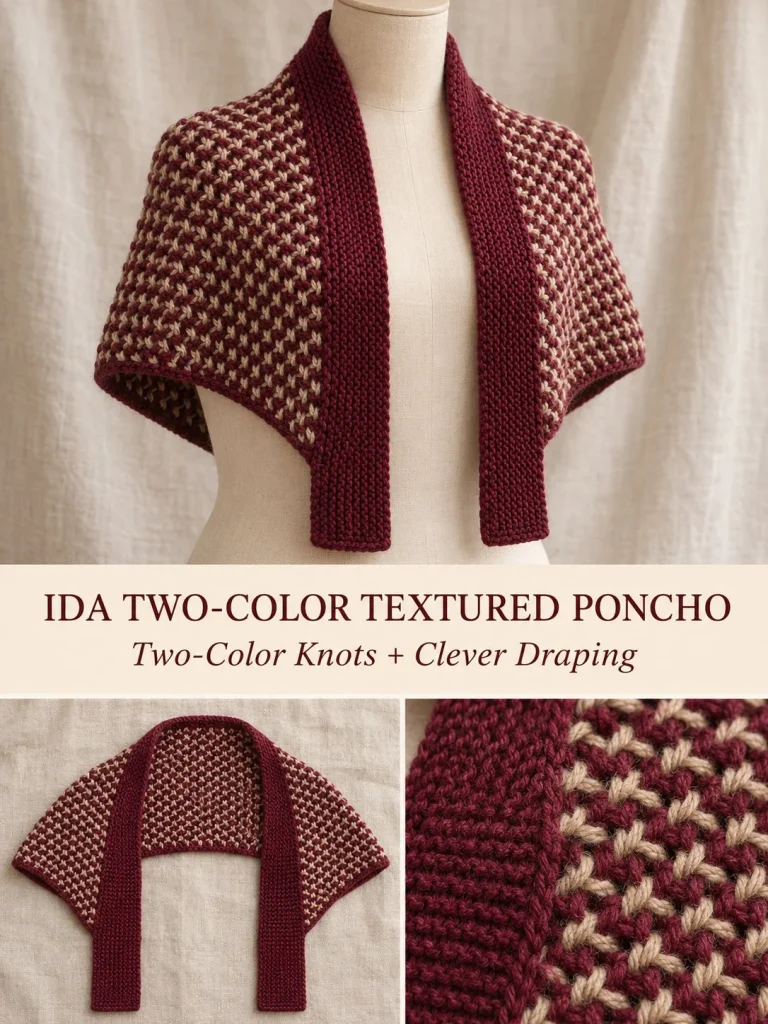
The Ida Bicolor Textured Poncho is a striking knit garment combining elegant two-color texture with smart shaping to enhance fit and drape. Crafted flat in a sophisticated bicolor knots stitch pattern, this poncho features a uniquely tailored back shaped with German short rows for a superior shoulder contour. Once the back is complete, matching textured front bands frame the silhouette, creating a distinctive wrap style that is both modern and timeless. Without sleeves or hoods, its open design emphasizes the beauty of hand-knit stitches and the contrast between the main and accent colors. This pattern is perfect for knitters who appreciate subtle woven textures and thoughtful garment shaping.
Working this garment involves careful color sequencing and stitch placement in a grid-like alternation of tiny knots, producing subtle dimensionality. The two-color bicolor knots texture is mastered by following the designer’s official PDF that details the exact color order and stitch repeats. The German short rows add form-fitting shaping while maintaining the striking stitch pattern integrity. The overall character is a short-back poncho with front bands, preserving an airy drape after blocking. Featuring a moderate finished size ideal for layering, the poncho is a versatile piece to brighten any wardrobe.
For knitters exploring textured garment projects, the Ida Poncho stands out similarly to other carefully planned textural works such as the Aaron Toe-Up Textured Socks, revealing how detailed stitch patterns can elevate wearable pieces.
Pattern at a Glance
Skill level: Intermediate – requires knowledge of short rows, two-color knitting, and picking up stitches.
Terminology: Standard US knitting terminology.
Construction: Worked flat from back panel, shaped with German short rows; front bands picked up and knit in same texture.
Finished size: Back panel approximately 19.6 x 15.7 in (50 x 40 cm); one size fits most due to open shape.
Yarn weight: Worsted (Alegría Grande worsted)
Needles: US 8 / 5.0 mm circular knitting needles, with spare cable or holder for short rows.
Main stitch: Two-color bicolor knots stitch pattern following designer PDF color sequences.
Gauge: 23 stitches x 36 rows = 4 inches in the bicolor knots stitch.
Motifs: Continuous two-color knots stitch grid, no separate motifs.
Layout: Single back panel with short-row shaping, front edges with picked-up stitches worked into bands.
Joining: No seams; work flat and finish edges with picking up and binding off.
Border: Worked in the same two-color textured motif on front bands and edging.
Seaming: None.
Materials
This project calls for Manos del Uruguay Alegría Grande worsted weight yarn, a luxurious blend of 75% superwash merino wool and 25% polyamide. The superwash feature aids easy care, while the merino ensures softness and warmth. You will need 2 skeins each of the main color Oporto AG6559 and the contrast color Sand AG2241; each skein provides approximately 197 yards (180 meters) per 100 grams.
Knitting is done using US 8 / 5.0 mm circular needles with a spare cable or needle holder to facilitate German short rows without dropping stitches. Stitch markers are recommended to mark pattern repeats or short row turns, and a tapestry needle is necessary for weaving in ends and finishing edges neatly.
Maintaining gauge with this yarn and needle combination is important to preserve the garment’s size and drape.
Yarn and Color Notes
The Alegría Grande yarn’s worsted weight and smooth merino-polyamide blend are ideal for the bicolor knots stitch, which relies on clearly defined color contrasts and precise stitch definition. Smooth fibers make the tiny knots pop visually, while the superwash allows for easier washing without felting.
The chosen pair of colors—deep red Oporto for the main and warm Sand for contrast—showcases the bicolor effect beautifully. When choosing alternative colors, consider that strong contrast enhances the texture’s visual impact, while tonal or lower-contrast pairs create a subtler effect.
For knitters interested in texture work, experimenting with different combinations can yield a range of looks from bold to understated. Avoid fuzzy or heavily textured yarns, as these can obscure the knot pattern.
Finished Measurements
- Back Panel: Approximately 19.6 inches wide by 15.7 inches tall (50 cm x 40 cm).
This dimension corresponds to the main back piece worked flat before adding front bands. The open style and short-back shape mean the poncho sits lightly on shoulders, with front bands framing the neckline and edges.
Since the poncho is worn as an open wrap, the one size fits most format works well. Keep in mind that gauge will directly affect sizing, so knitting a swatch is important to achieve these measurements.
Gauge
Measured in the bicolor knots stitch pattern, the gauge is:
- 23 stitches x 36 rows = 4 inches (10 cm) on US 8 / 5.0 mm needles with the specified yarn.
Gauge is critical to ensure the final piece fits as intended and that the stitch pattern forms a balanced grid of tiny knots.
To measure gauge accurately:
- Knit a sizeable swatch in the bicolor knots stitch with the same yarn and needles.
- Block the swatch as you plan to block the finished piece.
- Measure a 4-inch square in the center of the swatch to avoid edge distortion.
If your gauge shows larger stitches (fewer stitches per 4 inches), your piece will grow wider and longer, potentially changing the intended fit and drape. Conversely, a smaller gauge will make the fabric denser and smaller than planned.
For a garment with shaping and stitch pattern geometry like this poncho, staying close to gauge is crucial.
Abbreviations
- K = Knit
- P = Purl
- Ssk = Slip, slip, knit (used in short rows shaping)
- German short rows = Technique involving wrapped and turned stitches to create shaped fabric without holes, explained in detail below.
- St = Stitch
- Tbl = Through back loop
- Two-color bicolor knots stitch = The main textured stitch pattern featuring alternating small knot-like stitches in two colors arranged to simulate a grid.
- Picking up stitches = Method of knitting additional stitches directly from a finished edge.
Important Pattern Notes
- The poncho is worked flat, starting with the back panel using the bicolor knots stitch maintaining the designer’s color sequence.
- German short rows are used to shape the back, enhancing shoulder fit without disrupting the pattern’s two-color grid.
- Stitch repeat and color changes must precisely follow the official designer’s free PDF to preserve the knot pattern’s alignment.
- After completing the shaped back, stitches are picked up along the edges to knit the front bands in the same stitch motif.
- The garment preserves a short-back and two front bands silhouette; no sleeves, hoods, or seams are added.
- Edges are finished neatly and blocked to maintain an open, drapey texture.
Special Stitches and Techniques
Two-Color Bicolor Knots Stitch
This stitch creates a textured fabric with tiny, alternating knot-like stitches in two contrasting colors. The pattern forms a subtle checked grid with relief, achieved by manipulating the knit and purl combinations in alternating colors per the color sequence.
Precise attention to color changes and stitch repetition is needed to keep the knots aligned.
German Short Rows
Short rows create shaping by knitting partway through a row, then turning the work before reaching the end. German short rows are a specific technique where the stitch is wrapped and turned carefully to avoid gaps or holes in the fabric:
- Wrap and turn are wrapped around the stitch to maintain continuity.
- After completing short rows, some stitches are worked multiple times and then integrated seamlessly.
- This method allows shoulder shaping that retains the fabric’s dense, two-color bicolor knots texture.
This technique improves garment fit and comfort without disturbing the pattern.
Picking Up Stitches
Along the front edges, stitches are lifted up from the knitted fabric to create additional bands in the same stitch pattern. Correct pickup stitch counts and placement are essential to preserve texture congruency.
Understanding the Construction
The poncho consists of three main structural parts—one back panel and two front bands:
- Back Panel: Worked flat using the two-color bicolor knots stitch, following the exact color sequence and stitch repeat. German short rows shape the upper back, improving shoulder fit.
- Front Bands: After the back panel is complete, stitches are picked up evenly along each front edge. These bands are knitted down using the same bicolor knots motif and color sequence.
- No seams or sleeves are constructed; the piece remains an open wrap.
- The silhouette is balanced by the short back and longer front bands, emphasizing drape and architectural lines.
This yields a garment with a distinctive, contemporary wrap look that can be worn over layers for warmth or style.
Full Pattern Instructions
Foundation
Cast on the required number of stitches specified in the official PDF, using the main color (Oporto AG6559) as established in the color sequence.
Place stitch markers as needed to track pattern repeats and short row boundaries.
Row 1 (Right Side)
Knit the first row in the colored bicolor knots pattern, carefully alternating colors and stitches to follow the exact sequence shown in the designer’s PDF. This is the first row of the stitch repeat grid.
Rows 2 to N: Establish Texture and Begin Short Rows
Continue working the bicolor knots stitch pattern across rows, following the official repeat and color sequence precisely to maintain the grid.
At the designated rows for short rows shaping (German short rows), begin the shaping sequence:
- Work partial rows as instructed.
- Wrap and turn to create short rows at your German-turn positions.
- Continue the short row shaping as per supplied instructions to sculpt the back.
Back Panel Completion
Once the back panel reaches the size of approximately 19.6 x 15.7 inches (50 x 40 cm), and all German short rows are completed to shape the shoulders, bind off the back panel stitches loosely.
Picking Up Stitches for Front Bands
Using the same needles and color sequence, pick up the exact number of stitches along the edge of the back panel for each front band, ensuring even spacing.
Front Bands
Knit each front band downward in the two-color bicolor knots stitch, preserving the pattern continuity and texture.
Work front bands to the desired length as indicated.
Edging and Finishing
Complete the edges as specified in the official pattern notes, finishing all raw edges with neat bind-offs.
Block the fully assembled piece gently to open the texture and fix the drape. Pin to size, ensuring the short back and front bands fall naturally.
Checkpoints
- After short row shaping, confirm the back panel measures approximately 19.6 inches wide and 15.7 inches tall.
- Verify no holes or gaps have formed at German short row wraps.
- Front bands should be aligned with the rest of the garment’s color sequence and stitch count.
- The garment should maintain a flat but open texture after blocking.
Assembly
No seaming or joining is required as the poncho is a single piece worked flat.
Ensure front bands are picked up evenly and knit in continuation to maintain pattern flow.
Ends should be woven in neatly using a tapestry needle.
Border and Finishing
The edges are finished by continuing the textured motif on the front bands and binding off loosely to preserve stretch.
Blocking is essential to set the open drape and allow the two-color knots stitch to bloom softly. Pin edges gently to keep the garment flat and avoid distortions.
How to Resize
Because the poncho is constructed as a single back panel with front bands, its size can be adjusted by:
- Changing the total cast-on stitch count in multiples of the stitch repeat (corresponding to the two-color knots grid).
- Adding or subtracting full repeats of the stitch pattern to widen or narrow the back panel.
- Adjusting the number of short rows for different shoulder shaping or length.
- Modifying the number of picked-up stitches for the front bands to maintain balance.
Keep in mind that gauge should be checked when resizing to maintain correct dimensions.
Useful Variations
- Monochrome version: Knit using one color for a subtle textured effect.
- Different color combinations: Swap main and contrast colors for a reversed look.
- Longer back panel: Add extra rows (in multiples of 4) if a longer poncho is desired, maintaining the short-row shaping principles.
- Shorter front bands: For a more minimal drape, shorten front bands accordingly.
Knitting textured garments like this poncho often pairs well with exploring modular or sectioned patterns for variation, similar to the Curator Modular Wrap Knitting Pattern which also celebrates intricate textured stitch design.
Troubleshooting
Why Are the Short Rows Leaving Holes?
German short rows require careful wrap and turn techniques to prevent gaps. Ensure the wrap completely encircles the stitch and that you work both the wrap and wrapped stitch together on return rows.
Why Is My Texture Pattern Misaligned?
Check that you follow the exact color sequence and stitch repeats as per the designer’s PDF. Skipping or misplacing a stitch in the bicolor knots grid causes visual misalignment.
Why Is the Poncho Too Tight or Too Loose?
Gauge accuracy is crucial. Re-measure your gauge and adjust needle size if necessary. If already knitted, consider resizing by adding or subtracting repeats in future projects.
Why Are My Picked-Up Stitches Uneven?
Use stitch markers to divide the edge into equal segments before picking up stitches, ensuring consistent spacing.
How to Prevent Edge Curling?
Blocking and gentle edging using the original stitch pattern help stabilize edges. Avoid tight bind-offs which can cause the fabric to pucker.
Frequently Asked Questions
Can I use a different yarn weight?
A heavier or lighter yarn will change gauge and drape significantly. If attempting a different weight, knit a large swatch in the bicolor knots stitch and adjust needle size to approximate gauge before starting.
Can I substitute acrylic yarn?
Yes, but the fabric texture and drape will vary. Acrylic lacks the elasticity and softness of merino, possibly making the poncho firmer or less breathable.
Is this pattern suitable for beginners?
Intermediate knitting skills are recommended due to short rows, two-color knitting, and picking up stitches. Beginners can try simpler two-color projects first.
Can this pattern be adapted to crochet?
This is a knitting pattern using specific stitch textures and German short rows, not directly translatable to crochet.
Do I need special needles?
Circular needles with a flexible cable help manage the stitches when working short rows. A spare needle or cable holder is helpful but not mandatory.
How should I block the finished poncho?
Use gentle steam blocking or wet block, pinning the piece to the exact measurements. Smooth out edges and fabric to open the stitch texture.
Can I make this poncho longer?
Yes, add more rows respecting the stitch repeat, but maintain the short-row shaping logic.
Optional Related Uses
The two-color bicolor knots stitch lends itself well to scarves, cowls, or shorter wraps. Its delicate texture could enhance modular knit garments or accessories where intricate colorwork is desired.
Final Thoughts
This poncho project highlights how thoughtful stitch pattern design combined with shaping techniques like German short rows can create wearable art with texture and elegance. Its open, short-back silhouette with front bands offers versatility for layering, while the striking two-color knots stitch showcases the interplay of color and texture beautifully.
From casting on the initial back panel to picking up stitches for the front bands, experience the satisfaction of crafting a piece that balances technical skills and timeless style, suitable for knitters eager to challenge their abilities and enrich their wardrobe.



