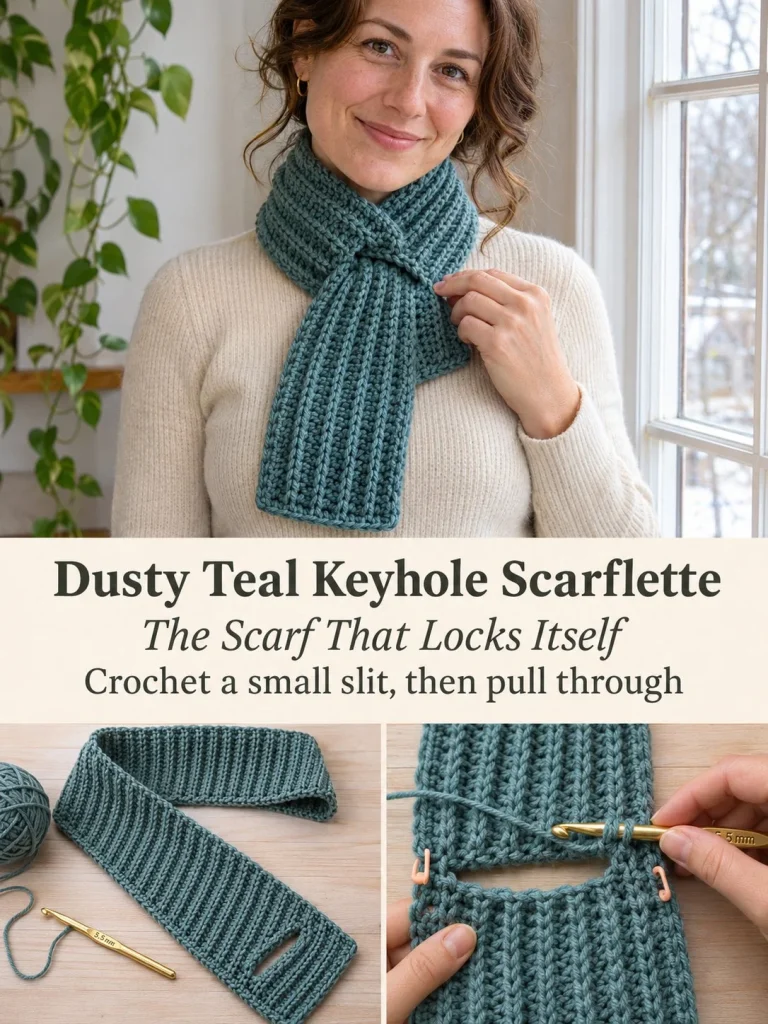
This elegant scarflette features a subtle keyhole design, blending classic texture with modern style. Worked in a dusty teal worsted weight acrylic/wool blend yarn, its compact size and soft fabric make it a versatile accessory for transitional weather. The ribbed back loop only half-double crochet (hdc BLO) stitch gives the scarflette depth and tactile interest without complicating the construction, making it suitable for intermediate crocheters looking to expand their skills.
The unique construction includes a deliberately created slit keyhole formed by working the piece in halves temporarily, allowing easy draping and an attractive pull-through styling option. This detail elevates the scarflette from a simple rectangle to a thoughtful fashion statement that balances cozy warmth and refined shape. Additionally, the solid color and textured stitch highlight the yarn’s qualities beautifully, while the keyhole slit adds functional charm.
Crocheters who enjoy wearing small, versatile wraps will find this pattern complements other dusty teal accessories such as the basket weave shoulder wrap for a coordinated wardrobe.
Pattern at a Glance
Skill level: Intermediate
Terminology: US crochet terms
Construction: Worked flat in half-double crochet back loops only; includes split panel keyhole and border finishing
Finished size: Approximately 6 inches wide × 38 inches long
Yarn weight: Worsted (#4) acrylic/wool blend
Hook size: 5.5 mm (US I-9)
Main stitch: Half double crochet through back loop only (hdc BLO)
Gauge: Swatch of BLO hdc fabric to measure stitches per 6-inch width and rows per length
Motifs: Single rectangular panel with keyhole slit
Layout: Flat rectangular fabric with an integrated keyhole slit starting approximately 7 inches from one short end
Border: Single crochet border around the outside, preserving the keyhole opening
Seaming: None (keyhole slit remains unsewn to allow pull-through closure)
Materials
- Yarn: Approximately 260 to 340 yards of dusty-teal worsted weight #4 acrylic/wool blend. This blend offers warmth, softness, and durability suitable for an accessory worn close to the skin.
- Hook: 5.5 mm (US I/9) crochet hook, chosen to achieve the recommended gauge and fabric drape.
- Notions: 2 stitch markers to mark the halfway point for the keyhole slit and other construction points.
- Tapestry needle: For weaving in yarn ends securely at the project’s conclusion.
This modest materials list ensures a straightforward project workflow. The adjustable yardage range allows crocheters to accommodate variations in gauge or desired length modifications without running short on yarn.
Yarn and Color Notes
The dusty teal hue is a muted, sophisticated shade suitable for many wardrobes. A smooth worsted weight acrylic/wool blend yarn is ideal here for blending softness with stitch definition. Fibers with too much halo or fuzziness could obscure the ribbing created by the back loop only stitch, whereas a firm twisted yarn would highlight the ridges beautifully.
This scarflette’s single-color scheme accentuates the texture and structural design, but variations could be tested with variegated or gradient yarns. When substituting yarns, maintain worsted weight and similar yardage to approximate the fabric thickness and scarf dimensions.
Finished Measurements
The scarflette finishes at approximately 6 inches wide and 38 inches long, creating a slim silhouette perfect for layering rather than wrapping bulky scarves. The keyhole slit measures about 3 inches wide, starting roughly 7 inches from a short end.
These measurements depend on accurate gauge achievement and yarn choice. The width sets the cozy scale across the neck, while the length allows the scarflette to drape nicely and provide enough tail to pull through the keyhole slit for closure.
Gauge
The pattern requires a gauge swatch worked in half double crochet stitches through the back loop only (hdc BLO). Measure:
- Stitches across to achieve a relaxed 6-inch width
- Rows vertically to calculate the desired length
Gauge is essential here because the scarf’s width and slit position depend on stitch counts. Too loose a gauge results in a wider, potentially slouchy scarflette; too tight may yield a narrower, denser fabric that could affect drape and keyhole fit.
Use the gauge swatch to adjust hook size and stitch counts before starting, ensuring the fabric’s ribbing texture and dimensions meet the pattern requirements.
Abbreviations
- ch: chain
- st: stitch
- sl st: slip stitch
- sc: single crochet
- hdc: half double crochet
- BLO: back loop only
- RS: right side
- WS: wrong side
- rep: repeat
Important Pattern Notes
- The turning chain does not count as a stitch in hdc rows worked flat.
- Work is done flat, back and forth, maintaining consistent stitch count using the BLO technique to create ribbing.
- The 3-inch keyhole slit is created by temporarily dividing the fabric into two halves which are worked separately in short rows before being rejoined across the stitch tops.
- No additional chain stitches should be added when reconnecting both halves to avoid bridging the slit.
- The border is worked in single crochet around the entire perimeter, excluding the keyhole opening, ensuring it remains functional.
- The slit remains unsewn for wearability, allowing the longer scarf tail to be pulled through for a tidy closure.
Special Stitches and Techniques
Half Double Crochet Back Loop Only (hdc BLO)
This technique involves inserting the hook only into the back loop of each stitch rather than both loops. This creates pronounced horizontal ribbing when worked in rows, adding textured interest without complicating stitch patterns. Ribbing makes the fabric stretch comfortably, useful for a snug scarflette that still has give.
Short Rows and Divided Panel Work
To create the keyhole:
- The scarf width stitches are divided into two halves.
- The halves are worked in separate short rows for 3 inches to form the slit edges.
- The halves are then joined by working across both stitch tops in one full-width row, preserving the slit.
This technique creates a slit without cutting or sewing the fabric, preserving the stitch continuity and fabric integrity.
Understanding the Construction
This scarflette is essentially a flat rectangular panel worked in hdc BLO stitch that measures roughly 6 inches wide and 38 inches long. After working 7 inches of the strip, the fabric is split into left and right halves along the stitch width to form a keyhole opening.
Each half is worked independently for 3 inches to create two parallel edges side-by-side without joining, effectively creating the slit. Then the halves are rejoined by one full-width row worked across both stitch tops, continuing the stitch count and texture uniformly.
The scarf continues for the remaining length until it reaches about 38 inches total, then a single crochet border is added around the perimeter but skipping across the keyhole to keep it open.
This construction results in a refined, textured scarflette with a functional keyhole for pulling through and shaping around the neck.
Full Pattern Instructions
Foundation: Gauge Swatch and Chain
-
Begin with a gauge swatch worked in half double crochet back loop only (hdc BLO).
-
Chain enough stitches to achieve a relaxed, comfortable 6-inch width based on your gauge measurement plus the turning chain.
-
The turning chain typically does not count as a stitch; start your first row of hdc in the second or third chain from the hook depending on your preferred turning chain method. Keep this consistent throughout.
Body: Working Ribbed Panel
- Work flat back-and-forth rows of hdc BLO until your piece measures approximately 7 inches from the starting short edge. The ridges created by the BLO stitch will run horizontally across the width and repeat vertically down the length.
Creating the Keyhole Slit
-
Count the total number of stitches across your row. Divide these into two halves, assigning the extra stitch (if any) to one side to keep the stitch count integral.
-
Mark the dividing point with stitch markers so you know where the keyhole will be.
-
For the first half, work hdc BLO across only the allotted half-width stitches. Turn at the end of each row and continue working short rows back and forth until this half measures 3 inches long.
-
Fasten off at the working end of this half, leaving a tail for weaving later.
-
Join the working yarn on the corresponding starting row of the second half beside the keyhole.
-
Work the same number of short rows of hdc BLO on the other half until it equals the length of the first half (3 inches), creating two parallel unsewn edges and a true slit between them.
Rejoining Both Halves and Completing Length
-
To reconnect the halves, work the next full-width row in hdc BLO across the tops of both side-by-side stitch groups. Treat the live stitch tops of both halves as one continuous row.
-
Carefully count stitches to ensure the stitch total matches the original full row width, avoiding bridging the slit with extra chain stitches.
-
Continue working full-width rows of hdc BLO until the scarf reaches approximately 38 inches long in total.
Border Finishing
-
To finish, work a neat single crochet border around the outside perimeter of the scarflette only. Do not crochet across the keyhole slit to maintain its unobstructed pull-through function.
-
Weave in all yarn tails securely, taking care not to sew the slit closed.
Checkpoints
-
After initial 7 inches: The fabric should be a smooth ribbed panel, 6 inches wide, with rib ridges running across the width (horizontal ridges).
-
After keyhole halves short rows: Both halves should be 3 inches long, edges parallel, forming an unstitched 3-inch slit in the width.
-
After rejoining halves: The stitch count should fully match original stitch count, no bridging or additions in the slit area.
-
At completion: The scarflette should measure approximately 6 inches wide and 38 inches long with a clean single crochet border all around except the keyhole opening.
Assembly
No seaming or assembly is required beyond rejoining the divided halves with a full-width row. The keyhole slit remains open and functional. The final single crochet border helps shape the edges and secures the form while maintaining the keyhole’s usability.
Finishing
-
Weaving in ends: Use a tapestry needle to weave in yarn tails securely on the wrong side of the fabric, inside the ribbed grooves, to keep the texture clean.
-
Blocking: Light blocking can enhance stitch definition and straighten edges, but avoid heavy stretching that may distort the ribbing or opening.
-
Wearing: To wear, drape the scarflette around your neck and pull the longer tail once through the 3-inch keyhole slit. Make sure the slit comfortably accommodates the thick ribbed fabric.
How to Resize
To modify the scarflette size:
-
Width: Adjust by increasing or decreasing the foundation chain in multiples of one stitch, maintaining a relaxed 6-inch width based on gauge. Recalculate split halves accordingly.
-
Length: Work additional rows beyond 38 inches to extend length or reduce rows for a shorter scarflette. Keep the keyhole slit position approximately 7 inches from one short end.
-
Be mindful to maintain stitch counts for the keyhole slit to ensure the keyhole’s proportions remain consistent.
Useful Variations
-
Colorwork: Introduce subtle stripes or contrasting borders while keeping the pattern’s texture prominent.
-
Yarn substitutions: Use a pure wool or alpaca blend for added warmth, or a cotton blend for cooler weather wearables.
-
Different stitch accents: Although the main stitch is hdc BLO, you could add simple ribbed texture variations near the border or keyhole for custom looks.
-
Length variations: Work a longer scarflette for more coverage or a shorter neck warmer style.
For complementary fashion pieces, consider projects like the granny bib cowl, which shares the same lovely dusty teal palette and can coordinate beautifully.
Troubleshooting
Why is my keyhole slit not the right size?
Ensure you divided your total stitch count accurately and held stitch counts steady during the half-panel short rows. Avoid adding or skipping stitches before or after the slit area.
Why does my ribbing look uneven?
Check that you are consistently inserting your hook into only the back loops of each stitch. Missing the correct loop causes stitch misalignment.
My scarflette edges curl or ripple—what can I do?
Back loop only stitches can cause slight curling. Blocking the finished piece gently and adding a firm single crochet border helps keep edges flat.
How to avoid bridging the keyhole when rejoining?
Work across both halves’ live stitch tops without adding chains between them. Count each stitch carefully to match the original full row stitch count.
My fabric is too tight or too loose—what now?
Adjust your hook size and redo the gauge swatch before proceeding. Correct gauge is essential for both scarf width and keyhole proportions.
Frequently Asked Questions
Can I use a different yarn weight?
Yes, but remember to adjust your hook and stitch counts to maintain the 6-inch width and overall proportions. Yardage requirements will also change.
Is this scarflette suitable for beginners?
This pattern is best suited to intermediate crocheters comfortable with short row shaping, back loop only stitches, and maintaining accurate stitch counts.
Can I make the keyhole slit bigger or smaller?
Adjust the half-panel length and stitch division, but keep proportions balanced to maintain neat edges and comfortable wear.
Do I need stitch markers?
Markers are highly recommended to mark the stitch divide for the keyhole and maintain even halves.
How should I block the finished scarflette?
Wet block or steam lightly on a flat surface to relax the stitches and even out edges, avoiding distortion.
Can I crochet this in a different stitch pattern?
This pattern is designed for hdc BLO ribbing to provide the right texture and stretch. Other stitches could change the look and size.
Optional Related Projects
The half double crochet back loop only stitch and split panel keyhole concept can inspire related accessories such as:
- Narrow shoulder wraps
- Lightweight bib-style cowls
- Textured neck warmers
These enjoy similar construction benefits and offer versatile styling, such as those seen in projects like the dusty teal shoulder wrap.
Final Thoughts
This ribbed scarflette combines a practical shape with thoughtful construction to deliver a cozy, stylish accessory. By splitting the panel under the keyhole and working halves separately before rejoining, it achieves a functional slit that elegantly secures the scarf when worn. The half double crochet back loop only stitch lends an understated textured appeal that pairs beautifully with the dusty teal yarn’s rich hue.
Following precise gauge, stitch counts, and construction steps ensures a polished finish ready to brighten your wardrobe. This project also offers flexibility for customization through length changes and complementary colorwork, encouraging creativity while maintaining the core structure.



