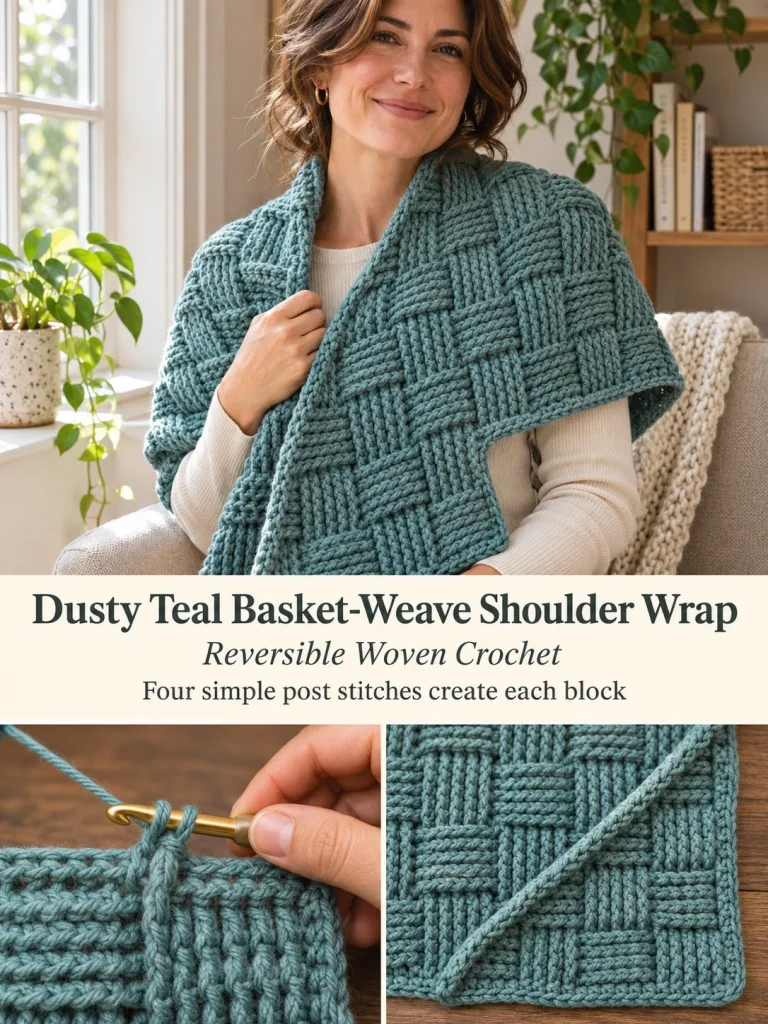
Creating a stunning shoulder wrap with a timeless basket-weave texture, this crochet project blends subtle sophistication with cozy comfort. The dusty teal hue offers a versatile and calming shade that complements many wardrobes, while the basket-weave stitch provides an intricate woven appearance that elevates the overall design. Crafted using post stitches to create depth and dimension, this wrap is both visually interesting and delightfully warm, making it an ideal accessory for chilly evenings or layering during transitional seasons.
Constructed entirely in one piece, the wrap employs a repeating 6-row basket-weave pattern created through alternating front and back post double crochet stitches. The pattern’s rhythm builds a fabric that is dense yet flexible, draping beautifully across the shoulders. This methodical stitch play gives an elegant tactile quality that showcases post stitch techniques, providing a wonderful learning experience for crocheters looking to enhance their skills. For those inspired by similar stylish wraps, you might find helpful ideas in a dusty teal granny wrap pattern that also features engaging textures in a serene color palette.
Pattern at a Glance
Skill level: Intermediate – familiarity with front and back post double crochet essential
Terminology: US crochet terms
Construction: Worked flat in rows, one continuous panel
Finished size: Approximately 19 inches wide by 60 inches long after blocking
Yarn weight: Worsted (#4)
Hook: 6 mm (US size J-10) crochet hook
Main stitch: Basket-weave using alternating front post and back post double crochet
Gauge: Not specified, but fabric should be flexible with loose post stitches
Motifs: None (one continuous woven pattern)
Layout: Single rectangle
Joining: None
Border: One round of single crochet around all edges, with three single crochet stitches in each corner
Seaming: None
Materials
To complete this shoulder wrap, gather the following materials:
- Worsted weight yarn (#4): Approximately 1300 to 1500 yards in dusty teal color. A soft, smooth yarn such as a wool blend or acrylic will highlight the basket-weave texture. Choosing a fiber with good stitch definition enhances the visual impact of the post stitches.
- Crochet Hook: 6 mm (US size J-10) hook, suitable for worsted yarn weight to achieve a flexible, drapey fabric.
- Tapestry Needle: For weaving in ends neatly after finishing.
- Scissors: To trim yarn ends cleanly.
Using the correct hook size helps ensure your fabric remains neither too stiff nor too loose, which is critical for the basket-weave pattern to drape attractively over the shoulders.
Yarn and Color Notes
The dusty teal color is a muted medium shade blending blue and green tones for a classic, versatile accessory that pairs well with a range of outfits. When selecting yarn:
- Choose a yarn that has good stitch definition to emphasize the intricate raised basket weave formed by the post double crochet stitches.
- Avoid highly fuzzy or textured yarns as they may obscure the stitch pattern.
- Smooth synthetic or wool blends work well by providing even stitch structure and comfortable warmth.
- Solid color yarn ensures the basket-weave texture is clearly visible, unlike variegated or heavily patterned yarns which might disguise the fabric’s depth.
For those interested in colorwork or buttoned details, you might enjoy exploring a burgundy buttoned crochet shoulder wrap that complements this pastel blue-green wrap with alternative styling options.
Finished Measurements
After gentle blocking, this shoulder wrap reaches approximately:
- Width: 19 inches (about 48 cm) across the short edge
- Length: 60 inches (about 152 cm) from end to end along the long edge
These dimensions make for a generously sized wrap comfortable to drape around the shoulders or wear loosely as a shawl. The width ensures good coverage, while the length allows versatile styling options including folded or bundled looks.
Gauge
While the pattern does not specify an exact gauge, it is important to maintain flexibility in the fabric by working the post stitches with a loose tension. The basket-weave texture relies on post stitches standing out without pulling too tight, so your fabric:
- Should feel fluid and pliable rather than stiff or constricted.
- Might become narrower and denser if worked tightly, which could reduce drape and flexibility.
- Might become loose and sloppy if tension is too loose, risking loss of stitch definition.
Always check your tension when working post stitches since they can compress the fabric differently than regular stitches.
Abbreviations
- ch = chain
- dc = double crochet
- bpdc = back post double crochet
- fpdc = front post double crochet
- sc = single crochet
- st(s) = stitch(es)
All abbreviations used here follow standard US crochet terminology.
Important Pattern Notes
- The foundation chain is calculated as a multiple of 8 + 4. This ensures the basket-weave pattern aligns properly throughout.
- The turning chain counts as the first double crochet (dc) of each row, maintaining consistent stitch counts.
- The basket-weave pattern is worked in rows, with the texture created by alternating blocks of back post double crochets and front post double crochets.
- The 6-row repeat forms one complete basket-weave pattern cycle.
- Post stitches should be worked loosely enough to allow fabric to remain flexible and drape well.
- The border uses single crochet stitches, with 3 sc in each corner to maintain a flat edge without puckering.
Special Stitches and Techniques
Front Post Double Crochet (fpdc)
A front post double crochet is worked around the post (vertical bar) of the stitch in the previous row, inserting the hook from front to back and then back to front, which creates a raised "rib" on the front of the fabric.
Back Post Double Crochet (bpdc)
The back post double crochet is worked around the post of the stitch from the back, inserting the hook from back to front and then front to back, creating a raised rib with an opposing texture to the front post.
Both fpdc and bpdc stitches produce a woven pattern when alternating blocks of these stitches are worked, mimicking the look of woven baskets.
Understanding the Construction
This wrap is constructed in a single rectangular piece, worked flat from end to end. The foundation chain is carefully measured for the correct stitch count to support the basket-weave pattern. The project follows these principles:
- The foundation row establishes the double crochet base stitches.
- Rows 1-3 create one alternating basket-weave texture pattern using blocks of 4 back post double crochets followed by 4 front post double crochets across.
- Rows 4-6 reverse the sequence to continue the woven illusion, alternating blocks of front post double crochets followed by back post double crochets.
- This 6-row pattern is repeated over and over until the desired length of about 60 inches is achieved.
- The border rounds off the edges with a simple, relaxed single crochet round that includes extra stitches in the corners to avoid drawing the edges inward.
- No seaming or additional joining is needed as the wrap is worked as a continuous rectangle.
This methodical repetition builds a sturdy but supple fabric ideally suited for the drape and coverage required in a shoulder wrap.
Complete Pattern Instructions
Foundation
Chain 68, which is a multiple of 8 plus 4, to set the proper stitch count. This chain forms the width of the wrap.
Foundation Row
- Starting in the 4th chain from the hook, work a double crochet (dc).
- Continue to work 1 dc in each remaining chain across to the end of the row.
- The turning chain counts as the first edge post double crochet.
- At the end of the foundation row, you will have 66 double crochet stitches — one turning chain as an edge post, 64 interior double crochet posts, plus one opposite edge post.
Basket Rows 1-3
- Chain 2 (counts as edge double crochet), turn your work.
- Work 4 back post double crochets (bpdc) around the next 4 posts from the previous row, then 4 front post double crochets (fpdc) around the next 4 posts. Repeat this to across the row.
- Finish the row by working 1 dc in the top of the turning chain from the previous row.
Basket Rows 4-6
- Chain 2 (counts as edge double crochet), turn your work.
- Work 4 front post double crochets (fpdc) around the next 4 posts, then 4 back post double crochets (bpdc) around the next 4 posts. Repeat this to across the row.
- Finish the row by working 1 dc in the top of the turning chain from the previous row.
Repeat
- Repeat basket Rows 1 through 6 until the wrap reaches approximately 60 inches in length.
- Maintain a loose tension on all post stitches to ensure the fabric remains flexible and comfortable to wear.
Border
- Working around all four edges of the finished piece, work a relaxed single crochet (sc) round.
- Place 3 single crochet stitches in each corner to prevent curling or puckering and to keep the edges flat and smooth.
Blocking
- Gently block the finished wrap to its final dimensions of approximately 19 inches wide by 60 inches long.
- Proper blocking will even out stitches, soften the fabric, and enhance drape, resulting in a polished, professional look.
Checkpoints for Success
- After completing the foundation row, check for 66 total posts (counting edge posts).
- At the end of each 6-row repeat, the texture should clearly alternate blocks of raised back post stitches and front post stitches, forming a basket-weave pattern.
- The wrap should measure close to 60 inches long before proceeding with the border.
- The edges should lie flat without curling before starting the border round.
- The border single crochet round should maintain the wrap’s flexibility and clean shape without pulling edges inward.
Finishing
Weaving in all the yarn ends with a tapestry needle secures your work and maintains a clean finish. After blocking, the wrap should have an elegant drape with the basket-weave texture distinctly visible. This finishing step completes the project and prepares it for styling.
How to Resize
This pattern allows for resizing by adjusting the foundation chain since the stitch multiple is 8 + 4:
- To increase width: Add multiples of 8 chains to the foundation plus the extra 4 chains.
- To adjust length: Simply work more or fewer repeats of the 6-row basket-weave pattern until the desired length is reached.
Keep in mind that changing yarn weight or hook size will also affect overall dimensions and drape:
- For a narrower wrap, use a smaller hook or lighter weight yarn.
- For a much wider wrap, ensure your foundation chain follows the 8 + 4 multiple to maintain pattern integrity.
Useful Variations
- Use a two-color yarn and alternate colors every 6-row basket-weave repeat for a striped effect.
- Work a similar basket-weave texture in different yarn weights for a deeper, chunkier wrap or a delicate, lightweight shawl.
- Add fringes or tassels on the short edges for a boho-inspired look.
- Combine with simple button closures or brooches for a wearable art piece.
- Explore complementary stitch patterns or borders, such as a scalloped edge or picot trim, to personalize your wrap.
Troubleshooting
Why Is My Fabric Too Stiff?
If your post stitches are worked too tightly, the fabric will lose drape and feel stiff. Loosen your tension on the front and back post double crochets, allowing the stitches to “relax” and the fabric to become softer.
Why Are My Edges Curling?
Edges curling can happen if the border is too tight or if the post stitches are unevenly tensioned. Make sure to work the border stitches loosely and place 3 single crochets in each corner to flatten edges.
Why Doesn’t My Basket-Weave Pattern Look Right?
The basket-weave pattern depends on alternating blocks of 4 back post double crochets and 4 front post double crochets. Missing or miscounting posts breaks the texture. Count each group carefully and use stitch markers to separate blocks if needed.
How Do I Avoid Gaps in Post Stitches?
Ensure your hook is inserted correctly around the posts, and pull your yarn through smoothly without skipping or accidentally inserting under more than one post.
Frequently Asked Questions
Can I use a different yarn weight for this pattern?
Yes, but you will need to adjust your hook size and the foundation chain length accordingly. Keep the multiple of 8 + 4 in mind to maintain the basket weave stitch alignment.
Can beginners make this wrap?
This pattern is best suited for intermediate crocheters familiar with front and back post stitches. However, confident beginners willing to learn post stitches and follow detailed instructions can successfully complete it.
Can I make this wrap longer or shorter?
Yes, add or subtract multiples of the 6-row basket-weave repeats to lengthen or shorten. Just maintain the foundation chain’s multiple stitch count.
Is the wrap reversible?
The basket-weave texture appears slightly different on each side but both sides are attractive and wearable.
How should I block the wrap?
Use a gentle steam block or pin the damp wrap to the exact measurements (19" x 60") and allow it to dry flat. Avoid stretching, just smooth out wrinkles and even stitches.
Can I add buttons or fasteners?
Yes, adding buttons or brooches can personalize your wrap and improve wearability, similar to styling options found in some buttoned crochet wraps.
Optional Related Uses
Beyond this shoulder wrap, the basket-weave stitch creates a beautiful fabric suitable for other projects:
- Scarves or cowls with alternating post stitches for texture.
- Throw blankets with enlarged dimensions.
- Home décor such as cushions or table runners for a woven look.
This versatile texture is adaptable across a range of accessories and decor items.
Final Thoughts
This project emphasizes a timeless basket-weave stitch pattern built entirely from carefully alternated front and back post double crochets over a foundation chain that adheres to a multiple of 8 plus 4. The result is a cozy, flexible shoulder wrap perfect for layering — finished with a neat single crochet border that ensures clean edges and excellent drape. By following the detailed instructions and maintaining loose tension on post stitches, crocheters can achieve both skill development and a beautifully wearable textured accessory.



