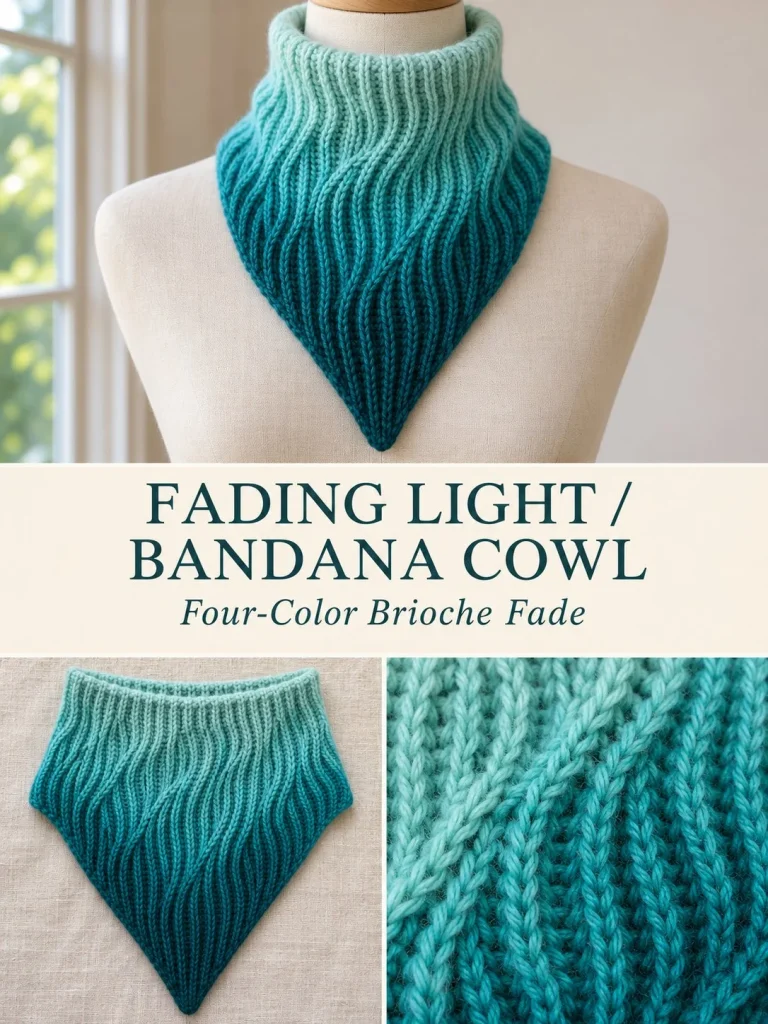
This elegant bandana cowl blends artistry and technique through a delicate fade of four complementary colors in DK-weight yarn. Featuring the brioche stitch—a knitting favorite known for its lofty, reversible texture—this top-down circular cowl embraces a sophisticated color transition with a modern bandana-inspired silhouette. The gradual shift across four hues uses brioche syncopation to reverse the foreground and background colors at color-change points, creating seamless gradients instead of harsh stripes. Designed to sit comfortably close at the neck and deepen into a pointed front bandana shape, it offers both warmth and refined style for chilly days.
The construction begins with a provisional cast-on to establish the neck circumference, followed by a progression from one-color to two-color brioche knitting and a gentle integration of all four fading shades. The stretchy, textured fabric is shaped to keep the cowl snug around the back of the neck while allowing the front to drape with increasing depth. A clean I-cord style elastic edge finishes the piece with sophistication, preventing flare. This design is an excellent project for knitters familiar with brioche techniques seeking a wearable accessory that elevates simple yarn into a statement piece. If you appreciate texture-rich knitting, exploring a similar style in our easy two-color brioche cowl pattern might also inspire you.
Pattern at a Glance
Skill level: Intermediate (experience with brioche knitting recommended)
Terminology: Standard US knitting terms
Construction: Top-down, circular knitting with provisional cast-on
Finished size: Approximate circumference 21.5 in; front depth 18 in; back depth 12 in
Yarn weight: DK (Double Knit)
Needles: US 7 / 4.5 mm, 24-inch circular needle
Main stitch: Brioche stitch, transitioning from one-color to two-color brioche
Gauge: 15 stitches x 21 rows = 4 inches in brioche stitch after blocking
Motifs: None; continuous fabric with color fades
Layout: Circular, top-down seamless bandana shape
Joining: None (knitted in the round)
Border: I-cord elastic edge finish
Seaming: None required
Materials
For this project, you will need four fading colors of DK-weight yarn, each approximately 87.5 yards (80 meters) or 25 grams, totaling around 350 yards (320 meters). The yarn should be suitable for brioche knitting—smooth with clear stitch definition to showcase the subtle play between foreground and background colors.
A US 7 / 4.5 mm circular needle with a 24-inch cable is required to comfortably accommodate the circumference as you work in the round. A stitch marker will help mark the beginning of rounds. Waste yarn and a crochet hook are necessary for the provisional cast-on, enabling seamless transitions and picking up stitches smoothly. A tapestry needle will be needed to weave in ends after finishing.
Because the gauge is an essential factor in sizing, it is important to match the stated 15 stitches by 21 rows over a 4-inch square in brioche stitch after blocking. A consistent gauge ensures that the neck opening and depth measurements are accurate to design.
Yarn and Color Notes
Selecting yarns with gradients or tonal variations works well for this pattern to accentuate the fading color scheme. DK-weight yarns with a soft halo or smooth plied fibers will bring out the brioche texture beautifully.
Avoid overly fuzzy or low-contrast colors as brioche’s signature ribbed texture relies on clear color changes for the syncopation effect to be noticeable. Solid colors or semi-solid yarns in the same tonal family but different shades will produce a harmonious fade.
Experimenting with color positioning offers creative freedom. The four colors should gradually shift, blending softly at transitions rather than forming hard edges. Consider yarns that transition naturally or hand-dyed tonal sets for best results.
Finished Measurements
The cowl’s finished circumference is approximately 21.5 inches, designed to fit comfortably snug around an average adult neck without being constrictive. The depth varies: the front point extends to about 18 inches, forming a bandana-style drape, while the back remains shorter at about 12 inches, ensuring comfort when worn and preventing bulk behind the neck.
These dimensions depend on accurate gauge and proper blocking after completion. The shaping produces a flattering silhouette that contours smoothly from the neckline to the pointed lower edge.
Gauge
Gauge is measured after blocking the fabric in brioche stitch:
- 15 stitches across
- 21 rows vertically
- Equals 4 inches by 4 inches (10 cm x 10 cm)
It’s critical to achieve this gauge to maintain both the neck circumference and the shaping proportions. If your gauge comes out larger (more stitches or rows per 4 inches), your cowl will be bigger and looser than designed. Conversely, a tighter gauge will result in a smaller, possibly too-tight neck.
Measure gauge in the brioche stitch pattern, not in stockinette or other stitches. Blocking the swatch before measuring will give an accurate read on how the fabric relaxes and stretches.
Abbreviations
- CO: Cast on
- pm: Place marker
- pco: Provisional cast on
- BR: Brioche
- k: Knit
- yo: Yarn over
- sl1yo: Slip one with yarn over (brioche decrease variant)
- BO: Bind off
Important Pattern Notes
- This cowl is worked top down in the round, starting with a provisional cast-on.
- Provisional cast-on allows for seamless picking up of stitches to begin brioche knitting.
- The upper neck section uses one-color brioche initially, creating a smooth base color.
- The pattern transitions to two-color brioche, gradually introducing the second shade and progressing through all four colors in fading order.
- Use brioche syncopation at color-change points to flip the foreground and background roles cleanly, avoiding harsh striping.
- The bandana shape results from intentional shaping: the front is lengthened and deepened, while the back remains shallower and close-fitting.
- The finished edge uses a tight I-cord style elastic bind-off, preventing flaring and maintaining a polished look.
- Blocking after knitting is essential to relax and shape the fabric to the specified dimensions.
Special Stitches and Techniques
Provisional Cast-On
A provisional cast-on creates a temporary edge using waste yarn and a crochet hook, allowing you to pick up these stitches later to knit seamlessly into your work.
Brioche Stitch
The brioche stitch is known for its lofty, cushy texture and reversible rib effect. It can be worked in one or two colors, where the stitch alternates between knit and slipped yarn-over stitches to create depth. Two-color brioche uses two yarns worked alternately on each row to produce a striking color pattern.
Brioche Syncopation
This technique at the color-change points reverses the knitted fabric’s foreground and background, flipping colors in a subtle way to prevent visible stripes. It involves adjusting the brioche stitch pattern to switch which color is dominant without breaking the flow or texture.
I-cord Bind-Off
Used here for a neat elastic finish, the I-cord bind-off is worked three stitches at a time to create a tubular edge that pulls gently to avoid any flaring or curling.
Understanding the Construction
This cowl is knit in the round starting at the neckline with a provisional cast-on to establish the exact circumference of about 21.5 inches based on gauge. Initially, one color is used to create a smooth, uniform upper neck band in brioche stitch.
Following this, a second color is introduced, and the knitting transitions into two-color brioche. Over the course of the project, all four colors are introduced gradually with carefully programmed brioche syncopation rows, creating a fade effect where the foreground and background colors exchange positions smoothly.
The lower edge shaping lengthens the fabric in the front to create a deep bandana point while keeping the back shorter and close-fitting for comfort. By manipulating increases and brioche stitch construction, the cowl develops this signature silhouette.
A clean elastic I-cord bind-off finishes the neckline, securing the shape and preventing the edge from flaring. The entire piece is blocked to relax the stitches and set the desired measurements and drape. The design avoids seams, being knit seamlessly in the round.
Full Pattern Instructions
Foundation
Begin by creating a provisional cast-on using waste yarn and a crochet hook. Cast on stitches sufficient to match a 21.5-inch neck circumference at the brioche gauge (15 sts per 4 inches).
Upper Neck – One-Color Brioche
Work brioche stitch in the first color for a set number of rounds to form the close-fitting upper neck band. This section acts as a base for introducing color transitions.
Transition to Two-Color Brioche
Introduce the second color cautiously, beginning to work two-color brioche in alternating rows. Use the brioche syncopation technique at color-change points to flip the foreground/background color roles cleanly. This prevents the formation of harsh stripes and creates soft gradients.
Gradual Color Changes Through Four Colors
Continue knitting while gradually transitioning to the third and fourth fading colors. Maintain syncopation at all color-change rows to keep the color flips smooth and visually pleasing.
Lower Edge Shaping
Start shaping the bottom edge so that the front grows longer and tapers into a deeper bandana point while the back remains shorter (about 12 inches deep). Use strategic brioche increases and decreases to achieve this contour, ensuring the cowl fits closely around the neck and increases in depth towards the front center.
Finishing Edge
Bind off with a neat elastic I-cord bind-off that secures the edge without flaring or waviness. This finish complements the textured brioche fabric and maintains seamless style.
Blocking
After casting off, block the cowl to the final dimensions: approximately 18 inches front depth and 12 inches back depth. Blocking opens the brioche stitches and sets the shape, ensuring comfortable wear and proper drape.
For precise shaping guidance and syncopation row details, use the designer’s original source. For additional inspiration, check the ribbed high neck shoulder cowl pattern, which also highlights advanced shaping and finishing techniques.
Helpful Checkpoints
- After completing the provisional cast-on and upper neck rounds, confirm your piece measures approximately 21.5 inches around the neck.
- When transitioning to two-color brioche, ensure your colors blend gradually; harsh color bands indicate syncopation issues.
- At the shaping stage, verify the front depth is increasing towards 18 inches while the back stays near 12 inches.
- After the I-cord bind-off, inspect the edge to make sure it lies flat without flare or curl.
Assembly and Joining
This cowl is knit seamlessly in the round; no seaming or joining is required. After completing the bind-off and blocking, weave in all yarn tails securely with a tapestry needle. The provisional cast-on edge disappears into the knitting once picked up and knit, so no raw edges remain.
Border and Finishing
The I-cord bind-off provides a polished border that prevents flare. To maintain this finish:
- Weave ends evenly to avoid lumps beneath the fabric surface.
- After blocking, store flat or gently folded to preserve shape.
The elastic nature of the I-cord edge ensures the cowl hugs the neck comfortably.
How to Resize
Adjusting the size involves modifying the initial provisional cast-on stitch count according to your gauge:
- Use the formula: Number of stitches = (Desired neck circumference in inches) x (15 sts / 4 in)
- Keep stitch multiples consistent with brioche stitch repeat requirements.
- Adjust the length of the upper neck section and lower edge shaping proportionally to suit your dimensions.
Due to brioche syncopation dependencies, consult brioche stitch multiples when changing stitch counts, or refer to the linked designer instructions for shaping.
Useful Variations
- One or Two-Color Version: Simplify fading by using fewer colors. A solid or duotone brioche produces a graphic, modern look.
- Different Color Families: Swap the fading colors for seasonal hues or bold contrasts to suit your wardrobe.
- Length Adjustments: Extend or shorten the bandana point front depth by adding/removing shaping rows for different layering styles.
- Yarn Substitutions: Use other DK-weight yarns with similar elasticity and texture for seasonal variations such as wool blends for winter or cotton blends for spring.
Troubleshooting
Why Does My Color Transition Look Like Hard Stripes?
Ensure you are properly applying brioche syncopation at color-change rows. Misplaced syncopation will cause abrupt color bands rather than a smooth fade.
Why Is My Neckline Too Tight or Too Loose?
Recheck your gauge swatch in brioche stitch after blocking. Inaccurate gauge affects the neck circumference, so adjust needle size or stitch count accordingly on the provisional cast-on.
Why Does the Lower Edge Not Shape Like a Bandana?
Confirm increases and decreases are placed correctly to lengthen the front relative to the back. Skipping shaping rows or miscounting stitches disrupts the contour.
Why Does My Edge Flare?
Make sure the I-cord bind-off is worked tightly and evenly. Loose bind-offs or incorrect tension cause edges to flare outward.
Why Are the Brioche Stitches Uneven?
Maintain consistent yarn tension and carefully follow brioche stitch techniques, including yarn overs and slipped stitches. Practice brioche if you are new to the stitch before starting.
Frequently Asked Questions
Can I Use a Different Yarn Weight?
This pattern is optimized for DK-weight yarn to match the gauge and drape. Using heavier yarn will change size and texture—if substituting, adjust needle size and provisional cast-on stitches accordingly.
Can Beginners Knit This Cowl?
Intermediate knitting skills and experience with brioche stitch are recommended because of color syncopation and shaping complexity.
Is This Pattern Reversible?
Yes, the brioche stitch naturally creates a reversible fabric, making this cowl attractive on both sides.
How Should I Block It?
Wet block gently by soaking, then lay flat on a towel, stretching to the specified dimensions (21.5-inch circumference, 18-inch front depth, 12-inch back depth). Allow to dry completely before wearing.
Can I Make a One-Color Version?
Yes, start with only one chosen color, omitting the color transitions and syncopation steps.
Do I Need a Circular Needle for This Project?
Yes, a 24-inch circular needle is needed to accommodate the circumference in the round comfortably.
Optional Related Projects
The brioche technique and fading color concept work beautifully in related accessories such as shoulder cowls, scarves, or even hat bands, offering endless possibilities to adapt this luxurious fabric style.
For further ideas, consider exploring the easy two-color brioche cowl project which highlights similar working principles with fewer colors and simplified shaping.
Final Thoughts
The project combines four fading DK yarn colors into a seamless, top-down circular cowl shaped with expert brioche syncopation techniques. Starting with a provisional cast-on for precise neck fit, it transitions through one- and two-color brioche, gradually fading colors while shaping the lower edge to create a distinctive bandana silhouette. Finished with an elegant I-cord elastic edge and careful blocking, this pattern offers both texture and style. By mastering the techniques presented, knitters can create a chic accessory that’s as comfortable as it is eye-catching.



