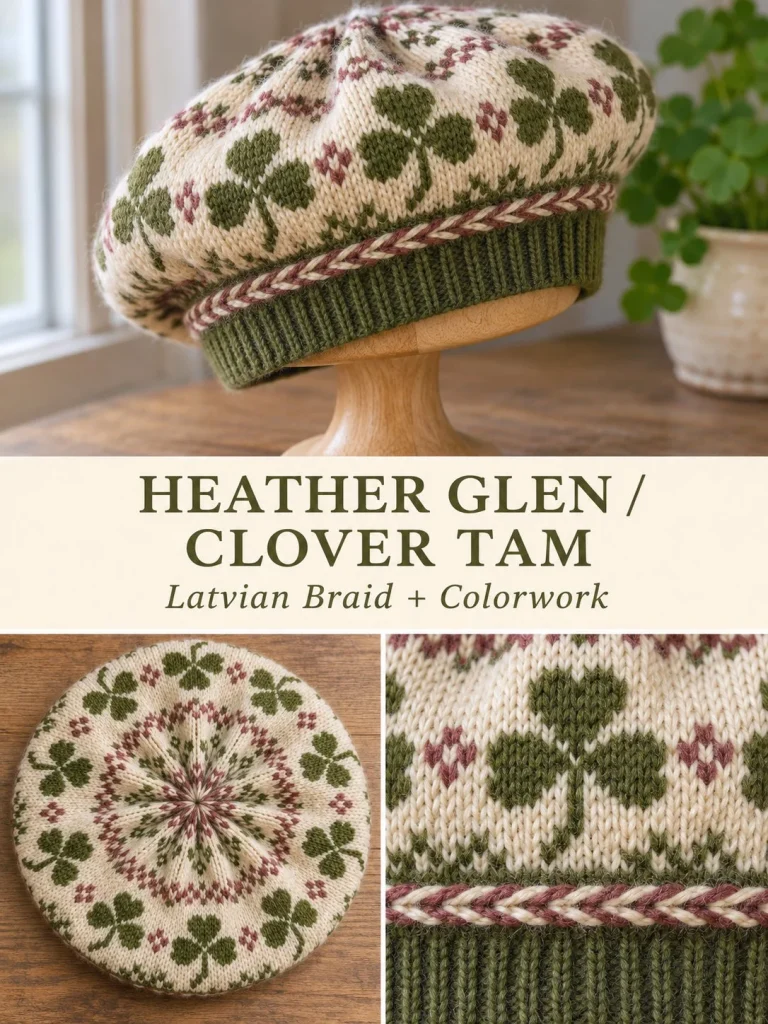
This charming clover colorwork tam is a beautiful blend of traditional knitting techniques and modern design, resulting in a cozy hat with a gentle slouch and intricate detailing. Worked seamlessly from the bottom up, it features a snug ribbed brim, a striking Latvian braid pattern, and an eye-catching stranded colorwork motif of clovers that lends a delicate texture and visual interest. Made with soft DK weight 100% merino wool, it offers warmth combined with breathability — perfect for cooler months.
Knitting this tam involves colorwork skills that include managing stranded floats carefully, making it an engaging project for knitters who enjoy using multiple colors in seamless circular knitting. The tam’s classic shape is enhanced through structured increases to create fullness, followed by gradual decreases shaping a softly slouchy crown. Blocking it over a dinner plate at the end helps achieve the perfect form and drape.
This design not only serves as an attractive accessory but also provides an interesting knit that balances technical techniques with practical construction. The use of a traditional Latvian braid offers a nod to folk craft, while the clover motif brings a natural, whimsical element to the overall style. If you’re intrigued by knitting colorwork hats, especially those incorporating traditional patterns, this tam is a rewarding project to add to your collection. For enthusiasts looking to explore complementary autumn-themed knitwear, consider also exploring the easy pumpkin socks pattern, which similarly uses rich colorwork motifs.
Pattern at a Glance
Skill level: Intermediate – requires familiarity with stranded colorwork and knitting in the round
Terminology: Standard US knitting terms
Construction: Bottom-up seamless hat knitted in the round
Finished size: Approximately 16 inches unstretched in circumference, 10 inches in height
Yarn weight: DK weight (light worsted)
Needles: US 5 / 3.75 mm (for ribbing and Latvian braid), US 6 / 4.0 mm (for body and crown)
Main stitch: Stockinette stitch in the round with stranded colorwork
Gauge: 22 stitches and 29 rounds = 4 inches in stockinette after blocking
Motifs: Clover stranded colorwork motif and two-color Latvian braid
Layout: Ribbed brim, Latvian braid band, all-over clover colorwork body, tapered crown
Joining: Worked seamlessly in the round
Border: 1–1.5 inch ribbed brim with Latvian braid above
Seaming: None – seamless construction
Materials
- Yarn: Approximately 300 yards (274 meters) of DK weight 100% merino wool across the chosen color palette. The quality of 100% merino offers exceptional softness and warmth, suitable for headwear that sits close to the skin.
- Needles: Two circular needle sizes are required: US 5 (3.75 mm) for the brim to achieve a firm, elastic ribbing and Latvian braid, and US 6 (4.0 mm) for the body and crown to allow fuller shaping and drape. Circular needles are essential for knitting in the round, and the needle length should suit the circumference comfortably.
- Notions: Stitch markers to mark rounds or pattern repeats, a tapestry needle for weaving in ends, and a marker for beginning of rounds or decrease sections.
- Blocking tools: Blocking tools such as a dinner plate or hat block form to shape the tam after knitting.
Yarn and Color Notes
Choosing yarn with good stitch definition is key for showcasing the complex colorwork. Smooth, tightly plied merino yarn is ideal as it highlights the Latvian braid and clover motifs crisply, avoiding blurring or fuzziness. Merino’s elasticity also helps the hat maintain shape after blocking.
For the color palette, select a coherent combination of two or more colors for the colorwork portion. High contrast between the source color and the clover motif will make the pattern pop, while using complementary hues preserves subtlety and elegance. Avoid heavily variegated yarns for the motifs, as they may obscure the clear geometry of the design.
Selecting yarn in a DK weight balance is important — using thicker or thinner yarns could affect gauge and finished sizing dramatically, which will necessitate adjustments in stitch counts and needle sizes.
Finished Measurements
- Lower edge circumference (unstretched): Approximately 16 inches.
- Height from cast-on to crown: Approximately 10 inches.
These dimensions mean the hat fits comfortably as a tam with gentle slouch. The circumference is measured without stretch; the elastic ribbing ensures a snug but comfortable fit. If your gauge differs, finished size may change, so careful blocking and gauge swatching are critical.
Gauge
The provided gauge for this pattern is:
22 stitches x 29 rounds = 4 inches in stockinette stitch knitted in the round after blocking.
To achieve this gauge:
- Use the specified needle sizes.
- Knit a swatch using stranded stockinette to account for colorwork tension.
- Block the swatch before measuring since stranded knitting relaxes significantly after washing and blocking.
Gauge is paramount in this project since it determines hat circumference and motif clarity. A tighter gauge will result in a smaller, denser hat, while a looser gauge might make the tam too large and shapeless. Adjusting needle size up or down is the safest way to get gauge.
Abbreviations
- sts: stitches
- rnd(s): round(s)
- k: knit
- p: purl
- CO: cast on
- dec: decrease
- YO: yarn over
- RS: right side
- WS: wrong side
Note: The pattern is worked entirely in the round, so RS is always the knit side facing you.
Important Pattern Notes
- The tam is knit seamless in the round from the bottom up.
- The cast-on is a rib-friendly multiple designed to measure about 16 inches unstretched at gauge (commonly 88 stitches for this project).
- Ribbing options include 1×1 or 2×2 rib for flexibility according to individual preference.
- The Latvian braid is a two-color stranded band knit above the ribbing, creating a textured horizontal band.
- Increase stitches uniformly at the start of the colorwork to create fullness in the body, targeting 25–35% more stitches than at the brim.
- Floats in stranded colorwork are relaxed and not pulled too tight to maintain elasticity.
- Decreases for crown shaping are spaced evenly and shift from every other round initially to every round near the top, carefully maintaining the colorwork pattern as long as possible.
- Final stitches are drawn closed with a tapestry needle.
- Blocking over a dinner plate or similar circular form sets the tam shape perfectly.
Special Stitches and Techniques
- Ribbing: Either 1×1 (k1, p1) or 2×2 rib (k2, p2) is used on the smaller needles to create a stretchy brim.
- Latvian Braid: A traditional twisted braid pattern using two colors, commonly achieved via specific stranded knitting techniques that create a raised braid-like effect. It requires careful tensioning to prevent puckering.
- Stranded Colorwork: The clover motif is knit using stranded techniques, carrying two colors across the row and "floating" inactive yarn loosely behind. Maintaining relaxed floats is essential to avoid puckering and tight fabric.
- Even Increases: Increases are placed evenly around the round to add fullness for the tam’s body.
- Even Decreases: Decreases divide the round into equal sections for smooth crown shaping, transitioning in frequency as the knitting reaches the top.
If you would like more practice with colorwork techniques, projects like the autumn drawstring bag provide excellent opportunities to hone stranded knitting skills.
Understanding the Construction
This tam is constructed seamlessly from the bottom up in the round, beginning with a stretchy ribbed brim that ensures a secure and comfortable fit. Above the brim lies a decorative Latvian braid — a distinctive folk art-inspired stripe that lends textural interest and a unique visual break before the main colorwork.
After the braid, the knitting expands with increases to give the tam its characteristic fullness, accommodating the clover motif spread evenly around the body. The tam height progresses through several inches of colorwork, embracing the stranded technique’s complexity.
Crown shaping begins once the knitted fabric reaches around 7 to 8 inches from the cast-on edge. Decreases are introduced gradually, spaced evenly to preserve continuity in the pattern as much as possible before closing the top. The tam is finished by drawing the remaining stitches together and blocking over a round object to achieve the traditional slouchy tam silhouette.
Complete Pattern Instructions
Foundation
- Begin by casting on a rib-friendly multiple that results in a circumference of approximately 16 inches unstretched at the gauge of 22 stitches = 4 inches (a practical starting point is 88 stitches).
Ribbed Brim
- Using the smaller US 5 (3.75 mm) needles, knit 1×1 (k1, p1) or 2×2 (k2, p2) ribbing for about 1 to 1.5 inches.
- Ensure the ribbing is snug and elastic to comfortably fit around the head.
Latvian Braid
- Continue on the same smaller needle size to knit a two-color Latvian braid band above the ribbing.
- This section uses stranded colorwork, carrying the two colors with loose floats.
- Follow your chosen Latvian braid chart or instructions carefully to maintain consistent tension and proper stitch twists.
- The width of this braid should be small enough to keep it delicate, serving as a featured border to the motif area.
Body Increases & Clover Colorwork
- Switch to the larger US 6 (4.0 mm) needles for the main body.
- Increase evenly spaced increases around the round to add about 25–35% more stitches than the brim (target roughly 110–120 stitches for fullness).
- This increase gives the tam a softly voluminous shape to accommodate the slouch.
- Start knitting the all-over clover motif in stranded colorwork using the original source chart for exact stitch placement.
- Pay particular attention to keep floats relaxed and not pulled tight to maintain elasticity and prevent fabric distortion.
- Work the colorwork until the piece measures about 7 to 8 inches from cast-on.
Crown Decreases
- Once the body length is reached, begin dividing the total stitch count evenly into decrease sections (such as groups of 8 or 10 stitches, depending on total count).
- Decrease stitches evenly around the round:
- Start by decreasing every other round to shape gradually.
- Transition to decreasing every round near the crown top, always maintaining the colorwork as long as possible without breaking the motif continuity.
- Continue decreases until only a small number of stitches remain.
Finishing the Crown
- Draw the remaining stitches closed with the tapestry needle, pulling firmly but evenly to close the top without puckering.
- Weave in all yarn ends securely on the wrong side.
Blocking
- Wet-block the tam thoroughly to encourage relaxation and even stitch distribution.
- Block it over a dinner plate or similar circular form about 10 inches in diameter to shape the classic tam silhouette with a gently slouchy crown and even circumference.
- Allow to dry completely before wearing.
Checkpoints
- After the ribbing and Latvian braid, your piece should measure about 2.5 to 3 inches tall with a circumference matching the brim measurement (~16 inches unstretched).
- After the increases, stitch count should have increased by about 25–35%, giving a fuller body fabric.
- The clover colorwork should spread evenly across the body of the tam with relaxed floats.
- Crown decreases should preserve the pattern as long as possible without distortion.
Assembly
- This tam is knit seamlessly in the round, so no seams or joins are necessary.
- Weaving in ends should be done carefully on the wrong side of the fabric to ensure comfort and durability.
- Blocking is essential to finalize shape and give the tam a professional finish.
Finishing
- After blocking, check the elasticity of the brim and the snugness of the fit.
- Stretch gently if needed to ensure ease of putting on and removing, while maintaining a comfortable fit.
- Maintain care instructions appropriate for merino wool: hand wash in cool water and dry flat to preserve shape and fiber quality.
How to Resize
- To resize larger or smaller, adjust the cast-on multiple while maintaining the ribbing stitch pattern multiple (e.g., 1×1 or 2×2 ribbing).
- The recommended starting point is 88 stitches for 16 inches circumference. For larger head sizes, increase the cast-on in multiples of the ribbing repeat.
- Remember to correspondingly increase the size of the Latvian braid chart and the colorwork repeats to maintain pattern coherence.
- Gauge swatches become even more critical when resizing colorwork patterns to maintain motif size and overall fit proportion.
Useful Variations
- Single-color version: Knit the entire tam in one color but keep the ribbing and Latvian braid as texture detail instead of color contrast.
- Different motifs: Swap out the clover motif for other stranded colorwork charts while maintaining the structure.
- Shorter or taller tam: Adjust the length of the colorwork section before crown decreases to make the tam less or more slouchy.
- Brighter or seasonal colors: Experiment with autumnal or winter palette colors for festive wear or gift projects.
Troubleshooting
Why is my colorwork fabric puckering?
Stranded knitting puckers if floats are carried too tightly. To fix this, consciously relax your tension on the yarns carrying the inactive color during colorwork rows, so floats lie comfortably behind stitches.
Why doesn’t my Latvian braid look crisp?
Check that you twist your stitches correctly per the Latvian braid technique. Using needles slightly smaller than gauge for this section can help keep stitches tight and defined.
Why is my tam too small or too large?
Your gauge most likely differs from the pattern’s 22 stitches and 29 rounds per 4 inches. Knit a gauge swatch with colorwork to be sure. Adjust needle size accordingly before starting the tam to achieve correct fit.
Why do the clover motifs not align on rounds?
Ensure you maintain the stitch count and increase placements exactly as instructed. Miscounted stitches can cause pattern shifts. Use stitch markers to mark motif repeats for easier tracking.
Why does the crown look uneven?
Make sure decreases are evenly spaced and timed as instructed — every other round first, then every round. Irregular decreases distort crown shape and fabric appearance.
Frequently Asked Questions
Can I use a different yarn instead of merino wool?
You can substitute with any DK weight yarn that has similar elasticity and stitch definition. Wool blends or superwash merino are good substitutes. Avoid very fuzzy yarns that may obscure the colorwork.
Is this pattern suitable for beginners?
This pattern is best suited for knitters with intermediate skills, comfortable knitting in the round and working stranded colorwork, as well as performing increases and decreases evenly.
How do I manage floats in the colorwork?
Keep floats loose (about every 3–4 stitches) to avoid puckering. Carry the non-working yarn behind your work without tension, and twist yarns at color changes to prevent long floats.
Can I make this pattern one color?
Yes, you can knit the tam in a single solid color, but the Latvian braid and clover motifs rely on contrast for their impact. Consider using texture stitches to replace color contrast effects if knitting monochrome.
How should I block this tam?
Wet-block the tam on a flat surface shaped over a dinner plate or a rounded hat block roughly 10 inches in diameter. Pin gently if needed, stretch lightly to shape, and allow to dry completely flat.
What if my gauge changes during knitting?
Recheck gauge periodically, especially after switching needle sizes or yarn weights. Consistency is key for a proper fit and motif alignment.
Optional Related Uses
The construction methods and colorwork techniques used in this tam can be adapted for related accessories such as:
- Fingerless gloves with matching clover motifs
- Slouchy beanie hats incorporating Latvian braids
- Colorwork cowls or neck warmers
- Decorative stripes on mittens or socks
Using the same stranded knitting and Latvian braid skills broadens your project repertoire effectively.
Final Thoughts
This tam combines thoughtful construction and beautifully traditional motifs to create a unique colorwork accessory. Starting with a ribbed brim and Latvian braid, it smoothly transitions into an all-over clover colorwork body, increasing for fullness and then decreasing to a gently slouchy crown. Following the detailed instruction and paying attention to tension and blocking will yield a sophisticated hand-knit piece that stands out for its craftsmanship and timeless style. The balance of structure and softness offered by the merino yarn ensures comfort without sacrificing warmth—making this an ideal hat for autumn and winter wear.



