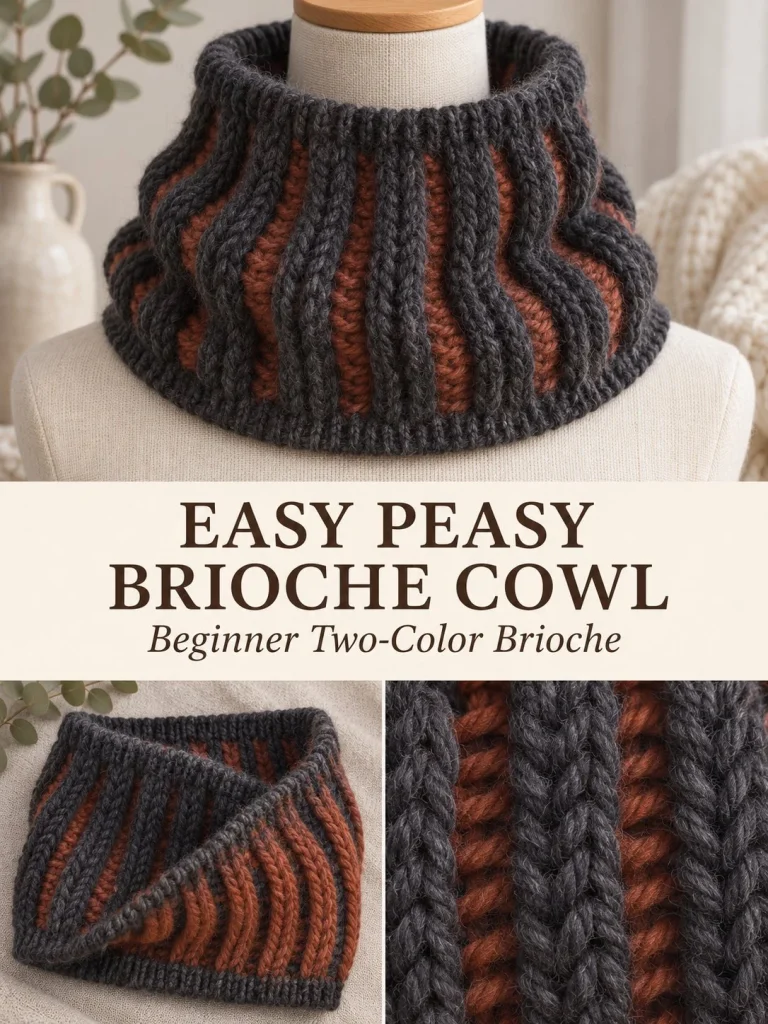
Creating a cozy, stylish accessory that highlights the beauty of two-color knitting techniques can be a delightful challenge for knitters, especially beginners eager to explore brioche stitch. This project features a seamless two-color brioche cowl that balances simplicity and visual interest, working in the round with a sophisticated, stretchy fabric that’s both warm and breathable. The contrasting Aran-weight yarns bring out the signature lofty texture of brioche, making the piece eye-catching yet wearable.
The fabric’s structure relies on a paired-round technique, where two colors alternate to build the signature double-ribbed brioche fabric with depth and elasticity. This cowl’s construction starts with a classic 1×1 rib border, leading into the brioche rounds worked on larger needles to emphasize the stitch’s springy qualities. After knitting to the desired height, the cowl closes with another ribbed edge, ensuring a tidy, elastic finish. Its relaxed circumference makes it comfortable to wear while preserving enough snugness to stay in place.
If you’re new to brioche but curious about two-color knitting, this project provides a manageable introduction. The instructions below offer clear explanations of each step and technique, so you can confidently create a chic accessory. For related seamless neck accessories with ribbed textures, exploring the Alize Shoulder Cowl knitting pattern might inspire your next knit.
Pattern at a Glance
Skill level: Beginner to Intermediate (practice with brioche stitches recommended)
Terminology: Standard American knitting terms
Construction: Seamless in-the-round knitting
Finished size: Approximately 22–24 in (56–61 cm) circumference, 8–10 in (20–25 cm) height
Yarn weight: Aran-weight wool (two contrasting colors)
Needles: US 7 (4.5 mm) for ribbing, US 8 (5 mm) circular for brioche rounds
Main stitch: Two-color brioche (brioche knit/purl with yarn-overs)
Gauge: Approximately 10 stitches x 17 rows = 4 in / 10 cm in brioche after blocking
Joining: Joined in the round after cast-on
Border: 1×1 ribbing on both edges
Seaming: None (seamless)
Materials
- Yarn: Two contrasting colors of Aran-weight wool, about 100 g / 150 m each. Choose fibers with good elasticity and stitch definition to maximize brioche texture.
- Needles: US 7 (4.5 mm) needles for the ribbed edges, and US 8 (5 mm) circular needle suitable for working brioche stitch in the round comfortably.
- Notions: Stitch marker to mark beginning of rounds, tapestry needle for weaving in ends.
The finer needle size for the ribbed edges helps keep cuffs neat and prevent stretching out, while the larger needles create an airy, flexible brioche fabric. Aran-weight yarn strikes a balance between warmth and thickness conducive to brioche’s lofty texture.
Yarn and Color Notes
Aran-weight wool is an ideal choice for two-color brioche because its firm yet soft characteristics allow the stitch pattern to bloom without losing structure. A smooth yarn surface enhances the visibility of brioche’s texture and yarn overs.
For color selection, pairing two contrasting shades—such as light and dark, or cool and warm tones—accentuates the brioche’s reversible two-sided effect. Unlike variegated yarns, solid colors showcase the intricate stitch interplay clearly.
If you prefer experiments with fibers or textures, keep in mind fuzzy or loosely spun yarns may blur the definition of brioche stitches. For a similar easy-care alternative, choose wool blends with good resilience.
Finished Measurements
Your finished cowl will have a relaxed but cozy circumference of approximately 22–24 inches (56–61 cm) and stand about 8–10 inches (20–25 cm) tall. These dimensions assume knitting to gauge and may vary slightly with tension.
The circumference is designed for an adult neck size that allows the cowl to sit comfortably without constriction or excess sag. The height offers plenty of coverage to keep the neck warm and displays the brioche pattern attractively.
Gauge
A crucial factor for achieving the intended fit and fabric style is matching gauge: about 10 stitches x 17 rows = 4 in / 10 cm in brioche after light blocking.
- Where to measure: Use your larger needle and tension to knit a brioche swatch in the two-color pattern, then block lightly before taking measurements.
- Why gauge matters: Brioche fabric stretches substantially and has a deep relief texture; knitting too tightly will produce a stiffer fabric and smaller circumference, while knitting too loosely will cause a floppy fabric that loses definition.
- Adjustments: If your gauge differs, adjust needle size accordingly or modify the cast-on count in even numbers to maintain stitch multiples.
Correct gauge ensures the cowl’s seamless fit and that the two-color brioche stands out with glorious depth.
Abbreviations
- MC: Main Color
- CC: Contrast Color
- brk1: Brioche knit one stitch (knit stitch together with its yarn-over)
- brp1: Brioche purl one stitch (purl stitch together with its yarn-over)
- sl1yo: Slip one stitch with yarn over
- 1×1 rib: Alternating knit 1, purl 1
Important Pattern Notes
- This cowl is worked entirely in the round, beginning with a stretchy 1×1 rib edge.
- Cast on an even number of stitches to fit the specified circumference; this number must remain even to maintain the brioche stitch pattern.
- The two-color brioche pattern runs on a two-round repeat, switching colors each round.
- Yarn-overs created during brioche knitting are worked together with stitches on the following round, allowing a deep, cushioned fabric texture.
- Bind off elastically to keep the rib edges stretchy and comfortable.
- Light blocking enhances stitch definition and fabric elasticity without flattening brioche’s characteristic depth.
Special Stitches and Techniques
Brioche Knit (brk1)
This specialty stitch knits together one stitch with its corresponding yarn-over from the previous round, producing a textured rib column.
- Insert needle knitwise into the stitch and its yarn-over.
- Knit them together as one stitch.
Brioche Purl (brp1)
Purl one stitch together with its yarn-over, creating the purled counterpart of the brioche knit stitch.
- Insert needle purlwise into the stitch and yarn-over.
- Purl them together as one stitch.
Slip One Yarn Over (sl1yo)
Slip one stitch together with its yarn-over, moving it from left to right needle without knitting or purling, to prepare for subsequent brioche knit or purl stitches.
This slipping technique helps maintain the brioche stitch structure and accommodates color changes smoothly.
Elastic Bind-Off
Use a loose, stretchy bind-off method such as the sewn bind off or a stretchy ribbed bind off to preserve edge elasticity.
Understanding the Construction
The cowl is worked seamlessly in the round, starting from the bottom edge upward. The initial rounds establish a 1×1 ribbing in the smaller needle size to provide a stable, elastic foundation.
After the ribbing, switching up to the larger circular needle allows the brioche stitch to expand with its characteristic height and volume. The two-color brioche pattern alternates colors each round within a fixed stitch count, forming a balanced reversible fabric.
The repeats continue until the cowl reaches the target length, then a final short ribbing edge is added to finish both the body and neck edges consistently.
This construction technique eliminates seams and side joins, resulting in a polished, continuous piece that is easy to wear.
Pattern Instructions
Foundation
Cast on an even number of stitches sufficient to yield a relaxed circumference of about 22–24 inches (56–61 cm) at the brioche gauge. Casting on evenly is essential for maintaining stitch pattern consistency.
Join and Ribbing
Carefully join to work in the round, making sure stitches are not twisted.
Place a stitch marker to mark the beginning of rounds.
Using the smaller US 7 (4.5 mm) needles, work 1×1 ribbing (knit 1, purl 1) for about 1 to 1.5 inches (2.5 to 4 cm). This provides a neat, elastic edge foundation.
Switch Needles and Begin Two-Color Brioche
Change to the larger US 8 (5 mm) circular needle.
The brioche stitch is worked over two rounds with two colors. These two rounds form the basic brioche repeat sequence.
Round 1 (MC):
With the Main Color, brk1 (knit the stitch together with its yarn-over), sl1yo around. Each brk1 uses a stitch and its associated yarn-over, then the next stitch with yarn-over is slipped together.
Round 2 (CC):
With the Contrast Color, sl1yo, brp1 (purl stitch together with its yarn-over) around.
Repeat these two rounds alternately until the piece measures approximately 8 to 10 inches (20 to 25 cm) from the cast-on edge.
Final Rib Edge and Bind Off
Work a short 1×1 rib edge in the color of your choice using the smaller needle for elasticity and clean finish.
Bind off very elastically to maintain the stretch of the ribbing edge. Avoid tight binding off which may constrict the edge’s natural elasticity.
Light Blocking
After all knitting is complete, block the cowl lightly so that the brioche stitches remain full and springy, enhancing texture without flattening.
Checkpoints
- After casting on and joining, ensure no twisting at the join.
- After working ribbing, measure to confirm length is 1–1.5 inches before switching needles.
- After completing each pair of brioche rounds, verify stitch pattern continuity.
- The final fabric should measure roughly 8–10 inches tall and maintain the 22–24 inches circumference.
- Bind off elastically to avoid a tight edge that limits stretch.
Finishing
Weave in all yarn ends carefully with a tapestry needle on the wrong side to avoid visible bumps.
Light blocking should involve gently steaming or pinning the cowl flat without stretching excessively. Brioche is naturally elastic, so minor shaping is enough to optimize its appearance.
How to Resize This Cowl
To resize:
- Adjust the cast-on stitch count in even numbers corresponding to the desired circumference. More stitches increase width; fewer reduce it.
- Maintain the two-round brioche repeat pattern exactly.
- Adjust the number of brioche stitch repeats to achieve preferred height (8–10 in original).
- Gauge swatches are essential before committing to size changes, as brioche tends to stretch.
For additional stitch pattern practice and seamless knitting inspiration, consider similarly sized projects like the Alpine Tweed Boucle Blanket, which helps build confidence with textured knits.
Useful Variations
- Single-color brioche: Use one color for a classic monochrome brioche fabric while retaining stitch texture.
- Longer cowl: Simply add extra repeats of the two-color brioche section for a longer scarf-style cowl.
- Different yarn fibers: Try blends of wool with alpaca or silk to modify drape and warmth.
- Contrast with gradient yarn: Pair a solid main color with a gradient contrast for subtle color shifts.
Troubleshooting
Why Is My Brioche Cowl Too Tight or Too Loose?
Gauge inconsistency can cause size issues. Swatching and adjusting needle size before starting is critical. Brioche is stretchier, but knitting much tighter or looser changes fit considerably.
My Color Changes Look Messy or Tight — How Do I Improve Them?
Ensure you slip yarn-overs without twisting and maintain consistent yarn tension. Practice smooth color transitions by carrying yarn loosely along the wrong side where possible.
Why Does My Stitch Pattern Look Uneven?
Brioche requires slipping yarn-over stitches correctly. Missing a yarn-over or misknitting brk/brp rounds causes pattern shifts. Use lifelines or stitch markers to keep track in complex rounds.
Why Is the Edge Curling?
This is less common with 1×1 ribbing edges, but if the rib is loose, blocking gently will correct slight curling.
How Do I Bind Off Without Losing Elasticity?
Use a stretchy bind-off technique designed for ribbed edges, such as the tubular bind-off or sewn bind-off.
Frequently Asked Questions
Can I use a yarn weight other than Aran?
While Aran weight is recommended for optimal brioche texture and stretch, you can experiment with DK or worsted weights. Adjust needle size and gauge accordingly.
Is this pattern suitable for beginners?
Yes, it’s beginner-friendly if you are comfortable with basic knit and purl stitches and willing to learn brioche knit and purl techniques.
Can I make this cowl in one color?
Absolutely. Although designed to highlight two-color brioche, knitting the brioche sections with one color creates a beautiful textured fabric.
How should I care for this wool cowl?
Hand wash gently in cool water and lay flat to dry to preserve shape and softness.
Is blocking necessary?
Light blocking is recommended to enhance stitch definition and elasticity without crushing the brioche texture.
Can I substitute circular needles for double-pointed needles?
Circular needles are preferred here to accommodate the seamless join and ease of switching colors for the brioche rounds, especially for the seamless round knitting.
Optional Related Uses
The two-color brioche technique and seamless in-the-round construction make this cowl method adaptable to related projects such as:
- Neck warmers or other cowl styles with different heights
- Seamless beanies using the same brioche stitch pattern
- Wrist warmers or cuffs with brioche texture
- Larger seamless blankets featuring two-color brioche in panels (see also the Alpine Tweed Boucle Blanket for inspiration)
Final Thoughts
This cowl merges classic ribbing and sophisticated two-color brioche to create a warm, stretchy, and visually complex accessory that’s surprisingly approachable for beginners eager to expand their knitting skills. The seamless in-the-round construction enhances comfort and continuity of pattern, while the elastic edges ensure excellent fit and shape retention. Mastering this brioche sequence opens the door to a variety of beautiful two-color knit fabrics and garments in the future. Happy knitting!



