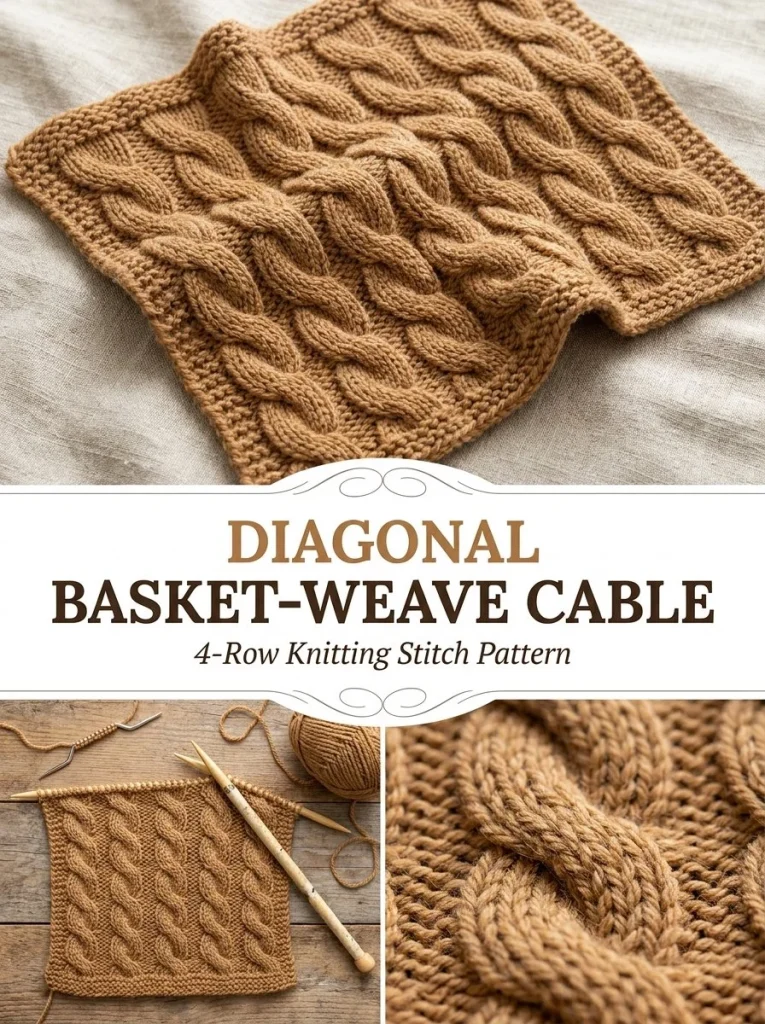
This stitch pattern is a great way to add texture and complexity to your knitting projects. Known for its dense and intricate appearance, the Diagonal Basket-Weave Cable Knit Stitch can be used in a variety of items, including panels, pillow fronts, bags, cowls, or blankets. If you’re looking for cozy designs, consider incorporating similar textures like those in the autumn plaid slip stitch cowl](https://velora.hapadltd.com/autumn-plaid-slip-stitch-cowl-knitting-pattern/).
Skill Level
This pattern is suited for those with an Intermediate skill level. It requires some familiarity with cable knitting techniques, including the use of a cable needle, making it a challenging yet rewarding project for crafters looking to enhance their skills.
Materials
To complete the Diagonal Basket-Weave Cable Knit Stitch pattern, you will need the following materials:
- Worsted-weight yarn
- Knitting needles (5.5-6 mm, approximately one size larger than normally recommended for the yarn)
- Cable needle
- Tapestry needle
- Scissors
Abbreviations — US Terms
- K – knit
- P – purl
- st(s) – stitch(es)
- RC – Right Cross
- LC – Left Cross
Special Stitches
2/2 Right Cross (2/2 RC)
To work this stitch, slip 2 sts to a cable needle and hold it at the back of your work. Knit the next 2 sts from the left needle, then knit the 2 sts from the cable needle.
2/2 Left Cross (2/2 LC)
For this variation, slip 2 sts to a cable needle and hold it at the front of your work. Knit the next 2 sts from the left needle, then knit the 2 sts from the cable needle.
Gauge
While gauge is not explicitly necessary for this project, maintaining consistent tension is crucial for achieving the dense fabric characteristic of this stitch.
Finished Size
The finished size will depend on how many repeats you work. As a guideline, cast on 24 stitches for a practice swatch, which typically results in a compact and textured piece measuring approximately 5 inches wide when using worsted-weight yarn.
Pattern Notes
- This pattern involves both right-side and wrong-side rows.
- The stitch multiple is 4, meaning you can cast on any multiple of 4.
- The project is reversible with no defined right or wrong side.
- A light blocking is recommended once your piece is completed to help set the stitches.
Crochet Instructions
Row 1
Begin by casting on your desired number of stitches in multiples of 4. For a practice swatch, casting on 24 stitches is ideal. Knit 2 stitches (K2) to start, then repeat the 2/2 RC across to the last 2 stitches, and finish with K2. You should end Row 1 with 24 stitches.
Row 2
Turn your work. Purl all stitches across the row. At the end of Row 2, the count remains 24 stitches.
Row 3
Turn your work again. For this row, you will repeat the 2/2 LC across the entire row. Start with K2, then execute the 2/2 LC across to the end, and finish with K2. Your count will still be 24 stitches.
Row 4
Turn your work. Again, purl all stitches across. The total stitch count remains 24.
Repeat Rows 1–4 until your piece reaches your desired length.
Pattern Repeat
Continue repeating from Row 1 to Row 4 for as long as needed for your project.
Tips for the Best Result
- Ensure to keep your cable crosses relaxed; pulling too tightly will affect the fabric’s drape.
- Use a blocking technique to lightly stretch your finished work without flattening it overly.
- When working your cable stitches, maintain awareness of the tension to prevent undesired puckering.
Common Mistakes
Uneven Stitch Tension
If you notice variance in your cable stitches, check that you’re maintaining consistent tension throughout the work. It’s common for tension to change between knits and purls.
Tight Cable Crossings
If your cables look too tight, practice working the cable stitches a bit looser. Make sure not to pull your yarn overly tight when casting on and binding off.
Project Ideas or Variations
This stitch can create beautiful textures in various projects. Here are some ideas for what you can create using the Diagonal Basket-Weave Cable Knit Stitch:
- Pillow covers
- Warm scarves
- Cozy throws or blankets
- Stylish bag panels
- Unique cowl designs like the cranberry moss stitch headband
Finishing
When you finish your project, bind off without pulling the stitches too tightly to maintain the elasticity. Weave in all ends carefully using a tapestry needle to ensure they are secure and the fabric remains neat. Consider lightly blocking your finished piece to enhance the stitch definition and achieve a polished look.
Care
Refer to your yarn label for specific washing instructions. Generally, it’s advisable to hand-wash items made with wool or blended yarns to maintain the fibers’ integrity. Avoid high heat during drying which can lead to shrinking or felting.