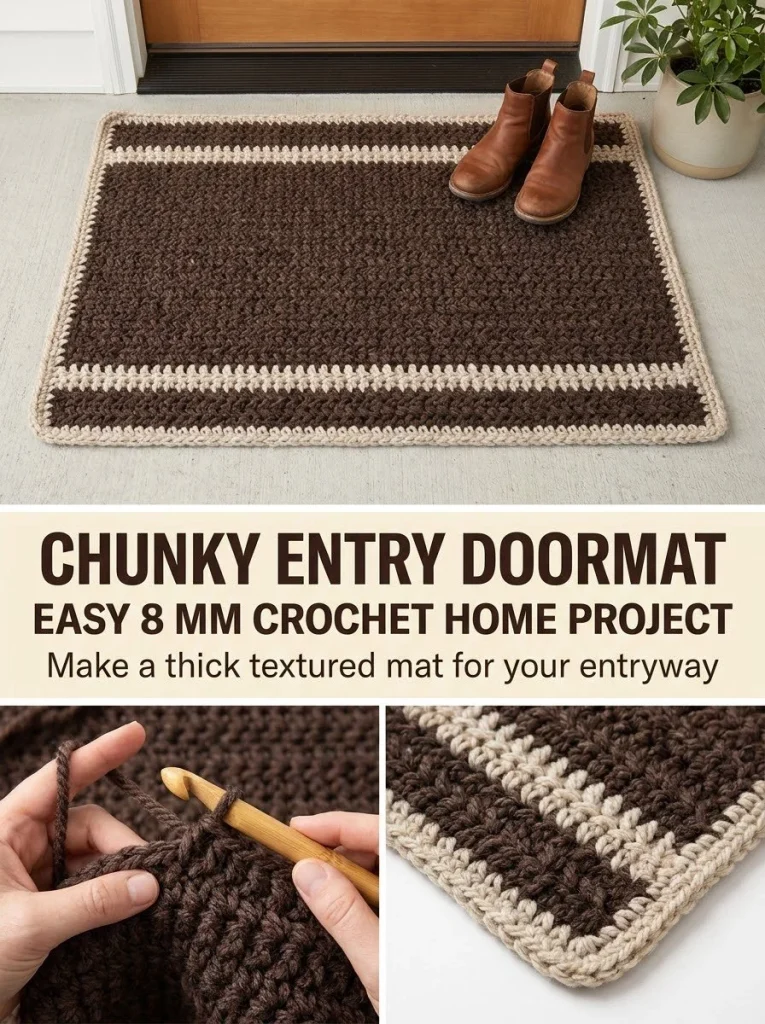
Crocheting a handmade entry doormat offers a perfect blend of practicality and style, adding a warm, inviting touch at your doorstep while withstanding daily wear. This chunky entry doormat project employs a rich espresso base accented by soft oatmeal stripes and a border, creating a striking visual contrast that complements a variety of home decors. Its super-bulky yarn and textured pattern not only ensure durability and absorbency but also give the piece an inviting tactile texture.
The construction of this doormat is straightforward yet sophisticated, working in rows with half double crochet stitches and a unique crossed half double crochet texture serving as the centerpiece. Color changes are thoughtfully integrated to highlight stripes without complicating the pattern, making it suitable for crocheters who want a quick project but enjoy a touch of complexity. Given its practical size and sturdy fabric, this doormat is perfect for high-traffic areas, providing both function and charm.
The method and stitch choices reflect an expert balance between sturdiness and softness, optimized for super-bulky yarns—a popular choice for home accessories due to their quick coverage and solid structure. The piece is finished with a neat oatmeal-colored border that adds stability and polish, while the use of an optional non-slip rug pad ensures safety on smooth floors. This project could serve as a cheerful introduction to your home or a thoughtful handmade gift.
For those intrigued by similar colorwork or chunky textures, this project aligns well with other patterns featuring bold stripes and textural stitch patterns, much like the style found in the autumn color block chunky scarf knitting pattern, offering inspiration for further crafted accessories.
Pattern at a Glance
Skill level: Intermediate (due to crossed half double crochet stitch)
Terminology: US Crochet terms
Construction: Worked flat in rows
Finished size: Approximately 22 x 30 inches (varies with tension)
Yarn weight: Super-bulky (#6)
Hook: 8 mm crochet hook
Main stitch: Half double crochet (hdc) with crossed hdc texture
Gauge: Not specifically measured, depends on yarn and tension
Motifs: Single rectangular piece
Layout: Colorblock stripes, four stripes total
Joining: Not applicable (single piece)
Border: Oatmeal half double crochet border with chain spaces in corners
Seaming: None
Materials
For this project, you will need:
- Approximately 400 yards of super-bulky weight (#6) yarn, primarily in a deep espresso shade for the main body, and oatmeal color for the stripe accents and border. The rich espresso lends depth, while oatmeal introduces warmth and contrast.
- An 8 mm (US L/11) crochet hook, the ideal size to work quickly and accommodate the thick yarn.
- A tapestry needle, for weaving in yarn ends cleanly.
- An optional non-slip rug pad to place underneath once finished, which is highly recommended if your doormat will sit on smooth flooring surfaces to prevent slipping.
Choosing durable, washable yarns such as acrylic blends or wool blends is advisable, as the doormat will endure frequent foot traffic and dirt.
Yarn and Color Notes
Super-bulky yarn accommodates rapid growth in size and offers a cushioned, substantial fabric that resists wear, perfect for a doormat that must be both resilient and inviting. For this project, solid colors with good stitch definition are preferable so that the crossed hdc texture and stripes stand out distinctly.
The chosen color palette of espresso and oatmeal not only gives a modern, neutral look but also helps hide dirt, practical for an entryway accessory. If desired, variations with different two-color combinations or more natural fibers can alter the tone and feel dramatically.
Finished Measurements
The finished doormat measures approximately 22 inches wide by 30 inches long, ideal for a standard entryway space or porch area. These dimensions depend on your crochet tension and yarn choice, so making a gauge swatch is helpful to anticipate final sizing.
Gauge
As this is a home accessory, exact gauge is less critical than for garments, but keeping consistent tension will ensure the proper size and a balanced texture. Measuring a swatch in half double crochet with your yarn and hook will let you see the fabric’s drape and density.
If your stitches are tighter than expected, the doormat might turn out smaller and firmer; conversely, looser stitches could yield a softer mat but less durable underfoot.
Abbreviations
- ch = chain
- hdc = half double crochet
- st(s) = stitch(es)
- sk = skip
- rep = repeat
- RS = right side
Important Pattern Notes
- The turning chain is always ch 1 and does not count as a stitch.
- The main texture involves crossed half double crochets, which create a subtle raised pattern that adds grip and aesthetic interest.
- Color changes are worked at precise rows to form stripes without interrupting the fabric’s structure.
- The border is crocheted continuously around all four edges without fastening off between sides.
Special Stitches and Techniques
Crossed Half Double Crochet (Crossed hdc)
This stitch is a variation on the half double crochet that produces a unique, textured appearance with a subtle "crossed" effect:
- Skip the next stitch.
- Hdc in the following stitch.
- Then, crochet back into the skipped stitch with another hdc.
Repeating this sequence across the row creates a chain of interlocking "X" shapes in half double crochet.
This stitch is repeated row upon row to develop the core textured fabric of the doormat.
Understanding the Construction
This project is worked entirely in horizontal rows, beginning with a foundation chain followed by a sequence of textured rows that alternate hdc stitches and crossed hdc pairs. Color changes introduce blocks of oatmeal stripes at intervals to coordinate with the espresso background. The final row is a simple hdc row to even out the shape before the border is added.
The border is worked directly onto the edges to create a clean, stable finished edge with a decorative corner detail formed by chaining 2 between half double crochet clusters.
Complete Pattern Instructions
Foundation
Using the espresso color yarn, chain 44.
Row 1
- Begin in the 3rd chain from the hook.
- Work 1 half double crochet (hdc) in each chain across until the end of the row.
- Total stitches worked: 42.
Row 2
- Chain 1 (turning chain), turn your work.
- Work 1 hdc in the first stitch.
- Across the next stitches, work crossed hdc pairs as follows:
- Skip the next stitch.
- Hdc into the following stitch.
- Then cross back and hdc into the skipped stitch.
- Repeat this across the row until you reach the last stitch.
- Finish the row with 1 hdc in the final stitch.
Rows 3 to 34 (Textured Rows)
- Repeat the Row 2 sequence, maintaining the crossed hdc pairs across the middle stitches and single hdc at each edge.
- Work color changes according to the following layout:
- Rows 1–5: Espresso yarn
- Rows 6–8: Oatmeal yarn
- Rows 9–27: Espresso yarn
- Rows 28–30: Oatmeal yarn
- Rows 31–34: Espresso yarn
Row 35 (Final Row)
- Chain 1, turn.
- Work 1 hdc in every stitch across, smoothing the top edge.
Border
- Without fastening off, join the oatmeal yarn at any corner.
- Work a half double crochet border around all four edges as follows:
- Work 2 hdc, chain 2, 2 hdc into each corner stitch to create rounded, flexible corners.
- Continue hdc evenly along all sides between corners.
- Join with a slip stitch to the first border stitch.
- Fasten off securely and weave in all yarn ends with a tapestry needle.
Checkpoints
- After Row 1, confirm you have 42 stitches across.
- The textured crossed hdc rows should produce visible "X" shaped stitch pairs creating a firm but flexible fabric.
- Measure periodically; the piece should be about 22 x 30 inches after finishing all rows, depending on your tension.
- The border should lay flat without puckering or curling.
Assembly
This project is a single crocheted piece and requires no seaming or joining.
Finishing
To finish, securely weave in all yarn ends inside the fabric using a tapestry needle. Place the doormat on a non-slip rug pad, especially when using on hardwood, tile, or other smooth floors to prevent slipping and protect surfaces.
Occasionally, hand wash your doormat gently and lay flat to dry, avoiding excessive moisture that can stretch or distort the fibers.
How to Resize
To resize, adjust the foundation chain in multiples of 2 to maintain the pattern’s stitch repeat. Adding or subtracting chains will increase or decrease the width, while adding or reducing the number of textured rows will change the length. Keep the color stripe pattern proportionate by adjusting the numbers of rows in each color block accordingly.
For example, to make a wider doormat, you could chain 54 stitches for about 10 more stitches in width, then repeat the texture pattern accordingly.
Useful Variations
- One-color version: Work the entire piece in espresso or oatmeal for a minimalist look.
- Different color stripes: Substitute oatmeal with a bright or pastel color for seasonal or festive doormats.
- Scrap yarn version: Use multiple colors in stripes to create a vibrant, patchwork effect.
- Matching accessories: Use the same crossed hdc texture for coordinating home accessories like rugs or placemats, inspired by projects such as the bold stripe chunky statement ring monochrome crochet pattern which use striking textures and stripes.
Troubleshooting
Why Is My Doormat Wider Than Expected?
Ensure you have chained exactly 44 stitches. Loose tension or skipped stitches can cause width fluctuations. Practice maintaining even tension, especially during the crossed hdc stitches.
Why Is the Edge Curling?
If edges curl, your stitches may be too tight or uneven. Blocking the finished mat by lightly dampening and shaping it flat can also help relax the fabric.
Why Are My Color Changes Visible?
To keep neat color transitions, carry the yarn up the edge discreetly or cut and weave in ends carefully. Avoid pulling ends too tight to prevent puckering.
Why Does the Crossed Texture Look Confusing?
The crossed hdc stitch requires skipping a stitch and then going back, so work slowly at first and count stitches carefully to ensure correct placement.
Frequently Asked Questions
Can I use a different yarn weight?
While it is possible, using lighter yarn will change the density and durability. Super-bulky (#6) yarn is recommended for a sturdy, quick-to-make doormat.
Can I use cotton yarn for this project?
Cotton can work well due to its absorbency and washability but may produce a stiffer fabric compared to acrylic blends.
Can I make this doormat larger or smaller?
Yes, adjust the starting chain in multiples of 2 and add or reduce rows in the stripe pattern.
Is this pattern suitable for beginners?
An intermediate skill level is better due to the crossed half double crochet stitch and color changes, but confident beginners willing to learn new stitches can succeed.
Do I need to use a tapestry needle?
Yes, for cleanly weaving in ends after finishing the piece.
How should I clean the finished doormat?
Hand wash gently and dry flat. Avoid machine washing if possible to maintain the texture and shape.
Optional Related Uses
This crossed hdc texture and stripe color pattern is very adaptable:
- Cozy floor mats or bathroom rugs
- Coordinating table runners or placemats
- Chunky scarves or wraps with bold stripes, similar to some knitting patterns
- Small bath mats with extra absorbency
Final Thoughts
This chunky entry doormat is crafted with a combination of the sturdy super-bulky yarn and a textured crossed hdc stitch that provides beautiful visual interest and durability. Its construction as one large rectangular piece worked in rows with strategic color striping and a simple border makes it a manageable yet rewarding project.
From chaining to the unique crossed hdc stitch and thoughtful color placement, the piece is designed for function and style, perfect for bringing warmth and organization to your entrance. Don’t forget the finishing touch of a non-slip rug pad to keep your doormat secure where it counts.
Whether for yourself or as a gift, this practical crochet project brings both texture and welcoming style to your home entrance.



