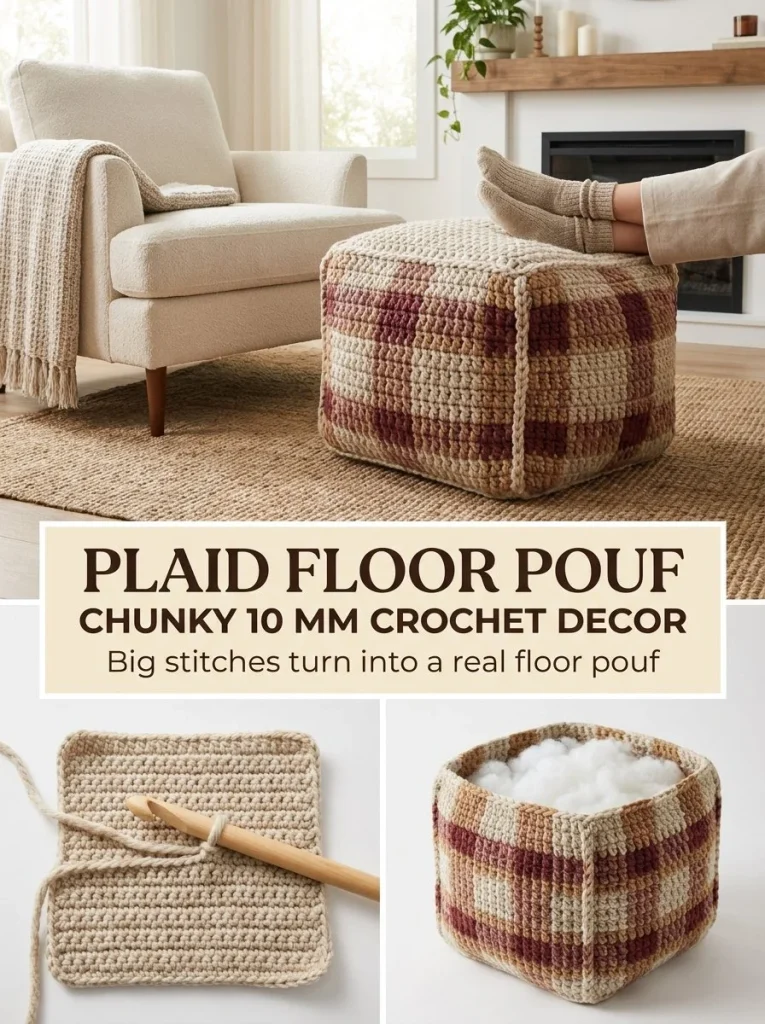
Creating a stylish and practical floor pouf with a cozy plaid design, this project combines solid construction with a colorful visual texture that enhances any living space. The pouf’s square shape and inviting hues of oatmeal, camel, and muted burgundy merge classic and warm aesthetics, making it a versatile accent piece. Utilizing a robust double-stranded worsted weight yarn approach provides both durability and softness, perfect for a soft seating option or footrest.
Constructed primarily using joined double crochet rounds, this pouf features a joined square base and top, with the sides crocheted upward to form a sturdy body. The plaid effect is cleverly crafted by working small color blocks of stitches in a repeating sequence, carefully carrying yarn along the inside to maintain a neat and clean fabric. This technique not only delivers the pattern’s visual charm but also ensures a firm and evenly-textured structure once filled.
This project offers an excellent opportunity to practice joined rounds and color block management in crochet. For those eager to try similar plaid patterns, exploring plaid crochet techniques can provide additional inspiration and skills to elevate your crafting.
Pattern at a Glance
Skill level: Intermediate – requires color changes and joined rounds technique
Terminology: US crochet terms
Construction: Bottom and top squares worked flat in joined double crochet rounds; sides crocheted upward in continuous joined double crochet rounds; finished top sewn to sides
Finished size: Approximately 20 inches square base and top; 17 inches high
Yarn weight: Worsted #4 held double or bulky weight equivalent
Hook: 10 mm (US N/P-15)
Main stitch: Double crochet (dc), single crochet (sc)
Gauge: Not explicitly specified; approximately 20" square base after sufficient rounds
Motifs: Solid square base and top; plaid blocks on sides
Layout: Square base; rectangular sides worked in continuous rounds; plaid color blocks arranged in sequences of 4 stitches per color
Joining: Joined double crochet rounds for continuous fabric; final top sewn on with single crochet border
Border: Single crochet round in back loop only (BLO) on base before sides
Seaming: Single crochet seam joining top to sides
Materials
To bring this project to life, you will need:
-
Worsted #4 yarn held double or a bulky weight yarn equivalent in three colors:
- Oatmeal (main neutral color)
- Camel (warm neutral)
- Muted burgundy (rich accent)
Holding two strands together creates the thick, sturdy fabric needed for a floor pouf.
-
10 mm crochet hook – This large hook size works well with the doubled yarn, yielding a dense fabric without holes.
-
Tapestry needle – For weaving in ends and sewing the top to the body.
-
Firm foam or an alternative stuffing such as old folded blankets or cushion filling – These materials provide the necessary firmness and shape retention.
-
Stitch markers – To mark corners and round joins accurately, especially important for maintaining the shape during joined rounds.
Each material is crucial: the yarn weight and hook choice ensure durability and softness, while firm filling stabilizes the pouf’s shape. Using stitch markers keeps your rounds neat and prevents accidental stitch count errors.
Yarn and Color Notes
Bulky or doubled worsted yarns are ideal because they provide thickness and visual heft to the pouf’s texture, essential for a supportive, long-lasting floor cushion. The chosen colors—oatmeal, camel, and muted burgundy—blend harmoniously for a classic plaid look that fits many interiors.
When selecting yarn:
- Opt for fibers that balance softness with resilience, such as acrylic blends, wool blends, or cotton blends. Avoid overly fuzzy yarns, which can visually obscure the plaid pattern and add bulk, making yarn management harder.
- Smooth yarns offer clean stitch definition, especially important in plaid patterns where color blocks need to be distinct.
- Consider matching the color saturation levels to maintain a balanced plaid appearance.
If you enjoy working on plaid stitch patterns, don’t miss the inspiration from the autumn plaid slip stitch cowl knitting pattern, which showcases similar cozy colorwork in a wearable form.
Finished Measurements
The finished pouf measures approximately:
- Base and top: 20 inches by 20 inches square
- Height: About 17 inches tall
These dimensions create a substantial floor pouf suitable for seating or footrest use. The size derives from working the base to 20" square, then crocheting the sides upward to 17" with no height adjustments in the base rounds.
Gauge
Although exact gauge is not specified, the dimension guides require the base square to measure approximately 20 x 20 inches after working joined double crochet rounds with doubled worsted yarn and a 10 mm hook. Gauge here is important because:
- A smaller gauge (tighter stitches) will result in a smaller square, potentially making the top and base mismatch.
- A larger gauge (looser stitches) could make the pouf floppy or too loose to hold filling firmly.
For projects like poufs, exact stitch gauge is somewhat forgiving, but still critical for matching the top square and creating a stable fabric.
Abbreviations
- ch: chain
- dc: double crochet
- sc: single crochet
- BLO: back loop only
- joined rounds: rounds worked joined with slip stitch at the end
- st(s): stitch(es)
- corner space: chain-2 space formed at corners in square motifs
Important Pattern Notes
- The pattern is worked primarily in joined double crochet rounds with increases only during base construction.
- Corners are marked by working (2 dc, ch 2, 2 dc) in chain-2 corner spaces.
- The transition from base to sides involves a single round of single crochet in BLO without increasing, which turns the fabric upward.
- The body is worked upward in continuous joined dc rounds without increasing, making straight sides.
- Plaid color changes occur in blocks of 4 stitches per color, repeated over 2 rounds before switching colors for the plaid effect.
- Yarn carrying inside the fabric keeps unused colors tidy and reduces bulk on the exterior.
- The top square matches the base size and is attached by single crocheting through both edges, closing the pouf after stuffing.
Marking corners and keeping track of rounds with stitch markers can greatly help maintain shape and pattern integrity.
Special Stitches and Techniques
- Magic ring: The base starts with a magic ring to avoid a hole at the center.
- Joined double crochet rounds: Each round ends with a slip stitch join, starting the next round with chain 2.
- Back loop only single crochet round: Used to create a slight bend so the sides can turn up from the base.
- Color block plaid: Blocks of four stitches per color, maintained for two rounds before switching colors to maintain a plaid grid.
- Carrying yarn inside: Tucking inactive yarn strands inside the fabric during color changes to avoid loose ends.
These techniques make the pouf look professionally finished and allow for clean color transitions.
Understanding the Construction
This pouf is built in three main parts:
-
Base square: Worked from the center outward using joined double crochet rounds. Increases occur at corners to keep the square shape. The base grows until it measures 20 x 20 inches.
-
Body sides: After a round of single crochet in the back loop only to turn the base fabric upward, the sides are crocheted continuously upward in joined dc rounds without increases, forming vertical sides about 17 inches tall. The plaid pattern is introduced here by alternating color blocks in a repeating sequence.
-
Top square: A second square identical in size to the base is worked in solid oatmeal color and joined by single crochet to the side fabric to close the pouf.
Stuffing the body firmly with foam or folded textile filling stabilizes the shape before closing the top.
Complete Pattern Instructions
Base
Foundation round:
- Hold two strands of yarn together (choose your colors as per the base solid oatmeal).
- Begin with a magic ring.
- Chain 2 (counts as first dc).
- Work four groups of 3 double crochet (dc) separated by chain 2 (ch 2) corner spaces around the magic ring.
- Join with slip stitch to top of the beginning chain-2 to close the round.
Subsequent rounds:
- Chain 2 (counts as first dc).
- Work 1 dc in each stitch and work (2 dc, ch 2, 2 dc) in every chain-2 corner space.
- Join each round with slip stitch to the starting chain-2.
- Continue this process in joined dc rounds with increases only in corners to maintain the square shape.
- Repeat until the square measures approximately 20 x 20 inches.
Turning round:
- Work one round of single crochet (sc) in back loop only (BLO) around the entire base square.
- Do not increase in corners this round.
- This round bends the fabric upward, turning the base side edges up for crocheting the body.
Body
- Continue to crochet in joined dc rounds without increasing to form vertical sides.
- Work until sides measure about 17 inches high.
- For the plaid design, work color blocks as follows:
- Work blocks of 4 stitches per color.
- Maintain each color arrangement for 2 rounds.
- Alternate between oatmeal/camel blocks for 2 rounds, then camel/burgundy blocks for 2 rounds.
- Repeat this 4-round color sequence continuously.
- While changing colors, carry the unused yarn neatly on the inside to keep the exterior tidy.
Top
- Make a second solid square using the same joined double crochet round method as the base.
- Work until it measures a 20-inch square to match the pouf’s opening.
- Ensure the top matches the base size precisely for neat assembly.
Assembly
- Fill the pouf firmly and evenly with firm foam or alternative padding such as old folded blankets or cushion filling.
- Position the top square over the opening.
- Use single crochet to join around through both the top and body edges, closing the pouf securely.
- Weave in all yarn ends with a tapestry needle for a clean finish.
Checkpoints
- After the base is completed, ensure the square is flat and measures 20 x 20 inches.
- The BLO single crochet round should cause the edges of the base to lift up, forming a “tray” shape.
- The sides should stand vertically and measure about 17 inches in height before the top is added.
- The plaid color blocks should align consistently for a uniform pattern.
- Before closing the top, stuff the pouf firmly to maintain shape.
Assembly and Joining
Joining the top to the body is done by working single crochet stitches through both the edge stitches of the top square and the side body fabric. This method creates a sturdy seam that closes the pouf and adds a subtle decorative border.
Ensure:
- The right sides of the fabric face outward.
- Edges are aligned evenly.
- Yarn tension when joining is firm but not overly tight to prevent puckering.
- Leave no gaps to keep the stuffing secured inside.
Using a tapestry needle, weave in all loose yarn tails neatly after joining is complete.
Finishing
After assembly:
- Check the pouf for loose ends and weave them in securely.
- Gently shape the pouf with hands to distribute stuffing evenly.
- Due to the nature of bulky yarn and foam, blocking is unnecessary.
- For added durability, consider fabric protector sprays if the pouf is used in high-traffic areas.
How to Resize
To resize the pouf:
- Adjust the size of the base and top squares by adding or subtracting rounds in the base’s square construction, maintaining the increase pattern at corners.
- Each additional round adds roughly 1–1.5 inches to the width and length.
- Height can be adjusted by crocheting more or fewer rounds in the body section.
- Keep plaid color blocks consistent by adapting the color block repeats accordingly.
Maintaining the proportion of the square base and top ensures a neat overall shape.
Useful Variations
- Single-color pouf: Create a monochromatic pouf using only the oatmeal or camel color for a subtler look.
- Alternative color schemes: Swap the burgundy for navy or forest green to match your decor.
- Smaller pouf: Crochet fewer rounds in the base and body for a smaller seat or footrest.
- Removable cover: Modify the top join with buttons or a zipper to allow washing or changing the filling.
- Different stitch textures: Experiment with texture by swapping the outer rounds with front post or back post dc stitches for a ribbed effect, inspired by patterns like the Amber Structuur Plaid.
Troubleshooting
Why Is My Square Not Lying Flat?
Make sure increases are made only in the corners by working (2 dc, ch 2, 2 dc). Missing increases or adding stitches mid-side can cause rippling or ruffling.
Why Is My Body Section Too Tight or Loose?
The body is worked without increases. If your stitch tension varies widely from the base, the sides may pucker or flare. Aim for consistent tension and consider blocking the base before continuing.
How Do I Manage Multiple Colors Without Tangling?
Carry unused yarn on the inside neatly, twisting yarns at color joins to avoid holes. Use bobbins for each color if necessary.
Why Is My Top Square Not Matching the Base?
Work the joined double crochet rounds evenly, counting each round. Use stitch markers to identify corners and measure frequently to ensure both squares stay the same size.
How Do I Keep the Plaid Pattern Sharp?
Maintain blocks of 4 stitches per color strictly and carry yarn on the inside without pulling too tight or leaving yarn loose.
Frequently Asked Questions
Can I Use a Different Yarn Weight?
Yes, but adjust hook size accordingly and check gauge to match the base’s 20×20 inch target size.
Can I Substitute the Foam Filling?
Yes, firm foam or old pillows/blankets work well. Avoid very soft fillings that won’t hold shape.
Is the Pouf Suitable for Outdoor Use?
Not recommended unless you use weatherproof yarn and waterproof fillings.
How Long Does It Take to Make?
Depending on skill and speed, approximately 1–2 weekends of casual crochet time.
Can Beginners Attempt This Project?
Intermediate skills are recommended, due to plaid color changes and managing joined rounds.
Is the Pattern Reversible?
The pouf is worked in rounds, designed for one-sided display with neat carrying inside.
Optional Related Uses
This pattern concept of joined double crochet plaid squares can be adapted to other projects such as:
- Floor pillows with different dimensions
- Storage cubes by omitting the top closure
- Decorative cushions with removable tops
- Matching throw blankets or scarves featuring plaid patterns combined with texture, like the slipped stitch designs seen in versatile knitting patterns
Final Thoughts
This floor pouf project builds from a base square worked in joined double crochet rounds, then turns upward through a clever back loop single crochet round to create sides that rise vertically with a classic plaid pattern. The finishing step attaches a matching top square, closing the pouf after firm stuffing. The interplay of solid tones with color-block plaid adds charm and dimension, while the sturdy yet soft construction produces a functional piece of home decor.
By carefully managing your yarn colors, stitch counts, and tension, you create a statement accessory that is both cozy and visually inviting—a lovely addition to any room.



