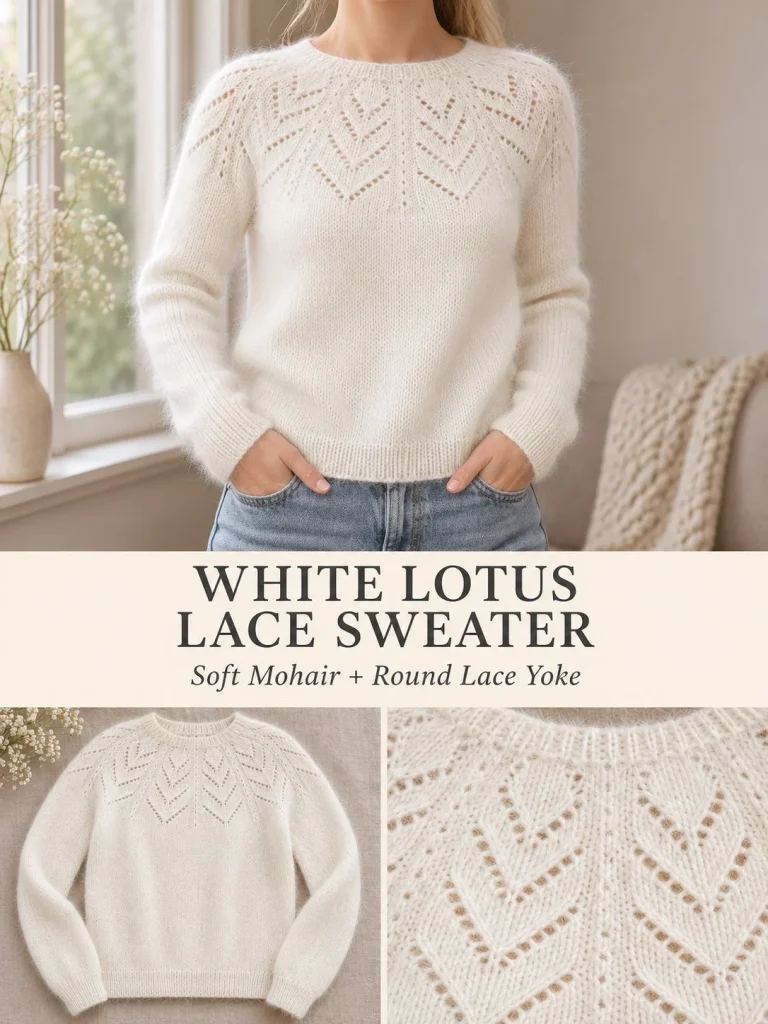
This delicate sweater features a round lace yoke constructed from a soft, cloud-like blend of mohair and wool. The lightweight yet warm fabric showcases intricate lacework that elegantly frames the neckline and shoulders, creating an ethereal and feminine silhouette. Worked seamlessly from the top down in the round, this garment offers both beauty and comfort with minimal finishing.
The design centers on a circular yoke that combines the airy mohair blend with a finely detailed lace pattern. This lace motif expands gradually, shaped by carefully distributed increases that ensure a perfect fit across the bust and shoulders. Below the yoke, the body and sleeves are knitted in smooth stockinette stitch, providing a cozy contrast to the openwork above. Finishing touches include ribbed edges at the neckline, hem, and cuffs, adding subtle texture and structure.
Knitted using two strands held together—one strand of DROPS Nord and one of DROPS Kid-Silk—this sweater achieves a light halo effect while maintaining stitch definition. The top-down construction allows knitters to try on the piece as they go and adjust the length to their preference. This method also means no seams to sew, enhancing both the workflow and the garment’s comfort. For those interested in elevated lace techniques, this pattern’s designer-charted yoke offers a rewarding challenge reminiscent of other mohair lace projects like the Lace Columns Wrap knitting pattern.
Pattern at a Glance
Skill level: Intermediate (due to lace chart reading and shaping)
Terminology: British/European knitting terms with stitch chart reference
Construction: Top-down seamless round yoke sweater with separated sleeves
Finished size: Available in XS through XXXL
Yarn weight: Fingering (Nord) combined with lace weight (Kid-Silk held together)
Needles: Circular needles 3.5 mm (neck & ribbing) and 4.5 mm (body/sleeves), plus DPNs or magic loop for sleeves
Main stitch: Lace motif on yoke; stockinette stitch on body and sleeves; 1×1 ribbing on neck, hem, and cuffs
Gauge: Specific gauge per DROPS instructions (exact gauge found on diagram instructions)
Motifs: Lace pattern repeats per original DROPS 271-1 diagrams A.1/A.2
Layout: Circular yoke with distributed increases, set-in sleeve stitches picked up, body and sleeves worked down
Joining: Seamless
Border: 1×1 ribbed cuffs, hem and neck edges
Seaming: None
Materials
- Yarn:
- DROPS Nord #01 Off White, approximately 200–350 g, depending on size
- DROPS Kid-Silk #01 Off White, approximately 75–175 g, held together with Nord throughout
- Needles:
- 3.5 mm circular needles for ribbing and neck
- 4.5 mm circular needles for the main body and sleeves
- Double-pointed needles (DPNs) or magic loop method for working sleeves in the round
- Notions:
- Stitch markers to mark lace repeats and increase points
- Tapestry needle for weaving in ends
- Measuring tape for gauge and fit checks
These materials create a soft, lightweight, and airy fabric with a subtle halo effect, ensuring warmth while maintaining breathability. Using two yarns held together gives the sweater its signature mohair glow paired with sturdiness from the wool.
Yarn and Color Notes
Choosing yarns with complementary fiber properties is critical for this project. The mohair component (Kid-Silk) offers fuzziness and warmth, while the Nord wool brings body and stitch clarity. Holding these together ensures a perfect balance of texture and durability.
Off-white is a classic neutral that highlights the lace pattern, though knitters could consider soft pastels or natural tones for subtle variation. Because intricate lace requires good stitch definition, variegated or highly textured yarns are not recommended as they may obscure the pattern.
When selecting substitutions, aim for yarns of similar weight and characteristics—one lightweight mohair or alpaca blend combined with a smooth fingering or light DK yarn is ideal.
Finished Measurements
The pattern accommodates sizes from XS to XXXL. Measurements include chest circumference tailored from the ease incorporated by the yoke increases, and sleeve length determined by the number of rounds worked in the round. Length of the body and ribbing mirror the wearer’s preferences facilitated by top-down construction.
Precise measurements for each size are detailed in the original DROPS diagrams (DROPS 271-1). Because the sweater is knitted in the round with flexible transitions, the fit is forgiving but designed to hug the neckline and upper body delicately. Adjustments to length can be made by working more or fewer stockinette rounds below the yoke before hem ribbing.
Gauge
Gauge is a key element for this sweater to ensure fit and drape, especially given the lace yoke construction paired with stockinette fabric.
- The gauge should be checked on the combined strands of Nord and Kid-Silk held together.
- Measure gauge on the lace pattern area as well as the stockinette sections with the 4.5 mm needles.
- Achieving the specified gauge will ensure that increases align perfectly and shaping matches the diagrams.
- If gauge is looser than specified, the sweater may become too large and loose; if tighter, it may fit small or distort the lace pattern.
Regular monitoring while knitting helps keep your project within intended dimensions.
Abbreviations
- K: Knit
- P: Purl
- St(s): Stitch(es)
- Rnd(s): Round(s)
- DPNs: Double-pointed needles
- YO: Yarn over (increase in lace)
- K2tog: Knit two together (right-leaning decrease)
- SSK: Slip, slip, knit (left-leaning decrease)
- Rep: Repeat
These are standard knitting abbreviations consistent with DROPS patterns.
Important Pattern Notes
- The sweater is worked top down in the round, starting at the neck with smaller needles for ribbing.
- Stitch markers indicate pattern repeats and increase points to distribute shaping evenly.
- The lace yoke pattern uses charted repeats (DROPS 271-1 diagrams A.1/A.2). Both original and corrected versions should be consulted for clarity on pattern repeats and sizing adjustments.
- After completing the lace yoke and distributed increases, stitch work will be divided to separate sleeves from the body.
- Sleeves are picked back up and worked down with decreases to shape the cuffs.
- Ribbing is worked with 1×1 rib for neckline, hem, and sleeve cuffs.
- The pattern requires familiarity with reading lace charts and following increases/decreases precisely.
- Continuous rounds are worked without joining or turning.
Special Stitches and Techniques
- Lace Rounds: Follow the intricate lace chart carefully, paying attention to yarn overs and decreases to create the openwork texture and shaping.
- Distributed Increases: Increases are spaced evenly around the yoke to shape the sweater top-down, expanding the circumference smoothly.
- Separating Sleeves: Stitches for the sleeves are slipped onto holders or scrap yarn to enable the working of the body in continuous rounds.
- Sleeve Decreases: Decreases shape the sleeves for a comfortable fit and are done symmetrically following the chart and instructions.
- 1×1 Ribbing: Used for edges to provide elasticity and neat clean finishes around the neckline, cuffs, and hem.
- Top-Down Circular Construction: Allows for try-on and length adjustment as you knit.
Understanding the Construction
The white mohair lace yoke sweater is built as a seamless garment worked from the neckline downward. The process begins by casting on and knitting a 1×1 ribbed collar with smaller needles for structure.
From there, the lace yoke is worked in the round, using charts A.1 and A.2 to form a circular pattern of eyelets and lace motifs. Alongside the lace, increases are strategically distributed to shape the body and allow for sleeve placement.
Once the yoke has reached the designated size, sleeve stitches are set aside while the body continues in stockinette stitch down to the hem ribbing. The sleeves are then picked back up to knit downward, shaping with decreases and finishing with ribbed cuffs.
This method optimizes fit and comfort, minimizing seams and allowing flexibility in length and size. The combination of lace and stockinette with the airy mohair blend gives a light yet warm texture ideal for layering.
Full Pattern Instructions
Foundation / Neck Ribbing
Using circular 3.5 mm needles, hold one strand of DROPS Nord Off White together with one strand of DROPS Kid-Silk Off White. Cast on the number of stitches specified for your size to begin the 1×1 ribbed neck.
Join in the round carefully to avoid twisting. Work the 1×1 knit 1, purl 1 ribbing for the number of rounds indicated in the pattern, ensuring the ribbing lies flat and forms a neat edge.
Lace Yoke and Distributed Increases
Switch to the 4.5 mm circular needles.
Using the charted lace pattern from DROPS 271-1 diagrams A.1/A.2, begin working the circular lace round yoke. Follow the lace repeats closely, paying attention to yarn overs which create the lace holes, and decreases which shape the fabric.
The lace rounds include evenly spaced increases to expand the circumference of the yoke. Place stitch markers at pattern repeats or increase points to track progress and maintain consistency.
Continue knitting the lace yoke in rounds according to the chart until all increases are complete, and the yoke measures to the size desired.
Separating Sleeves from Body
Once the yoke lace portion is finished, it is time to separate the sleeve stitches from the body stitches.
Slip the sleeve stitches onto stitch holders or pieces of scrap yarn without twisting them. This preserves the sleeve stitches for later.
Continue working the remaining body stitches on your circular needles in stockinette stitch (knit every round) to the length desired.
Hem Ribbing
At the end of the stockinette body, switch to the 3.5 mm needles.
Work the hem in 1×1 ribbing for the number of rounds indicated, matching the neckline ribbing style. This adds a stretchy, refined finish to the lower edge.
Sleeves
Resume knitting by placing the held sleeve stitches back on DPNs or using the magic loop method.
Working in the round with 4.5 mm needles, knit the sleeves in stockinette stitch, incorporating decreases as instructed in the original pattern to shape tapered sleeve cuffs.
Once decreases are complete, switch to 3.5 mm needles and work 1×1 ribbed cuffs to match the neckline and hem.
Finishing
Weave in all loose yarn ends carefully, ensuring that the joins are secure and cannot unravel.
Block the sweater gently to open the lace pattern and even out stitches without stretching the fabric out of shape.
Checkpoints
- After completing the neck ribbing and starting the lace yoke, your piece should lie flat with an even circular opening.
- Lace pattern repeats should align symmetrically around the yoke with increases evenly spaced.
- Sleeve stitches must be carefully separated without twisting to ensure comfortable armholes.
- Stockinette body should measure consistently with desired length before beginning hem rib.
- Sleeves after decreasing should taper smoothly to the ribbed cuff height.
- Final blocked garment should drape softly with lace sections open and textured.
Assembly and Joining
Thanks to the top-down circular knitting technique, no traditional seaming is required. The sleeves are separated and returned to needles but remain attached to the body, forming a seamless join.
This construction method produces a comfortable fit free from bulky seams, especially around delicate lace areas.
Border and Finishing
The ribbed edges on neckline, hem, and cuffs provide elasticity and neat finishing contrasted with the lacy yoke. Maintaining consistent tension when knitting ribbing prevents curling or puckering.
Weave in yarn tails with a tapestry needle, hiding them inside ribbing or stockinette for durability.
Careful blocking is essential: gently wet and shape the garment, pinning lace sections to open eyelets without overstretching, to achieve the signature ethereal finish.
How to Resize
Sizing is integrated into the pattern by varying stitch counts, number of lace repeats, and round counts.
- To make a larger or smaller sweater, choose the size range XS to XXXL with corresponding yarn quantities and instructions.
- Since the yoke uses charted lace with increases, resizing involves adding or reducing lace repeats per diagram recommendations.
- Length adjustments are easily made by knitting more or fewer body stockinette rounds before hem ribbing.
- Sleeve length and width are controlled by the number of sleeve rounds and decreases worked.
- Careful gauge measurement is essential when changing size to preserve shaping.
Useful Variations
- One-color version: Instead of holding two yarns, knit the entire sweater with a single neutral-colored mohair blend for simplicity.
- Color accents: Introduce a subtle colored strand in place of one off-white yarn for faint tonal interest.
- Longer length: Extend the body by knitting extra rounds for a tunic-style sweater.
- Short sleeves: Adapt the sleeve rounds to knit a three-quarter or elbow-length sleeve.
- Contrast ribbing: Use a different colored yarn for ribbed edges to highlight sweater contours.
Troubleshooting
Why Is My Lace Yoke Not Matching the Chart?
Double-check that you’re following the correct DROPS 271-1 diagrams A.1/A.2, including the current corrected versions for lace repeats and sizing. Count stitches frequently and use stitch markers to separate pattern repeats, preventing confusion with complex lace increases and decreases.
Why Are My Sleeve Stitches Twisting When I Separate Them?
Ensure when slipping sleeve stitches onto holders, they remain in the same orientation as knitted. Twisting sleeve stitches will cause uneven armholes and discomfort.
Why Is My Ribbing Curling at the Hem?
Maintaining consistent tension and switching to smaller needles for ribbing helps keep edges flat. Blocking may also be needed to settle ribbed borders.
Why Are My Increases Uneven Around the Yoke?
Place stitch markers at each increase point before starting the lace yoke rounds. This evenly distributes increases and keeps shaping symmetrical.
How Do I Fix Dropped Stitches in Lace Sections?
Use a crochet hook or knitting needle to carefully ladder dropped stitches back up, ensuring yarn overs and decrease stitches are restored correctly.
Frequently Asked Questions
Can I Substitute Other Yarns for DROPS Nord and Kid-Silk?
Yes, but choose yarns with similar weights and fiber content to maintain fabric characteristics. A soft mohair or alpaca blend held with a sturdy fingering wool works best.
Is This Pattern Suitable for Beginners?
This pattern is best for knitters comfortable with lace charts, increases, and top-down construction. Intermediate or advanced knitters will find it rewarding.
How Should I Block This Sweater?
Wet block gently with pins to open the lace sections without stretching excessively. Allow to dry flat.
Can I Wash the Sweater in a Machine?
Hand washing is recommended to preserve the mohair fiber and lace integrity. Use cool water and gentle detergent.
How Can I Adjust Sleeve Length?
Work fewer or more rounds on the sleeves before ribbing to adjust cuff length without affecting yoke fit.
Are the Lace Charts Easy to Follow?
The pattern uses detailed DROPS 271-1 diagrams with corrections available. Using stitch markers and referring to chart keys helps maintain accuracy.
Is the Neck Ribbing Tight or Loose?
The 1×1 ribbing provides gentle elasticity for a comfortable neckline fit without constriction.
Optional Related Uses
The lace yoke technique used here can be adapted for garments such as cardigans or shrugs by modifying body shaping accordingly. Similar motifs may also complement knit shawls or sculptural collars for layering pieces.
Final Thoughts
This sweater elegantly couples the softness of mohair wool blends with the intricate beauty of a circular lace yoke, all crafted using seamless top-down construction. Its flexible fit, harmonious texture combo, and refined ribbed borders make it a versatile, wearable statement piece perfect for transitional weather and layering. Following the detailed charts and step-by-step separation of sleeves and body ensures a rewarding knitting experience with a delicate result you’ll cherish for seasons to come.



