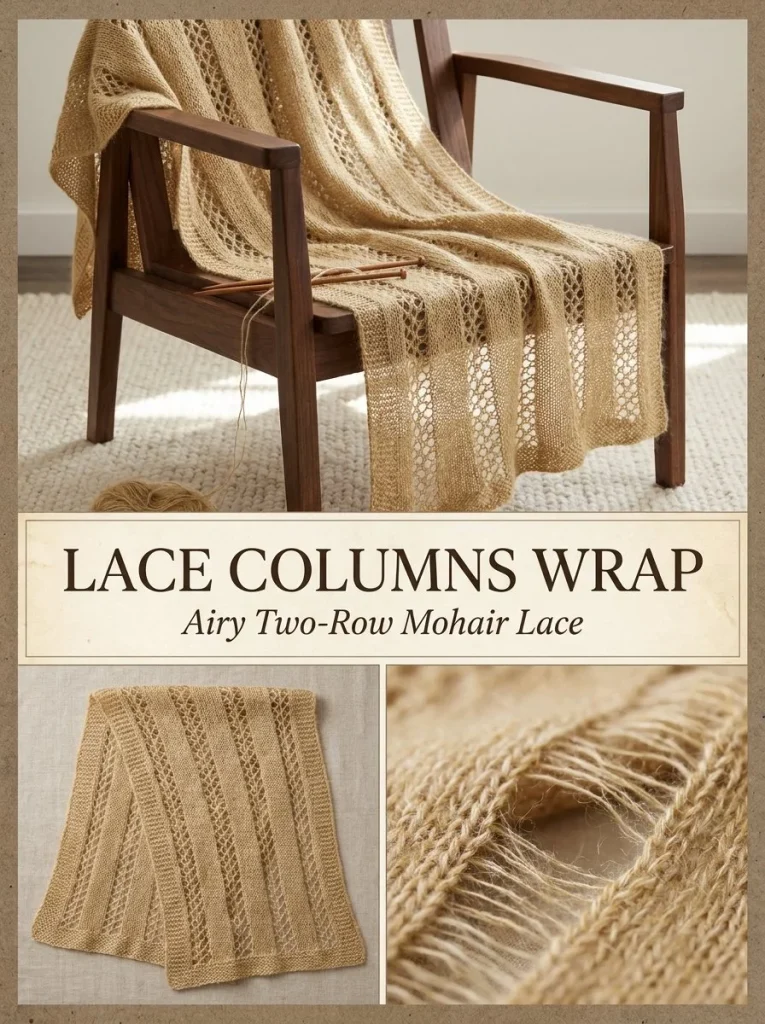
Knitting a delicate and sophisticated wrap that floats around the shoulders with airy mohair eyelets offers an enchanting project for intermediate knitters seeking to combine texture, lightness, and elegance. This wrap creates a stunning visual effect by alternating solid vertical columns of knit stitches with lace “windows” formed by pairs of decreases surrounding double yarn overs. The result is a fabric that is both light as a whisper and impressively dimensional, thanks to the combination of lace and mohair silk fibers.
Held together in dual strands of contrasting lace-weight mohair silk, the mohair’s halo beautifully softens the crisp structure of the lace, creating depth and a gentle glow in each eyelet column. This wrap’s length and width make it versatile enough to wear as a generous scarf, shoulder shawl, or cozy layering piece. A similar aesthetic can be found in the subtle layering of texture and light provided by the Autumn Sampler Wrap pattern, which also features intricate stitches layered for tactile beauty.
Pattern at a Glance
Skill level: Intermediate knitters comfortable with lace techniques and managing multiple yarn strands
Terminology: American knitting terms
Construction: Worked flat in straight rows, starting with a cast on and worked lengthwise
Finished size: Approximately 17.25 inches wide by 70 inches long
Yarn weight: Lace weight mohair-silk blend, held double
Needles: US 5 / 3.75 mm straight or 24-inch circular needles
Gauge: 19 stitches x 27 rows = 4 inches in pattern
Main stitch: Two-row lace-column repeat with paired decreases and double yarn overs
Layout: Single rectangular piece worked straight on needles
Joining: None—worked in one piece
Border: Narrow knit/purl setup edge; bind off knitwise on right side
Materials
-
Yarn: Approximately 3 skeins each of two lace-weight mohair-silk fibers, totaling about 700 yards (640 meters) per color. Each color is held together (one strand of each color held together throughout the project), creating a subtle color blend and additional soft halo effect.
-
Needles: US 5 (3.75 mm) needles are recommended to achieve the intended gauge. You may use either straight or a short (24-inch) circular needle for greater flexibility when handling the long wrap.
-
Notions: Stitch markers may be helpful, especially when learning to count multiples for the lace repeat. A tapestry needle for weaving in ends and blocking materials (pins and mats) are essential for final finishing.
This lightweight yarn combination provides an ethereal softness balanced with the stability needed for lace openness and structural integrity in your wrap.
Yarn and Color Notes
Mohair-silk blends offer a delicate halo that highlights lace patterns uniquely. The fuzzy halo softens edges and adds visual depth but also requires mindful tension control to avoid overly tight stitches, which can crush the airy eyelets.
Holding two different lace mohair-silk yarns together invites a subtle gradient or blended effect depending on yarn colors chosen. For example, pairing a pale gray with a dusty rose creates a muted rose shadow in the fabric. Solid yarns tend to emphasize structure, while lightly variegated mohair may diffuse the lace clarity but add interest.
Choose yarns that are smooth and moderately strong to hold the lace shape but gentle enough not to overpower the fine stitch definition. Avoid yarns with heavy twisting or extreme fuzziness to maintain crisp lace columns.
Finished Measurements
The completed wrap measures approximately:
- Width: 17.25 inches (about 44 cm) across
- Length: 70 inches (about 178 cm) long
These measurements reflect the blocked, finished dimensions — a generous size for multi-way wear: comfortably draping shoulders or doubling as a soft scarf.
The length is essential for wrap versatility, while the narrower width ensures the lace columns remain defined and the overall drape lightweight without excessive fabric bulk.
Gauge
Gauge is a key factor for this pattern’s delicate lace texture and final size. The original gauge is:
- 19 stitches and 27 rows = 4 inches (10 cm) in the lace-column pattern
- Measured over the double-yarn-over lace with mohair held double using US 5 needles
Gauge here includes working two strands held together, which affects the fabric density and stitch appearance.
Why gauge matters:
-
If gauge is too large (fewer stitches per inch):
The wrap will be looser and longer than planned, potentially diminishing lace definition. -
If gauge is too small (more stitches per inch):
The wrap could feel narrower and denser; the airy quality of eyelets may close up.
It’s recommended to knit a swatch in pattern holding both yarn strands simultaneously, blocking it gently, before proceeding.
Abbreviations
- k: knit
- p: purl
- k2tog: knit two stitches together (right-leaning decrease)
- ssk: slip, slip, knit (left-leaning decrease)
- yo: yarn over (creates a new stitch/eyelet)
- RS: right side (knitting side)
- WS: wrong side (purl/return rows)
Important Pattern Notes
- The pattern is worked flat, back and forth, starting with 82 stitches cast on.
- The stitch pattern repeats over multiples of 8 stitches plus 2 edge stitches, ensuring balanced lace columns framed by solid stitches.
- Holding two strands together throughout means you are knitting with doubled yarn, boosting softness and halo but requiring loose tension.
- The lace columns are formed on RS rows by paired decreases (k2tog and ssk) flanking a double yarn over, creating open vertical eyelets.
- On WS rows, the pattern cleverly restores the stitch count by knitting and purling into the double yarn overs twice, which enlarges eyelets for that airy look.
- The fabric is ended with a knit bind off on the right side after a final WS stabilizing row.
- Wet-blocking is strongly emphasized to open the lace fully without overextending the delicate mohair fibers.
Following these instructions carefully will ensure the detailed lace columns maintain their crisp definition along the length of your wrap.
Special Stitches and Techniques
This project involves a few specialized knitting techniques key to shaping the lace columns:
- k2tog (knit two together): A standard right-leaning decrease that reduces stitch count by one.
- ssk (slip, slip, knit): A left-leaning decrease; slip 1 stitch knitwise, slip the next stitch knitwise, then knit these slipped stitches together through the back loops to mirror k2tog.
- Double yarn over: Placing two yarn overs before the next stitch to create an extra large eyelet which on the WS is worked twice (knit and purl) to restore stitch count and create a larger lace opening.
Managing these decreases and yarn overs symmetrically around each lace window creates the distinctive columns of air lace and solid fabric.
Understanding the Construction
This wrap is a single rectangular piece worked back and forth on needles, wide enough to create multiple vertical lace columns separated by solid knitted columns. The primary focus is on the repetition of a two-row pattern repeat that forms the lace motif continuously down the length of the wrap.
The fabric’s beauty comes from the vertical interplay — open eyelet columns with ethereal mohair halo, contrasted by opaque vertical solid columns — resulting in a striking linear texture.
Holding together two skeins of lace-weight mohair silk strands in different shades creates a color blend that adds depth without complexity, making the project both accessible and rewarding visually.
If you want to see more examples of modular and textured wraps built on repeating lace structures, consider exploring the Curator Modular Wrap, which also plays with textured sections and combination yarns to create multidimensional effects.
Full Pattern Instructions
Foundation
Using both colors held together as one strand, loosely cast on 82 stitches. Casting on loosely is important because the mohair yarn is delicate and working too tightly may distort the lace edges.
Work a narrow setup edge in knit and purl stitches for a few rows to provide a stable base. For example, 2-4 rows alternating knit and purl stitches establishes a neat selvage while preventing edge curl.
Establishing the lace pattern
The main stitch pattern operates on a multiple of 8 stitches plus 2 edge stitches, which aligns with the 82 stitches cast on ((8 x 10) + 2 = 82).
This multiple maintains the correct balance of lace columns and solid columns.
Row 1 (Right Side – RS)
- Begin working the lace columns establishing the motif across the row.
- For each lace column, pair a k2tog (knit two together) and an ssk (slip, slip, knit) decrease placed on each side of a double yarn-over opening (two consecutive yarn overs).
- Between these lace columns are solid knit columns — simple knit stitches without holes — providing a steady framework.
- This shaping using paired decreases around the double yarn overs creates vertical eyelet "windows."
Row 2 (Wrong Side – WS)
- Work back in pattern across the row.
- For every double yarn over from the previous row, work into it twice: once by knitting and once by purling.
- This step is critical to restore the stitch count after the decreases on RS rows.
- It also forms a larger eyelet, enhancing the airy, open lace effect that defines the pattern.
- The rest of the stitches are purled or knitted according to the established solid columns and lace pattern.
Repeat these two rows continuously until the wrap measures approximately 70 inches in length. The wrap should end after completing a right side (RS) lace row.
Final finishing rows
- Work one last wrong side (WS) stabilizing row following the established pattern to secure the lace.
- Bind off knitwise on the right side (RS) to ensure a clean edge.
Wet-blocking
After finishing, wet-block gently by soaking the wrap and shaping it to the full width (~17.25 inches) and length (~70 inches) without overstretching, which could damage the delicate mohair fibers.
Blocking opens the lace eyelets fully, enhances drape, and stabilizes the shape of the wrap.
Helpful Checkpoint
When you have reached about 70 inches in length (measuring from your cast-on edge), and have finished a right side lace row, stop knitting and proceed with the last wrong side row and bind off.
Your piece should be approximately 17.25 inches wide. If your width differs significantly, recheck your gauge swatch and needle size before proceeding.
How to Resize This Wrap
Adjust width
- This wrap’s stitch count is a multiple of 8 plus 2 edge stitches.
- To make the wrap wider, increase the cast-on by multiples of 8 stitches.
- For example, adding 8 stitches increases the width by approximately (8 / 19) * 4 inches ≈ 1.68 inches.
- Ensure you maintain the two edge stitches and the multiple of 8 pattern for a balanced lace structure.
Adjust length
- Work more or fewer repeats of the two-row lace-column pattern.
- Each repeat is 2 rows; add or subtract repeats as needed to reach your desired length.
- Always end after a right side lace row before binding off.
When resizing, be mindful that changing stitch count and repeats affects overall yarn requirements.
Useful Variations
- Single-color version: Use the same mohair-silk lace yarn held double in one color for a subtler, less blended effect.
- Color reversal: Swap colors halfway through to create a striped effect, holding yarn strands together as you change.
- Chunkier yarn substitute: Though the pattern is designed for lace-weight mohair, experimenting with a fine fingering-weight mohair blend held double may produce a warmer yet still airy wrap.
- Shorter wrap/scarf: Work fewer repeats for a narrower, shorter scarf version suitable as a neck wrap.
- Longer shawl: Add several repeats to create a long shawl ideal for draping over formal wear.
Troubleshooting
Why is my stitch count changing unexpectedly?
Make sure you are working into each double yarn over twice on wrong side rows—once knit, once purl—to restore stitch count lost by decreases.
Why are my lace eyelets uneven?
Check that paired decreases (k2tog and ssk) are correctly placed flanking the double yarn overs on right side rows.
Why is the edge curling?
Use the knit/purl setup edge and final bind off to stabilize edges. Mohair fabric can curl if edges lack structural contrast.
Why is my mohair splitting or snagging?
Use sharp, smooth needles and hold yarn strands softly but consistently to prevent fiber damage.
Frequently Asked Questions
Can I use a different yarn for this wrap?
The pattern is designed for lace-weight mohair-silk held double, which provides the halo and airy texture essential to the lace columns. Using a different yarn, especially non-halo fibers or heavier weights, will alter the fabric’s look and drape significantly.
Can I knit this on circular needles?
Yes. Using 24-inch circular needles allows more comfortable handling of the long wrap, even though the pattern is worked flat.
Is this pattern suitable for beginners?
It’s best for knitters comfortable with lace techniques, paired decreases, and managing doubled yarn strands.
Can I make this wrap larger?
Yes, add multiples of eight stitches to the cast-on count for greater width, and additional lace-repeat rows for length, maintaining the stitch and row multiples.
How should I block this mohair wrap?
Wet soak gently, then lay flat on blocking mats and stretch gently to the desired width and length, securing with rust-proof pins. Avoid overstretching to protect mohair fibers.
Optional Related Uses
The lace-column technique and dual-strand mohair yarn can easily adapt to various accessories such as scarves, cowls, or even cardigans if combined with shaping.
Explore this elegant lace pattern in smaller pieces or modular sections for a textured layering effect.
Final Thoughts
This wrap is a beautiful interplay of open airy lace columns and solid stitch texture, made ethereal by the invisible shimmer of lace-weight mohair silk yarns held double. The key lies in the precise balance of decreases and double yarn overs to maintain both structure and softness, resulting in a versatile layering accessory perfect for cooler evenings.
The project’s simplicity in construction—one long rectangle worked flat—makes it manageable, yet the subtle complexity of double yarn overs and paired decreases offers an engaging knitting experience.
By mastering this design, you unlock the artistry of combining intricate lace with the soft halo of luxurious fibers, producing a timeless, wearable piece that carries both craft and style seamlessly.



