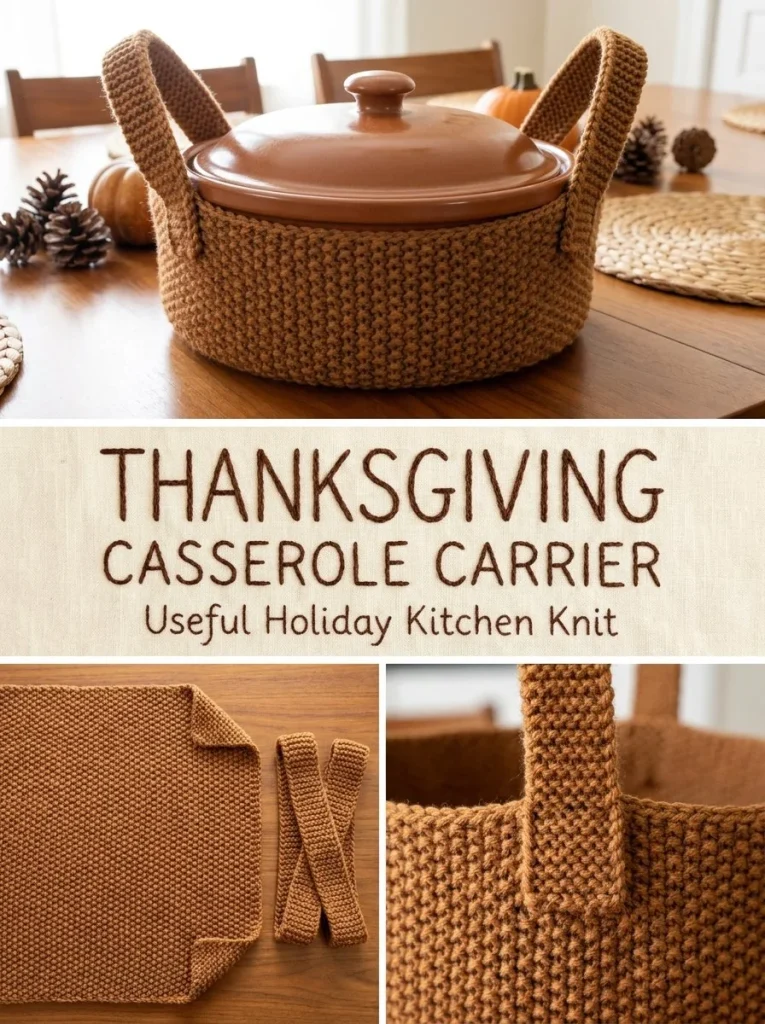
Creating a soft and functional knit carrier for your casserole dishes offers a charming combination of practicality and hand-crafted beauty. Designed specifically for securely lidded dishes that have cooled to warm or room temperature, this project embraces simplicity and elegance using seed stitch fabric. The rectangular main panel, sewn into a shallow sling with boxed corners, provides a snug cradle for your casserole dish. Paired with sturdy knit straps arranged for balanced carry, this carrier is both aesthetically pleasing and highly useful for holiday gatherings or everyday use.
The construction is straightforward knitting, making it accessible for knitters who are familiar with basic stitches such as knit and purl. The seed stitch chosen for the main panel creates a dense and textured fabric that is excellent for grip and durability. Using worsted cotton yarn in warm cinnamon or deep olive underscores the seasonal appeal of this carrier, while an optional cream edging adds a refined finish.
This project also offers a great opportunity to explore joining techniques and handle attachment, which can be helpful skills for a variety of other knitting projects, such as bags or trays with soft fabric bases. For those interested in complementary accessory ideas, the subtle pumpkin-hued tones are reminiscent of other cozy fall knitting projects like the Acorn Brown Keyhole Scarf, which similarly combines texture and functionality.
Pattern at a Glance
Skill level: Intermediate beginner to intermediate
Terminology: Standard knitting terms (US)
Construction: Knit flat rectangular panel, boxed corners sewn, knit straps attached
Finished size: Approximately 17 x 27 in / 43 x 69 cm main panel, straps 22 in / 56 cm
Yarn weight: Worsted weight cotton yarn
Needle size: US 8 / 5 mm knitting needles
Main stitch: Seed stitch (k1, p1 alternating)
Gauge: 18 sts = 4 in / 10 cm in seed stitch
Motifs: None (worked in one large piece)
Layout: One rectangular panel with attached handles
Joining: Sewn boxed corners, straps sewn on long sides
Border: Optional applied 3-st I-cord or blanket stitch edge around top rim
Seaming: Diagonal seams at corners, reinforced strap attachment
Materials
To craft this practical yet stylish knit casserole carrier, gather the following materials:
- Yarn: Approximately 650-750 yards (595-686 meters) of 100% worsted cotton yarn in a warm cinnamon or deep olive color. Choose cotton for its durability, ease of washing, and natural heat resistance.
- Contrast yarn (optional): 60-80 yards (55-73 meters) of cream worsted cotton yarn for an accent edge if desired.
- Needles: One pair of US 8 / 5 mm straight knitting needles for optimal fabric density.
- Notions and tools: A tapestry needle for weaving in ends and sewing seams, scissors, and stitch markers to mark handle attachment points.
- Fit testing: A lidded 9 x 13 inch casserole dish is recommended for testing the carrier’s fit during and after assembly.
These materials are chosen to balance durability with a comfortable grip. Cotton yarn is particularly appropriate since it provides a firm yet soft fabric that is also machine washable—a necessity for kitchen-related projects.
Yarn and Color Notes
Cotton yarn is favored here for household items that may need frequent laundering. Its breathability and strength make it ideal for something that may come into contact with mildly warm cookware. The seed stitch pattern will showcase the yarn’s texture beautifully, so it’s advisable to choose smooth, plied cotton over highly fuzzy or novelty yarns.
The warm cinnamon or deep olive color palettes fit the autumn and Thanksgiving aesthetic perfectly, evoking rustic, earthy vibes. Adding a cream accent edge can give just the right touch of contrast and refinement, which works well with the basic shapes and textures. Solid colors ensure the seed stitch detail shows clearly, while variegated yarn might obscure the subtle pattern.
For another project with a coordinated color and flower motif theme that pairs nicely with this carrier, consider the Aubergine Knit Flower Brooch for a seasonal accessory accent.
Finished Measurements
The main panel should measure approximately 17 inches wide by 27 inches long (43 x 69 cm). The straps each span approximately 22 inches (56 cm) in length and 9 stitches in width, providing secure handholds for carrying.
These dimensions accommodate a standard 9 x 13-inch casserole dish with a securely fitted lid but cooled to a safe handling temperature. The boxed corners create a soft rectangular “tray” that cradles the dish, preventing it from sliding.
Because the carrier is knit flat, the dimensions are directly tied to stitch and row counts, making accurate gauge especially important for proper fit.
Gauge
Gauge is about 18 stitches = 4 inches / 10 cm in seed stitch. To check your gauge:
- Cast on 77 stitches on US 8 / 5 mm needles using worsted cotton yarn.
- Work a seed stitch swatch measuring at least 4×4 inches (~10×10 cm).
- Measure within the swatch the number of stitches per 4 inches.
Maintaining gauge ensures that your carrier will fit your casserole dish as intended. A looser gauge will yield a larger carrier, potentially making the dish less secure, while a tighter gauge could reduce flexibility.
Since this item is a functional container rather than fitted clothing, some variance in gauge is tolerable, but staying close to the specified gauge will give the best results.
Abbreviations
- CO: Cast on
- K: Knit
- P: Purl
- sts: Stitches
The seed stitch pattern is made by alternating knit and purl stitches every other stitch and every other row.
Important Pattern Notes
- The project is knit flat in rows, not in the round.
- The seed stitch is established by alternating K1, P1 across Row 1 and P1, K1 across Row 2. This pattern is repeated for the full length.
- Make sure to end rows appropriately to maintain seed stitch symmetry (ending Row 1 with K1 and Row 2 with P1).
- Handle straps are knit separately as simple garter stitch strips.
- Straps are sewn on with reinforced stitching for durability. Multiple rows should be sewn through the panel for stability.
- The boxed corner seams are sewn with the work inside out, then reversed to the right side for the final shape.
- The optional cream edge uses an applied I-cord or blanket stitch around the top rim only, adding both decoration and structure.
Special Techniques and Stitch Explanation
Seed Stitch
Seed stitch creates a distinctive textured fabric by alternating knit and purl stitches in every row and every stitch, like so:
- Row 1 (RS): K1, P1 across, ending with K1
- Row 2 (WS): P1, K1 across, ending with P1
This technique gives a bumpy, textured fabric that lies flat without curling, ideal for functional items like carriers.
Boxed Corners
Boxed corners are constructed by folding corners diagonally inside the rectangle and sewing a short diagonal seam to create a 3D tray shape. This technique transforms the flat knit panel into a soft sling that contours around the casserole dish.
Straps
Straps are knit separately in garter stitch (knit every row) for added elasticity and strength. The narrow straps are 9 stitches wide and knit until measuring approximately 22 inches, then sewn securely onto the panel.
Applied I-cord / Blanket Stitch (Optional Edge)
An applied I-cord adds a neat, rounded edge around the top rim, improving durability and giving a refined finish. Alternatively, a simple blanket stitch with contrasting cream yarn can achieve a similar decorative and functional border.
Understanding the Construction
This project creates a single large rectangular panel that wraps around the casserole dish. The panel is knit flat in seed stitch, ensuring a sturdy but flexible fabric. Once the panel reaches the desired length, its corners are folded and sewn diagonally to shape a soft tray.
Knitting two narrow straps separately and attaching them on the long sides creates handles for carrying. The handles’ placement, at two points spaced approximately 7 inches apart, distributes the weight evenly.
The optional cream edging emphasizes the carrier’s opening and adds a polished touch. This construction method is straightforward but requires careful finishing to uphold strength and fit.
Complete Pattern Instructions
Important Use Note
This carrier is designed as a soft transport helper for casserole dishes that have cooled to warm or room temperature and have a securely fitted lid. It is not heat proof, does not replace oven mitts, and should not be used to carry hot cookware directly from the oven.
Main Panel
Goal: create a rectangular panel approximately 17 inches wide by 27 inches long.
- Gauge: about 18 stitches = 4 inches in seed stitch.
- Cast On: 77 stitches on US 8 / 5 mm needles.
Row 1 (Right Side)
Knit 1, purl 1 across until the last stitch, then knit 1 to end the row correctly, maintaining the seed stitch pattern.
Row 2 (Wrong Side)
Purl 1, knit 1 across until the last stitch, then purl 1 to complete the row, sustaining the alternating seed stitch.
Repeat Rows 1 and 2 continuously, preserving the seed stitch pattern, until the panel measures approximately 27 inches (69 cm) in length.
Bind off loosely but securely to maintain edge elasticity.
Boxed Corners
Turn the panel inside out (wrong side facing out). At each of the four corners:
- Fold adjacent edges together so that they align perfectly, creating a sharp corner fold.
- Measure 3 inches (7.5 cm) from the corner along the folded edge.
- Sew a short diagonal seam (using a tapestry needle and yarn) across the corner at the measured point, forming a small triangle of seamed fabric.
Repeat this for all four corners.
Once complete, turn the entire panel right side out. The folded and sewn corners now create a shallow, soft tray or sling that cradles your casserole dish.
Handles
Create two identical handle straps.
- Cast On: 9 stitches each on US 8 / 5 mm needles.
- Work garter stitch (knit every row) evenly until the strap measures approximately 22 inches (56 cm) in length.
- Bind off loosely.
Attaching Handles
On each long side of the main panel:
- Measure and mark two attachment points spaced about 7 inches (18 cm) apart, centered on the side.
- Sew one end of a strap securely at each marked point, using a reinforced square of stitching to strengthen the handle.
Repeat for both long sides, creating two handle loops per side. Ensure to sew through multiple rows of the main panel for maximum durability.
Optional Cream Edge Accent
Using the cream-colored yarn and a matching needle:
- Work an applied 3-st I-cord or a simple blanket stitch around the top rim of the carrier only.
- This adds a refined decorative touch and reinforces the edge.
Finishing
- Weave in all yarn ends carefully and securely to avoid unraveling.
- Test the carrier first with an empty lidded casserole dish to check fit and seam integrity.
- Follow with a lightweight, room-temperature dish to ensure all attachments maintain strength and stability.
Helpful Checkpoints
- After knitting the main panel, the piece should measure about 17 x 27 inches.
- Confirm the seed stitch pattern is consistent, ending each row correctly.
- After sewing the boxed corners, the piece should form a shallow rectangular tray that fits your casserole dish snugly.
- Handle straps should be 22 inches long and 9 stitches wide.
- Handles sewn on must feel firmly attached with no loose areas when pulled gently.
Assembly
- Boxed corners are sewn first on the wrong side, then reversed, forming the sling shape.
- Two knit straps are attached securely on the long sides with reinforced stitching.
- The optional cream edging is applied last to the top rim, enhancing aesthetics and structure.
Alignment accuracy during handle attachment is critical for a balanced carrier when in use.
Finishing and Care Tips
- Weave in ends using a tapestry needle with multiple passes for secure finishing.
- The cotton yarn used is washable but should be washed gently to maintain shape and color.
- Avoid carrying hot casserole dishes directly; damage can occur and safety can be compromised.
- To keep your carrier looking fresh, air dry flat after washing and reshape as needed.
How to Resize
To resize for different dishes:
- Adjust width by casting on stitches in multiples of 2 to maintain seed stitch pattern (e.g., +2 sts for approx. 0.44 in per 2 sts at gauge).
- Adjust length by knitting more or fewer rows in seed stitch to reach desired measurement.
- Keep in mind boxed corner seaming remains the same, but you may need to adjust corner seam length proportionally if significantly resizing.
- Straps can be lengthened or shortened by knitting longer or shorter garter stitch strips, but aim for a comfortable carry length (~22 inches is recommended for most).
Always test fit with your dish before final finishing.
Useful Variations
- Use solid colors exclusively for a classic look or try alternating colors row by row for a striped seed stitch texture.
- Replace the optional cream edge with a contrasting yarn in a vibrant fall color for seasonal flair.
- Knit straps can be wider or narrower depending on preference for comfort and style.
- Add small decorative knit motifs or appliqués on the panel, such as knit leaves or pumpkins, for a festive touch without changing the core construction.
- Make a matching set for other kitchen items using the seed stitch fabric concept, inspired by similar accessory projects like the Aubergine Knit Flower Brooch.
Troubleshooting
Why is my carrier too big or too small?
Check your gauge carefully. If your stitches are larger, the piece will grow in size. Try a smaller needle or more tightly knit tension next time. Conversely, use a larger needle or loosen tension if too small.
Why won’t the corners fold neatly?
Ensure that the corner edges line up exactly before sewing. Use pins or clips to hold fabric in position. Measuring precisely 3 inches along the fold before sewing the diagonal seam is critical.
Why are my straps not sturdy enough?
Use reinforced stitching when attaching straps, sewing through multiple layers of the panel. Avoid just sewing around a single stitch to prevent unraveling.
Why is the seed stitch pattern uneven?
Maintain careful stitch counts and always end rows as directed (Row 1 ending with knit, Row 2 ending with purl) to keep the texture consistent.
Frequently Asked Questions
Can I use a different yarn weight or fiber?
This pattern is designed for worsted weight cotton yarn to achieve the needed durability and size. Using a lighter or heavier yarn will alter size and fabric density. If using other fibers, choose those with similar thickness and structure.
Can I knit this with larger or smaller needles?
Changing needle size will affect gauge and finished size. Adjust stitch count accordingly and knit a gauge swatch before proceeding.
Can I make it in one solid color?
Absolutely. Solid colors highlight the seed stitch texture well, but contrasting or accent colors also add interest.
Is this reversible?
Yes, seed stitch looks the same on both sides, so either side can be used as the right side.
Can beginners knit this?
If you are confident with casting on, knitting, purling, and simple seaming, this project is achievable. The sewing of boxed corners is a bit advanced but well worth learning.
How should I block the finished piece?
Light steaming or wet blocking can help shape the panel, especially if gauge feels off. Stretch gently into shape and dry flat.
Optional Related Uses
The same seed stitch panel and boxed corner technique can be adapted for:
- A soft tray liner for bread or fruit baskets.
- A knit tote bag base by adding taller sides and possibly a lining.
- A rectangular pillow insert cover with wrapped edges.
- Seasonal placemats or kitchen mats, adjusting size.
This versatile stitch and construction method open many crafting possibilities.
Final Thoughts
This knit casserole carrier embodies simple elegance through the classic seed stitch and functional design with boxed corners and sturdy straps. The construction forms a soft but supportive sling that easily holds and transports your favorite casserole dishes once cooled. Choosing worsted cotton yarn ensures durability and ease of care, while optional accents let you personalize the project.
With just three essential steps—knitting the main panel, creating boxed corners, and adding straps—you’ll create a charming and practical accessory sure to enhance family gatherings and everyday meals alike. Whether you opt for the optional cream edging or keep it simple, this carrier blends beauty and utility in a timeless knit fabric.



