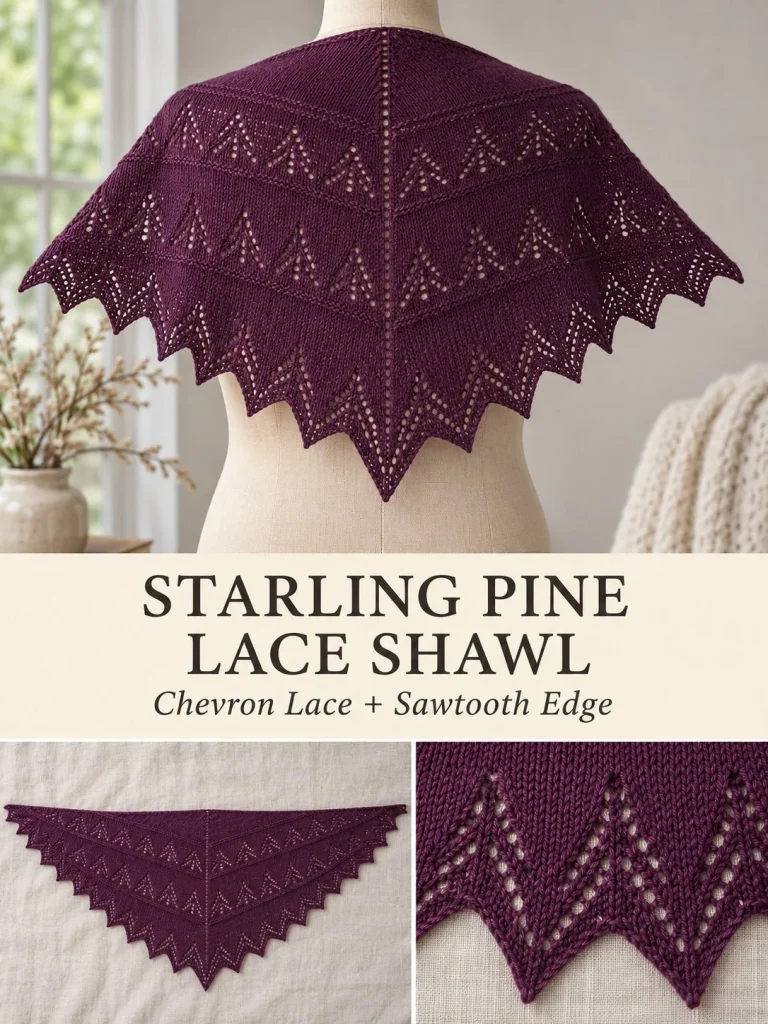
Creating a stunning knitted triangular shawl like this one combines intricate lace textures with elegant shaping techniques. This shawl showcases a beautifully chevroned fabric featuring the Pine Trees lace motif, which lends the piece a delicate natural inspiration and a rhythmic depth. The wide triangular form is carefully constructed with increases and decreases that maintain a precise and sharp pointed shape, alongside a distinctive zigzag silhouette. The finishing touch is a separate sawtooth lace border that complements the main pattern perfectly, enhancing the shawl’s sophisticated edge with a gentle openness that invites light and movement.
This project requires knitting flat, so you will work back and forth on your needles. The lace pattern throughout the chevron print demands attention to detail but creates an eye-catching texture reminiscent of pine branches. Following the designer’s directions with exact stitch counts and shaping ensures the shawl achieves its polished chevron look without distortion. Once complete, blocking the piece makes the lace motifs spring to life while preserving the structure of the sawtooth border’s points.
To dive deeper into the specific sawtooth border finish that complements this chevron lace motif beautifully, see this detailed guide on the Starling Pine-Lace Shawl Pattern Sawtooth Border, which explores edging techniques that enhance lace shawls with neat, defined points.
Pattern at a Glance
Skill level: Intermediate to advanced knitters familiar with lace knitting and shaping
Terminology: Standard US knitting terms
Construction: Flat knitting of a large triangular piece with separate lace border
Finished size: Approximately 54 inches across the top edge and 21 inches deep at the center point
Yarn weight: DK (double knitting) weight yarn
Needle size: US 6 (4 mm) knitting needles
Main stitch: Pine Trees lace motif arranged in a chevron pattern
Gauge: Based on yarn and needle, gauge tailored to maintain pattern clarity and size
Motifs: Repeated Pine Trees lace motifs arranged in a zigzag layout
Layout: Triangular shawl worked from the center top outwards with increases/decreases shaping edges
Joining: Separate border attached after main body knitting
Border: Sawtooth lace border finished separately and then blocked carefully
Seaming: Minimal finishing seams; primarily weaving in ends
Materials
To produce the smooth fabric and soft drape that this shawl demands, the selected yarn is Cascade Yarns MeriKash DK, an 80% merino and 20% cashmere blend. This combination offers a luxurious softness and excellent stitch definition, key for the intricacy of lace patterns. Approximately 765 yards (700 meters) of yarn is required to complete the shawl in the photographed size.
You will also need:
- US 6 (4 mm) knitting needles, suitable for DK weight yarn, to achieve the desired gauge
- Stitch markers to track pattern repeats and shaping points
- A yarn needle for weaving in ends securely
- Blocking tools such as pins and a blocking mat to stretch and shape the shawl after knitting
Selecting high-quality needles and blocking tools enhances your finishing experience by helping maintain stitch clarity and shaping precision.
Yarn and Color Notes
Because the pattern’s lace motifs rely on clear stitch definition, a smooth yarn like MeriKash DK shines in this project. Avoid heavily textured or fuzzy yarns as they can obscure the delicate pine tree patterns and chevron edges.
For color, solid or semi-solid tones work best to highlight the lace texture. Variegated yarns may distract from the geometric chevron and lace interplay, so choose a shade that aligns well with natural inspirations like forest greens, soft grays, or cream tones, depending on your personal style.
The luxury blend of merino and cashmere adds warmth and softness for a shawl that is not only beautiful but cozy to wear through cooler seasons.
Finished Measurements
- Width (across the top edge): approximately 54 inches (137 cm)
- Depth (center point from top edge to bottom point): approximately 21 inches (53 cm)
These measurements provide ample coverage for wrapping around the shoulders or styling as a decorative accessory. Because knit fabric stretches slightly with blocking, measuring after this step ensures accuracy.
Gauge
Gauge is a critical factor to preserve the lace pattern’s clarity and maintain the triangular shaping dimensions. Using the specified needles and yarn, achieve the gauge recommended in the original designer’s pattern (not explicitly stated in the source but implied by yarn and needles).
To measure gauge accurately:
- Knit a 4-inch square in the lace pattern
- Block the swatch as for the finished garment
- Measure stitches and rows carefully
If your gauge is too loose, the shawl may become larger and lose defined stitch details; too tight and the fabric could be stiff with inaccurate sizing. Maintaining gauge keeps increases and decreases in scale, preserving the chevron and sawtooth outlines.
Abbreviations
This pattern uses standard US knitting abbreviations:
- K = knit
- P = purl
- YO = yarn over (to create lace holes)
- K2tog = knit two stitches together (a right-leaning decrease)
- SSK = slip, slip, knit (a left-leaning decrease)
- M1 = make one stitch (increase)
- RS = right side
- WS = wrong side
Familiarity with these abbreviations will aid in following lace charts or written instructions.
Important Pattern Notes
- The shawl is knit flat, so you will turn your work at the end of each row.
- Increases and decreases shape the triangular form on both edges simultaneously.
- The lace motif is integrated into a chevron arrangement, aligned precisely with shaping to maintain a balanced appearance.
- Stitch markers are helpful to keep track of pattern repeats and shaping points.
- The separate sawtooth lace border is worked after completing the main shawl body in the same yarn, requiring a blocking phase to open the lace and define points.
- Chart placement, row counts, and edge treatments are to be followed exactly from the original written pattern to ensure the intended shape and texture.
Special Stitches and Techniques
Because this pattern features a complex lace motif, understanding and mastering a few key techniques is invaluable:
- Yarn Overs (YO): These create the necessary eyelets in lace. Make sure yarn overs are executed cleanly for sharp holes.
- Decreases (K2tog, SSK): These shape lace motifs by slanting stitches either right or left; count carefully to maintain stitch consistency.
- Increases (M1): Used to shape the triangle edges; often positioned symmetrically to keep balance.
- Blocking: Crucial to open the lace fabric and set the sawtooth edge, blocking transforms the shawl from raw knitting into a flowing, wearable art piece. Always block gently to avoid distorting the detailed points.
Familiarity with lace chart reading or written lace instructions will make pattern navigation much smoother.
Understanding the Construction
The shawl is constructed as a large flat triangle worked from the center top (the neck edge) downward to the widest point, and then tapering to the pointed bottom edge. This shape is achieved through carefully placed increases and decreases along the edges and center line, which integrate smoothly with the Pine Trees lace motif.
The main body combines chevron stitch patterning with pine tree lace repeats, creating a delicate yet structured fabric. After the body is complete, the sawtooth lace border is knitted separately with matching yarn. This border features pointed scallops that highlight and enhance the triangular shape.
Finally, the entire piece is blocked to open the lace motifs and set the edges, ensuring the shawl wears beautifully and drapes elegantly.
Complete Pattern Instructions
Foundation
Begin with the center top edge of the shawl by casting on the required number of stitches according to the original pattern instructions. This forms the starting edge from which you will build the triangle’s body.
Main Body
Work the Pine Trees lace motif arranged in a chevron pattern across the fabric. Maintain the lace pattern as you shape the triangle:
- Increase stitches at designated edges and center to widen the shawl accurately.
- Decrease stitches to sharpen the triangular points and maintain the zigzag outer edge.
- Carefully follow pattern repeats for stitch placement and motif alignment.
Keep track of row counts and chart progressions to ensure accuracy.
Shaping
The triangle’s shaping is fundamental for the iconic zigzag edges:
- Use increases (M1 or yarn overs placed as shaping increases) exactly where the pattern specifies.
- Use decreases (K2tog, SSK) where needed to maintain point sharpness and along edging.
- Sync increases/decreases with the lace pattern to avoid disrupting motifs.
Border
After completing the main shawl body, knit the sawtooth lace border separately using the same yarn and needles. This border features distinct pointed scallops that follow the shawl’s zigzag edge.
To retain perfect points and structure:
- Block gently once the border is finished to open the lace and prevent distortion.
- Follow the original written pattern for exact chart placement, row counts, and edge treatment.
The border accentuates the pine-lace’s natural inspiration and provides a refined finishing touch.
Finishing
- Weave in all yarn ends neatly on the wrong side.
- Block the shawl fully to enhance lace openness and set the overall shape.
- Avoid aggressive stretching of the sawtooth points to maintain their crispness.
Helpful Checkpoints
- After initial casting and a few repeats, confirm stitch count matches pattern for foundation row.
- Midway through the body, check that the triangle is widening as expected and the chevron lace motifs align symmetrically.
- Upon finishing the body, the dimensions should be close to 54 inches wide and 21 inches deep pre-blocking.
- After the border is knit and blocked, verify the sawtooth points are even and well-defined along the edges.
Assembly and Joining
The shawl is constructed as one flat piece, so assembly involves only joining the separate border to the main body if required (procedure depends on original instructions). Seam orientation should keep right sides facing for neatest presentation. Use a yarn needle and matching yarn to sew edges cleanly without bulk.
Border and Finishing Tips
To maintain the sawtooth border’s beauty:
- Use sharp, but gentle blocking pins to define points.
- Avoid overstretching points to prevent stretching out the lace.
- Consider light starching if you want extra stiffness, but test on a swatch first.
- Keep yarn ends woven in close, with minimal bulk inside the scalloped edges.
How to Resize
Sizing depends on maintaining the lace motif repeats and shaping increases:
- To make a larger shawl, add more repeats of the Pine Trees lace motif in the chevron pattern before proceeding to edge shaping.
- Increase the number of increase rows carefully, making sure the zigzag edge remains consistent with the motif.
- Adjust yarn yardage proportionally based on the number of additional repeats or rows added.
For smaller sizes, decrease repeats and reduce shaping rows correspondingly.
Because the pattern shape relies heavily on precise increases and decreases, resizing requires careful attention to how these interact with lace motifs to avoid distortion.
Useful Variations
- One-Color Option: Knit entirely in one solid shade to emphasize lace texture and shadows inside motifs.
- Color Blocking: Use subtle gradient yarns or companion colors in the border for enhanced dimensionality.
- Yarn Substitution: Choose a similar weight yarn with comparable fiber content for a different drape or warmth level (though merino/cashmere blends are ideal).
- Shorter Shawl: Knit fewer motif repeats before shaping for a smaller, neck scarf length variant.
Troubleshooting
Why Is My Shawl Losing Its Triangular Shape?
Ensure you are maintaining all increases and decreases exactly as specified. Missing shaping stitches will distort the triangle or remove the zigzag edges. Count stitches regularly and place stitch markers at recurring increases/decreases.
Why Do My Lace Motifs Look Uneven?
Check yarn tension, especially during yarn overs and decreases. Consistent tension is crucial to keep the Pine Trees motif distinct and balanced. Blocking may also help even out inconsistencies.
Why Is the Sawtooth Border Curling?
Proper blocking is vital. Curling often results from insufficient blocking or drying the lace in a free-form manner. Pin the points carefully and stretch gently during blocking.
Why Is My Gauge Off?
Try adjusting needle size or loosely re-knitting a swatch until you achieve the correct stitch dimensions. Remember gauge affects finished size and motif clarity significantly.
Frequently Asked Questions
Can I use a different yarn instead of the MeriKash DK?
Yes, but choose a DK weight yarn with similar fiber content (soft wool blends) to keep drape and stitch definition. Avoid overly fuzzy or heavily textured yarns as they may obscure lace details.
Is this pattern suitable for beginner knitters?
This pattern is best for knitters comfortable with lace stitches, increases, decreases, and chart reading. Beginners may find the shaping and lace motif challenging but manageable with practice.
How should I care for the finished shawl?
Hand wash gently in cool water and lay flat to dry to maintain softness and shape. Avoid harsh detergents or machine washing.
Can I make this shawl larger or smaller?
Yes, resizing is possible by adjusting motif repeats and shaping rows, but be mindful of pattern alignment and increases/decreases to preserve the chevron lace and border integrity.
Is blocking absolutely necessary?
Yes, blocking opens the lace beautifully and sets the sawtooth lace border’s points, turning the knitted fabric into a graceful, airy shawl.
What is the best way to weave in ends without disrupting lace?
Use a yarn needle to carefully work ends into the inside of the fabric following stitch paths, avoiding bulk or pulling to keep lace edges smooth.
Optional Related Uses
The Pine Trees lace motif and chevron construction used here could be adapted to:
- Lightweight scarves or cowls emphasizing the lace texture
- Rectangular lace shawls by modifying shaping and repeat placement
- Throw pillows with lace panels, backed for structure
- Elegant table runners using the chevron lace striping pattern
These projects benefit from the delicate nature of the pine-lace motif and the visual interest of chevron shaping.
Final Thoughts
This shawl is a refined blend of natural inspiration and technical skill, constructed flat with precise shaping to achieve an elegant triangular form. The chevroned Pine Trees lace motif flows throughout the main body, while the separate sawtooth lace border perfectly frames the piece with crisp points. Following the exact increases, decreases, and stitch counts prescribed by the designer preserves the shawl’s neat zigzag edge and intricate lace clarity, making for a truly beautiful hand-knit accessory that wears like a work of art.



