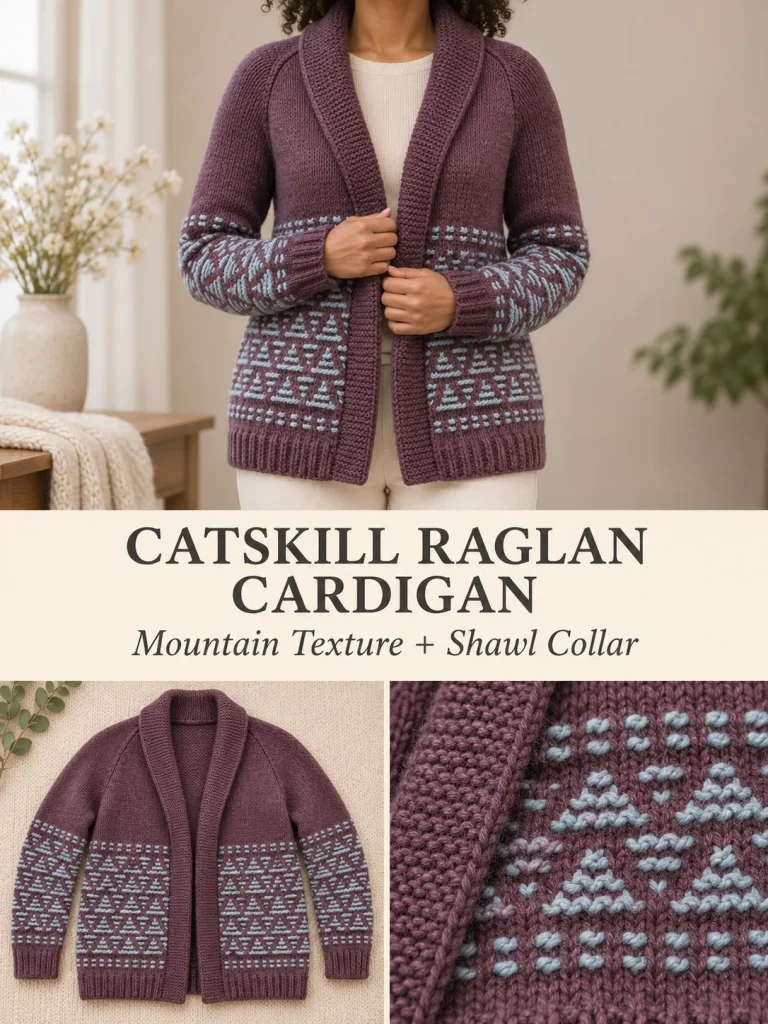
Crafting a warm and stylish raglan cardigan with a distinctive mountain-textured stitch pattern and a cozy shawl collar has never been easier than with this thoughtfully designed pattern. This long raglan cardigan combines classic tailoring with a textured slipped-stitch motif inspired by mountain silhouettes, giving the garment both depth and visual interest. Its flat-knit construction enhances wearability, while the relaxed raglan shaping allows for comfortable layering without sacrificing shape or elegance.
The shawl collar and carefully designed front bands add a timeless, polished finish, perfect for casual everyday wear or dressing up chilly days. This cardigan caters to a wide range of sizes from S/M to 4X/5X, accommodating chest measurements from 46 to 68.5 inches, ensuring a flattering fit and versatility for many body types. The use of a double knitting (DK) weight wool/acrylic blend yarn offers warmth, softness, and durability, making this an ideal layering piece for transitional seasons or outdoor adventures.
One of the standout features is the slipped-stitch mountain texture, developed through slipped stitches that create a subtle raised pattern evocative of mountain peaks—a refreshing alternative to the usual knit textures. The pattern calls for working in flat rows on circular needles, which allow for accommodating larger stitch counts and easy progress. This pattern encourages knitters to enjoy a satisfying balance of texture and construction, resulting in a relaxed yet polished garment.
Besides the technical knitting details, this cardigan project is a chance to explore raglan shaping techniques combined with slipped-stitch texturing, making it suitable for knitters looking to develop their skills with intermediate techniques. Notably, the pattern maintains precise cuff and hem treatments and a clean front opening that enhances its classic style.
Pattern at a Glance
Skill level: Intermediate
Terminology: Standard American knitting terms
Construction: Flat knitting with raglan shaping; separately knit front bands and shawl collar attached at finishing
Finished size: Chest circumference range 46–68.5 inches (sizes S/M through 4X/5X), excluding bands
Yarn weight: DK (double knitting) weight wool/acrylic blend
Needles: US 7 (4.5 mm) circular needles (other sizes may be used as per official instructions)
Main stitch: Slipped-stitch mountain texture pattern
Gauge: Specified by official Lion Brand PDF (refer to official instructions for size-specific gauge)
Motifs: Mountain-textured stitch pattern chart
Layout: Flat knit body and sleeves, raglan increases shaping yoke
Joining: Attach front bands and shawl collar after body and sleeves are completed
Border: Cuffs and hem as per source pattern
Seaming: Raglan seams and attachment of collar and bands following instructions
Materials
To recreate the look and feel of the original, use:
- Yarn: Lion Brand Wool-Ease DK or an equivalent DK-weight wool/acrylic blend. This choice balances warmth, stitch definition, and softness. Wool adds insulation and elasticity, while acrylic improves durability and ease of care.
- Needles: US 7 (4.5 mm) circular needles. Using circular needles is preferable even though the cardigan is knit flat because they can support the weight and large stitch count comfortably. Alternate needle sizes can be used depending on personal gauge.
- Notions: A yarn needle for weaving in ends and sewing bands/collar to the body; stitch markers to clearly mark raglan increases or pattern repeats, essential for tracking the mountain stitch texture and raglan shaping progress.
- Sizing: Patterns accommodate chest sizes from 46 inches to 68.5 inches, excluding bands, offering custom fit options from S/M through 4X/5X.
Each material plays a crucial role: from the yarn choice influencing the drape and stitch clarity to the circular needles facilitating smooth flat knitting for large pieces.
Yarn and Color Notes
When selecting yarn, smooth DK-weight wool blends are optimal for this texture pattern. Smooth yarn allows the slipped stitches to stand out clearly and makes the “mountain” motif visually striking. Avoid overly fuzzy or halo yarns that may obscure stitch definition.
Color-wise, solid or semi-solid hues best highlight the textured mountain pattern. Strong contrasting variegated yarns might muddle the visual impact of the slipped-stitch mountains. Neutral earth tones or muted blues and greens can evoke an actual mountainous landscape feel.
Pairing this textured stitch with a tonal color enhances subtle shadows and gives the fabric a rich appearance. If you want to experiment with color, consider using complementary shades for bands or collar to accentuate the cardigan’s structure.
Finished Measurements
The official garment sizes range from a chest circumference of 46 inches (S/M) up to 68.5 inches (4X/5X), excluding the front bands and collar. This measurement refers to the cardigan’s body circumference under the arms measured flat before adding bands.
Length and sleeve lengths vary according to size but maintain a long, relaxed fit typical of raglan cardigans. The pattern ensures the hem and cuff treatments maintain the garment’s shape and clean finish.
Check sizing regularly during knitting by comparing your measurements to the pattern’s schematic to ensure a perfect fit, especially when working between sizes.
Gauge
Gauge is a critical factor for this garment, affecting both fit and the proportions of the mountain-texture stitch.
- Gauge: Consult the Lion Brand official PDF for precise gauge as it varies depending on size, but generally the fabric should achieve the tension specified with US 7 (4.5 mm) needles using DK-weight yarn.
- Measure gauge over the mountain stitch pattern in flat knitting, not just plain stockinette, to ensure texture pattern consistency.
Why gauge matters:
- If your gauge is looser (fewer stitches per inch), the cardigan will be larger and possibly less structured.
- If tighter (more stitches per inch), the fabric may be stiff and the garment smaller than anticipated.
Always swatch and block your gauge swatch to the same conditions as wearing, including any finishing treatments, to get an accurate measure.
Abbreviations
- k: knit
- p: purl
- sl: slip stitch (as per pattern chart; refer to stitch chart for direction)
- inc: increase
- dec: decrease
- RS: right side
- WS: wrong side
Refer to the original Lion Brand PDF for full lists of size-dependent notation and specific raglan increase/decrease instructions.
Important Pattern Notes
- The cardigan is knit flat in long rows with raglan shaping forming the sleeves and body yoke as the work progresses.
- The slipped-stitch mountain texture is worked following an original chart repeat; stitches are slipped to create the textural peaks.
- Raglan shaping involves increases that are worked relaxedly to preserve drape.
- Sleeves and body are finished separately, with front bands and the wide shawl collar knit separately and sewn on.
- Turn chains follow the style in the source PDF; follow their instructions carefully for smooth edges.
- Maintain the cuff and hem treatments exactly as described for consistent shaping.
- Stitch markers are recommended on raglan seams and pattern repeats to aid accurate shaping and texture consistency.
- Use the official size-dependent row and stitch counts from the Lion Brand instructions, especially for raglan and band construction to ensure fit.
Special Stitches and Techniques
Slipped-Stitch Mountain Texture
This stitch pattern uses slipped stitches to form raised mountain-like shapes across the fabric surface. The slipped stitches are worked according to an original chart:
- Slipping a stitch means transferring it from the left to right needle without knitting or purling it, which elongates the stitch and creates texture.
- The strategic positioning of slipped stitches forms geometric mountain peaks in the fabric.
Mastering this pattern requires attention to the chart and consistent tension on slipped stitches to maintain even texture.
Raglan Increase Shaping
This cardigan uses raglan shaping, which forms diagonal seam lines from the underarm up to the neckline by increasing stitches regularly along raglan lines:
- Increases are spaced as per the official PDF instructions to create relaxed shaping.
- Maintaining the integrity of the mountain texture while increasing is essential; increases should be integrated smoothly within the stitch pattern.
Finishing Techniques
- The broad shawl collar and front bands are knit separately and attached after the main parts are completed.
- The hem and cuffs have specialized treatments to prevent curling and provide shape retention.
- Seaming techniques involve mattress stitch or equivalent “invisible” seaming to preserve the clean lines of the cardigan.
Understanding the Construction
This raglan cardigan is constructed in several key components:
- Body and Sleeves: Worked flat, starting from the bottom hem upward with raglan shaping that increases stitches diagonally for sleeves and body shaping.
- Mountain Texture: Maintained consistently throughout body and sleeves using the slipped-stitch stitch pattern.
- Front Bands and Shawl Collar: Knit separately in pieces and carefully attached at the end to frame the front opening and neck.
- Cuffs and Hems: Finished with band treatments designed to hold shape and add polished edges.
This construction balances ease of knitting (flat construction) with sophisticated visual texture and shaping, suitable for intermediate knitters.
Complete Pattern Instructions
Foundation
Begin by casting on the number of stitches corresponding to your chosen size as directed in the Lion Brand PDF.
Ensure your cast-on is elastic yet firm enough to support the hem treatment.
Mountain Stitch Pattern
Work the mountain stitch using the original chart repeat provided:
- The chart shows a 4-row repeat with slipped stitches placed to create peaked shapes.
- Repeat the chart across each row to the full width of your piece.
Body and Sleeves
- Work in flat rows on circular needles, following the raglan shaping as per the official instructions.
- Raglan increases replace plain stitches along designated raglan seam lines.
- Continue the mountain stitch pattern throughout increases and plain sections to keep a unified fabric surface.
- When body length and sleeve lengths reach the measurements indicated for your size, bind off according to the official directions.
Front Bands and Shawl Collar
- Knit front bands separately, following the pattern for cuff and hem treatments to ensure a smooth finish.
- The broad shawl collar is an oversized rectangular or triangular piece depending on sizing.
- Attach bands and collar using a yarn needle, aligning edges carefully so the mountain pattern matches and seam lines are neat.
Checkpoints
- Your piece should measure approximately as given for your size at key intervals (e.g., after raglan shaping, sleeve length).
- The pattern remains consistent with raglan shaping increases.
- The mountain stitch pattern continues seamlessly over raglan edges and bands.
Assembly and Joining
- Join raglan seams using mattress stitch to achieve nearly invisible seams.
- Attach the separately knitted front bands and shawl collar to the body and sleeves with a neat mattress stitch or whipstitch for secure, flat seams.
- Make sure the front opening lies flat and the shawl collar sits smoothly without puckering.
- Weave in all yarn ends securely on the wrong side.
Border and Finishing
- The cuff and hem treatments add a firm but elastic edge, preventing rolling and contributing to garment durability.
- Blocking the finished garment lightly will even stitch texture and help the mountain peaks stand out.
- Avoid heavy blocking to retain the texture’s definition and raglan shaping integrity.
How to Resize
Resizing can be achieved by:
- Adjusting stitch multiples according to the mountain stitch chart repeat (multiples of the chart width).
- Using the official Lion Brand PDF guides for smaller or larger chest sizes provided.
- Modifying length by adding or subtracting repeats of the mountain stitch and corresponding rows before raglan shaping.
- Sleeve width and length also adjusted by adding pattern repeats consistent with the stitch multiple.
Accuracy in raglan increases is vital to prevent fit issues, so follow increase instructions precisely when resizing.
Useful Variations
- One-color version: Knit entirely in a single color for a minimalist look highlighting texture without color distraction.
- Two-color version: Use subtle contrast for slipped stitches to emphasize mountain peaks.
- Shorter length version: Create a cropped cardigan by working fewer body repeats and raglan rows.
- Longer collar: Extend shawl collar length for a more dramatic wrap effect.
- These variations maintain the core stitch pattern and raglan construction.
Troubleshooting
Why Is My Mountain Stitch Pattern Not Aligning?
Ensure you are slipping stitches as per the chart exactly. Use stitch markers at chart repeats to keep track. Missing a slipped stitch can shift the mountain motif pattern.
Why Is the Raglan Shaping Uneven?
Check you are increasing the correct number of stitches on each raglan seam as per size-specific instructions. Counting stitches at each raglan seam before moving on helps prevent errors.
Why Is the Collar Wavy or Curling?
Blocking gently will help. Also, make sure the collar is attached flat without stretching the fabric. Use the recommended finishing method to stabilize.
Why Is My Fabric Too Tight or Too Loose?
Adjust needle size accordingly after swatching to match gauge. The slipped-stitch texture requires consistent tension for best effect.
Frequently Asked Questions
Can I use a different yarn weight?
This pattern is designed for DK weight yarn to maintain stitch texture and sizing. Using heavier or lighter yarn may distort the mountain texture and sizing.
Can I substitute needles?
Circular needles US 7 (4.5 mm) are recommended for gauge and handling the stitch count. You can experiment with needle size but check gauge carefully.
Is this pattern suitable for beginners?
This is best suited for intermediate knitters because of raglan shaping and slipped-stitch patterning combined with separate band and collar assembly.
How should I block this garment?
Lightly steam or wet block flat on a towel, shaping edges gently to avoid distorting peak textures.
Can I knit this in the round?
This pattern is designed for flat knitting to simplify raglan shaping and allow for slipped-stitch texture. Knitting in the round would require significant pattern alterations.
Are the bands and collar attached by sewing or knitting?
They are knit separately and sewn on afterward, which allows precision finishing.
Optional Related Uses
The mountain stitch texture and raglan shaping technique can be applied to other garments such as sweaters, cardigans with hoods, or cozy pullovers. The slipped-stitch mountain motif also lends itself well to cozy accessories like scarves and hats, where texture adds depth and interest.
Final Thoughts
This long raglan cardigan combines the charm of classic shaping with the unique appeal of slipped-stitch mountain texture and a cozy shawl collar. Working the cardigan in flat rows with circular needles ensures ease of handling while accommodating large stitch counts. The separate bands and collar provide polished finishing touches that elevate the piece beyond simple outerwear.
Knitters taking on this project will appreciate the synthesis of textured stitches and raglan shaping to create a beautiful, wearable mountain-inspired garment designed for versatility and comfort. For an additional knitting texture challenge, exploring the Aaron Toe-Up Textured Socks knitting pattern can be an excellent next step. This cardigan offers both a satisfying knitting experience and a timeless piece perfect for layering in cooler weather.



