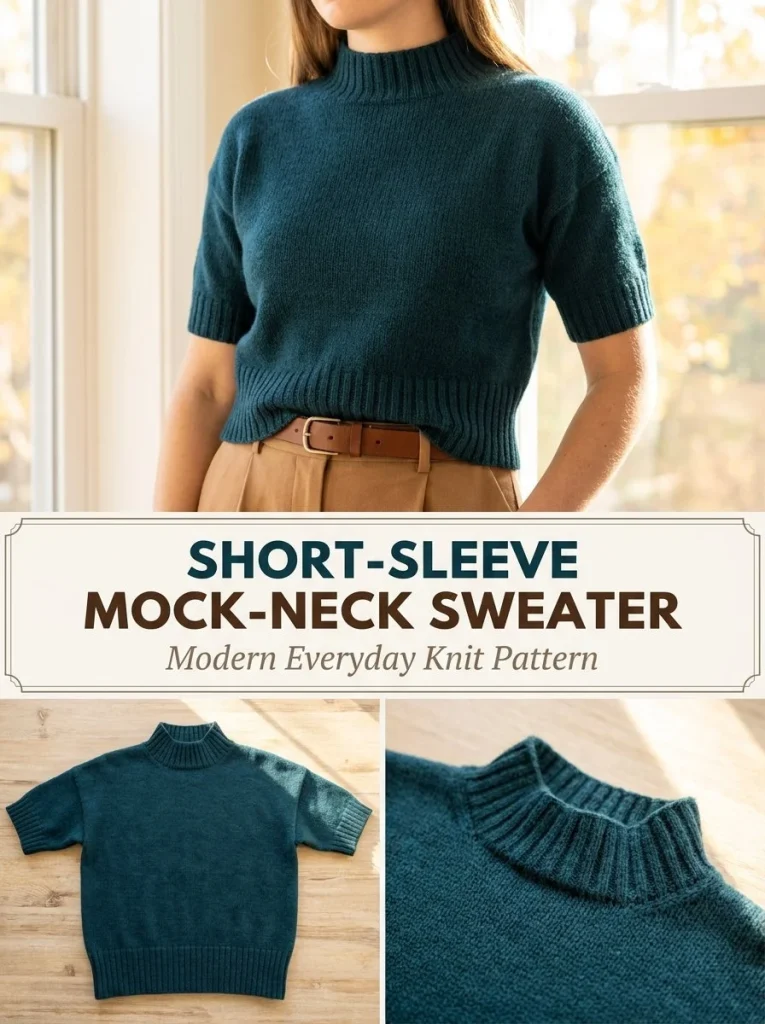
This stylish short-sleeve mock-neck sweater is perfect for transitional weather and provides a cozy yet chic look. Its simple construction and elegant ribbing make it an enjoyable project for those looking to enhance their knitting skills. If you’re interested in expanding your wardrobe with similar knitted designs, you can explore options like the Acorn Brown Keyhole Scarf Knitting Pattern to complement your new sweater!
Skill Level
Confident Beginner
This project is ideal for those who have basic knitting skills and are familiar with techniques such as casting on, knitting, purling, and binding off. The sweater’s simplicity in design will challenge and enhance your abilities as you work through the ribbing and stockinette sections.
Materials
- Yarn: 1000–1150 yd / 915–1050 m worsted #4 wool, merino blend, or soft acrylic blend
- Needles:
- US 8 / 5 mm for body
- US 7 / 4.5 mm circular needle for ribbing, sleeves, and mock neck
- Notions: stitch markers, tapestry needle, scissors
Abbreviations — US Terms
- K – knit
- P – purl
- sts – stitches
- RS – right side
Special Stitches
This pattern primarily uses basic knit and purl stitches, which are essential for the ribbing and stockinette portions of the design. The construction relies on these simple techniques to create a comfortable and stylish fit.
Gauge
Gauge is not specified for this pattern, but achieving consistent tension is essential for the desired fit. It’s a good practice to knit a small swatch to ensure your stitches match the intended fabric density.
Finished Size
The finished sweater will feature a clean solid-color body, short sleeves, a slightly cropped hem, and a relaxed upright mock neck.
Pattern Notes
- The sweater is worked in rows for the body and then joined in rounds for the sleeves and neck.
- The ribbing is worked on smaller needles, while the stockinette is completed with larger needles.
- Adjustments can be made for a lower front neckline by beginning the neck opening slightly earlier.
Crochet Instructions
BACK
- Cast on 100 sts with the smaller needle.
- Work K1, P1 ribbing for 2.5 inches (6.5 cm).
- Switch to larger needle and continue in stockinette stitch (knit all stitches) until the piece measures 19.5 inches (49.5 cm) from the cast-on edge.
- Next RS row: K32, bind off center 36 sts, knit remaining 32 sts — this creates the neck opening.
- Shoulders: Work each shoulder separately:
- Knit each shoulder for 1 inch (2.5 cm).
- Bind off.
FRONT
- Work exactly as for the Back, but begin the neck opening 0.5 inches (1.25 cm) earlier if a slightly lower front neckline is desired.
- Bind off with 32 sts for each shoulder and 36 center neck sts.
ASSEMBLY
- Seam the shoulders using a tapestry needle.
- Seam side edges from hem upward, leaving an 8 inches (20 cm) armhole opening on each side.
SHORT SLEEVES
- With the smaller circular needle and RS facing, pick up 72 sts evenly around one armhole.
- Join in the round and work 14 rounds in stockinette stitch (knitting all stitches).
- Work K1, P1 ribbing for 1 inch (2.5 cm).
- Bind off stretchily.
- Repeat for the second sleeve.
MOCK NECK
- With the smaller circular needle and RS facing, pick up approximately 84 sts evenly around the neckline, adjusting to an even number as necessary.
- Join in the round.
- Work K1, P1 ribbing for 3.5 inches (9 cm).
- Bind off very stretchily so the neck slips comfortably over the head.
- Do not fold the collar unless a double-layer neck is desired.
Tips for the Best Result
- Using stitch markers can help keep track of the ribbing sections and shoulder seams.
- When picking up stitches for the sleeves and neck, ensure the stitches lie flat to avoid puckering.
- Properly stretching your bind-off edge will aid in maintaining elasticity, especially around the neck and sleeves.
If you want to explore more intricate patterns and styles, consider trying the Autumn Color Block Chunky Scarf Knitting Pattern, which can add variety and flair to your winter wardrobe.
Finishing
Once all parts are assembled, take a moment to weave in any loose ends with a tapestry needle for a neat finish. Blocking the sweater to measurements will help it hold its shape and give a polished appearance. This is especially important around the mock neck and hems.
Care
For optimum longevity of your sweater, it’s advisable to follow the care instructions specific to the yarn used. Generally, hand washing in cold water and laying flat to dry will maintain the integrity of the fibers. Always refer to the yarn label for best care practices.