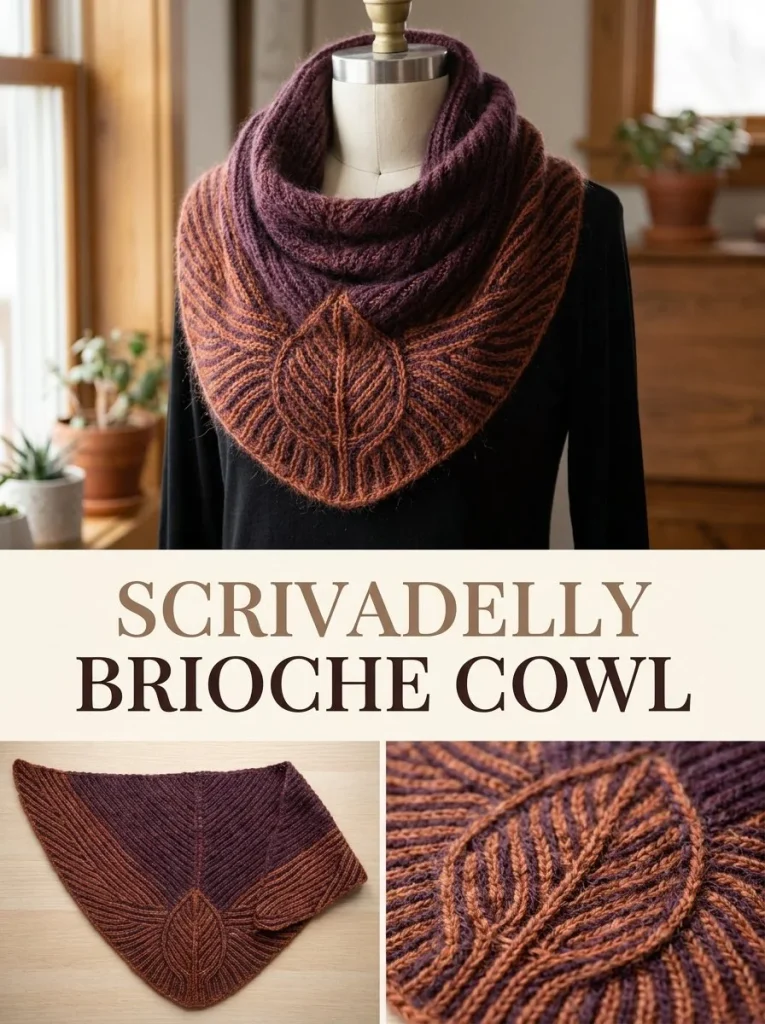
A beautifully draped accessory that combines artistry with comfort, this brioche cowl-scarf offers unique styling versatility. The design’s elegant leaf motif gradually expands from the front, then transitions into a supple brioche rib pattern that gracefully angles and narrows as it wraps around the neck. This innovative construction creates a wearable piece that can be spread over the shoulders like a chic dickie or relaxed into a cozy cowl, perfect for adding warmth and style to any outfit.
The charm of this project lies in its interplay of colors and textures achieved by holding two yarns double within each color group, enriching the fabric’s depth and softness. The use of circular knitting needles paired with stitch markers ensures a smooth shaping process, crucial for the subtle curves and tapered silhouette that define this piece. Beyond knitting, pairing it with delicate accessories like the Pink Lily Bell Anklet can complete an elegant ensemble, reflecting careful attention to complementary details.
Pattern at a Glance
Skill level: Intermediate to Advanced
Terminology: Standard knitting terms (US)
Construction: Worked in one continuous piece starting at the front leaf motif, transitioning into brioche rib with shaping for angled silhouette
Finished size: Neck circumference approximately 19 in (48 cm), longest depth about 15 in (38 cm)
Yarn weight: Fingering or light sport weight, held double
Needle: US 8 / 5 mm circular needle
Main stitch: Brioche rib with leaf motif
Gauge:
- 21 sts / 30 rows = 4 in (10 cm) in stockinette (both yarns held together)
- 18 sts / 34 rows = 4 in (10 cm) in brioche rib
Motifs: Widening leaf motif at the front
Layout: Shaped triangular piece widening then tapering and angling left
Joining: Seam at the tail ends to form a continuous loop
Border: None specified; edges cleanly finished by stitches in pattern
Seaming: Tail ends seamed together at top
Materials
- Yarn:
- 1 skein Ripples Crafts Burras in Damson and 1 ball Ito Sensai in Prune for the background color, yarns held double
- 1 skein Ripples Crafts Burras in Copper Beech and 1 ball Ito Sensai in Coke for the foreground color, yarns held double
- Needles: US 8 / 5 mm circular knitting needle, preferred length for comfortably holding wider piece and accommodating full stitch count
- Notions:
- Multiple colored stitch markers (5 colors ideal) to track pattern sections and transitions
- 2 removable stitch markers for temporarily marking positions
- Yarn needle for sewing seam and weaving in ends
These materials reflect a thoughtful combination to highlight the brioche texture and the rich color palette, resulting in a sumptuous drape perfect for layering.
Yarn and Color Notes
Combining the Ripples Crafts Burras with Ito Sensai held double adds both substance and a gentle halo to the fabric. Burras is known for its silk-wool blend, giving a soft sheen and warmth, while Sensai adds durability and subtle texture. Deciding between more solid or subtly variegated yarns affects finished stitch definition, with this combo allowing leaf and brioche ribs to stand out beautifully.
Using two distinct color sets for background and foreground enhances the dimensionality of the leaf motif and rib sections. For similar projects, consider choosing colors with strong contrast or smooth tonal shifts depending on whether you want the details to pop or blend softly.
Finished Measurements
The completed piece forms a neck circumference of about 19 inches (48 cm), making it comfortably snug around the average adult neck. The maximum depth measuring approximately 15 inches (38 cm) allows it to drape pleasingly over shoulders or fall softly like a cowl around the neck.
These dimensions reflect the fabric’s final blocked size and provide an ample wrap without excessive bulk, ideal for layering over coats or lightweight tops.
Gauge
Two gauges are critical for this pattern:
- Stockinette gauge: 21 stitches and 30 rows equal 4 inches, measured with both yarns held together.
- Brioche rib gauge: 18 stitches and 34 rows equal 4 inches, also using both yarns held double.
Accurately matching gauge ensures the cowl-scarf maintains its intended size and drape properties. Gauge affects both fit around the neck and the fabric’s elasticity, especially important with brioche ribs that can stretch. If your gauge is looser, the piece may become larger and more relaxed; if tighter, less drape and more snugness will occur.
Abbreviations
- k: Knit
- p: Purl
- br: Brioche row or brioche stitch
- inc: Increase
- dec: Decrease
- st(s): Stitch(es)
- RS: Right side
- WS: Wrong side
(Note: Refer to the original source for specific brioche stitch abbreviations and chart symbols.)
Important Pattern Notes
- The piece starts at a front leaf motif and widens asymmetrically before transitioning into the brioche rib stitch pattern.
- Irregular increases and decreases create an angled shape that shifts to the left, narrowing around the neck’s back.
- Stitch markers in different colors are crucial for tracking these increases, decreases, and pattern transitions.
- The final tail end of the piece is joined by seaming it to the beginning tail, forming a continuous loop without visible breaks.
- The finished design offers styling versatility: it can be worn as a classic cowl or extended over shoulders like a dickie.
Special Techniques
This project embraces several advanced knitting techniques:
- Brioche rib stitch: A luscious, lofty stitch pattern creating a double-sided reversible fabric with excellent warmth and elasticity.
- Irregular increases and decreases: These shape the piece, allowing for an asymmetrical silhouette that drapes elegantly.
- Two-color brioche: Holding yarn double within color groups to achieve striking color contrasts within the rib stitch.
- Seaming tails: Using a yarn needle to join the starting and ending tails seamlessly without interrupting the fabric’s flow.
Mastery of brioche knitting, including reading charts carefully, is essential for success with this project.
Understanding the Construction
The entire cowl-scarf is knitted in one piece, beginning at the front neckline with a widening leaf motif to create visual interest and shaping. As knitting proceeds, the pattern transitions to partial brioche rib before employing irregular shaping—increases and decreases—that shift the fabric angle to the left, tapering it as it moves around the neck toward the back.
This asymmetrical shaping is key to the piece’s elegantly draped look, avoiding a uniform circle and instead producing a relaxed form that hugs one side while gracefully slimming in the back.
The project concludes by seaming the ending tail to the starting tail, creating an uninterrupted loop that can be styled freely. This construction method maximizes both visual impact and functional versatility.
Full Pattern Instructions
Due to the complexity and charted nature of the brioche rows, the original source pattern should be followed closely for exact stitch counts and brioche stitch sequences. Below is an expanded outline of the process:
Foundation
- Cast on the number of stitches required for the front leaf motif using the background and foreground double yarns, ensuring even tension.
- Place multiple colored stitch markers to segment the motif and subsequent brioche transitions.
Leaf Motif Section
- Work the leaf motif using stockinette and brioche rib stitch combinations, gradually increasing width and shaping to create a widening leaf panel.
- Follow the stitch pattern charts or written instructions carefully, using stitch markers to track pattern repeats.
Transition to Brioche Rib
- As the leaf motif reaches its widest point, begin gradual transition stitches partly into brioche rib.
- This transition involves alternating double yarn brioche stitches to blend visual textures smoothly.
Angling and Narrowing Section
- Employ irregular increases and decreases spaced carefully across rows so the fabric angles to the left as it narrows.
- These shaping maneuvers create the cowl’s characteristic asymmetry and comfortable fit.
- Stitch markers are key for marking decrease and increase locations to maintain stitch count accuracy.
Tail and Seaming
-
Continue working the brioche rib with shaping until the ending tail matches the starting tail’s length.
-
Bind off loosely to maintain elasticity along the edges.
-
Using the yarn needle, seam the ending tail to the beginning tail on the right side to complete a smooth loop without bulk in the neck area.
Styling Alternatives
This piece may be worn spread over shoulders for an elegant look resembling a dickie or gathered loosely around the neck as a classic cowl.
Checkpoints
- After completing the leaf motif, your piece should measure approximately half the final width and show a clear shape emerging.
- Once transitioned into brioche rib, check gauge especially, ensuring stitches remain consistent.
- When irregular shaping begins, keep count of increases and decreases; your piece should angle naturally and the stitch counts reflect the shaping.
- Final measurement before seaming should be around the specified 19 in neck circumference and about 15 in depth.
Assembly and Joining
Join the ending tail to the starting tail carefully:
- Align edges ensuring stitch patterns align seamlessly.
- Use mattress stitch or an invisible seaming technique to preserve fabric continuity.
- Avoid pulling too tight to maintain elasticity—it should form a natural, comfortable loop.
Finishing
- Weave in all yarn ends neatly on the wrong side using the yarn needle.
- Light blocking may be employed to even out stitch patterns, stabilize the fabric, and enhance drape; however, take care to preserve brioche rib elasticity.
- Inspect the seamed join and edges for smoothness and adjust as necessary.
How to Resize
This pattern is only provided in one size. To adjust sizing:
- Widening the cowl: Extend the initial leaf motif or add additional brioche rib repeats in the transition section to increase neck circumference.
- Adjusting depth: Work more rows in brioche rib before starting decreases to make the cowl deeper.
- Maintaining gauge and shape: Adjust stitch counts symmetrically and continue irregular increases/decreases proportionally.
- Always check gauge on swatches before making major size changes to ensure fit and drape.
Useful Variations
- Monochrome version: Use a single color held double for a sleek, elegant texture emphasis.
- Multi-color stripes: Introduce subtle variegated yarns held double for dynamic color shifts without disrupting motif clarity.
- Shorter cowl: Omit some brioche rib rows for a snugger neck warmer version.
- Wider dickie: Increase leaf motif and brioche repeats for a shoulder-covering capelet style.
Matching this piece with accessories like the Rose Vine Bracelet complements its botanical theme, creating a cohesive look that balances textures and shades.
Troubleshooting
Why is my cowl widening unevenly?
Ensure increases and decreases are done at correct stitch markers; misplacing them can skew shaping.
Why doesn’t my brioche rib look consistent?
Check tension on double-held yarns; incorrect tension or slack can cause fabric to look loose or tight.
Why is the fabric curling or rippling?
Brioche rib has natural elasticity; however, uneven gauge or inadequate blocking can cause curling. Light blocking and careful seaming will help.
Why doesn’t the seam lay flat?
Use invisible seaming with mattress stitch and avoid pulling yarn too tightly. Align stitches carefully.
How to keep stitch markers from slipping?
Use different-colored markers with sizes appropriate for the needle and yarn thickness; removable markers help adjust placement easily.
Frequently Asked Questions
Can I use different yarns for this pattern?
Yarns with similar weight and fiber content held double are best to maintain gauge, drape, and color contrast.
Can I knit this on straight needles?
Circular needles are recommended due to the width and shaping requiring continuous work; straight needles may be impractical.
Is this pattern suitable for beginners?
Intermediate skill at brioche knitting and understanding irregular shaping is required; beginners should practice brioche first.
How do I care for this cowl?
Hand wash gently and lay flat to dry to preserve fiber integrity and shape.
Are stitch markers essential?
Yes, especially multiple colors to track pattern changes, shaping, and motif sections.
Can I wear this as a shoulder wrap?
Yes, the design allows spreading over shoulders like a dickie, offering styling versatility.
Optional Related Uses
The brioche rib technique and shaping used here can be adapted for related accessories such as:
- Elegant shawls with angular edges
- Lightweight scarves with leaf motif accents
- Cozy neck warmers with custom shaping
- Shrugs or shoulder wraps employing partial motifs
Exploring these variants opens creative possibilities for matching wardrobe versatility.
Final Thoughts
This brioche cowl-scarf brings together delicate leaf motifs and textured brioche rib shaping to deliver a wearable art piece that blends eye-catching style with everyday comfort. Its asymmetric angle and tapered back ensure a flattering fit that can be styled multiple ways, while the clever use of color and yarns adds depth and warmth.
Knitting this project requires attention to detail—especially in tracking increases and decreases and working brioche stitches two colors held double—but the result is richly rewarding. With careful blocking and finishing, the cowl becomes an elegant complement to any cold-weather outfit, and its seamless join provides a polished, professional finish that stands out in your accessory collection.




This is such a pretty cowl. I’m wondering if there is or will be one that starts with a snowflake instead of the leaf? I’d love to make that!
Unfortunately I can not download the pattern, as I do not have the right email address. Is there another way to obtain this wonderful pattern? I esp. like this version with the leaf in the centre! Kind regards, Iris