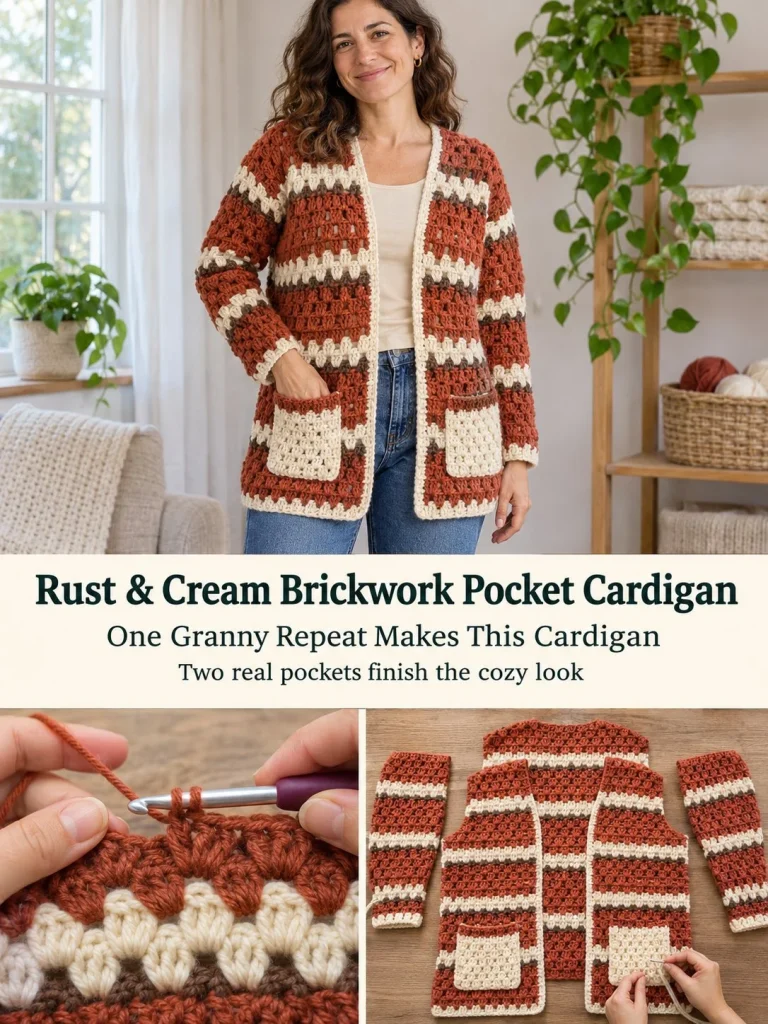
This cozy cardigan features a charming brickwork crochet pattern combining warm rust, cream, and subtle cocoa hues. Constructed entirely from rectangular panels, the garment showcases an offset three-double-crochet granny stitch reminiscent of classic brick walls. The carefully aligned color stripes add texture and sophistication, while cream edging and pockets with rust accents provide a polished finish. This open-front cardigan, free of buttons, offers relaxed layering with true-to-form sleeves and roomy hand pockets positioned on each front panel.
Crochet enthusiasts will appreciate the straightforward construction—seven precise flat fabric pieces joined with careful seaming and finished with a continuous front border. The use of worsted weight yarn paired with a 5.5 mm hook produces a substantial yet flexible fabric ideal for transitional weather. The design emphasizes repeated color bands in brickwork rows, combining several rust rows, a smaller ivory segment, and single cocoa stripes as separators to create a unified look across body and sleeves.
The brickwork stitch pattern is both visually striking and texturally interesting. Its offset grouping of three double crochets mirrors laid bricks, offering subtle depth with each row’s placement. For those seeking a cardigan that presents a warm fall-inspired palette and an artisan feel, this pattern balances classic crochet technique with modern garment assembly. Its moderate complexity suits crocheters wanting to explore both garment making and colorwork coordination.
Pattern at a Glance
Skill level: Intermediate — requires color changes and garment assembly
Terminology: US crochet terms
Construction: Flat rectangular panels joined and shaped into a cardigan with sleeves; pockets added separately
Finished size: Approximately 22 × 25 inches (back panel), front panels 11 × 25 inches, sleeves approximately 16 × 19 inches flattened (forming tubes post-seam), pockets 6 × 6 inches
Yarn weight: Worsted (medium #4)
Hook: 5.5 mm crochet hook
Main stitch: Offset 3-double-crochet granny brickwork pattern
Gauge: Gauge swatch highly recommended for stitch accuracy and sizing
Motifs: None, repeat stitch pattern
Layout: 7 separate fabric pieces: back, 2 fronts, 2 sleeves (flat rectangles), and 2 small pockets
Joining: Seamed shoulder sections, side seams leaving space for sleeves; sleeve tube seams on 19-inch side; sleeves attached to armholes
Border: Narrow single crochet ivory edging around front openings, neckline, hem, and cuffs
Seaming: Shoulder seams, side seams, sleeve seams, pocket attachments by stitching multiple edges
Materials
- Yarn: Worsted weight yarn in three colors: rust (650–750 yards), warm ivory (250–350 yards), cocoa (60–90 yards)
- Hook: 5.5 mm crochet hook, suitable for worsted yarn gauge
- Notions: Yarn needle for weaving in ends and sewing seams; stitch markers for aligning pieces, particularly sleeve joins and armhole edges
- Fabric pieces required:
- 1 back panel approximately 22 × 25 inches
- 2 front panels approximately 11 × 25 inches each
- 2 sleeve rectangles approximately 16 × 19 inches flattened, later seamed to tubes
- 2 small cream pockets about 6 × 6 inches with narrow rust trim on top edge
- Edging: Cream single crochet to finish front openings, cuffs, neckline, and hem
- All pieces are constructed flat before assembly for better stitch control and pattern alignment.
Yarn and Color Notes
Selecting smooth worsted weight yarn in the recommended colors is vital for maintaining crisp stitch definition in the brickwork pattern. The rust and warm ivory colors dominate the panel stripes, with the cocoa reserved as delicate row separators to highlight the brick offset. Using firmly twisted yarns helps to create durable clusters of double crochets without fuzziness that could obscure the pattern’s texture.
Color transitions are frequent but controlled through single-row cocoa bands and repeated rust and ivory stripes. Using solid, non-variegated yarn keeps the brick motif distinct and clean. Yarn with some elasticity supports comfortable wear and less distortion in seams.
Avoid loose, overly soft yarns that may cause the fabric to stretch excessively or lose brick alignment after washing. Holding the yarn consistently to maintain gauge across color changes ensures the panels remain square and suitable for assembling the garment.
Finished Measurements
- Back Panel: Approximate width 22 inches and length 25 inches
- Front Panels: Two pieces, each 11 inches wide and 25 inches long, matching the back length
- Sleeves: Each initially a flat rectangle 16 inches wide and 19 inches long, later seamed along the 19-inch edge to form sleeves with approximately 16-inch upper arm circumference
- Pockets: Two 6-by-6 inch square cream panels with rust-topped rims
- Final fit depends on precise gauge matching due to garment’s rectangular panels and seams; measuring flat swatches and adjusting stitch count accordingly is crucial.
Gauge
This pattern advises crocheting and washing a representative gauge swatch before beginning, as finished dimensions hinge on maintaining consistent stitch and row size.
- Gauge Method: Measure a 3-dc granny brickwork repeat on a flat, unstretched swatch.
- Why Gauge Matters: Overly loose gauge will make the cardigan larger, looser, and possibly less stable near seams; too tight gauge can shrink dimensions and restrict fit, especially in sleeves and body panels.
Maintaining width is critical since brickwork rows are offset; adding or omitting stitches outside edge allowances could distort the geometric pattern.
Abbreviations
- ch – chain
- st/sts – stitch(es)
- sl st – slip stitch
- sc – single crochet
- hdc – half double crochet
- dc – double crochet
- sp – space
- sk – skip
- BLO – back loop only
- RS/WS – right side / wrong side
- rep – repeat
Important Pattern Notes
- Turning chains should follow standard rules for double crochet granny stitch height and placement.
- Edge stitches remain stable throughout to maintain panel width consistency during clustered stitch placement.
- Color sequence bands – several rows of rust, a group of ivory rows, then a single cocoa separator row – repeat identically across all panels and sleeve tops for consistent stripe alignment.
- Seams where shoulders meet are reinforced with solid single crochet or half double crochet rows for strength.
- Sleeve tubes are formed separately by seaming two rectangles, then attached to body armholes, leaving wrists open.
- Pocket placement is symmetric, sewn on three sides with open tops for easy access.
- The continuous single crochet ivory border is worked in one piece, running along both front edges, back neckline/hem, and cuffs with minimal corner shaping.
Special Stitches and Techniques
- Offset 3-dc Granny Brickwork Repeat:
Groups of three double crochets worked into chain spaces with chains between clusters, alternating placement on every row like bricks in a wall. Edge stitches remain constant for panel width. - Cluster Placement: On subsequent rows, clusters are worked into the spaces between prior row’s clusters, offsetting horizontally each row.
- Color Changes: Strategic striping with seamless transitions.
- Seam Reinforcements: Solid sc or hdc rows added at shoulder and edges for durability in joins.
Understanding the Construction
The cardigan consists of exactly seven fabric pieces, crocheted flat in rows:
- The back panel is a large rectangle (~22 × 25 in) worked in brickwork stitch with aligned rows and colors.
- Two front panels, slightly narrower (~11 × 25 in), are created to match the back in stitch count and color placement.
- Two sleeves start as flat brickwork rectangles 16 × 19 inches, then seamed along the longer edge to form tubes of about 16-inch circumference.
- Two pockets are small square panels (6 × 6 inches) crocheted in cream, topped with a narrow rust border, and sewn to lower front panels.
- After all pieces are complete, they are joined by seaming approximately 6-inch shoulder sections, leaving the neckline and front open. The front and back sides are seamed bottom-up to the underarm, leaving ~8 inches open per front and back for the sleeve openings.
- Sleeves are then sewn into these armholes, matching circumference carefully using markers for alignment.
- Finally, a continuous single crochet border in cream trims the front openings, neckline, hem, and cuffs for a neat finish.
Complete Pattern Instructions
1) Color Plan
Begin by crocheting a gauge swatch using the offset 3-dc granny brickwork repeat:
- Start with stable double crochet edge stitches.
- Create 3-dc groups worked into previous chain (ch) spaces with chain-1 between clusters.
- On the next row, place clusters into the alternating spaces between previous row clusters, offsetting like bricks in a wall.
- Adjust stitch count and rows only within edge allowances to maintain constant width.
- Repeat color bands in the sequence: multiple rows of rust, a shorter group of ivory rows, and an occasional single cocoa row as a separator.
- Record your actual row counts to replicate this exact sequence on all body panels and sleeves for stripe alignment.
2) Body Panels
- Crochet one back panel measuring about 22 × 25 inches using the established brickwork pattern and color sequence.
- Make two front panels each approximately 11 × 25 inches, ensuring color stripe orientation and stitch gauge match the back panel.
- Reinforce shoulder edges and seam areas with a single solid row of either sc or hdc for stable joins.
3) Sleeves
- Make two sleeve rectangles, each approximately 16 inches wide by 19 inches long in the brickwork stitch.
- Ensure the upper edge color sequence matches the body panel stripes for continuity.
- Measure wrist circumference and upper arm clearance to ensure comfortable fit.
- Seam the 19-inch edges together inconspicuously to form a tube approximately 16 inches in circumference.
4) Join Body
- Seam about 6-inch shoulder sections on both the back and front panels, leaving the neck and full center front open.
- Seam the sides from bottom upward to underarm, leaving armhole openings of roughly 8 inches each on front and back for sleeve attachment.
- Work symmetrically on both sides.
5) Attach Sleeves
- Align each sleeve tube around the corresponding armhole, matching the sleeve’s 16-inch circumference to the combined 8-inch openings on the front and back.
- Use markers to align the shoulder top and underarm edges precisely.
- Sew sleeve openings stitch-to-stitch, leaving wrists unclosed.
6) Pockets
- Crochet two cream 6 × 6 inch square pocket panels with a narrow rust band finishing the top edge.
- Place pockets symmetrically on lower halves of front panels, ensuring not to extend beyond the open front edge.
- Stitch the left, bottom, and right edges of each pocket to the panel, leaving the top open for hand access.
- Ensure both pockets are positioned at equal height above the hem on each side.
7) Edging
- Using warm ivory yarn, crochet a continuous single crochet border along both front openings, around the back neckline and hem, and finishing at both cuffs.
- Shape corners gently to avoid puckering.
- Work pocket edges only as needed for a neat finish.
- Secure and weave in all yarn ends carefully.
- Final checks: both pockets should open freely, the front edges remain open (no button closure), sleeves securely attach to armholes, and color stripes remain coherent throughout.
Pattern Checkpoints
- After making your gauge swatch, confirm that brickwork repeats are aligned and fabric measures as expected before proceeding.
- Body panels should be of equal length and match in stripe sequence to ensure seamless assembly.
- Sleeve tubes created should have consistent circumference for an even fit without puckering at seams.
- After all panels are crocheted and prior to seaming, lay flat to confirm measurements.
- After seaming shoulders and side seams to armholes, sleeves should fit without distortion or strain.
- Pocket placement should be symmetrical and secure; pockets should move freely and be functional.
Assembly and Joining
Assembly requires neat, strong stitching to join flat panels into a wearable garment. Start with shoulder seams where the sc or hdc reinforcement rows improve durability. Side seams connect fronts to back, working from bottom toward underarm, leaving the armhole openings free.
Sleeve rectangles are seamed along their long edge into tubes, then carefully pinned and sewn into the armholes aligning stitch-for-stitch, using stitch markers at key points (shoulder tops and underarms) to keep seams symmetrical. The bottom of the sleeves remains unclosed for hand comfort.
Pocket panels, although small, require precise placement on the front panels to maintain balance and aesthetic. Pockets are sewn on three sides only to keep them open on top.
Border and Finishing
The continuous single crochet border in ivory is crocheted last, uniting front edges, neckline, hem, and cuffs. This border ensures clean edges and helps prevent stretching or rolling of the fabric.
For smooth corners, ease the border with minimal increases or decreases where the fabric turns to avoid bunching or ruffling.
All tails and ends must be woven in securely to maintain garment strength and appearance.
Blocking the assembled cardigan gently (wet blocking) can aid in evening out edges and enhancing fabric drape without stretching the brickwork pattern.
How to Resize
Sizing adjustments can be approached by:
- Changing stitch counts in multiples of the brickwork repeat, which is based on cluster placement and chain spaces; increase or decrease edge stitches carefully to retain panel width.
- Adjusting length by adding or subtracting brickwork row repeats, carefully maintaining the established stripe color sequence for consistent look.
- Sleeve circumference can be altered by wider or narrower rectangles before seaming into tubes.
- Keep all pieces proportional by maintaining the same stitch and row gauge as indicated by your swatch.
Because this pattern depends heavily on the offset 3-dc clusters and stripe alignment, drastic resizing may require recalculation and swatching first.
Useful Variations
- Create a one-color version using only warm ivory for a minimalistic, elegant look.
- Substitute color stripes for seasonal palettes such as autumn tones or pastel spring hues.
- Convert the cardigan style into a cozy vest by omitting sleeves and adjusting armholes.
- Experiment with variegated yarns for pockets or borders to add subtle pattern contrast without changing the main brickwork fabric.
Troubleshooting
Why is my brickwork fabric uneven?
Ensure your edge stitches remain constant on every row. Variations in tension or missed chains between clusters can distort the brick alignment. Practice swatching the offset 3-dc granny brick pattern carefully before starting your panels.
Why are my stripes not aligning across panels?
Record and follow the same number of rows per color band exactly for all body panels and sleeves. Small deviations in count produce color misalignment and disrupt the seamless look.
My sleeve tubes are too tight or loose, what now?
Measure wrist circumference and upper arm circumference before seaming. Adjust the width of the flat sleeve rectangles accordingly by increasing or decreasing stitch groups in the foundation chain or by adding/removing brickwork repeats.
How do I keep the border from puckering at corners?
Use minimal increases or decreases at corner turns and maintain consistent tension in the single crochet border. Blocking the finished edges smooths out minor distortions.
Why do my pockets gape or look uneven?
Position pockets symmetrically by measuring from the bottom hem and sides equally for both front panels. Sew securely along three edges with neat slip or whip stitches, leaving the top unjoined.
Frequently Asked Questions
Can I use a different yarn weight?
The pattern is designed for worsted (#4) yarn; switching yarn weights may require changing hook size and recalculating stitch counts for correct sizing.
Can I make this cardigan without color changes?
Yes, but the brickwork texture is best highlighted with contrasting stripes. A monochrome version will be subtler but still attractive.
Is this pattern suitable for beginners?
This pattern suits intermediate crocheters comfortable with color changes, stitch group repeats, and garment assembly. Beginners may find the seaming and striping challenging.
How do I wash and care for this garment?
Hand wash or machine wash gently on delicate cycle. Lay flat to dry to prevent stretching, especially in seams.
Can I add buttons or a closure?
The original design has a continuous open front without buttons, but adding buttonholes in the front edging and sewing on buttons is feasible.
Can I lengthen the sleeves?
Yes, add extra brickwork row repeats to the sleeve rectangles before seaming to tubes. Keep color stripe sequence consistent with body panels.
How can I modify the fit for a larger size?
Increase stitch counts and row repeats proportionally for back, front panels, and sleeves, ensuring the brick pattern and stripe sequence remain uniform across all pieces.
Does the edging reverse on the inside?
The single crochet border is visible on the right side and lies flat with minimal shaping on corners, providing a neat inside finish as well.
Where can I find tips for working the offset brickwork stitch?
Detailed tutorials on granny brickwork stitches and offset clusters improve swatching accuracy and fabric uniformity. This stitch is fundamental to the cardigan’s look.
How to keep color changes neat with the brickwork stitch?
Carry yarn along edges or break and rejoin yarn at color changes, securing ends carefully. Weaving in ends inside the fabric minimizes bulk.
Optional Related Uses
The offset brickwork granny stitch pattern and panel construction could be adapted to related crochet projects such as:
- Textured scarves combining brick stripes and solid color edging
- Rectangular shawls or wraps made of multiple aligned brickwork panels
- Pillows with similar pocket placements for functional accents
- Tote bags using the brickwork textures for body panels and pocket accents
These applications benefit from the strong structural appearance and color blocking offered by the stitch pattern.
Final Thoughts
This thoughtfully designed brickwork cardigan blends a classic crochet motif with functional garment construction, resulting in a cozy layer suitable for cooler seasons. The combination of warm rust, cream, and cocoa creates inviting color bands that accentuate the textured fabric. Crocheting seven precise rectangular panels, assembling with seam reinforcements, and adding charming cream pockets makes this project both a rewarding challenge and a wearable work of art.
Staying true to the brickwork stitch repeat, carefully managing color transitions, and accurately joining pieces are keys to success. The continuous ivory border finishes the look with elegant simplicity, framing the open front without buttons for flexible styling. For those looking to incorporate a unique brick-inspired crochet fabric into wearable fashion with hand pockets and coordinating stripes, this design offers a balanced blend of technique, comfort, and style.
For a cozy accessory echoing similar colorwork and tactile pockets, consider exploring the charming cream and sage foot pocket reading blanket project, which shares the same inviting yarn choices and cozy vibe perfect for relaxing at home.



