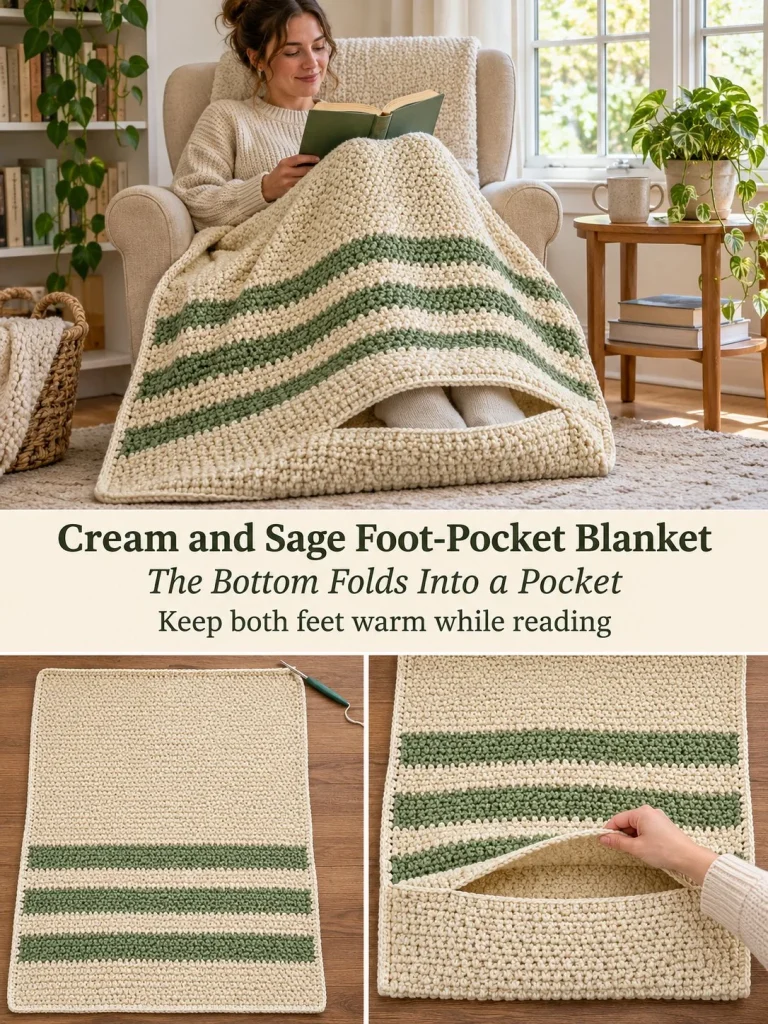
This cozy foot-pocket blanket combines the soft, understated charm of cream and muted sage tones into a functional and beautiful accessory ideal for reading, relaxing, or lounging with warmth wrapped around your feet. Crocheted entirely using simple moss stitch, this rectangular blanket is thoughtfully designed with three horizontal sage bands placed strategically for visual interest in the lower half. The subtle stripes bring a delicate variation to the predominantly cream fabric, lending a timeless appeal that is easy to coordinate with any décor.
Constructed as a full rectangle with a cleverly integrated foot pocket, this project uses a continuous straightforward stitch pattern that creates a textured and reversible fabric, making it ideal for relaxed, everyday use. The foot pocket is formed by folding and sewing the bottom portion of the blanket, allowing the blanket to slip easily over your feet to keep them warm while reading or watching TV. This combination of simplicity and practical design makes it a rewarding project for intermediate crocheters who want an accessible yet satisfying piece.
The key technique for this blanket is the moss stitch—a classic crochet pattern that alternates single crochet and chain stitches to create a fabric with gentle texture and flexibility. The stitch pattern helps produce a fabric that lies flat and has a subtle grid-like pattern, enhancing stitch definition and soft draping. This choice also makes switching colors for the horizontal bands straightforward while maintaining fabric consistency.
If you appreciate projects that blend style with comfort, this pattern offers a satisfying blend of design and function, reminiscent of other great cozy textiles like the cream sage linked ridge lap blanket.
Pattern at a Glance
Skill level: Intermediate
Terminology: US crochet terms
Construction: Flat rectangle worked in rows, folded and sewn to form foot pocket
Finished size: Approximately 42 inches wide by 56 inches long
Yarn weight: Worsted (#4)
Hook: 6 mm (US size J-10)
Main stitch: Moss stitch (also known as linen or granite stitch)
Gauge: Approximately 3.3 stitches per inch measured in moss stitch
Motifs: None; solid patterned fabric with color bands
Layout: Three sage horizontal stripe bands within cream background in the bottom half
Joining: Sew side edges only on folded foot-pocket portion
Border: Single crochet edging in cream yarn
Seaming: Side seams across foot-pocket fold only; foot pocket opening left unsewn
Materials
To craft this foot-pocket blanket, you will need:
- Worsted weight (4) yarn: Approximately 1300–1600 yards in cream and 200–300 yards in muted sage green. The quantity range depends on exact gauge and tension.
- Crochet hook: 6 mm (US J-10) hook recommended for worsted yarn to achieve the proper gauge and fabric drape.
- Tapestry needle: For weaving in ends and assembling the foot pocket seams.
The cream yarn forms the dominant background, while the muted sage adds subtle horizontal bands that highlight the bottom half of the blanket. Using medium-weight yarn provides enough warmth without excessive bulk, making the blanket comfortable and easy to handle.
Yarn and Color Notes
Choosing yarn with a smooth texture will best show off the moss stitch’s intricate yet subtle pattern. Acrylic, wool, or blends of both work well if they offer good stitch definition. Avoid yarns that are too fuzzy or textured, as they might obscure the moss stitch texture and the horizontal striping.
The two-color scheme emphasizes simplicity and elegance. Cream as the dominant color creates a neutral, calming base, while the muted sage adds understated color interest without overwhelming the piece. This color placement allows the stripes to subtly peek through while maintaining a clean, classic look. You can experiment with other earthy or pastel color combinations for a similarly soft effect.
If you prefer variations, consider the related sage cream Tunisian chevron blanket that plays with a complementary hue arrangement and stitch texture in the same palette.
Finished Measurements
The completed blanket measures approximately 42 inches wide and 56 inches long. These dimensions make it perfect for covering the legs comfortably while seated or lying down. The foot pocket formed by folding up the bottom 12 inches creates a roomy opening to slide your feet in while keeping your ankles warm.
Measurement accuracy depends on gauge and yarn thickness, so pre-assembly measurements ensure the final fold aligns with the intended foot-pocket size.
Gauge
The stitch gauge is approximately 3.3 stitches per inch in the moss stitch pattern. This gauge is crucial for obtaining the stated finished size because the stitch density affects the blanket’s width and length.
To measure the gauge:
- Crochet a small swatch of moss stitch using the specified hook and yarn.
- Measure the number of stitches across 4 inches and divide to get stitches per inch.
If your gauge is looser (fewer stitches per inch), the blanket will be wider and shorter for the same stitch count; if tighter (more stitches per inch), it will be narrower and longer. Adjusting hook size accordingly is recommended for proper size.
For a blanket, exact gauge is less critical than for fitted garments, but significant deviations will alter the size and stripe placement.
Abbreviations
- ch = chain
- sc = single crochet
- st(s) = stitch(es)
- sp = space
- tog = together (usually refers to decrease)
All abbreviations follow US crochet terminology conventions.
Important Pattern Notes
- The pattern follows a moss stitch worked flat in rows, which consists of single crochets alternating with chain stitches.
- Chains made in the body form spaces that become the foundation for the next row’s stitches.
- The pattern uses turning chains of 1 chain at the start of each row, which do not count as stitches.
- Color changes occur only in horizontal bands restricted to the bottom half of the blanket—they do not wrap fully around or appear on the top half.
- Edging is worked after the main rectangle is complete, using single crochet in the cream color to frame the blanket neatly.
- The foot pocket is formed by folding and sewing only the side edges of the bottom 12 inches; the top edge of the fold remains unsewn to allow feet entry.
- Maintain straight edges carefully by starting with an even number of foundation chains and following the moss stitch pattern precisely.
Special Stitches and Techniques
Moss Stitch
The moss stitch creates a dense, textured fabric using an alternating sequence of single crochet and chain stitches. It can also be called linen or granite stitch. The pattern here works into chain-1 spaces rather than the stitches themselves, giving a stable yet flexible fabric with subtle grid-like holes.
This stitch is worked as follows:
- Row 1: Single crochet in the 2nd chain from hook, chain 1, skip the next chain, single crochet in the next chain, repeat across.
- Row 2 onward: Chain 1, turn. Single crochet into the next chain-1 space, chain 1, skip next single crochet, repeat across.
This stitch produces a balanced "checkerboard" texture that is reversible and lies flat without curling.
Color Banding
The three wide sage horizontal bands create an elegant contrast with the cream background while being limited to the blanket’s lower half. Changing colors in these bands requires a clean color change technique—switching yarns at the end of a row to begin the next with a new color.
Understanding the Construction
The blanket is a large rectangular panel measuring approximately 42 inches wide by 56 inches long, crocheted flat in rows using the moss stitch. The rectangular shape offers a simple base to work on, ideal for adding color blocks and texture evenly.
The three muted sage horizontal stripes are arranged only in the bottom half, approximately rows 28–34, 39–45, and 50–56 from the top edge, with each band being equal in width. Beginning with cream as a dominant background maintains a neutral and calm aesthetic for most of the blanket.
After completing the rectangle and edging, the bottom 12 inches are folded up inside the blanket to form a foot pocket. Only the side edges of this fold are sewn to allow the top edge of the fold to remain open for inserting feet. This practical construction allows for a straightforward project with an added functional element.
Complete Pattern Instructions
Foundation
- Begin by chaining an even number of stitches to achieve approximately 42 inches in width. Based on stitch gauge (roughly 3.3 sts per inch), this corresponds to about 140 chains.
- It’s essential to start with an even number of chains to ensure the moss stitch pattern aligns correctly.
Row 1
- Starting in the 2nd chain from the hook, work 1 single crochet.
- Chain 1, skip the next chain, single crochet in the following chain—repeat this sequence across the entire foundation chain until you reach the last chain.
- Your first row establishes the moss stitch pattern and foundation for subsequent rows.
Row 2 and Onward
- Chain 1 and turn your work.
- Work 1 single crochet into the next chain-1 space from the previous row (not into a stitch).
- Chain 1, skip the next stitch, single crochet into the following chain-1 space. Repeat this sequence across the entire row.
- Continue working each row in this moss stitch pattern, preserving the straight edges. This means no stitches should be added or missed along the sides to avoid shaping; keep the stitch count constant.
Color Bands
- The blanket primarily uses cream yarn, but three wide sage horizontal stripes are worked only in the bottom half to add delicate contrast and visual interest.
- The approximate row ranges for sage stripes are:
- First band: rows 28 to 34 from the top (7 rows)
- Second band: rows 39 to 45 from the top (7 rows)
- Third band: rows 50 to 56 from the top (7 rows)
- Adjust these rows to ensure each band is equal in width, based on your gauge and tension.
Edging
- After completing all 56 rows (including colored bands), work a single crochet edging around the entire rectangle using cream yarn.
- The edging provides a neat frame and keeps the edges tidy and straight.
Folding and Sewing the Foot Pocket
- Fold the bottommost 12 inches of the blanket up towards the inside, aligning the vertical side edges soundly.
- Sew only the side edges of the folded portion using a tapestry needle and matching yarn, securing the edges firmly.
- Do not sew the new top edge created by this fold; this edge remains open to allow your feet to slide into the pocket easily.
Final Fit Test
- After assembly, test fit the blanket by tucking your feet inside the foot pocket opening. Adjust the seam tension if necessary to allow comfortable foot entry.
Checkpoints
- Your rectangle should measure approximately 42 inches wide at the foundation chain stage and about 56 inches long after all rows are complete.
- The sage bands appear only in the bottom half and are evenly spaced with roughly equal widths of about seven rows each.
- Edging completes the rectangle with no curling or distortion.
- Post fold, side seams are tidy and secure, with an unobstructed foot-pocket opening.
Assembly and Joining
The unique feature of this blanket is the pocket formed at the bottom by folding and sewing. To assemble:
- Fold up the bottom 12 inches of the blanket’s length toward the inside.
- Ensure vertical edges meet precisely to maintain straight lines.
- Sew side edges only along this fold, leaving the horizontal top edge open. This ensures the foot pocket opens across the full 42-inch width.
- Use a tapestry needle with matching cream yarn for subtle, secure seams.
Since only side seams are sewn, the blanket remains flexible and easy to slip feet into the pocket.
Finishing
- Weave in all yarn ends securely with a tapestry needle, hiding them inside the fabric for a clean finish.
- Blocking is optional but can be helpful to relax the fabric, align edges evenly, and showcase the color bands cleanly.
- If blocking, gently pin to proper dimensions and allow to dry completely.
- Store in a dry environment to maintain the yarn’s softness.
How to Resize
Resizing this blanket to different dimensions is straightforward by modifying the starting chain and row count while maintaining the moss stitch pattern and folding concept.
- Width: The starting chain must be an even number for the stitch multiple, and each chain corresponds roughly to 3.3 stitches per inch. For a wider blanket, increase the initial chain by multiples of 2 chains.
- Length: Increase or decrease the number of rows. To keep proportionate color band placement, adjust the row counts accordingly.
- The foot pocket fold should always remain approximately 12 inches for comfortable foot coverage but can be adjusted as desired.
Useful Variations
- One-Color Version: Skip the sage stripes to make an elegant solid cream blanket.
- Alternate Color Bands: Use different sage-like or contrasting colors for stripes to customize your palette.
- Wider or Longer Blanket: Increase chain count and rows for a larger throw size or smaller lap throw.
- Scrap Yarn Blanket: Use leftover worsted yarn in creams and sage tones for a patchwork stripe effect.
- Matching Cushions: Create coordinating cushions using moss stitch texture and colors for a matching reading nook.
Troubleshooting
Why Is My Blanket Too Narrow or Too Wide?
Check your gauge carefully. Adjust your hook size: use a larger hook for a wider, looser fabric or a smaller hook for a denser, narrower fabric.
Why Are My Edges Crooked or Wavy?
Ensure you do not add or skip stitches along each row’s edges. Maintain the exact stitch count and properly chain 1 before turning each row.
Why Do My Color Changes Look Messy?
Make clean color transitions by switching yarns at the end of rows and weaving yarn tails securely inside the fabric without pulling tightly.
Why Is the Foot Pocket Too Tight or Too Loose?
Verify that the folded 12-inch section matches your personal foot size. Adjust seam tightness or fold length to accommodate wider or narrower feet.
Why Is My Moss Stitch Fabric Curling?
This stitch tends to lie flat. If curling occurs, try blocking the piece or ensuring consistent tension throughout.
Frequently Asked Questions
Can I use a different yarn weight?
Yes, but adjusting hook size and stitch count will be necessary to maintain finished measurements and fabric drape.
Can I use cotton yarn?
Cotton works but results in a less stretchy fabric. It’s best for warmer climates or decorative use.
Is this pattern suitable for beginners?
Intermediate skill level is recommended due to row counting, color changes, and foot pocket assembly.
Are the stitches reversible?
Yes, moss stitch creates a lovely reversible texture, so both sides are attractive.
Can I make this blanket larger, like a full throw?
Absolutely. Increase stitch and row counts proportionally while maintaining the stitch pattern.
How should I care for this blanket?
Hand wash or machine wash on gentle cycle with cool water; lay flat to dry to preserve shape.
Related Projects
This simple moss stitch rectangle construction lends itself well to other cozy accessories:
- Lap blankets and throws with different color band arrangements
- Floor cushions or pillow covers using rectangular panels folded and sewn
- Easy wearables like cowls or poncho bodies constructed in similar stitch and shape
These variations capitalize on the elegant texture and simple lines of this stitch and layout style.
Final Thoughts
This foot-pocket blanket pattern is a perfect blend of style, comfort, and function. Using basic moss stitch and straightforward color bands, you create a timeless piece that keeps feet warm during quiet moments. The clever folding and side-seaming for the foot pocket add practical value without complicating construction, making it an enjoyable project for intermediate crocheters.
Its simple foundation allows for customization in size, colors, and edging, while the moss stitch texture offers subtle visual and tactile interest. Whether for yourself or as a thoughtful handmade gift, this blanket combines craftsmanship and coziness in every stitch.



