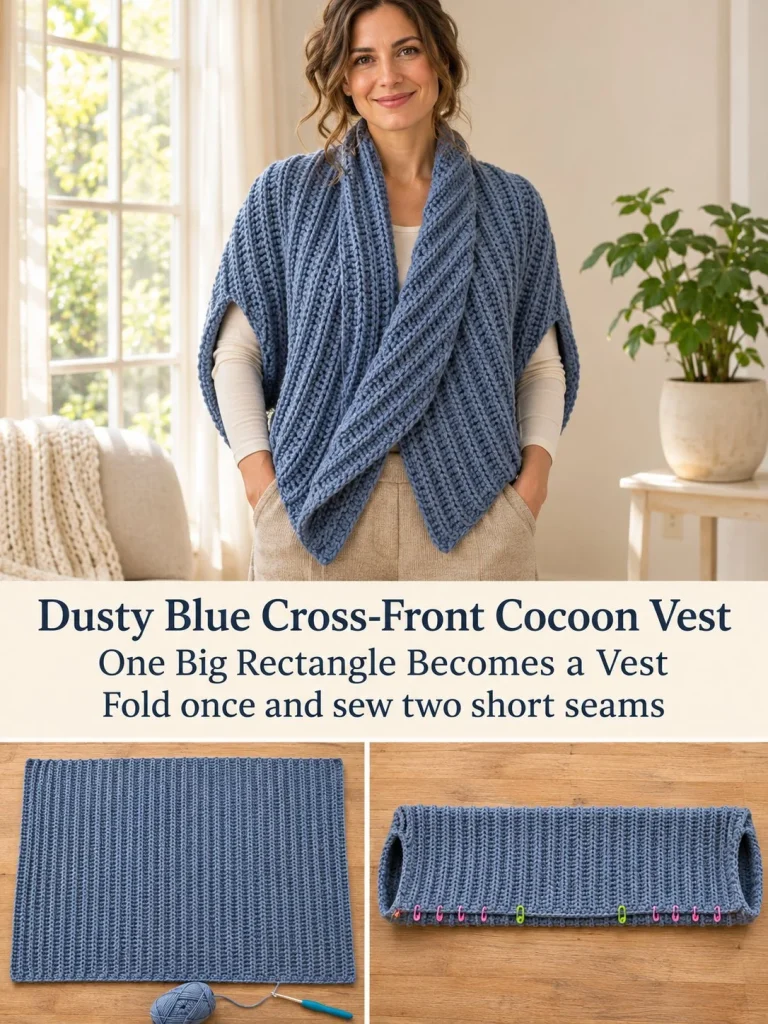
This relaxed crochet vest features a modern cocoon silhouette in a soothing dusty blue denim shade. Constructed from a single rectangular panel folded and sewn strategically, it offers effortless layering with a flattering cross-front design. The piece showcases a distinctive raised-ridge texture created by alternating double crochet and front post double crochet stitches, providing both visual interest and subtle structure. Its loose fit and soft drape make it ideal for transitional weather or as a cozy indoor layer.
The construction is minimalist yet clever: a large rectangular fabric is folded in half, and its edges are joined only partially to create comfortable armholes and an open front with overlapping panels that fall naturally without closures. This method simplifies the garment assembly while delivering a stylish and versatile vest. Using a 6.5 mm hook with worsted weight yarn ensures the fabric has a substantial, wearable weight that maintains the shape but is still soft and touchable.
The textured fabric approach ensures a neat but dynamic surface, and maintaining consistent tension throughout is crucial for smooth edges and even seaming. For crocheters interested in enhancing their accessories collection with complementary pieces—consider coordinating the vest with a dusty blue keyboard wrist rest crochet accessory to unify your workspace aesthetic seamlessly.
Pattern at a Glance
Skill level: Intermediate – requires familiarity with front post double crochet and precise seaming
Terminology: US crochet terms
Construction: Single rectangular panel folded and sewn partially along edges
Finished size: Approximately 40 inches long by 16 inches wide (folded dimension)
Yarn weight: Worsted (#4)
Hook: 6.5 mm
Main stitch: Alternating double crochet (dc) and front post double crochet (fpdc) for raised-ridge texture
Gauge: Swatch made in alternating dc/fpdc texture – crucial for stable edges and consistent tension
Motifs: None, single textured fabric
Layout: One large rectangle folded in half widthwise
Joining: Seaming 11 inches at each end along folded edges, leaving middle 18 inches open
Border: Optional relaxed single crochet edging on armholes and front openings
Seaming: Tapestry needle and yarn used to sew folded overlap seams
Materials
- Yarn: Approximately 1000 to 1200 yards of worsted weight yarn in dusty denim blue. Choose a yarn that is smooth with good stitch definition to show off the textured raised-ridge stitch clearly.
- Hook: 6.5 mm crochet hook, large enough to produce a fabric with a good drape and softness without too much looseness.
- Tapestry Needle: Essential for sewing seams neatly and weaving in ends securely.
- Markers: Stitch markers can help maintain stitch counts and mark seam lines or fold points to ensure accurate assembly.
Each material plays an important role in the final garment’s quality. The yarn must provide durability and softness, while the hook size dictates the fabric’s density and drape. Markers are indispensable when managing a large rectangular panel to keep stitch counts consistent.
Yarn and Color Notes
The dusty denim blue shade is perfect for a relaxed yet polished look. Cotton blends, acrylic, or wool yarns can all work, but fiber choice affects drape and warmth. Smooth yarns highlight the raised-ridge texture best. Avoid highly fuzzy or loosely spun yarns here, as uneven stitch definition may hide the front post double crochet pattern. Consider solid color or subtly heathered yarns rather than variegated to maintain the garment’s clean lines.
For a modern twist, pair this vest with accessories in the same dusty blue palette such as the origami shoulder bag, creating a cohesive look for casual outings. This coloring lends itself well to mixing with soft neutrals or contrasting rich earth tones.
Finished Measurements
- Rectangular panel before folding: 40 inches (length) × 32 inches (width)
- Folded fabric dimensions: 40 inches long × 16 inches wide
- Seamed edges at folded long sides: 11 inches at each end, leaving an 18-inch center opening for body access
- The armholes formed by the folded outer short edges provide generous width; seam length can be adjusted slightly for comfort.
The measurements provide a comfortable, loose fit adaptable across sizes. Minor modifications to seam lengths allow customization of armhole size to suit different body types or layering thicknesses.
Gauge
Gauge is established by making a generous swatch in the alternating double crochet and front post double crochet raised-ridge texture. This ensures:
- Consistent stitch height and width for even edges
- Stable fabric that won’t flare or pucker excessively
- Reliable measurements to meet the specified rectangle dimensions
For garments, maintaining gauge is vital because size and fit depend directly on the stitch tension. Check gauge by measuring several rows and stitches in the main pattern before proceeding with full panel construction. Adjust hook size if necessary; a tighter gauge results in a smaller vest, a looser one in a larger, less dense fabric.
Abbreviations
- dc: Double crochet
- fpdc: Front post double crochet (stitch worked by inserting hook from front around post of stitch below)
- ch: Chain
- sc: Single crochet (used optionally for edging)
All terms follow standard US crochet terminology.
Important Pattern Notes
- The fabric is worked as a flat rectangular panel; stitch counts remain consistent to maintain size.
- Turning chains should follow the established pattern to maintain edge height and texture (usually ch 3 counts as first dc).
- The front post double crochet produces raised ridges by working around the post of the stitch in the previous row rather than the top loops.
- Edges must be kept stable with consistent tension for neat seaming later.
- Seaming technique is important to allow stretch and maintain soft drape; use mattress or whip stitch to sew edges 11 inches from each end, leaving an 18 inch opening at the center.
- The arm openings are formed by overlapping the short edges of the folded rectangle; test seam length and armhole fit before final stitching.
Special Stitches and Techniques
- Front Post Double Crochet (fpdc): This stitch is crucial for creating the raised-ridge textured fabric. Insert the hook from front to back around the post of the stitch below, yarn over, pull through, yarn over, pull through two loops twice, similar to a double crochet but worked around the post.
- Double Crochet (dc): A basic stitch worked in standard way through top loops.
- Maintaining even tension while alternating dc and fpdc creates striking ridged fabric that drapes well without curling.
Understanding the Construction
The vest is essentially a single rectangular panel worked flat and then folded in half widthwise. The fold reduces the 32-inch width by half, creating a 16-inch width panel that will wrap around the body. The two long edges (each 40 inches) now meet when folded.
Seams are sewn from the outer edges inward 11 inches on each long side, leaving an 18-inch center front opening to allow the body to slide through comfortably. This open central section creates two overlapping front flaps that drape loosely, forming the cross-front style. The short edges of the rectangle become wide armholes due to the fold.
After seaming, the vest is turned right side out for wearing. Optional single crochet edges can be added at the armholes and front flaps openings for a polished finish and to ensure edges remain relaxed and do not curl.
Full Pattern Instructions
Foundation
Begin by making a generous gauge swatch in the alternating dc/fpdc raised-ridge stitch pattern to confirm your gauge and stitch tension.
Main Rectangle
- Chain foundation to the required width to achieve a 40 inch length along the long dimension when worked flat.
- Work the alternating dc/fpdc raised-ridge texture, maintaining stable edges and consistent yarn tension.
- Continue crocheting rows until the rectangle reaches 32 inches along the short dimension.
Note: Keep the edges neat and stitch tension uniform throughout to ensure even seaming later.
Folding and Seaming
- Lay the finished rectangle flat horizontally with the 40-inch edges running left and right, and the 32-inch edges top and bottom.
- Fold the rectangle exactly in half along the 32-inch width, so these edges meet perfectly. Now the folded piece measures 40 inches long × 16 inches wide.
- The folded long edges are aligned for seaming. Sew the edges for 11 inches from both the top and bottom ends, leaving the middle 18 inches unsewn. This unsewn section forms the front body opening.
- Before final seaming, test the arm openings and body opening for comfort. Adjust seam length slightly if needed by reducing from 11 inches at each end for wider armholes or ease of movement.
- Turn the sewn vest right side out.
Finishing
- Slip your arms through the side openings created by the folded outer short edges forming wide, relaxed armholes.
- Let the center front drape naturally into two overlapping loose flaps, with no closure needed.
- Optionally, add a relaxed single crochet edging along all exposed openings (armholes and front flaps) for a neat frame and improved edge stability.
Checkpoints
- After completing the rectangle panel, verify it measures 40 × 32 inches exactly.
- After folding and pinning, confirm fold edges align perfectly before seaming.
- Test armhole openings for ease by slipping arms through before sewing final seams.
- After seaming, ensure the center front opening measures about 18 inches and flaps overlap comfortably.
- Check all edges for consistent tension and neatness, preparing for optional edging.
Assembly and Joining
Assembly involves no complex shaping beyond folding the large rectangle in half and setting the seams. Use the tapestry needle and yarn to sew the seams securely by hand, working carefully with matched stitches at the edges. Use mattress stitch or whip stitch for a flexible seam that supports the fabric’s natural stretch.
Align each long edge carefully to avoid puckers. The seams only span the outermost 11 inches at both the top and bottom ends, so pay attention to leave the exact unsewn gap between those seams.
After seaming, turn the piece right side out through the open front.
Border and Finishing
Adding a single crochet edging around the armholes and front edges softens the look and stabilizes the fabric’s edges. Use relaxed tension for the edging to prevent pulling or puckering.
To add the edging:
- Insert hook in any stitch along the armhole or front edge.
- Work a single crochet stitch evenly spaced around the edge, joining the rounds as needed.
- Use markers to maintain corners and prevent curling.
Weave in all ends on the wrong side with the tapestry needle.
Block the vest gently if desired by pinning it to the exact final dimensions, dampening lightly, and letting dry flat.
How to Resize
The size of this vest is directly controlled by the rectangles dimensions:
- To increase length, add rows maintaining the alternating dc/fpdc pattern until the fabric reaches a longer 32+ inch dimension before folding.
- To increase width, add stitches to the foundation chain proportionally to achieve more than 40 inches along the long dimension.
- Adjust seam lengths when sewing folded edges to suit armhole size and body openness. Decreasing seam length creates wider arm openings.
- Gauge must remain consistent to ensure accurate size scaling.
Since the construction depends on folding the rectangle exactly in half, aim to keep the width dimension divisible by two for balanced fit.
Useful Variations
- Use variegated or tonal yarns to add subtle color shifts that highlight the ridge texture.
- Omit the single crochet edging for a more casual, raw-edge look suitable for spring layering.
- Crochet a shorter rectangle for a cropped vest version.
- Experiment with different yarn fibers for varying warmth and drape.
- Incorporate a contrasting color edging for a bolder statement.
Troubleshooting
Why Is My Fabric Curling at the Edges?
The alternating dc/fpdc stitch pattern helps reduce curling, but some edge curling is normal for projects without borders. Consistent tension and adding a single crochet edging will help flatten edges.
Why Are My Seams Puckering?
Seams can pucker if edges were stretched unevenly or fabric edges mismatch. Ensure accurate stitch count matching and sew with relaxed tension allowing fabric stretch.
My Armholes Feel Too Tight; What Can I Do?
Before final seaming, test armhole openings by slipping arms through. Reduce seam length from 11 inches at each edge to widen armholes slightly for comfort.
Why Does the Front Not Drape Properly?
Ensure the center front opening remains unsewn for 18 inches to allow overlapping flaps to fall naturally. If seams are too long or pulls are tight, adjust seam lengths.
Frequently Asked Questions
Can I use a different yarn weight?
Worsted weight yarn is recommended to achieve proper drape and fabric structure. Using much lighter or heavier yarn will alter gauge and affect folding dimensions and fit.
Is this project suitable for beginners?
Intermediate crochet skills are needed due to working front post double crochet and sewing techniques. However, confident beginners can try with practice and tutorial references.
Can I make it in a different color?
Yes, any solid or semi-solid color yarn works well to emphasize the stitch texture.
Do I need special tools?
Standard crochet hook, tapestry needle, and stitch markers suffice. No special equipment is required.
How should I block the vest?
Block gently by pinning flat to size when damp. Avoid stretching folded dimensions to maintain shape.
Is the vest reversible?
While the fabric texture is consistent, seams on the folded edges are visible. The right side is recommended for wear.
Related Project Ideas
The alternating dc/fpdc raised ridge stitch and minimalist construction technique can be adapted for projects such as wrap scarves, rectangular shawls, or easy tote bags. Similar fabric design could also inspire stylish accessories for day-to-day use.
Final Thoughts
This vest’s charm lies in its simple, elegant construction and textured fabric that brings timeless style with minimal sewing. Starting with a well-made rectangular piece and folding it creates comfortable armholes and an open front with natural overlapping flaps—perfect for layering. The thoughtful use of front post double crochet combined with double crochet produces a fabric that is sturdy yet pliable.
For those looking to expand their crochet wardrobe, this garment is both versatile and fashion-forward, blending comfort with a touch of artisanal detail. Along with coordinating accessories like a crochet keyboard wrist rest, it completes a cohesive dusty blue collection worth wearing and gifting.



