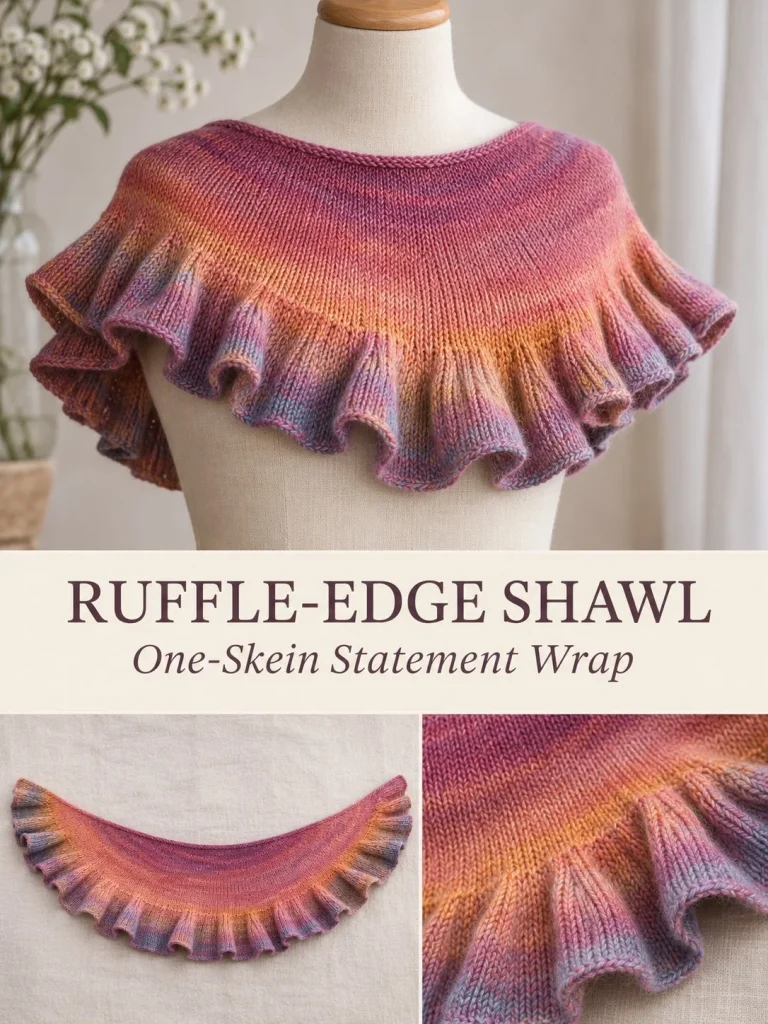
This refined shawl project offers a sophisticated blend of simplicity and elegance with its ruffle-edged finish, designed for knitters who appreciate a stylish accessory crafted from just one skein of sport-weight yarn. The wrap features a shallow square-backed shape that drapes beautifully across the shoulders, providing both warmth and a visual statement with its flowing silhouette. The ruffle edging introduces a dynamic, tactile element that enhances the shawl’s allure while maintaining wearability and comfort.
Constructed entirely in stockinette stitch, this shawl emphasizes clean lines and smooth fabric, allowing the subtle tonal shifts of the yarn to shine. The shaping is carefully planned to ensure the upper edge fits neatly around the shoulders, creating a flattering and functional design. This pattern is perfect for those looking to knit a quick yet sophisticated accessory that combines practical wear with a touch of whimsy and sophisticated texture. For knitters interested in expanding their collection of stylish wraps, exploring the Autumn Sampler Wrap knitting pattern offers a wonderful insight into different textural possibilities.
Pattern at a Glance
Skill level: Intermediate (due to shaping and ruffle increases)
Terminology: Standard US knitting terms
Construction: Flat knitting, single piece with shaped stockinette body and ruffle edging
Finished size: Approximately 66 in (168 cm) width across the lower hem and 15 in (38 cm) height from hem to upper edge
Yarn weight: Sport weight or light fingering, approx. 273 yards (250 meters) per skein
Needle size: US 6 / 4.0 mm circular or straight needles (to accommodate width)
Main stitch: Stockinette stitch
Gauge: 23 stitches and 30 rows = 4 inches (10 cm) in stockinette stitch
Motifs: None; single-piece construction
Layout: Shallow square-backed wrap with ruffle edging
Joining: None; worked flat in one piece
Border: Knitted ruffle formed by increases
Seaming: Not applicable
Materials
- Yarn: Cascade 220 Superwash Sport Wave or a similar sport-weight wool yarn, approximately 273 yards (250 meters). The original sample uses the Beach Sunset colorway which offers lovely tonal variation ideal for highlighting the stockinette body.
- Needles: US 6 / 4.0 mm needles, either straight or circular. Circular needles are recommended for comfort due to the shawl’s width, even though the piece is worked flat.
- Notions: Tapestry needle for weaving in ends and sewing in the working yarn tails.
- Blocking tools: Blocking mats and pins to shape the shawl after finishing, particularly important for opening the ruffle edge to display its full wave and to even out the stockinette fabric.
Yarn and Color Notes
Choosing a sport-weight wool like Cascade 220 Superwash Sport Wave ensures warmth and excellent stitch definition, crucial for the smooth stockinette background and the ruffle detail. Wool’s elasticity naturally assists in blocking, helping to open the ruffle’s waves attractively. A solid or tonal yarn with subtle color gradation works best to highlight the texture without overwhelming it.
Avoid overly fuzzy or highly textured yarns which can obscure the clean stockinette and ruffle definition. Smooth yarns maintain crisp stitch lines and facilitate the light ruffle waves along the edge. Consider color choices that suit your wardrobe to maximize the shawl’s wearable appeal.
Finished Measurements
The completed shawl measures approximately 66 inches (168 cm) wide across the lower hem — providing generous shoulder coverage and drape — and stands about 15 inches (38 cm) tall from hem to the upper edge. The height is designed to deliver a shallow square-backed wrap that sits comfortably, not bulky or oversize, making it perfect for layering.
Because the gauge directly affects these dimensions, it is essential to knit a swatch first to confirm accuracy.
Gauge
The established gauge for this pattern is 23 stitches and 30 rows per 4 inches (10 cm) in stockinette stitch. To measure gauge accurately:
- Knit a swatch larger than the 4-inch square, ideally 6 inches square, to allow for measuring center fabric unaffected by edge distortions.
- Lay the swatch flat without stretching and count stitches and rows over 4 inches.
Maintaining correct gauge ensures the shawl reaches the designed size and drape. If your gauge is tighter (more stitches per inch), expect a smaller shawl requiring fewer rows to maintain proportions. Conversely, a looser gauge (fewer stitches per inch) will produce a larger wrap and may require adjustments to row count or needle size if you prefer the intended measurements.
Abbreviations
- st(s): Stitch(es)
- k: Knit
- p: Purl
- inc: Increase (specific placement according to pattern)
- bind off: Finish and secure stitches at edge
- RS: Right side
- WS: Wrong side
Important Pattern Notes
- The shawl is worked completely flat from the bottom edge upwards.
- Stockinette stitch construction means knit on the right side rows and purl on the wrong side rows unless otherwise specified.
- The shaping uses published increases placed precisely to create the shallow square-backed shape. Follow the increase placement carefully for the correct fit.
- The ruffle is knitted along the entire outer edge at the completion of the stockinette body. Increasing is done to create fullness, and it is important to achieve a balance for a “wearable wave” rather than a tight or shriveled edge.
- Bind off loosely to maintain edge elasticity and prevent pulling in.
- Blocking is critical to open the ruffle waves and even out the stockinette fabric for a polished finish.
Special Techniques and Knitting Skills
The pattern relies on fundamental knitting techniques but includes tuning shaping and working the ruffle edge which involves brisk increases. The key skills include:
- Knit and purl stitches for stockinette fabric.
- Increases following the pattern’s exact placement to shape the upper edge and ruffle.
- Loose bind off to preserve elasticity at the ruffled border.
- Blocking to shape and expand the ruffle waves.
There are no complex stitch patterns or motifs, making this project accessible to knitters comfortable with shaping and lace/frill edges.
Understanding the Construction
This project is worked flat as a single piece:
-
Main Body: The largest section is a shallow, square-backed wrap made in stockinette stitch. It is shaped through strategic increases that gently angle the edges rather than making a perfect rectangle. This shaping ensures the wrap sits smoothly over the shoulders without bunching.
-
Ruffle Edge: Once the main rectangular body is complete, the outer edge is picked up or worked along to knit a ruffle. The ruffle employs increase rows to create a lengthened, flowing wave along the border, adding volume and flair without creating stiffness or excessive width.
After bind-off, the entire piece is blocked to open the ruffle and align the stockinette fabric into a smooth, elegant statement wrap.
Full Pattern Instructions
Foundation
Cast on the number of stitches specified in the source pattern’s one-skein construction (refer to exact counts to replicate gauge and size).
Body
Work the stockinette body flat, knitting all right side rows and purling all wrong side rows. Use the published shaping increases placed at exact points per the source pattern to gradually form the shallow square-backed shape.
Continue this until the total width measures approximately 66 inches (168 cm) across the bottom hem and the depth from hem to the upper edge is 15 inches (38 cm).
Checkpoints: Periodically measure to confirm the width and height correspond closely to these dimensions. It is better to measure than rely on stitch counts alone as needle tension may vary.
Ruffle Edge
With the shawl flat, proceed to knit the ruffle along the outer edge. Follow the source pattern’s exact increase placement and count details to achieve a full but wearable wave.
Increases should be executed evenly to allow the ruffle to expand outward without curling or pulling tight. The edge should have a natural wave form that adds a scalloped aesthetic framing the main fabric.
Bind Off and Finishing
Bind off stitches loosely to maintain edge elasticity and prevent the ruffle or stockinette edge from constricting. After completing the binding off:
- Blocking: Soak the shawl gently, then pin flat on blocking mats.
- Allow the ruffle edges to open fully by spreading pins along the waves.
- Ensure the stockinette fabric lies smooth, adjusting pins as needed to correct any curling or uneven edges.
- Let dry completely to set the shape.
Blocking is essential to bring the full effect of the ruffle to life and soften the texture of the stockinette body.
Checkpoints During Knitting
- After the body is approximately half complete, confirm that the width aligns with the projected increase shaping and the shape is beginning to reflect a square-backed rectangle rather than simple rectangle.
- When beginning the ruffle, check the number of stitches after increases carefully to ensure the desired waviness will be achieved.
- Regularly measure length and width against the pattern specifications to catch any gauge or tension drift early.
Assembly
This wrap is a single-piece project that does not require seaming. The edges are finished as you knit, and the ruffle is added directly to the main piece.
Finishing and Blocking Tips
To maximize the elegant wave of the ruffle edge, block the shawl after knitting fully:
- Use rust-proof pins that won’t stain yarn.
- Pin out the ruffle waves gently but firmly to open them fully.
- Flatten the stockinette body during blocking to prevent curling along plain edges.
- Allow to dry completely on a flat surface to maintain shape.
Proper finishing will transform your shawl into a wearable art piece ready for any season.
How to Resize the Shawl
Resizing involves adjusting the width and height by modifying the number of increases and total rows:
- To widen the wrap, add more increases along the edges during the body knitting following the source pattern’s shaping logic. Maintain the stitch multiple per the stockinette stitch gauge of 23 sts per 4 inches.
- To lengthen the shawl, add more rows while maintaining the shaping increases proportionally. The height is the vertical measurement from hem to upper edge.
- Resizing the ruffle requires proportional increases to maintain the fullness of the wave; scale the count carefully based on the new edge length.
Maintaining gauge is crucial during resizing to ensure shape and drape remain consistent.
Variations
- Solid Color Elegance: Use a single dyed skein in a rich hue for a timeless shawl that highlights the ruffle silhouette.
- Self-Striping or Gradient Yarn: Showcases the stockinette body’s smooth expanse with subtle color or shade transitions.
- Block the Ruffle Differently: For a less dramatic wave, reduce increases to make a gentler ruffle.
- Longer Wrap: Extend the vertical dimension for more coverage, ideal for cooler climates.
For ideas on styling shawls with similar construction but different stitch work, consider the Birdhouse Wide Shawl knitting pattern featuring twisted stitches for added texture.
Troubleshooting
Why Is My Ruffle Too Tight or Too Loose?
If your ruffle lacks fullness, you may have missed increases or knit too tightly. Conversely, an overly loose ruffle may have too many increases or very loose stitches. Follow the exact increase count and placement from the pattern and adjust needle tension lightly.
Why Is My Stockinette Curling?
Stockinette naturally tends to curl, especially when unblocked. Blocking is essential for this pattern to flatten and even the fabric. Use heavy blocking pins and a firm soaking method to eliminate curling.
How Do I Keep the Edge Even When Increasing for the Ruffle?
Distribute increases evenly as specified. Counting stitches regularly helps catch errors early. Use stitch markers if needed to mark increase points.
What If My Dimensions Don’t Match the Pattern?
Check your gauge first. Knit a swatch and adjust needle size as needed to hit the gauge of 23 sts and 30 rows per 4 inches. Also ensure you are following the increase count precisely.
Frequently Asked Questions
Can I use a different yarn weight?
This pattern is designed for sport weight yarn. Using a heavier or lighter yarn will alter dimensions and drape significantly. If experimenting, swatch and adjust needle size accordingly.
Can I knit this shawl in one color?
Absolutely. A single solid yarn will elegantly showcase the ruffle and shaping with understated texture.
Is this pattern suitable for beginners?
Intermediate knitters who are comfortable with stockinette stitch, increases, and reading shaping charts will find this project rewarding. Beginners may want to practice basic shaping first.
Do I need circular needles?
While straight needles can be used, circular needles are recommended for comfort and to accommodate the wide width.
How should I block the shawl?
Soak gently and pin flat on blocking mats, spreading the ruffle waves evenly and flattening the stockinette fabric. Allow to dry fully.
Is the ruffle reversible?
The ruffle is designed to flow outward gracefully and appears best from the right side. The wrong side will show the stockinette purl side and the underside of the ruffle increases.
Optional Related Uses
The same stockinette stitch and shaping technique used here can be adapted for other projects such as lightweight wraps, bench scarves, or even large lapghans. The ruffle technique can embellish edges of blankets or even garment collars for a feminine touch of movement and texture.
Final Thoughts
This one-skein shawl pattern beautifully demonstrates how simple stockinette, expert shaping, and thoughtful finishing like a knitted ruffle can transform basic knitting into a statement wrap. The combination of a shallow square-backed form and a full, wearable wavy border offers an elegant accessory that balances warmth with style.
Working it flat with precise increases for shaping and edging makes it a manageable but satisfying knit. Proper gauge and careful blocking are essential to reveal the shawl’s full potential, ensuring a comfortable fit and a striking ruffle finish. This project stands as a refined reminder that the most effective knitting often arises from well-controlled simplicity and thoughtful detail.



