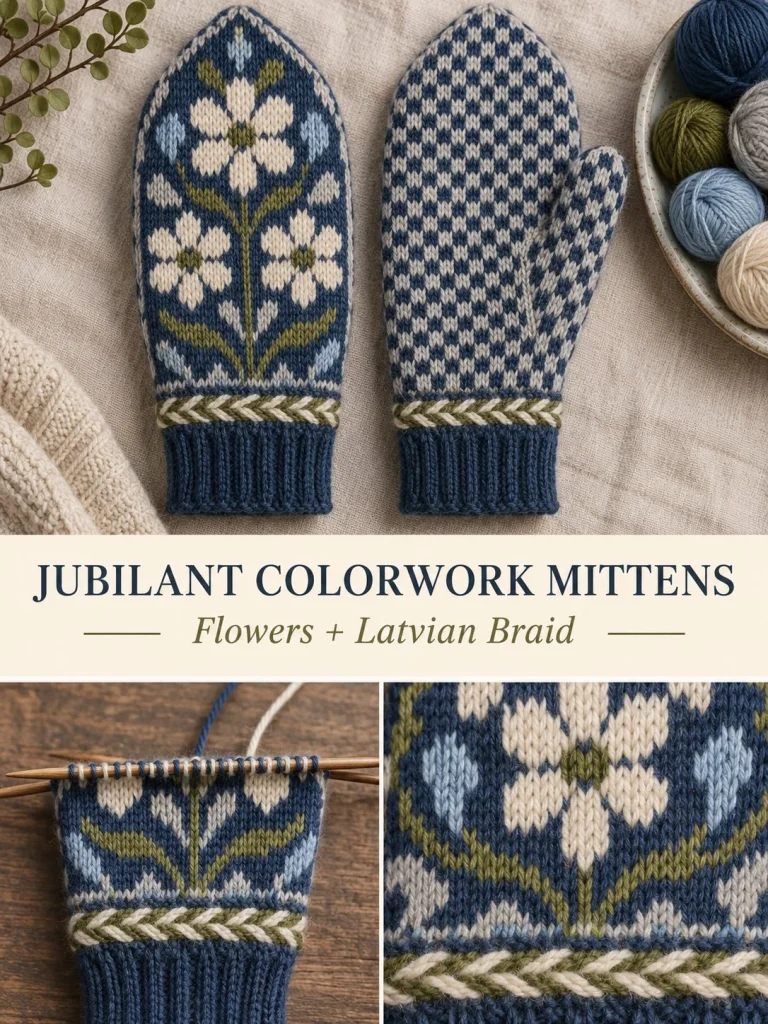
The joyous interplay of floral colorwork combined with the striking detail of Latvian braid creates a truly captivating pair of knitted mittens. Crafted with careful attention to pattern, texture, and technique, this project celebrates traditional motifs while delivering warmth and function. Utilizing fingering weight wool yarns, these mittens offer an ideal balance of intricate craftsmanship and practical wearability.
The construction is seamless and worked entirely in the round, beginning with a snug ribbed cuff on smaller needles for a comfortable fit around the wrist. Following this, the distinct Latvian braid encircles the cuff, adding both textural interest and a nod to heritage knitting styles. The main body showcases three carefully designed charts: a jubilant flower motif on the back of the hand, a contrasting checkerboard pattern across the palm, and a thumb/gusset chart to shape and structure the thumb. This combination of motifs injects dynamic visual appeal and complexity without compromising the fabric’s ability to stretch and shape with the wearer’s hand.
This pattern is perfect for those looking to deepen their colorwork skills, experiment with Latvian braid techniques, or simply make a standout accessory for chilly weather. The choice to use playful yet harmonious colors adds to the mittens’ charm, making them both a technical challenge and a stylish winter essential. Knitters who enjoy balancing careful chart reading with the tactile pleasure of wool will find this project rewarding.
For knitters interested in exploring similar colorful hand accessories, the Snowberry Mittens with Bobble Flowers and Cuffs provide a wonderful complement to the Latvian braid design shown here.
Pattern at a Glance
Skill level: Intermediate to Advanced (due to stranded colorwork and Latvian braid)
Terminology: Standard US Knitting terminology
Construction: Knitted in the round, starting from cuff to fingertip, thumb worked separately from picked-up stitches
Finished size: Adult
Yarn weight: Fingering weight, 100% wool
Needles: US 1 (2.25 mm) and US 2 (2.75 mm) circular needles for small circumference work
Main stitch: Colorwork stranded knitting with Latvian braid and ribbed cuff
Gauge: 7 stitches per inch (2.5 cm) in pattern
Motifs: Latvian braid, flower motif, checkerboard palm, thumb/gusset chart
Layout: Circular, radial colorwork with isolated motifs
Joining: Seamless knitting in the round, Kitchener stitch to close mitten tip
Border: Ribbed cuff transitioning into Latvian braid
Materials
To execute this pattern successfully, the following materials are recommended:
-
Yarn: Knit Picks Palette or a comparable fingering weight 100% wool yarn in six distinct colors:
- Seafaring: 66 yards
- Caper: 46 yards
- Ash: 36 yards
- Sky: 36 yards
- Almond: 25 yards
- Oyster Heather: 20 yards
These specific quantities ensure you have enough yarn for multiple color changes required for the motifs and braid. Fingering weight wool provides warmth with a lovely stitch definition ideal for colorwork.
-
Needles:
- US 1 (2.25 mm) for ribbed cuff and Latvian braid (smaller circumference)
- US 2 (2.75 mm) for the main mitten body to achieve gauge and comfortable fabric drape
-
Notions:
- Stitch markers to mark rounds and pattern sections
- Waste yarn to hold stitches temporarily during thumb construction
- Tapestry needle for weaving in ends and grafting the mitten tip with Kitchener stitch
Selecting high-quality wool yarn with good elasticity and stitch memory enhances the longevity and fit of the mittens.
Yarn and Color Notes
This pattern’s bold visual effects rely on high-contrast color combinations worked carefully in stranded knitting. Fingering weight wool is particularly suitable because it is firm enough to maintain stitch clarity without becoming too stiff. Avoid highly fuzzy or halo yarns that could obscure intricate colorwork details or cause wear.
The six colors range from deep to light shades, offering beautiful depth and natural shading. When choosing yarn, smooth, plied wool yarns that hold a crisp stitch definition will best showcase the Latvian braid texture and floral motifs. Solid or semi-solid colors are preferred over variegated yarns to avoid muddled patterns in stranded work.
For knitters intrigued by colorwork accessories rich in subtle hue shifts, the Autumn Drawstring Bag with Slip Stitch Colorwork is an excellent project to explore related colorwork techniques and layering.
Finished Measurements
The mittens are designed to fit an average adult hand, though precise finished circumference and length depend largely on following the specified gauge of 7 stitches per inch in pattern. Typically, mittens following this gauge will fit a hand circumference around 7-8 inches (18-20 cm) and fingertip to cuff length approximately 9-10 inches (23-25 cm).
Since these mittens are knit in the round with elastic ribbing and stretchy colorwork, they conform nicely to the hand’s natural shape, creating a snug and comfortable fit without being restrictive.
Gauge
The specified gauge is 7 stitches per inch (2.5 cm), measured in colorwork pattern stitches, rather than plain knitting. Achieving this gauge is crucial for fit because mittens worn too loose will let cold air in, while too tight makes the hand uncomfortable.
- To measure gauge:
Knit a swatch in stranded colorwork similar to the mitten charts (including Latvian braid if possible), and measure stitches over 4 inches. - Adjust needle size if gauge differs:
- If gauge is smaller (fewer stitches per inch), switch to slightly smaller needles for tighter fabric.
- If gauge is larger, larger needles will give a looser, roomier fabric.
Maintaining gauge also ensures the motifs remain proportionally correct, preventing distortion of the Latvian braid or checkerboard patterns.
Abbreviations
- k: knit
- p: purl
- st(s): stitch(es)
- rnd(s): round(s)
- Kitchener stitch: technique for grafting two sets of live stitches
- Loosely carried floats: strands of yarn carried at the back of the work without tightening, to prevent puckering
- Picked-up stitches: stitches knitted from live stitches on the edge or waste yarn to form new sections
Important Pattern Notes
- This pattern is worked entirely in the round from the cuff upward.
- The ribbed cuff is knit on smaller needles to produce a firm, elastic edge.
- The Latvian braid, a slipped stitch pattern creating a raised braid texture, follows immediately after the cuff. It adds structure and visual interest. Exact braid instructions must be followed carefully to preserve design integrity.
- Colorwork must maintain no more than two yarns active per round to reduce tangling and excess floats.
- Loose floats are essential: yarn strands carried behind stitches during color changes should not be pulled tight to avoid puckering or fabric distortion.
- The main mitten body follows three charts — flower motif on back of hand, checkerboard palm pattern, and thumb/gusset shaping chart. These charts are integral and should not be replaced with alternate designs.
- The mitten tip is shaped following the chart and then grafted closed using Kitchener stitch for a seamless finish.
- The thumb is worked last from held stitches or stitches picked up along the thumb gusset and follows the checkerboard chart.
Special Stitches and Techniques
Latvian Braid
A distinctive slipped-stitch pattern that creates a raised braid around the cuff. This technique involves slipping stitches without knitting, manipulating the yarn in front or behind, producing a thick, textured cord effect.
Stranded Colorwork (Fair Isle)
Two colors are worked in one row, switching yarns as per the chart. Managing yarn tension and floats is critical to maintain even fabric and prevent puckering.
Kitchener Stitch
A grafting method using a tapestry needle to seamlessly join the live stitches at the mitten’s tip, creating an invisible finish without bulk.
Picking Up Stitches
For the thumb, stitches are either picked up or retrieved from waste yarn holding them during main body knitting, allowing the thumb to be knit in the round afterward.
Understanding the Construction
These mittens begin at the wrist with a stretchy ribbed cuff knit on smaller needles for a close fit. Next comes the Latvian braid, a signature feature that encircles the wrist and adds texture and durability.
After completing the cuff and braid, the knitter switches to larger needles to work the hand’s body in three distinct colorwork charts spanning the back, palm, and thumb gusset. This section uses stranded knitting with carefully managed two-color rounds to produce dense motifs without overwhelming the fabric.
Once the hand length is reached, the mitten tip is shaped by decreases shown in the chart and grafted closed seamlessly.
Finally, the thumb is knit separately from stitches held aside, ensuring a well-fitting and comfortable thumb pocket that aligns stylistically with the palm’s checkerboard colorwork.
Full Pattern Instructions
Foundation: Ribbed Cuff
Using US 1 (2.25 mm) needles, cast on the required number of stitches for your size. Join carefully to knit in the round without twisting.
Work k2, p2 ribbing for the cuff length specified by the Latvian braid chart or desired wrist coverage.
Latvian Braid
Continue on US 1 needles, working the Latvian braid pattern exactly as described in the designer charts. This typically involves sequences of slipped stitches combined with knit stitches to form a decorative braided band.
Be mindful of yarn tension and floating yarns behind slipped stitches. Ensure your floats are loose enough to allow fabric elasticity.
Transition to Main Hand Body
Switch to US 2 (2.75 mm) needles to accommodate the larger circumference needed for the hand section.
Prepare to follow the three source charts controlling flower motifs on the back, checkerboard palm pattern, and the thumb/gusset area.
Colorwork Body
- Work the flower motif chart on the back of the hand following the color keys precisely.
- Knit the palm in the checkerboard pattern, alternating colors as per the chart.
- Use the thumb/gusset chart to shape the thumb opening and gusset increases.
Keep no more than two yarn colors active at once to reduce yarn tangling. Carry floats loosely across the wrong side.
Mitten Tip Shaping
At the proper length, begin the decrease rounds as indicated in the chart to shape the mitten tip.
Once the final stitches remain, bind off or graft live stitches together seamlessly with Kitchener stitch to close the tip without a bulky seam.
Thumb
Using waste yarn or stitches held aside during gusset increases, pick up or knit these stitches onto US 2 needles.
Follow the checkerboard palm chart as you knit the thumb in the round, maintaining color changes accordingly.
Finish the thumb tip similarly with decrease rounds and grafting.
Checkpoints
- After completing the ribbed cuff and Latvian braid, the circumference should match the wrist measurement snugly.
- When transitioning to the main body, ensure stitch count corresponds to pattern charts for motifs to align correctly.
- The mitten body should measure approximately the length from wrist to the base of fingers before tip shaping.
- Thumb gusset increases should create a comfortable opening, tested by trying on or measuring against your hand.
- Final mitten tip closed with Kitchener stitch ensures a smooth, comfortable finish.
Assembly and Joining
As this project is knit seamlessly in the round, assembly is minimal. Weaving in all yarn ends neatly on the inside of the mittens with a tapestry needle will ensure durability and comfort.
The thumb is grafted in by picking up held stitches, knit in the round, and closed with Kitchener stitch, eliminating sewn seams.
Finishing
- Thoroughly weave in loose ends inside the mittens to prevent snagging or unraveling.
- Block the mittens gently using steam blocking or wet blocking, shaping them to the exact hand size to relax stitches and even out colorwork tension.
- Avoid excessive stretching during blocking to maintain gauge and motif clarity.
- Ensure the Latvian braid lies flat and retains its texture post-blocking.
How to Resize
Resizing requires maintaining the gauge of 7 stitches per inch and respecting the stitch counts dictated by the Latvian braid and motif charts.
- To make larger mittens, increase the number of stitches in multiples consistent with the colorwork repeats in the charts, generally in increments of the full pattern repeat to preserve motif integrity.
- Adjust knit circumference before starting the rib cuff accordingly.
- For smaller sizes, decrease stitch count similarly but ensure the Latvian braid and motifs remain proportionate.
Since this pattern is tightly charted, arbitrary resizing is not recommended without following the exact multiples shown in the original charts.
Useful Variations
- Use a monochromatic palette for a subtler, more modern look while keeping chart design intact.
- Substitute the Latvian braid with a simpler rib or mock-cable if colorwork textures are preferred over braiding detail.
- Work the mittens in a two-color scheme emphasizing contrast between base and motif colors for bolder graphic effect.
- Adapt the mitten length by extending or shortening the ribbed cuff or hand body within gauge limits.
Troubleshooting
Why Are My Color Floats Too Tight?
Ensure yarn floats at the back of the work are carried loosely to avoid puckering and stiff fabric. Use your finger or a yarn needle to catch floats gently.
Why Does My Latvian Braid Look Uneven?
The Latvian braid depends on consistent tension and accurate slipping of stitches. Review the braid chart carefully and practice the stitch sequence before beginning the cuff.
Why Are My Motifs Misaligned?
Check that your stitch count matches the chart and that no accidental increases or decreases have occurred. Use stitch markers to help keep track of pattern repeats.
Why Is My Mitten Too Small/Large?
Gauge relates directly to fit. Knit a swatch to confirm gauge before starting. Adjust needle size if your knitting tension differs from the pattern gauge of 7 stitches per inch.
Why Are My Color Changes Messy?
Carry yarns behind the work without twisting unnecessarily, and limit to two colors per row to reduce tangling. Cut yarn only when needed for longer stretches to avoid too many ends.
Frequently Asked Questions
Can I substitute a different yarn weight?
The pattern relies on fingering weight yarn for stitch definition and fit. Using heavier yarns will affect size and motif clarity but can be adapted with adjusted needle size and stitch counts.
Can I knit these mittens flat instead of in the round?
This pattern is designed for knitting in the round to create seamless tubes. Flat knitting would require pattern modification and seaming.
Are these mittens suitable for beginners?
Due to the advanced colorwork and Latvian braid techniques, this pattern suits knitters with intermediate or higher colorwork experience.
How do I block stranded colorwork mittens?
Use gentle steam blocking or soak in lukewarm water and shape while damp, allowing them to air dry flat.
Is there a recommended needle type?
Circular needles with a small cable or double-pointed needles can be used for the small circumference rounds. Needle material is a personal preference but smooth needles help with colorwork yarn floats.
Can I customize the flower or checkerboard motifs?
The original designer charts are integral to this pattern’s style. If you wish to substitute, do so carefully, mindful of stitch counts and color changes to maintain structure.
Related Projects
This style of stranded colorwork and motif-based knitting is well-suited to other warm accessories such as hats, socks, and fingerless gloves. The Latvian braid technique can be adapted for cuffs and borders on various knitwear projects. Colorwork bags, such as the Autumn Drawstring Bag Knitting Pattern, employ similar color interplay and add an exciting dimension to your knitting portfolio.
Final Thoughts
This project elegantly blends the timeless beauty of Latvian braid with lively floral and checkerboard motifs, all wrapped in the cozy warmth of fingering weight wool. Starting from a well-structured ribbed cuff, the seamless in-the-round construction ensures comfort and durability. The careful colorwork technique balances technical challenge with stunning visual results.
The mittens come together through three main stages: the rib and braid cuff, the colorwork body employing three detailed charts, and a final thumb section worked separately. Finishing with Kitchener stitch grafting ensures a smooth, seamless fit.
Perfect for knitters wanting to explore intricate stranded knitting, this pattern rewards patience with a striking pair of mittens that are both practical and beautiful.



