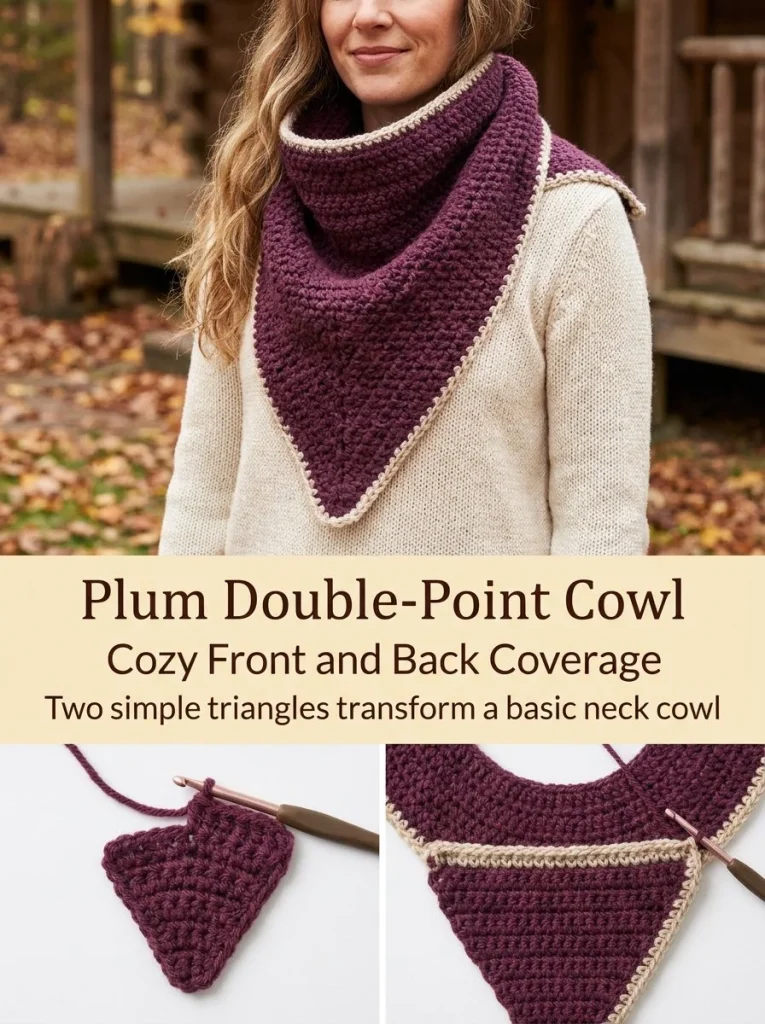
Creating a stylish, warm, and uniquely shaped accessory, this double-point cowl employs a clever construction that combines a circular foundation with strategically added triangular points. Its rich plum hue juxtaposed with gentle oatmeal edging offers a sophisticated palette perfect for fall and winter wear. The cowl’s textured fabric, achieved through selective back loop only (BLO) stitches and increases, creates visual interest while maintaining coziness and comfort. The project centers around classic crochet techniques enhanced with geometric shaping, making it both accessible and rewarding for crocheters looking to try a more sculptural wearables piece.
This design shares some structural inspiration with other popular constructions, such as the subtle complexity found in the plum asymmetric moss cowl, where texture and shape play off each other in elegant harmony. The double-point cowl’s distinctive silhouette, combining a round band with two triangular extensions at the front and back, sets it apart as a statement accessory that’s also very practical at keeping your neck and chest warmly enveloped.
Pattern at a Glance
Skill level: Intermediate
Terminology: US crochet terms
Construction: Circular base band with front and back triangular points attached; edged with contrasting color single crochet
Finished size: Approximately 9 inches in depth at front, 5-6 inches depth at back triangle; circumference roughly 60 stitches in the base ring
Yarn weight: Bulky (#5) yarn
Hook size: 7 mm (approx. US K / 10.5) crochet hook
Main stitch: Half double crochet (hdc), worked both normally and back loop only (BLO)
Gauge: Not explicitly provided; recommended to work loosely for drape and comfort
Motifs: One circular band and two triangular points (front and back)
Layout: Band forms the neck ring; front triangle centered on lower front edge; back triangle centered on opposite edge
Joining: Whip-stitching triangles to band; sc border in contrasting oatmeal color around edges
Border: Single crochet row in oatmeal yarn for a soft, relaxed finish
Seaming: Whip-stitch joining
Materials
- Approximately 350 yards of bulky (#5) yarn in deep plum color for the primary body of the cowl. Bulky yarn offers warmth and a plush fabric with fast progress.
- About 60 yards of bulky (#5) yarn in oatmeal color to create a delicate contrasting border.
- 7 mm crochet hook, suitably sized for bulky yarn to ensure the fabric remains soft and not stiff.
- A tapestry needle to weave in ends and securely whip-stitch the triangular points onto the base band.
Using a bulky weight yarn and a large hook helps produce a soft, warm fabric that is quick to crochet, appealing to those wanting a stylish winter accessory without long delivery times.
Yarn and Color Notes
Choosing fibers that have a little loft and softness—like wool blends or acrylic blends—will enhance the cowl’s warmth and drape. Natural fibers such as merino blends add softness and breathability, whereas acrylic or superwash wools facilitate easy care. While the pattern suggests deep plum and oatmeal, these colors can be substituted to suit your wardrobe palette. For example, try a rich burgundy for the main body with a soft cream contrast, or experiment with jewel tones paired with neutrals.
Because the stitch work is simple and relies heavily on half double crochet, the texture truly shines when using smooth yarns that show the stitch definition clearly. Avoid overly fuzzy or fluffy yarns if you want the triangular shaping and the BLO rows to be clearly visible.
Finished Measurements
- The base ring forms a circular band measuring approximately 60 stitches around, roughly equivalent to a comfortable neck circumference for most adults.
- The front triangular point is worked up to Row 16, resulting in 32 stitches wide across the base edge and approximately 9 inches in depth from base to tip.
- The back triangular point reaches Row 10, ending with 20 stitches across and about 5-6 inches in depth.
- Once assembled and edged in oatmeal with a relaxed single crochet border, the cowl fits snugly yet comfortably, with elegant length and fullness in front to protect the chest and neck.
These dimensions make it easy to wear and layer over coats or sweaters, while the unique shape adds visual appeal.
Gauge
While the pattern does not specify a formal gauge, working with the recommended bulky yarn and a 7 mm hook will yield a fabric with the ideal drape and stitch size. To check the gauge, measure the height and width of a swatch of 10 stitches by 10 rows in half double crochet worked normally and worked BLO (back loop only) as required.
Why gauge matters:
- A tighter gauge will result in a smaller, denser cowl, possibly limiting stretch and drape.
- A looser gauge might produce a larger and more open fabric, affecting the triangular shaping and fit.
- Consistency in stitch tension is key, especially for the BLO rows, to maintain the geometric texture and triangle dimensions.
Abbreviations
- ch – chain
- hdc – half double crochet
- BLO – back loop only (work stitch only in the back loop of the stitch below)
- sc – single crochet
- st(s) – stitch(es)
- rnd – round
- RS – right side
- WS – wrong side
All abbreviations follow US crochet terminology.
Important Pattern Notes
- The initial foundation ring is formed by chaining 60 stitches and joining with a slip stitch without twisting the chain. This ensures a flat band foundation.
- The cowl body is worked in continuous rounds using half double crochet stitches, shifting to back loop only (BLO) from Round 2 onwards through Round 9, which produces subtle ribbing and texture.
- Triangular points are created separately by increasing stitches at both ends of each row, starting from a small base chain.
- Increases use two half double crochet stitches in the first and last stitches of each row.
- For texture interest, every second row on the triangles is worked in BLO.
- The front triangle is larger and deeper than the back, giving an asymmetrical shape that contours comfortably when worn.
- Final assembly involves carefully centering and whip-stitching the triangles to opposite edges of the ring with the right side outward, then edging all open edges with a relaxed single crochet border in the contrasting oatmeal color for neat finishing.
Special Stitches and Techniques
Half Double Crochet (hdc)
A common crochet stitch creating a medium-height textured fabric. Insert the hook into the stitch, yarn over, pull up a loop (3 loops on hook), yarn over and pull through all loops.
Back Loop Only (BLO)
Working a stitch in the back loop only creates a ribbed or ridged texture as the front loops of the stitches remain visible and unworked. This adds subtle linear texture to the fabric and is key for the cowl’s aesthetic.
Whip Stitch
Used for assembly/seaming by sewing pieces edge to edge with yarn and a tapestry needle. This stitch is strong yet flexible, perfect for joining the triangular points to the cowl base without bulk.
Understanding the Construction
This cowl combines a continuous circular band with two triangular points strategically placed to add shape and character.
- The base ring: Begins with a chain of 60 stitches joined seamlessly to form a ring. This forms the neckband of the cowl.
- The body of the ring: Several rounds of hdc are worked, with texture created by working in the back loops only. This produces a softly ribbed ring about 2-3 inches tall.
- The two triangles: Crocheted separately as increasing panels. The larger front triangle will lie at the front bottom of the cowl, while the smaller back triangle attaches to the back side. Both have texture created with alternating BLO rows.
- Joining: The wide edge of each triangle is whip-stitched centered precisely on the bottom edges of the ring opposite each other.
- Final border: One relaxed round of single crochet in oatmeal yarn finishes the edges and unifies the look.
This combination of shapes gives a dramatic silhouette that is both sculptural and wearable, perfect for layering.
Complete Pattern Instructions
Foundation Ring
- Start with plum yarn. Chain 60, then join with a slip stitch in the first chain without twisting the chain to form a flat ring.
Round 1
- Work 1 half double crochet in each chain stitch around—total 60 stitches. Join if preferred or continue in joined rounds.
Rounds 2–9
- Work half double crochet in back loop only (BLO) around 60 stitches per round. This textural detail develops subtle ribbing.
Front Triangle Point
- Using plum yarn, chain 4.
- Work 2 hdc in the 3rd and 4th chain from hook (this forms your first two stitches).
- For each subsequent row from Row 2 to Row 16:
- Chain 2, turn your work.
- Work 2 half double crochets in the first stitch (increase at the beginning).
- Hdc across remaining stitches in the row.
- Work 2 half double crochets in the last stitch (increase at the end).
This pattern increases by 2 stitches each row, ending with 32 stitches across the wide edge and about 9 inches depth.
- For texture, work every second triangle row in BLO. For example, Rows 2, 4, 6… are worked BLO.
Back Triangle Point
- Repeat the same method as the front triangle but work through Row 10 only, resulting in 20 stitches wide and approximately 5–6 inches in depth.
- Apply the same alternating BLO technique for texture on every second triangle row.
Assembly
- Place the 32-stitch wide edge of the front triangle centered along the lower front of the cowl ring and whip-stitch securely to attach.
- Position the 20-stitch wide edge of the back triangle along the exact opposite back edge of the ring and whip-stitch in place.
- Carefully ensure even alignment and a smooth seam without puckering.
Border
- Join the oatmeal yarn with a slip stitch anywhere on the seam joining edges.
- Work one relaxed round of single crochet (sc) evenly around the edges of both triangles and the uncovered lower portions of the cowl band.
- This creates a soft, contrasting finish, adds durability to the seams, and prevents curling.
Final Checkpoints
- The cowl should now measure approximately 9 inches deep at front and 5–6 inches deep at back.
- The ring should maintain a circumference consistent with 60 stitches.
- All edges have a neat oatmeal single crochet border.
- The texture from the BLO rounds should create subtle ribbing around the band and textured triangles.
Assembly Tips and Finishing Details
- Use the tapestry needle to whip-stitch triangles gently, making sure to keep tension balanced — not too tight to distort length or width, not too loose to leave gaps.
- Finishing with a relaxed single crochet border in oatmeal yarn creates a visual frame and helps the fabric edges lie flat.
- Weave in all ends carefully on the inside to avoid bulk under the border.
- No blocking is explicitly required due to the bulky yarn, but a gentle steam block can help even out edges if desired.
For additional inspiration and similar projects exploring texture and shaping, consider the plum between the thorns cowl, which also uses asymmetrical shaping and color contrast with dramatic effect.
How to Resize
To resize this cowl, focus on adjusting the initial chain for the ring and scaling triangle sizes proportionally:
- Increase the starting chain (must remain an even number for symmetry) to make the ring larger. For example, chain 70 instead of 60 for a bigger neck circumference.
- When increasing the base ring, adjust the number of rounds worked in the ring band to maintain depth and texture.
- The triangular points can be lengthened by adding more increase rows for a deeper point, adjusting the stitch count accordingly. For example, extend front triangle beyond Row 16.
- Similarly, reduce rows to make a smaller cowl.
- Maintain consistent stitch multiples and increase placement to preserve shape.
- Keep the BLO texture rows consistent relative to total row count for balanced texture.
Because all shaping follows simple geometric increases, resizing is straightforward once the proportions are understood.
Useful Variations
- Single Color Version: Omit the oatmeal border for a tone-on-tone look emphasizing the plum texture.
- Color Block: Swap the oatmeal yarn for a bolder shade like mustard or teal for a striking pop of contrast.
- Longer Front Point: Add more increase rows to create a dramatically elongated front triangle for extra warmth or style.
- Double Thickness: Work the project twice and seam together for an oversized, extra warm cowl.
- Ongoing Border Variations: Add multiple rounds of different borders such as crab stitch or shell stitch for decorative edging.
Troubleshooting
Why Is My Cowl Ring Not Lying Flat?
If the initial chain is twisted before joining, the cowl will twist. Make sure to join the chain without twisting to form a flat ring. Uneven tension in the first rounds can also cause curling—maintain consistent stitch tension.
Why Are My Triangles Not Shaping Properly?
Double-check that increases are made only at the first and last stitch of every row. Missing increases results in a trapezoidal shape, not triangular.
Why Is The Texture Uneven?
When working BLO rows, ensure only the back loop of the stitch is worked and not both loops. Confusing this can disrupt the ribbed texture.
How Can I Avoid Tight Seams?
When whip-stitching triangles to the band, keep seam tension relaxed to avoid puckering or distortion.
Why Does The Border Curl?
Working a relaxed, even single crochet border prevents curling. Tight stitch tension in edging causes pulling and rippling.
Frequently Asked Questions
Can I use a different yarn weight?
For this pattern, bulky (#5) yarn provides the ideal texture and warmth. Finer yarns can be used but adjust hook size and stitch count accordingly, which may affect sizing and fabric drape.
Can beginners make this cowl?
This pattern uses basic stitches but involves shaping and assembly, making it suitable for confident beginners or intermediate crocheters.
Is the cowl reversible?
The texture and shape make both sides wearable, though seams may be visible on the inside.
Do I need to block the finished piece?
Blocking is optional for bulky yarn but can smooth out edges and align seams.
How do I maintain the ballooning or softness of the ribbed texture?
Working the BLO rounds loosely with the right hook is key; avoid pulling the yarn tight.
Can I substitute the colors?
Absolutely—choose any two coordinating colors to fit your style.
Final Thoughts
This double-point cowl combines geometric shaping, textural subtlety, and a two-tone palette to create a sophisticated and cozy accessory. The generous front triangle balances warmth and flair, while the smaller back triangle completes the silhouette for comfortable wear. Working from a simple circular band, the technique introduces incremental shaping and skill-building with BLO stitches and assembly joins, perfect for expanding your crochet repertoire.
The cowl construction is straightforward once the basics of increases and BLO are mastered, and the finished piece is a standout addition to any cold-weather wardrobe. For further creative ideas on similar shaped cowls, texture interplay, and yarn color use, exploring patterns like the plum asymmetric moss cowl or plum between the thorns cowl can provide inspiration.
Enjoy crafting this stylish double-point cowl that blends comfort, warmth, and unique design with classic crochet techniques!



