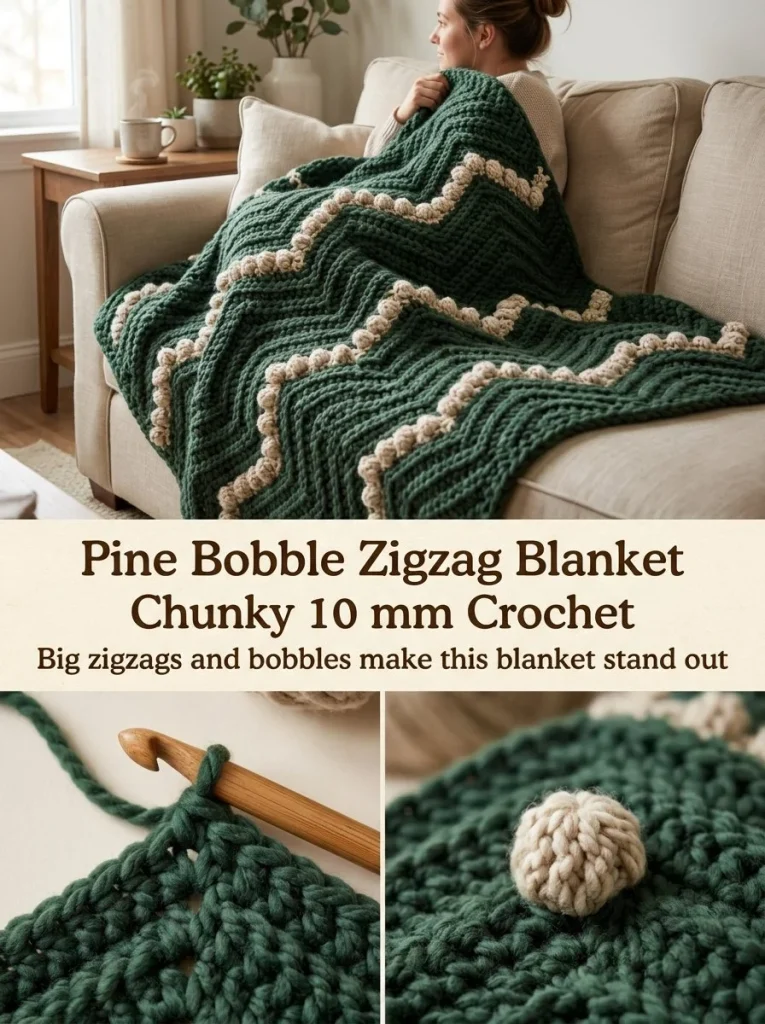
This crochet project creates a richly textured afghan featuring a distinctive zigzag pattern enhanced with bobble accents. The combination of deep pine and oatmeal hues contributes to an earthy, calming palette that reinforces the natural, woodland-inspired look. Constructed from super-bulky yarn or two strands of bulky held together, the blanket works up quickly with a large 10 mm hook, resulting in a cozy, warm fabric perfect for snuggling.
The blanket’s signature zigzag texture is achieved through an interplay of peaks and valleys formed by strategically placed chain spaces and stitch skips. The repeating six-row sequence includes two plain zigzag rows, one bobble-highlighted row, and three additional plain zigzag rows. The bobbles, made in oatmeal yarn for contrast, add a delightful tactile and visual interest without interrupting the blanket’s flowing pattern. This rhythmic construction not only keeps the fabric flat and balanced but also makes it engaging to crochet.
Because of the use of thick yarn and the rhythmic pattern, this blanket lends itself well to both beginner advanced crocheters and those seeking a quick but visually appealing project. The subtle bobble stitches provide just enough complexity to keep experienced crocheters interested. For those eager to create an inviting throw that perfectly balances texture and warmth, this project presents an appealing option. If you appreciate tactile crochet blankets, you might also enjoy exploring the Soft Cloud Bobble Baby Blanket, which offers a different take on bobble accents.
Pattern at a Glance
Skill level: Intermediate (due to bobble stitches and stitch pattern management)
Terminology: US crochet terms
Construction: Worked flat in rows with a repeating six-row pattern
Finished size: Approximately 50-56 inches long (width determined by starting chain)
Yarn weight: Super-bulky #6 or equivalent by holding two bulky strands together
Hook: 10 mm (size N/P)
Main stitch: Double crochet (dc), bobble stitch (created by 5 partial dc in same stitch)
Gauge: About 7-8 double crochet = 4 inches
Motifs: Zigzag peaks and valleys formed by chain 3 spaces and skipped chains
Layout: Continuous zigzag rows built upon foundation chain
Joining: N/A (blanket is a single piece)
Border: Not specified; finishing suggested with gentle blocking
Seaming: None needed
Materials
This blanket requires super-bulky yarn or two strands of bulky yarn held together to provide the appropriate thickness and weight. Specifically, about 1300-1500 yards of deep pine green yarn forms the main body, with approximately 150 yards of oatmeal-colored yarn used exclusively for bobble accents.
Other materials you will need include:
- 10 mm crochet hook – This large hook is essential for working comfortably with super-bulky yarn and maintaining the correct gauge.
- Tapestry needle – For weaving in ends after completing the blanket.
- Scissors – To cut yarn when changing colors or finishing.
These materials together ensure the blanket develops the proper drape and texture. Choosing yarns with good stitch definition allows the zigzag and bobble details to stand out clearly. A brand that offers softness with minimal halo or fuzz will highlight the structured stitch pattern best.
Yarn and Color Notes
Selecting the right yarn fiber can influence both the look and feel of your finished blanket. Wool blends or soft acrylics work well because they provide good stitch definition and remain warm. Avoid highly fuzzy or textured novelty yarns as they may obscure the intricate zigzag and bobble details.
The two-color scheme—deep pine for the main fabric and oatmeal exclusively for the bobbles—creates a subtle contrast that elevates the visual interest without overwhelming the eye. You could experiment with other earth tones or neutral shades to keep the sophisticated vibe, or swap the oatmeal bobble color for a brighter accent if you prefer a bolder look.
Smooth, plied yarns or tightly spun fibers will make the zigzag edges crisp and maintain defined peaks and valleys. Considering the thickness, super-bulky weight or holding two bulky strands together are recommended to meet the gauge and reinforce stitch structure. This approach also shortens overall project time compared to finer yarns.
Finished Measurements
The finished blanket measures approximately 50 to 56 inches in length. The width is determined by the initial chain of 83 stitches worked loosely with the pine yarn. Given the gauge and stitch pattern, this width is ideal for a small throw sized comfortably for lap use or as a decorative accent on a couch or chair.
Because the blanket’s height is controlled by repeating a 6-row rhythm until the desired length is reached, you can adjust the length by crocheting more or fewer sets of the 6-row sequence to customize the final dimension.
Gauge
The specified gauge for this project is:
- About 7-8 double crochet stitches = 4 inches
Maintaining this gauge ensures that the zigzag peaks and valleys form correctly, and the blanket’s overall dimensions match the pattern’s intended size.
To measure gauge:
- Work multiple rows of double crochet using the same yarn and hook.
- Measure over about 4 inches across the row to count the number of double crochet stitches.
- If you have more than 8 dc per 4 inches, your tension is too tight; try a larger hook or loosen your stitching.
- If you have fewer than 7 dc per 4 inches, your tension is loose; use a smaller hook or tighten your stitch tension.
While gauge is important for achieving the ideal size and appearance, a loose or tight gauge in this blanket mainly affects final dimensions rather than fit. Straying a little from gauge is permissible for throws, especially if you plan to resize. However, the shape of the zigzag peaks and valleys depends on balancing increases and decreases as specified, so maintaining approximate gauge supports a flat, even fabric.
Abbreviations
- ch: chain
- dc: double crochet
- sp: space
- st: stitch
- yo: yarn over
- tog: together (used in bobble stitches)
Important Pattern Notes
- Begin with a foundation chain worked loosely to preserve fabric flexibility.
- The foundation row creates peaks (chain-3 spaces) and valleys (skipped chains) that define the zigzag shape.
- Following rows maintain this shape by balancing increases (dc, ch3, dc) at peaks and decreases (bridging across skipped chains) at valleys.
- The stitch counts in straight sections are important for even ripple formation: 11 dc at edges and groups of 13 dc in middle sections.
- The bobble stitch is worked only on the designated bobble row, using the contrasting oatmeal yarn.
- Immediately switch back to pine yarn after completing each bobble to maintain color placement.
- The 6-row rhythm is key to pattern repetition and keeping the zigzag peaks perfectly aligned vertically.
- Blocking gently at the finished stage helps relax stitches and flatten edges.
Special Stitches and Techniques
Bobble Stitch (5-loop)
On the bobble rows, special bobbles are worked using oatmeal yarn into selected stitches in the straight sections:
- Yarn over, insert hook into the designated stitch.
- Pull up a loop and leave it on the hook; repeat this step 5 times in the same stitch, so you have 6 loops on the hook.
- Yarn over and pull through all 6 loops at once to complete the bobble.
- Switch immediately back to pine yarn before proceeding to the next stitch.
This creates a raised cluster that stands out from the flat double crochet fabric, adding texture and interest.
Understanding the Construction
The blanket is crocheted flat in rows, starting from a loosely formed foundation chain of 83 stitches using the pine yarn. The foundation zigzag row sets up the characteristic ripple effect: peaks are created by chain-3 spaces and valleys are formed by deliberately skipping chains.
Subsequent rows maintain the zigzag shaping, alternating between sections working straight double crochet and sections where increases and decreases balance the blanket’s edges. The diamond-shaped undulation results from working (dc, ch3, dc) increases around peaks and bridging decreases at valleys, keeping the fabric perfectly flat without curling or puckering.
The pattern cycles through a six-row sequence: the first two rows are plain zigzag in pine, the third row incorporates oatmeal bobbles for texture, and the next three rows return to plain pine zigzag. This sequence repeats until the blanket’s length reaches 50–56 inches.
Because all peaks and valleys are kept vertically aligned, the ripple runs consistently across the entire fabric, making both the texture and the color changes visually coherent.
Full Pattern Instructions
Foundation Chain
Using deep pine yarn, loosely chain 83 stitches. A loose chain allows the fabric to have flexibility and helps maintain a flat shape as you work the chevron.
Foundation Zigzag Row
- Begin in the 4th chain from the hook (counts as first double crochet).
- Work 11 double crochet stitches across the first 11 chains.
- Chain 3 (this creates the first peak).
- Then, repeat the following sequence twice:
- Work 13 double crochet stitches.
- Skip 3 chains (this forms the valley).
- Work another 13 double crochet stitches.
- Chain 3 for the next peak.
- Finish the row by working 11 double crochet stitches.
The chain-3 spaces at this point form the peaks of the zigzag, and the skipped chain sections become the valleys.
Subsequent Rows: Maintaining the Zigzag
For all rows after the foundation, the goal is to preserve the zigzag pattern:
- Work double crochet stitches across the straight sections between peaks and valleys.
- Work a cluster of (dc, ch3, dc) or an equivalent increase around each chain-3 peak space to maintain the stitch count and create the sharp peak shape.
- Bridge cleanly across the skipped chain sections (valleys) by decreasing appropriately to avoid fabric distortion, so the blanket remains flat.
Row Structure
Work the blanket in a repeating 6-row rhythm:
- Rows 1 and 2: Plain pine zigzag rows without bobbles.
- Row 3: Bobble-accent row using oatmeal yarn.
- Rows 4, 5, and 6: Plain pine zigzag rows again.
Repeat this sequence until the blanket’s length reaches approximately 50-56 inches.
Bobble Row Instructions
On the bobble row:
- Use oatmeal yarn at evenly spaced stitches along the straight double crochet sections where indicated.
- For each bobble:
- Work 5 partial double crochets into the same stitch; for each partial dc, leave the last loop on the hook.
- After the 5 partial dcs, you will have 6 loops on the hook.
- Yarn over and pull through all 6 loops to complete the bobble.
- Switch immediately back to pine yarn after completing each bobble.
This alternating yarn technique creates a rhythmic contrasting bobble texture without interrupting the zigzag flow.
Finishing
When your blanket approaches the desired length, end after completing the last row of the 6-row pattern. Gently block the blanket if needed by lightly wetting and pinning it flat to enhance the crisp zigzag edges and even out any unevenness.
Checkpoints
- After completing the foundation zigzag row, your stitch count should remain consistent with the prescribed numbers (e.g., 11 dc sections, 13 dc sections, skips, and chain-3 peaks).
- The peaks and valleys should be clearly visible, with chain-3 spaces forming the crisp zigzag points.
- On the bobble row, count bobbles to ensure they are evenly spaced and placed accurately according to the pattern.
- As you repeat the 6-row pattern, the overall width should remain steady with no increases or decreases beyond those implied by the zigzag shaping.
- The vertical alignment of peaks and valleys should be maintained to prevent shifting zigzags.
Finishing and Blocking
To achieve optimal drape and showcase the textured pattern:
- Weave in all yarn ends using a tapestry needle, ensuring no tails protrude.
- If desired, soak your blanket gently in lukewarm water, squeeze out excess moisture, and lay it flat on a blocking surface.
- Pin the edges to straighten ripples and flatten uneven areas, paying special attention to keep peaks and valleys aligned.
- Allow to dry completely before use.
Blocking enhances the definition of the zigzag pattern and smooths out any uneven tension encountered during crocheting.
How to Resize the Blanket
You can customize the width by altering the foundation chain:
- The foundation chain is constructed with specific counts creating sections of 11 chains at the edges, pairs of 13 chain groups separated by skipped chains, and chain-3 peaks.
- To widen the blanket, add repeats of the 13 double crochet sections, each accompanied by its corresponding skipped chains and chain-3 peaks.
- To narrow it, reduce the number of these repeats, maintaining the edge sections and the overall peak/valley ratio.
Length adjustment is simple:
- Work more or fewer repeats of the complete 6-row pattern cycle until the desired length is achieved.
- Ensure the final row completes a full rhythm to preserve the look.
Maintaining the stitch balancing of increases at peaks and decreases at valleys is critical to keep the blanket flat and the zigzag pattern true.
Useful Variations
- Single-color version: Work the whole blanket in the deep pine color, omitting bobble rows or working bobbles in the same yarn for a subtle texture.
- Alternate bobble colors: Swap the oatmeal bobble yarn for a complementary contrasting color, such as cream or burnt orange, to change the mood.
- Lengthened throw: For a larger blanket, extend the number of 6-row pattern repeats.
- Coordinated sets: Use the same zigzag and bobble motif to create matching pillows or scarves to coordinate with your blanket. For baby projects with soft bobbles, explore a pattern like the Alpine Moss One-Row Repeat Throw for inspiration.
Troubleshooting
Why Is My Blanket Becoming Wider?
If your zigzag edges seem stretched beyond the pattern’s shape:
- Ensure you are skipping the correct number of chains to form valleys.
- Verify increases at peaks are done precisely as (dc, ch3, dc).
- Avoid adding extra stitches in straight sections.
- Maintain consistent tension to prevent overly loose fabric.
Why Is My Edge Wavy or Curling?
Waving edges often indicate uneven tension or incorrect stitch balancing:
- Keep stitches even, neither too tight nor too loose.
- Confirm decreases are placed correctly over valleys.
- Block the blanket gently after finishing to smooth edges.
Why Are My Bobbles Not Standing Out?
- Use yarn tension that keeps loops on hook until all 5 partial double crochets are completed.
- Switch colors cleanly between bobble yarn and main yarn.
- Place bobbles evenly spaced for maximum effect.
Why Is My Zigzag Shifted Vertically?
Misaligned peaks and valleys occur if stitch placement around chain-3 spaces or skipped chains is inconsistent:
- Work carefully around peaks, making sure to increase precisely and mirror decreases at valleys.
- Count stitches regularly to maintain pattern harmony.
Frequently Asked Questions
Can I use a different yarn weight?
The pattern calls for super-bulky yarn or two bulky strands held together to achieve the correct gauge and fabric density. Using lighter yarns will change gauge and fabric properties, so you would need to recalculate the foundation chain and stitches per row.
Can I crochet this blanket in one color?
Yes, a monochromatic version provides a sleek, textured fabric emphasizing the zigzag and bobble stitch details through shadow rather than color contrast.
Are the bobbles difficult to make for beginners?
The bobble stitch here involves working multiple partial double crochets into the same stitch—while not the simplest stitch, it is manageable with practice. Beginners comfortable with double crochet can learn bobbles by following detailed instructions and practicing beforehand.
How do I carry the oatmeal yarn between bobbles?
Carry the oatmeal yarn loosely along the row, catching it behind the pine stitches or cutting and weaving ends for a cleaner look.
Is this pattern suitable for all seasons?
Due to its thickness, this blanket is cozy for cold months, but less ideal for warm climates unless lighter yarns are substituted.
Do I need to block this blanket?
Blocking helps keep the zigzag pattern flat and visually consistent but is optional depending on your finishing preference.
Final Thoughts
This richly textured zigzag blanket combines strategic increases and decreases with rhythmic bobble accents in contrasting colors to create a warm, tactile throw that is as inviting as it is visually interesting. Its construction involves repeating a six-row pattern that balances peaks and valleys, maintaining a flat fabric with undulating ripples. Choosing super-bulky yarn and a large hook accelerates progress and ensures a warm, dense fabric suitable for cozy use.
By following the careful stitch counts and consistent rhythm, crocheters can create rhythmic waves that captivate both the eye and the touch. The interplay of color and texture in the bobble rows adds sophistication without complexity. When you finish your blanket, gentle blocking will showcase the crispness of the zigzag and accent bobbles, making this piece a treasured addition to any home.



