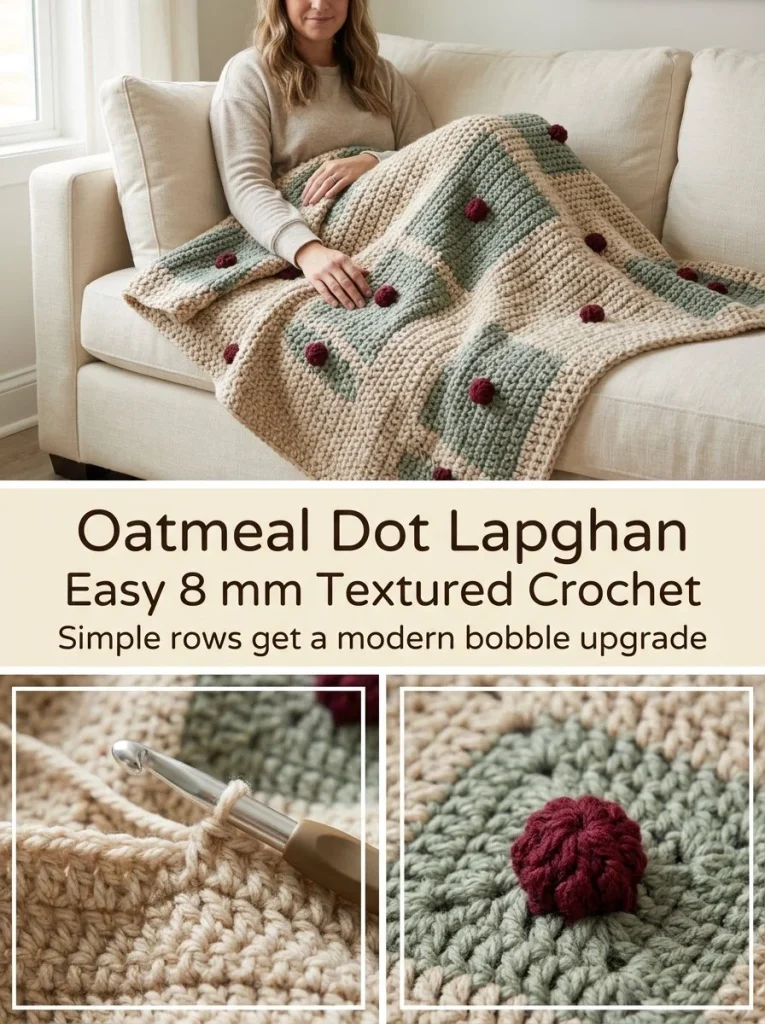
This cozy lapghan blends simple double crochet stitches with delicate bobble textures and subtle color changes to create a visually engaging yet straightforward blanket. The combination of oatmeal, sage, and burgundy hues arranged in blocks and accented with bobbles adds a charming tactile detail that elevates the fabric without complicating the process. Constructed row-by-row using bulky #5 yarn and an 8 mm hook, this project works up relatively quickly, making it ideal for those who want a satisfying, medium-scale crochet experience.
The lapghan’s design showcases mosaic-like color blocks in calming sage and oatmeal tones, punctuated by plum-colored bobbles. These bobbles add depth and dimension, giving the blanket a playful yet sophisticated feel. Because the pattern relies on the double crochet stitch predominantly, it is accessible for crocheters familiar with basic stitches but also incorporates a specialized bobble stitch that adds interest and texture. If you appreciate crafting projects that are both visually attractive and practical, this lapghan offers a lovely balance.
Crocheting this lapghan offers a valuable opportunity to practice color changes and bobble stitch techniques while creating a useful, snuggly item for chilly evenings or thoughtful gifting. Its generous finished size makes it perfect for lap warmth on a couch or layering on a favorite armchair. Patterns combining textured and colorwork elements such as these provide a creative way to enhance fundamental crochet skills within a single project. The warm, neutral oatmeal base is versatile and the sage and burgundy accents bring subtle pops of color that harmonize beautifully.
If you enjoy projects with colored accents, try exploring other accessories like the Candy Dot Rainbow Bracelet, which also features delightful textural elements and colorwork in a different form.
Pattern at a Glance
Skill level: Intermediate — suitable for crocheters confident with double crochet and color changes
Terminology: US crochet terms
Construction: Worked flat in rows using double crochet and bobble stitches with color blocks
Finished size: Approximately 36 x 48 inches
Yarn weight: Bulky (#5) yarn
Hook: 8 mm crochet hook
Main stitch: Double crochet (dc), bobble stitch
Gauge: 8.5 dc by 5 rows = 4 inches
Motifs: Color blocks of sage and oatmeal with burgundy bobble accents
Layout: Horizontal rows with alternating color sections and bobble placement
Joining: No joining required — continuous row construction
Border: None specified; the pattern finishes with oatmeal rows
Seaming: None required
Materials
To complete this project, you will need:
- Bulky weight #5 yarn in three colors:
- About 548 yards of oatmeal (main color, MC) for the background and majority fabric
- About 274 yards of sage (contrast color 1, CC1) for the blocks of color
- About 137 yards of burgundy (contrast color 2, CC2) used selectively for bobble accents
- 8 mm (US L/11) crochet hook, appropriate for bulky yarn to create a loose, warm fabric
- Tapestry needle for weaving in ends and finishing the lapghan neatly
Using bulky yarn and a large hook size helps achieve a snuggly texture and makes the stitches easier to see and count, especially important when working multiple colors and bobbles.
Yarn and Color Notes
Bulky weight yarns provide warmth and a lofty fabric perfect for lapghans or throws. Choose a yarn that feels soft against the skin and has good stitch definition to allow the bobbles and color blocks to stand out clearly. Smooth yarns typically showcase stitch textures better than novelty or fuzzy yarns.
The color palette in this lapghan is subtle yet attractive. The oatmeal base provides a neutral, cozy background, while the sage blocks offer a calm, earthy tone contrast. Burgundy bobbles add just a touch of richness and visual interest without overwhelming the fabric.
You might experiment with other color combinations in this pattern—such as muted pastels or jewel tones—but ensure the contrast remains strong enough to highlight the color blocks and bobbles effectively. Variegated yarns are less suited here because the pattern relies on clean color distinctions.
Finished Measurements
The finished lapghan measures approximately 36 inches wide by 48 inches long, a comfortable size for draping over legs or shoulders. This size reflects the carefully counted stitch and row numbers based on the gauge and yarn weight provided. Achieving this size depends on consistent tension to meet the given gauge.
Gauge
Gauge is measured as 8.5 double crochet stitches by 5 rows = 4 inches using bulky #5 yarn and an 8 mm hook. To match the pattern’s intended size and drape:
- Measure a 4-inch square by working double crochets in your chosen yarn and hook.
- Adjust hook size if necessary to meet gauge:
- Use a smaller hook if you get more stitches/rows than 8.5 by 5.
- Use a larger hook if you get fewer stitches/rows.
Gauge is especially important to keep the lapghan’s dimensions stable and the color blocks proportionate. For blankets, a slight variation is generally acceptable, but for best results, matching gauge will ensure consistent color block sizing and overall shape.
Abbreviations
- ch = chain
- dc = double crochet
- st(s) = stitch(es)
- bobble = bobble stitch as described below
- MC = main color (oatmeal)
- CC1 = contrast color 1 (sage)
- CC2 = contrast color 2 (burgundy)
Important Pattern Notes
- Chains at the start of rows do not count as stitches.
- Work in rows turning at the end of each row.
- Carry colors only over short stretches to avoid long floats and bulky strands.
- Use tapestry needle to weave in all ends securely for a neat finish.
- Bobbles are worked by making 5 partial double crochets (without completing each fully) into one stitch, leaving loops on the hook, then yarn over and pull through all 6 loops to form a bobble.
- Color changes happen within rows to create blocks and textured accent dots.
- Keep track of stitch counts closely to ensure block sizes remain consistent.
Special Stitches and Techniques
Bobble Stitch
The bobble adds a wonderful raised texture to the fabric. To work a bobble stitch:
- Yarn over, insert hook into the stitch, yarn over, pull up a loop but do not complete the dc.
- Repeat this step 5 times into the same stitch, leaving the final loop of each partial dc on the hook.
- Yarn over and draw through all 6 loops on the hook at once.
- Chain 1 to secure and continue with the pattern.
This stitch is featured in burgundy for decorative dot accents and requires careful tension to maintain an even size.
Color Changes
To maintain sharp contrast without gaps or holes:
- Change colors at the last yarn-over of the previous stitch before the new color stitch.
- Carry the unused yarn loosely along the short color floats, twisting it with the working yarn occasionally to avoid long strands on the back.
- Weave ends securely to prevent unraveling.
Understanding the Construction
The lapghan is worked in one long strip of rows, beginning with a foundation chain of 77 stitches in oatmeal yarn. The fabric mainly uses double crochet stitches, with select rows featuring blocks of sage and oatmeal color and accented with burgundy bobble stitches.
Color blocks appear as horizontal bands of sage against an oatmeal ground with brownish plum bobbles sprinkled in organized rows. The pattern is constructed row by row, alternating sections of solid oatmeal, sage blocks, and detailed rows with bobble accents.
Because it is made in a single piece, there are no seams or joins except the weaving in of ends. The pattern ends with several rows of oatmeal to balance the finish. This straightforward yet visually dynamic approach keeps the lapghan cozy and dense but texturally interesting.
Full Pattern Instructions
Foundation
Using the main color (oatmeal), chain 77 stitches.
Row 1
Starting in the second chain from the hook, work 1 double crochet (dc) in each chain across. You will have 76 dc stitches.
Rows 2–6
Chain 2 to turn, then work 76 dc across each row, maintaining consistent stitch count and tension to build a solid oatmeal fabric base.
Rows 7–9 (First Sage Block)
- Row 7: Switch to sage yarn. Work 25 dc in sage, then switch back to oatmeal and work 51 dc.
- Row 8: Start with 51 dc in oatmeal, switch to sage and work 3 dc, then work 1 burgundy bobble, continue with 21 dc in sage.
- Row 9: Repeat Row 7 pattern: 25 dc in sage, followed by 51 dc oatmeal.
Rows 10–12
Return to oatmeal yarn and work 3 rows of 76 dc to separate the blocks.
Rows 13–15 (Large Sage Block)
- Row 13: Work 63 dc in sage, followed by 13 dc in oatmeal.
- Row 14: Start with 13 dc oatmeal, then 3 dc sage, then alternate burgundy bobble and 3 sage dc repeatedly across the sage section.
- Row 15: Repeat Row 13.
Rows 16–18
Work 3 rows of 76 dc in oatmeal.
Rows 19–21
Switch colors for blocks:
- Work a 51-stitch sage block and a 25-stitch oatmeal block across the row, maintaining 76 stitches.
Rows 22–24
Work 3 rows of 76 dc in oatmeal.
Rows 25–27
Work 35 dc in sage, 41 dc in oatmeal, placing 1 burgundy bobble centered in the sage section.
Rows 28–38
Work 11 rows of 76 dc in oatmeal to extend the fabric plain and balanced.
Rows 39–41
Pattern with alternating sections:
- Work 45 dc oatmeal, 31 dc sage, and add a row of evenly spaced burgundy bobbles across the sage area for texture.
Rows 42–44
Work 3 rows of oatmeal dc to separate color sections.
Rows 45–47
Work 16 dc oatmeal, 60 dc sage, and place 1 burgundy bobble near the color junction to highlight the transition.
Rows 48–50
Work 3 rows of 76 dc oatmeal.
Rows 51–53
Work 29 dc oatmeal, 47 dc sage, and include evenly spaced burgundy bobbles throughout the sage section.
Rows 54–59
Complete with 6 rows of 76 dc oatmeal for a solid, balanced finish to the lapghan.
Finishing
Carry colors only over short sections to avoid long floats on the back and maintain fabric neatness. Use a tapestry needle to weave all color and tail ends securely on the wrong side.
Your lapghan should now measure approximately 36 by 48 inches with a pleasant texture and balanced color design.
Checkpoints for Progress
- After Foundation and Rows 1–6: Fabric should be flat and measure approximately 4 inches tall to match gauge.
- After color block rows (Rows 7–15): Ensure blocks are cleanly separated with no skipped or extra stitches.
- When completing bobble rows: Bobbles should be uniform in size and securely formed, adding texture without puckering.
- After final Rows 54–59: Look for even stitch tension and squared edges to prevent curling or distortion.
Assembly and Finishing
This lapghan is a single-piece construction with no additional assembly steps required. Weave in all ends carefully with a tapestry needle. Trimming tails to about 1 inch will prevent knots or pulling.
To enhance the finished look, consider adding a simple border such as single crochet all around in oatmeal or a matching shade for a polished edge. Blocking is optional but can help flatten any curled edges and relax stitches. Light steam blocking or laying flat to dry with gentle shaping will suffice for bulky yarns.
How to Resize This Lapghan
Since the lapghan is worked in an even number of stitches (76 double crochets per row) plus a starting chain of 77, resizing can be done by adjusting the starting chain in multiples of one stitch. However, to maintain the color block patterns correctly, changes should be made in multiples that allow the color blocks and bobble placements to remain proportionate.
For example:
- To increase width, add multiples of the stitch counts used for each block segment (e.g., increments of 25 or 35 stitches for sage blocks).
- To increase length, add additional rows in oatmeal or repeat the color block row sequences, ensuring the row counts for bobble and color accents remain balanced.
Careful note-taking of stitch counts is essential when modifying sizes to preserve pattern alignment.
Useful Pattern Variations
- One-color version: Work the entire lapghan in oatmeal or sage for a simple textured blanket featuring bobbles only.
- Two-color version: Use oatmeal and sage only, omitting burgundy bobbles for a more subtle look.
- Different color palette: Swap sage and burgundy for other favorite color combinations, such as blues and grays or warm oranges and yellows.
- Match with accessories: Coordinate this lapghan with similar colorwork projects like a shoulder warmer knitting pattern that complements the oatmeal base and cozy style.
Troubleshooting
Why Are My Color Blocks Not Lying Flat?
Uneven tension or carrying yarn too tightly across color sections can cause puckering. Loosen tension slightly on color changes and keep floats loose but neat.
Why Are My Bobbles Inconsistent in Size?
Bobble stitches require consistent loop height. Practice the bobble carefully, ensuring loops stay on the hook and loops are not pulled too tightly or too loosely.
Why Does My Edge Ripple?
A wavy edge usually indicates inconsistent stitch counts or tension changes at the row ends. Count stitches frequently and maintain consistent hook size and tension.
How Can I Avoid Visible Bobble Floats?
Work the bobbles on the right side and carry the burgundy yarn only over a few stitches at a time to prevent long floats. Twist yarns when changing colors in the row to secure ends.
How Do I Fix a Too-Small or Too-Large Blanket?
Adjust your hook size or yarn weight accordingly. For a larger lapghan, add color block repeats in width and length, keeping stitch counts balanced.
Frequently Asked Questions
Can I use a different yarn weight?
Bulky #5 yarn is recommended to achieve the soft, thick texture and gauge. Using a lighter yarn will alter the size and drape significantly, requiring gauge adjustment.
Is this pattern suitable for beginners?
This pattern is best suited for intermediate crocheters comfortable with double crochet, carrying yarn for color changes, and working bobbles.
Can I make it in all one color?
Yes, omit the sage and burgundy colors and work all rows in oatmeal for a textured, monochrome fabric.
How do I carry the yarn when changing colors?
Carry the unused color loosely along the back for a few stitches, twisting with the working yarn to avoid long floats.
Do I need to block the finished lapghan?
Blocking is optional but can help smooth edges and even out stitch tension.
Can I add a different border?
Absolutely. A simple single crochet or shell stitch border in oatmeal or sage can frame the blanket nicely.
Optional Related Uses
The same double crochet and bobble techniques in color blocks can be adapted for other projects:
- Cushion covers featuring textured bobble stripes
- Baby blankets with similarly sized color blocks for easy color play
- Scarves and wraps using alternating oatmeal and sage with bobble accents
- Table runners for seasonal decor with colorful raised dots
Final Thoughts
This lapghan combines a solid oatmeal foundation with blocks of soft sage and delicate burgundy bobbles to create a versatile and tactile accessory. The construction is straightforward yet visually appealing, making it a satisfying project that offers both texture and colorwork practice. Working row by row with color changes and bobble stitches, the piece grows into a cozy 36×48 inch blanket that beautifully balances simplicity and detail. Whether for personal use or gifting, this lapghan’s warm palette and cushy fabric promise a handmade treasure perfect for keeping cozy.
This project beautifully illustrates how texture and subtle color variation can elevate a simple blanket beyond basic crochet. Enjoy the process and the comforting warmth of your finished lapghan.



