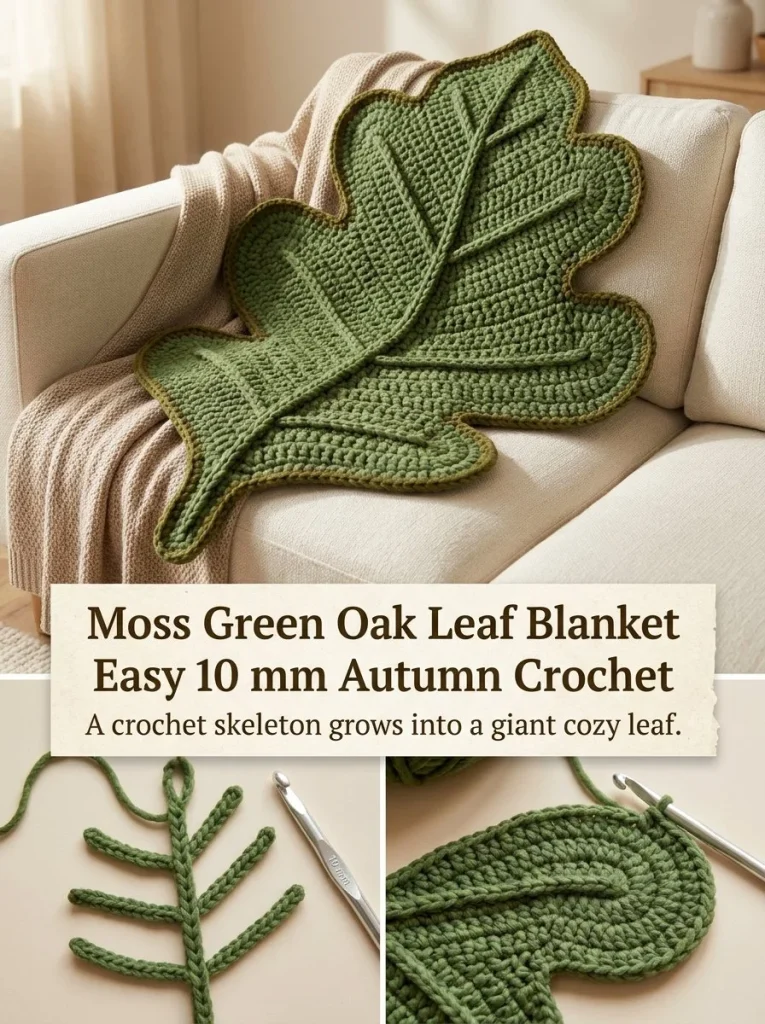
This striking crochet blanket features a naturalistic oak leaf design rendered in a rich moss green palette. The blanket’s silhouette closely mimics the intricate vein structure and lobed edges of an oak leaf, lending an organic elegance to your cozy home décor. Crafted using super-bulky yarn and worked entirely in crochet, this project brings together advanced shaping techniques and detailed stitch work to achieve its sculptural leaf form.
Its construction begins with a foundation chain that outlines the central stalk and lateral veins of the oak leaf, creating a "skeleton" that serves as a guide for subsequent shaping rounds. Progressively taller stitches add dimension to the leaf veins while strategic decreases pull the lobes inward for authenticity. A darker olive border softly frames the piece, emphasizing the natural motif. This blend of texture, structure, and color makes the blanket both a functional throw and an eye-catching statement piece.
Working with super-bulky yarn on a large 10 mm hook allows the stitches to showcase the leaf’s raised veins with clarity, while keeping the blanket warm and cozy. Because the pattern relies heavily on stitch placement to sculpt each lobe and valley of the leaf, precise attention to stitch counts and shaping instructions is critical. The finished dimensions approximately reach 47 by 23 inches, sized perfectly for a lap blanket or decorative accent.
If you enjoy projects that combine artistry with rigorous stitch technique, this blanket’s sophisticated vein and lobe shaping will be an enjoyable challenge. For further inspiration blending moss-inspired green tones into your crochet collection, consider exploring the relaxing textures of the Harvest Moss Stitch Blanket, which shares a complementary earthy color palette and tactile appeal.
Pattern at a Glance
Skill level: Advanced — intermediate crochet skills with shaping techniques required
Terminology: US crochet terms
Construction: Worked flat in one piece, from foundation chain stalk and veins outward
Finished size: Approximately 47 inches long by 23 inches wide
Yarn weight: Super-bulky (#6)
Hook: 10 mm
Main stitch: Slip stitch foundation veins, then single crochet (sc), half double crochet (hdc), double crochet (dc) shaping
Gauge: Not specified; focus on stitch tension to maintain correct shaping
Motifs: Single large oak leaf form with detailed vein construction
Layout: One continuous piece, symmetric along central stalk
Joining: None; worked seamlessly
Border: Relaxed single crochet round in contrasting dark olive
Materials
- Approximately 360 yards of super-bulky #6 moss green yarn (main body of leaf)
- Approximately 40 to 60 yards of super-bulky #6 dark olive yarn (border round)
- Crochet hook size 10 mm (US N/P-15 or Q), suitable for super-bulky yarn to produce defined stitches without tightness
- Tapestry needle for weaving in ends and any smocking slip stitches
- Stitch markers to help keep track of veins and valleys during shaping
The yarn choice focuses on a super-bulky weight to quickly build the blanket with well-defined stitch texture. A smooth or slightly fuzzy yarn will show stitch definition effectively for the veins and lobes. The yarn amounts provide a generous supply for the large leaf shape and border round.
Yarn and Color Notes
Selecting yarns with a subtle sheen and solid colorway, like moss green and dark olive, enhances the visual depth and realism of the oak leaf veins and lobes. A solid color supports the detailed shaping, while two tonal greens distinguish the veins (moss) from the border (dark olive), lending natural variation reminiscent of leaf edges.
Avoid highly variegated or heavily textured yarns, which may obscure the silhouette and stitch definition. Wool blends, acrylics, or super-bulky cotton blends work well, as long as they maintain consistent gauge and drape to not distort the leaf shape.
Finished Measurements
The blanket measures approximately 47 inches (119 cm) in length and 23 inches (58 cm) in width after blocking flat. These dimensions reflect the finished leaf’s length from base to tip, and its width at the widest lobe span. Proper blocking is critical to open the stitches and flatten the subtly sculpted lobes for an accurate shape.
Abbreviations
- ch = chain
- sl st = slip stitch
- sc = single crochet
- hdc = half double crochet
- dc = double crochet
- dc2tog = double crochet two stitches together (decrease)
- dc3tog = double crochet three stitches together (decrease)
Important Pattern Notes
- The foundation chain consists of 86 chains in moss green yarn, worked in back bumps for slip stitches.
- Veins are constructed by chaining a certain number of stitches, then slip stitching back across most of them to achieve the vein length and texture.
- The central stalk is worked continuously with slip stitches and acts as the baseline for symmetrical veins and shaping.
- Leaf shaping rounds use progressively taller stitches (sc, hdc, then dc) moving from the base toward the vein tips to add contour.
- Spoiler: Tighten the lobes during shaping by using dc2tog or dc3tog at valleys between veins, pulling edges inward.
- The final relaxed single crochet round in a contrasting dark olive softens the edges and unifies the form.
Special Stitches and Techniques
- Slip stitching in back bumps: creates a clear, elevated vein understructure.
- Slip stitch returns along chain veins: to highlight vein contours within the leaf.
- Double crochet increases at vein tips: with 4 to 5 dc stitches at each tip to create a point with volume.
- Dc2tog/dc3tog decreases in valleys: pulls the adjacent lobes inward shaping the iconic oak leaf curves.
- Backing slip stitches: fastens overlapping lobe edges on the reverse for stability.
Understanding the Construction
This blanket is executed in a single flat piece starting with a long foundation chain that defines the leaf’s main stalk and side veins. Slip stitches worked in the chain’s back bumps construct a vein skeleton, which serves as both framework and aesthetic feature.
Once the skeleton is established, shaping rounds encompass the veins to fill in the lobes using a sequence of shorter to taller stitches simulating the leaf’s natural curvature and thickness increase toward vein tips. The valleys between veins narrow inward with decreases, sculpting the lobed contours typical of an oak leaf.
Finally, a contrasting dark olive round of single crochet softens the leaf edges and lends a polished finish. Blocking the finished piece ensures the lobes lie flat and the veins remain prominent.
Full Pattern Instructions
Foundation Skeleton
- Using the moss green yarn, chain 86 stitches. Work strictly in the back bumps of the chain.
- Starting from the second chain, slip stitch across the first 13 chains along the back bumps, forming the initial base of the stalk.
Now the veins branch off the main stalk as follows, each constructed by chaining forward and slip stitching backward along the chain:
- Vein 1: chain 7, slip stitch back along 6 chains; then slip stitch forward 16 stitches on the main stalk.
- Vein 2: chain 11, slip stitch back 10 chains; slip stitch forward 16 on the stalk.
- Vein 3: chain 19, slip stitch back 18; slip stitch forward 16.
- Vein 4: chain 23, slip stitch back 22; slip stitch forward 16.
- Vein 5: chain 21, slip stitch back 20; slip stitch forward 8.
- Top Vein: chain 15, slip stitch back 14.
Having reached the leaf tip, continue down the opposite side of the foundation chain and mirror the vein sequence, slip stitching:
- 8 stalk stitches, Vein 5, 16 stalk stitches, Vein 4, 16, Vein 3, 16, Vein 2, 16, Vein 1, then finish the stalk.
This symmetrical vein skeleton frames the shape and provides the scaffolding for the leaf.
Leaf Shaping
Work around each vein from base to tip using progressively taller stitches for dimension:
- Begin with single crochet (sc) stitches closely following the vein edge.
- In subsequent shaping rounds, use half double crochet (hdc), then double crochet (dc) to add height as you move towards the vein tips.
- At each vein tip, place 4 to 5 double crochets to form a full, curved point.
After shaping around the vein and tip, mirror the stitches down the opposite side of the vein to complete the lobe shape.
At each valley between adjacent veins (the indentations between lobes), use dc2tog or dc3tog to decrease stitches across the adjoining edges and pull the lobes inward, mimicking the oak leaf’s characteristic lobed appearance.
Work two additional shaping rounds around the entire skeleton:
- Increase around each vein tip to maintain pointed lobes.
- Decrease in each valley so that the lobes lie flat and the silhouette stays true to oak leaf form.
On the back side, slip stitch any touching inner lobe edges together to secure the shape and prevent gaps.
Border
Join the dark olive yarn to the edge and work one relaxed single crochet (sc) round around the entire leaf shape.
- Use sc2tog at deep valleys to keep those indentations defined.
- Add 2 single crochets in stitches around outer peaks to keep the edge gently flared and avoid curling.
This border not only enhances contrast but also stabilizes the blanket edge.
Blocking
Block the finished blanket flat to approximately 47 inches by 23 inches.
- Blocking helps open the stitches and sets the lobed leaf shape beautifully.
- Pin the lobes flat, paying particular attention to the vein tips and valleys for accurate shaping.
Checkpoint
At this stage, your blanket should measure close to the specified dimensions and showcase a prominent central stalk with symmetrical veins.
The leaf lobes should curve naturally with pointed tips, and valleys between lobes should curve slightly inward without puckering.
Finishing
- Weave in all yarn ends securely with a tapestry needle.
- Ensure back slip stitches on the lobes are touch-fastened as intended for long-lasting form.
- Optionally, hand wash and re-block if needed to refresh the shape after use.
How to Resize
This pattern’s size is primarily controlled by the foundation chain length, which outlines the main stalk and veins. Increasing or decreasing the starting chain length significantly would disrupt the entire vein sequence and leaf proportion.
Instead, to adjust:
- For a larger blanket, consider making multiple oil leaf panels or varying the yarn thickness and hook size slightly to change overall dimensions.
- Using a thicker yarn or larger hook can increase size marginally but may affect stitch definition.
- For a smaller variant, switch to a chunky (#5) yarn and a smaller hook, adjusting yarn length proportionally.
Due to the complex, symmetrical vein skeleton, this pattern is best preserved at its intended size.
Useful Variations
- Create a single color version by using moss green throughout, including the border, for a uniform, earthy look.
- Contrast veins and borders more dramatically by substituting a brighter green or autumn orange for the dark olive border.
- A seasonal autumn palette version using rusty reds, yellows, and browns can mimic fall foliage.
- Smaller versions can be adapted into leaf-shaped reading pocket pillows that celebrate the same vein motif for cozy reading nooks. For an inspired example, check out the design of the moss green crochet reading pocket pillow.
Troubleshooting
Why Is My Leaf Not Lying Flat?
- Ensure decreases (dc2tog or dc3tog) at valleys are worked evenly to pull lobes inward.
- Missing decreases will cause the leaf edges to ripple or flare unnaturally.
- Blocking accurately with pins holding points and valleys flat can greatly improve final shape.
Why Are My Veins Not Well Defined?
- Slip stitching in back bumps of the chain is critical for defining veins; confirm chains are worked in back bumps, not usual loops.
- Use smooth yarn to highlight stitch contrast.
- Tension should be relaxed but consistent.
How Do I Handle Uneven Lobes?
- Mirror each shaping stitch count exactly on both sides of veins.
- Use stitch markers to mark corresponding stitch points at vein tips and valleys.
The Edges Curl or Ripple – How to Fix?
- The relaxed single crochet round in dark olive helps stabilize edges.
- Add or remove single crochets slightly in the border to avoid tightness or looseness.
- Blocking with appropriate tension completes a smooth edge.
Frequently Asked Questions
Can I use a different yarn weight?
It’s possible but not recommended to use a lighter or heavier yarn because the design depends on super-bulky yarn for its textured veins and lobed shaping. Switching yarn weights will affect final size and stitch definition.
Can I work this pattern in any color?
Yes, but for best contrast and enhanced vein definition, choose a moss green for the leaf and a slightly darker green for the border to echo natural leaf hues.
Is this suitable for beginners?
Due to the complex shaping with slip stitches in back bumps, mirrored vein construction, and precise decrease placement, this project is best suited for advanced beginners comfortable with shaping techniques or intermediate crocheters.
Can I make this blanket larger?
The pattern’s oak leaf shape is fixed by the foundation chain length and vein counts. To make it larger, consider creating multiple panels or using larger yarn and hook, but resizing the pattern directly is limited.
How should I wash and care for this blanket?
Use gentle hand washing or machine wash on delicate with cold water if your yarn is washable acrylic or wool blend. Lay flat to dry and re-block as needed to maintain the leaf shape.
Is the pattern reversible?
The front side shows the leaf veins protruding, while the back stitches and slip stitch joins may be visible. It is not fully reversible but looks neat on both sides if finished carefully.
Optional Related Uses
The intricate vein and lobe construction used here can inspire related cozy projects such as leaf-shaped cushions, table runners with natural motifs, or unique scarves with leaf edging, all capitalizing on the same technique of slip-stitched vein skeletons and shaping.
Final Thoughts
This blanket is a masterclass in shaping through stitch variation and foundational slip stitch scaffolding. Beginning with a foundation chain that outlines veins, you build up the lobes layer by layer, sculpting them with increases at vein tips and decreases at valleys. The use of contrasting yarn hues and a relaxed border adds depth and finishing polish.
Working the moss green oak leaf blanket transforms a single piece of yarn into an organically shaped art piece perfect for warmth and display. For a relaxing companion project focused on mossy textures and comforting shapes, try the Harvest Moss Stitch Blanket, which shares a similarly soothing green theme and rich crochet textures.



