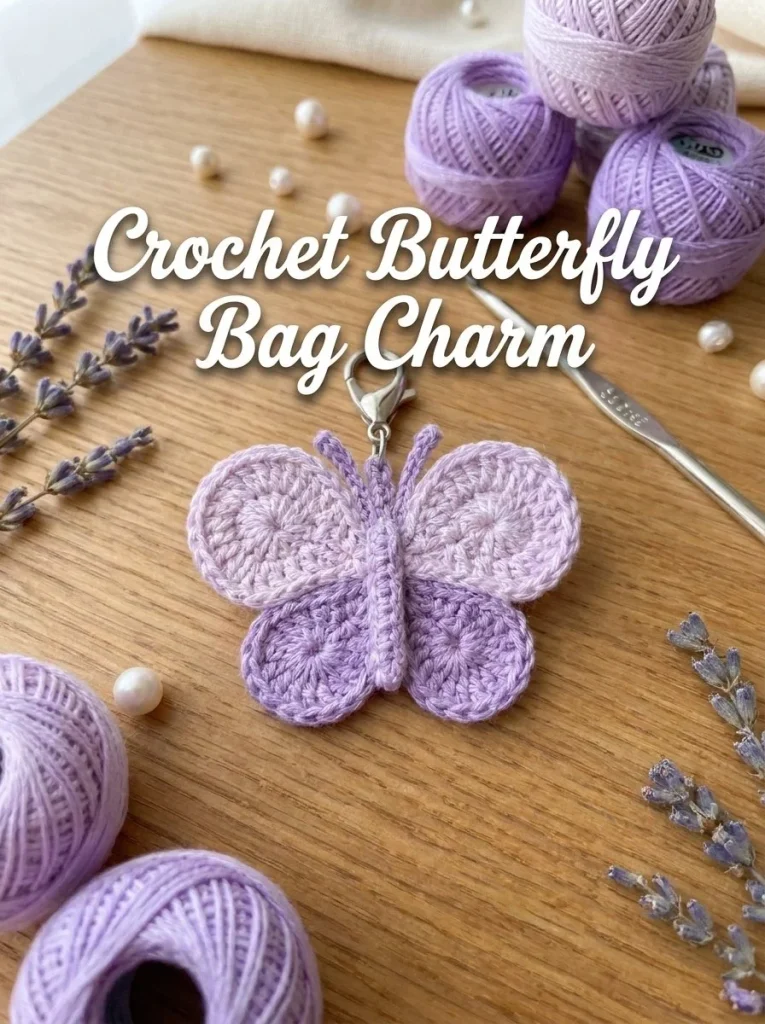
A charming and delicate accessory, this lavender crochet butterfly bag charm is a delightful project for those who appreciate intricate yet manageable crochet work. The design captures the gentle elegance of a butterfly with its four rounded wings—two larger upper wings and two smaller lower wings—crafted in soft shades of lavender and pale lilac. Made from sport-weight cotton yarn, this accessory lends a subtle pop of color and texture to any bag, making it both a stylish and personal statement piece.
The construction employs a proven four-wing flat method, creating a figure that is perfectly balanced in shape and stitch definition. The butterfly’s body is worked as a small crocheted strip in lavender, with the wings composed of rounds in a magic ring construction, enabling smooth curves and rich stitch texture. Surface slip stitches outline the wings, giving them definition and a delicate finish. This piece is practical as a bag charm thanks to its integrated clasp and split ring, securely attached by reinforcing several stitches at the butterfly’s “head.” Whether used as a gift or a personal treat, this accessory is a charming introduction to shaping with crochet and color transitions, suitable for intermediate crocheters.
For those interested in similar beginner-friendly wing patterns, you may find inspiration in a butterfly applique bag charm with a beginner-friendly wing pattern, which shares thematic connections and construction principles.
Pattern at a Glance
Skill Level: Intermediate due to shaping and assembly
Terminology: US crochet terms
Construction: Flat crochet, four separate wings joined and sewn to a crocheted body
Finished Size: Small charm size, suitable for bags (approximate size depends on tension and yarn)
Yarn Weight: Sport weight cotton
Hook Size: 3 mm crochet hook
Main Stitch: Single crochet (sc), double crochet (dc), half double crochet (hdc), slip stitch (sl st)
Gauge: Not specified; accessory size adaptable by tension
Motifs: Four wing pieces (two upper, two lower) plus body and antennae
Layout: Central body with sewn wings—upper and lower wing pairs distinctly sized
Joining: Sew wings to body; surface slip stitch outlining; attach clasp via reinforced stitches
Border: Surface slip stitch outlining upper wings
Seaming: Hand sewing wings to body and parts to assembly
Materials
- Sport cotton yarn:
- Lavender: approximately 8 grams
- Pale lilac: approximately 3 grams
- Crochet hook: 3 mm for tight, neat stitches suitable for shaping
- Notions:
- Clasp and split ring for attaching the charm to bags or keys
- Tapestry needle for weaving in ends and sewing parts together
Using cotton yarn provides a firm structure with good stitch definition, which is ideal for showing the subtle curves of the wings. The sport-weight yarn is light enough to keep the charm delicate but provides enough body to hold its shape well.
Yarn and Color Notes
Choosing sport weight cotton yarn in shades of lavender and pale lilac gives this butterfly a serene, calming palette. Cotton’s natural fibers promote clear stitch visibility and are durable, which is perfect for an accessory that might be handled frequently.
Smooth cotton yarn supports neat surface slip stitching for outlining the wings, highlighting their shape without fuzziness obscuring details. For a softer effect, a blend with bamboo or a mercerized cotton yarn can be considered, but keep in mind that changes in yarn texture may affect stitching precision and final charm size.
Color transitions are minimal but deliberate: the butterfly’s body and lower wings are lavender, while the upper wings are pale lilac outlined in lavender, creating captivating visual contrast. For experimentation, you might try variegated yarn for the wings with a solid tone body or switch the two tones to create a reversed color scheme.
Finished Measurements
While no exact dimensions are provided in the original pattern, the finished charm’s size is primarily influenced by gauge and yarn choice. Sport weight yarn with a 3 mm hook typically produces a small, lightweight accessory roughly in the range of 2–3 inches in width and height, making it ideal for bag charms or zipper pulls.
Measure your piece after completing each wing and the body to ensure proportionality. The upper wings should be noticeably larger than the lower wings; the unified shape should visually suggest the natural butterfly wing proportions.
Gauge
No numerical gauge is specified for this charm, allowing flexibility since size isn’t critical for functionality here. Gauge can be loosely assessed by making a small swatch of the stitches used:
- For reference, sport weight cotton with a 3 mm hook usually produces fairly tight stitches suitable for fine, shaped work.
- If your fabric is too loose, the charm may become floppy and lose its defined shape.
- If stitches are too tight, assembly and shaping might be difficult, and the piece could appear stiff.
Maintaining consistent tension throughout your work will ensure the piece comes together proportionally.
Abbreviations
- ch — chain
- sc — single crochet
- dc — double crochet
- hdc — half double crochet
- sl st — slip stitch
- rnd — round
Important Pattern Notes
- The body is made with a foundation chain and worked in rows using single crochet.
- Wings use the magic ring starting method to create smooth curves.
- Wings are worked in rounds with increases to shape, then folded and sewn for a rounded effect.
- The upper wings are larger, two rounds with dc and sc rounds creating a gentle half-circle shape.
- The lower wings use hdc and sc increases for a smaller rounded shape.
- Surface slip stitch outlining helps separate the wing edges visually and adds a decorative finishing touch.
- Antennae are simple chains worked back with slip stitches to create a delicate twist.
- Tails are woven on the wrong side for a clean finish.
- Clasp and ring attachment should be reinforced with multiple stitches to secure the piece’s functionality as a charm.
Special Stitches and Techniques
- Magic Ring: A technique to start circular motifs that can be tightly closed at the center, perfect for wing bases.
- Surface Slip Stitch: Worked on the surface of finished fabric to outline shapes and add texture without changing the base fabric.
- Folding and Sewing Wings: Folding the round motifs into half-circles before sewing provides anatomical shaping.
- Chain and Slip Stitch Antennae: Creates fine corded antennae that maintain shape without stiffness.
Understanding the Construction
This butterfly charm is built in three main parts:
- Body: A short crocheted strip made of a foundation chain and single crochet stitches — sturdy enough to hold the wings in place and create the torso.
- Wings: Four rounded flat sections — two upper wings worked in a pale lilac yarn, and two smaller lower wings in lavender — all made in rounds with the magic ring start, folded and sewn for shaping.
- Antennae and Attachment: Small chains slip stitched back form the delicate antennae. The clasp is firmly sewn to the butterfly’s head section for functionality.
The pieces are assembled by sewing the wings beside and below the body, ensuring the upper wings are larger and sit above the lower wings, thus mimicking natural butterfly wing proportions. The surface slip stitch outlining enhances the upper wings for a completed look.
Complete Pattern Instructions
Body
- Using lavender yarn, chain 8.
- Work 1 single crochet (sc) in the 2nd chain from the hook and in the next 6 chains — a total of 7 sc.
- This forms a small rectangular body piece that serves as the foundation for wing attachment.
Upper Wings (Make 2)
- Using pale lilac yarn, start with a magic ring.
- Round 1: Chain 3 (counts as first double crochet), then make 7 double crochets (dc) into the ring, join with slip stitch to the top of the beginning chain 3 — total 8 dc.
- Round 2: Chain 1, then 2 single crochets (sc) in each stitch around (including stitches from previous round), join — total 16 sc.
- Fold the flat circle into a half-circle shape, forming the upper wing.
- Sew each upper wing to either side of the upper part of the body.
Lower Wings (Make 2)
- Using lavender yarn, start with a magic ring.
- Round 1: Chain 2 (counts as first half double crochet), then make 6 half double crochets (hdc) into the ring, join with a slip stitch — total 6 hdc.
- Round 2: Work 2 single crochets (sc) in each stitch around (all 6), join — total 12 sc.
- Fold this piece into a half-circle as with the upper wings.
- Sew each lower wing directly below the corresponding upper wings on the body.
Wing Outlining
- Using lavender yarn, outline each curved upper wing by working surface slip stitches (sl st) along the edge.
- This technique visually defines the wing’s shape and adds a subtle decorative accent.
Antennae
- Join lavender yarn at the butterfly’s “head” (top of the body).
- Chain 5, then slip stitch back along the chain to the starting point.
- Repeat this antenna chain once more to create a matching pair.
- Weave all yarn tails to the wrong side, securing the ends neatly.
Assembly and Finishing
- Carefully sew the wings securely to the body, ensuring correct placement and wing proportion (the butterfly must have exactly four wings, with the upper pair larger).
- Reinforce the clasp attachment by stitching several times through the head stitches before attaching the split ring.
- Use a tapestry needle to weave in all loose ends on the wrong side, maintaining the clean appearance of the charm.
Checkpoints
- Body: Confirm 7 single crochet stitches across the body foundation chain.
- Upper Wings: Each should have 8 dc in the first round and 16 sc in the second. Folded properly, the shape is a neat half-circle.
- Lower Wings: Verify 6 hdc in round one, 12 sc in round two, also folded into half-circles.
- Assembly: The charm must have four distinct wings with the upper wings noticeably larger than the lower ones.
- Antennae: Two symmetrical chain & sl st pairs, securely attached at the head.
Assembly and Joining
Assembly focuses on proper piecing of wings beside and below the crocheted body. Use a yarn needle with matching lavender yarn and sew firmly to avoid detachment. Pay close attention to symmetrical wing placement, ensuring the charm embodies the natural butterfly’s silhouette.
The clasp is sewn to the head area with several reinforcing passes to achieve durability, crucial for a bag charm subject to hanging and handling.
Finishing
After assembly:
- Weave in all yarn ends on the back/wrong side for a neat finish.
- Use surface slip stitches not only for outlining upper wings but also to double-check the wing edges for any gaps or loose stitches.
- Shape antennae gently with fingers to maintain curves before final use.
Blocking is generally unnecessary for small cotton accessory pieces but can be lightly steamed and shaped if desired.
How to Resize
This pattern is sized for charm-level accessories; resizing involves:
- Using thicker yarn or larger hooks for a bigger charm, keeping the same stitch counts but adjusting tension.
- For a more delicate, smaller charm, switch to fingering weight yarn and smaller hooks, but keep in mind the clasp and split ring size compatibility.
- For significant size changes, consider adjusting stitch multiples uniformly—for instance, increasing the upper wing rounds by adding extra stitches in multiples of 2—to maintain proportions.
Remember, drastic modifications require test swatches and assembly trials to keep the butterfly’s recognizable shape and balance.
Useful Variations
- Single-color butterfly: Use lavender or lilac for the entire butterfly for a monochromatic look.
- Multicolor wings: Substitute the upper or lower wings with other pastel tones for a springtime palette.
- Sparkle effect: Incorporate a subtle metallic cotton blend yarn for a shimmering charm.
- Different motifs: Experiment with wing shapes or sizes while maintaining the four-wing flat construction to create a family of charms (e.g., a moth or dragonfly).
For a related small crocheted accessory, combining wing-focused charm making with bows, see patterns like the blue bow bag charm pattern that complements this butterfly style perfectly.
Troubleshooting
Why does my butterfly’s body feel too flimsy?
Use the recommended 3 mm hook and sport cotton to maintain firmness. If your stitches are loose, try decreasing the hook size slightly or adding more rounds for sturdiness.
Why are my wings not folding into neat half-circles?
Ensure you increase stitch counts correctly and sew tightly after folding. Incomplete or uneven folding often comes from skipped increases or inconsistent tension.
Why does the surface slip stitch look uneven?
Use a smooth yarn with little fuzziness and consistent tension for surface slip stitching. Practice this technique on a swatch before outlining the wings.
How do I keep the antennae in shape?
Chain lengths matching the pattern and slip stitching back along the chain create a corded look that holds shape well. Avoid pulling the chain tight; gentle blocking with your hands helps maintain the curve.
What if the clasp loosens after use?
Reinforce the clasp attachment by sewing multiple times through the head stitches. For heavy usage, consider adding a small button or bead underneath for extra stability.
Frequently Asked Questions
Can I use yarn other than cotton?
Yes, but cotton is preferred for its firmness and stitch definition. Acrylic or blends work, but softness might reduce shape retention.
Is this pattern suitable for beginners?
Intermediate skills are recommended, especially familiarity with magic rings, folding motifs, and surface slip stitch. Beginners may attempt it with practice.
Can I use a larger hook?
You can, but the charm will be larger and may be floppy. Adjust yarn or add more rounds to compensate.
How do I keep the wings symmetrical?
Count stitches carefully and check placement before sewing. Mirror the wings as you make them.
Can I attach this charm to other items besides bags?
Certainly. Use it as a zipper pull, keyring charm, or even decorate home accessories like bookmarks.
How do I wash this charm?
Hand wash in cool water with mild detergent. Reshape and air dry flat to preserve shape.
Optional Related Uses
This four-wing motif lends itself to various small accessories:
- Brooches or pins by sewing a brooch back instead of a clasp.
- Appliques on hats, scarves, or baby blankets as delicate accents.
- Barrette decorations or headbands with minimal assembly.
By adapting yarn colors and sizes, you can produce a small family of butterfly-themed accessories fitting a gift set.
Final Thoughts
This lavender crochet butterfly combines simple rounds and folds with subtle colorwork to create a visually appealing and functional bag charm. Its flat, four-wing construction highlights shaping techniques and finishing touches like surface slip stitch outlining and antennae construction to bring delicate life to this accessory. With solid materials, careful assembly, and attention to detail, it becomes a sweet embellishment that enhances any bag or zipper while providing a rewarding crochet experience.



