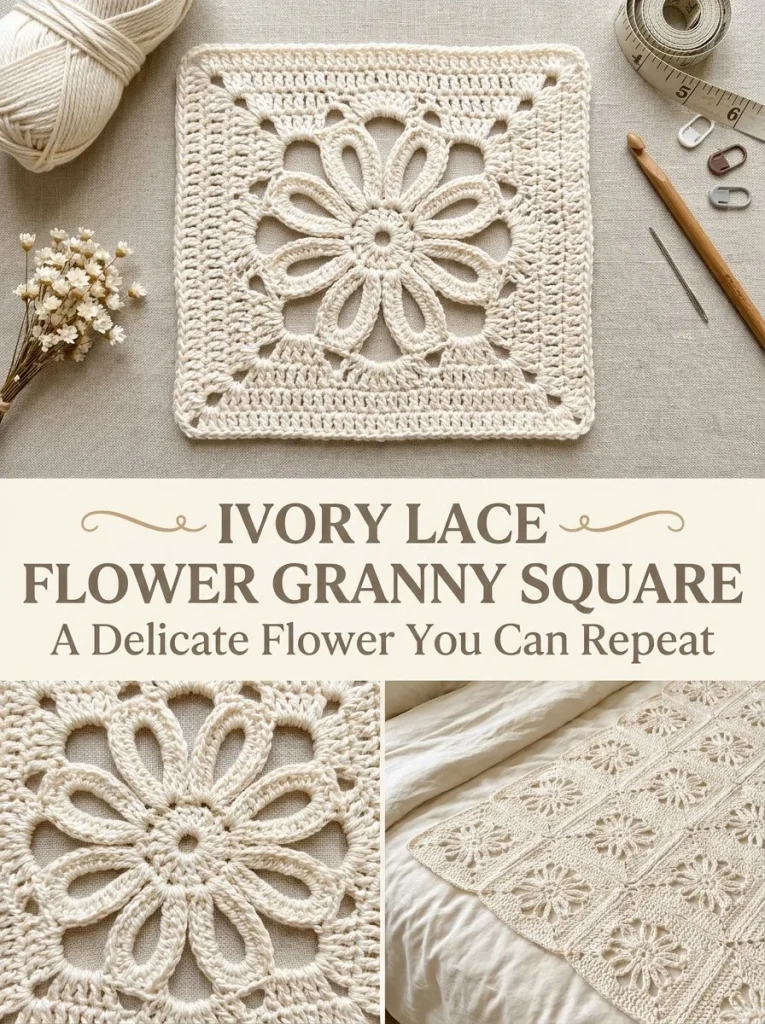
Creating an elegant and intricate bed throw with delicate floral motifs brings a refined touch to any bedroom. This crochet project features a bed throw composed of ivory eight-petal lace granny squares that combine classic granny square construction with a floral lace motif. Each square showcases distinct eight-petal flowers with an openwork lace design, offering a timeless, airy texture that drapes beautifully over your bed.
The construction employs traditional crochet techniques with a modern lace twist, worked in rounds to craft each motif individually before joining them into a larger rectangular piece. The motif’s design cleverly places petals and open arches to maintain clarity of the floral shape while gradually expanding the square’s edges into a seamless granny square format. This method makes it accessible to intermediate crocheters who are comfortable with multiple stitch types and round-by-round shaping.
Crocheted in light DK weight cotton in a warm ivory shade, the smooth texture of the yarn highlights the petals and lace details, resulting in a sophisticated look that complements diverse bedroom decors. The design is not only beautiful but functional—a perfect decorative throw that adds both warmth and a luxurious look, making it an ideal gift or personal project.
Additionally, this project aligns well with other delicate crochet patterns; for instance, exploring the charming techniques in a mini granny square bag charm pattern can inspire complementary accessories or smaller decorative pieces.
Pattern at a Glance
Skill level: Intermediate
Terminology: US crochet terms
Construction: Motif-based, worked in rounds, joined into a rectangular grid
Finished size: Approximately as per layout (10 x 12 motifs for throw)
Yarn weight: Light DK cotton
Hook size: 3.5–4 mm (E-4 to G-6)
Main stitches: Magic ring, chain (ch), slip stitch (sl st), single crochet (sc), half double crochet (hdc), double crochet (dc), groups of 3 dc
Gauge: Determined by one blocked motif; essential for sizing and yardage estimation
Motifs: Eight-petal lace granny squares worked individually
Layout: 10 motifs wide by 12 motifs long (120 motifs total)
Joining: Mattress stitch, whip stitch, or slip stitch through inner or edge loops, matching ch-2 spaces at intersections
Border: Sc all around with corner increases; hdc rounds for edging
Materials
To achieve the best results for this bed throw, use the following materials:
- Yarn: Light DK cotton yarn in a warm ivory shade. Smooth yarns are highly recommended to showcase the petals and open lacework clearly. Avoid fuzzy or textured yarns which can obscure stitch definition.
- Crochet Hook: Size 3.5 to 4 mm, chosen to suit your yarn and to achieve the correct tension.
- Tapestry Needle: For weaving in ends and joining motifs securely.
- Stitch Markers: Useful for marking corners or rounds during motif creation.
- Tape Measure and Scale: To measure motif size and accurately weigh yarn; essential for estimating total yarn needs.
- Yarn Quantity: Make and fully block one motif first, then weigh it. Multiply the gram weight by the total number of motifs (for a 10 x 12 layout, that is 120 motifs) plus an additional 15–25% yarn to account for joining, edging, waste, swatching, and slight tension or fiber differences during blocking.
This yarn calculation approach ensures you purchase sufficient yarn without significant shortage or waste.
Yarn and Color Notes
Cotton fiber is a natural choice here, prized for breathability, durability, and softness. The choice of a warm ivory color enhances the lace design by providing excellent stitch definition and a warm glow, fitting both classic and contemporary bedroom styles.
Smooth yarns are vital in this project. They allow the eight-petal shapes and the open ch-5 arches behind the petals to stand out clearly without fuzziness that could muddle the details. Since this is a lace-heavy design, solid or very subtly variegated yarns are best to maintain clarity.
If you want to experiment, consider complementary ivory shades, but avoid multicolor or variegated yarns that might hide the delicate flower motifs. For ideas on exploring different granny square styles that are also visually appealing, the Meadow Medallion Lace Throw pattern may offer inspiring insights.
Finished Measurements
The finished bed throw is composed of 10 squares across by 12 squares down, totaling 120 lace squares.
Each motif’s flat side length is determined by your gauge since individual crochet tension affects size. Once you complete and block one motif, measure it flat to establish the side length S in centimeters.
The unbordered throw dimensions will approximate C × S cm wide by R × S cm long, where C = 10 and R = 12 for this pattern layout.
Joining and edging might slightly increase dimensions, so it’s recommended to measure the assembled panel before adding borders.
Because bed sizes vary, you can adjust C and R to suit your mattress or desired throw size by making more or fewer motifs.
Gauge
Gauge is measured by creating and blocking a single motif. Although no strict stitch per inch count is provided, the process is:
- Crochet one full motif with the recommended yarn and hook size.
- Wash and block gently according to yarn instructions.
- Measure the flat side length S in centimeters (or inches).
- Weigh the motif in grams for yarn estimations.
Gauge matters mainly to:
- Ensure square motifs fit together neatly without distortion.
- Achieve the intended finished dimensions reliably.
- Estimate yarn requirements accurately.
If your gauge is larger (looser tension), motifs will be bigger, thus your throw will be larger than planned, and you will need more yarn.
If your gauge is smaller (tighter), motifs will be smaller, leading to a more compact throw and less yarn used, but you risk dimensions that may not cover the bed properly.
For throws and household items, gauge is somewhat flexible, but it is still best to measure and adjust accordingly to avoid surprises in size and yarn supply.
Abbreviations
This pattern uses standard US crochet terms. Below are the abbreviations used:
- MR: Magic Ring
- ch: Chain
- sl st: Slip Stitch
- sc: Single Crochet
- hdc: Half Double Crochet
- dc: Double Crochet
- sp: Space
- st: Stitch
- sc2tog: Single Crochet Two Together (single crochet decrease)
- 3-dc group: Three separate double crochets worked into one stitch or space (not a closed cluster stitch)
- CORNER: (3 dc, ch 2, 3 dc) worked into one ch-2 corner space
Remember, where the instructions say “join with a standing dc,” you create a new yarn double crochet into the indicated space or chain 3 and count it as the first dc of the round.
Important Pattern Notes
- Work with the right side facing for rounds unless otherwise specified.
- Each round closes with a slip stitch into the first dc (or the top of the counting chain 3).
- Use removable corner markers to keep track of corners, especially during joining or finishing rounds.
- For joining motifs, do NOT crochet petals or arches together; ensure motifs remain distinct with clear petal visibility.
- Ch-5 rear arches in Round 4 must remain unpinched to preserve lace openness.
- No additional colors are added in the motif center; maintain the single ivory yarn color throughout.
- Blocking is essential to open the lace petals and flatten the motifs for assembly.
Special Stitches and Techniques
- Magic Ring (MR): Creates a neat closed center for the motif’s core stitches.
- 3-dc Group: Three separate double crochets worked into one stitch or space, not a cluster, allowing more open lace petals.
- Corners: Made with 3 dc, ch 2, 3 dc into single chain-2 loops for sharp square shaping.
- Working Behind Petals: Round 4 instructs to join yarn on the wrong side and crochet behind the petals to avoid joining petal tops and to maintain motif texture.
- Fastening Off at Color Changes: Even though this motif uses a single color, periodic fasten-offs occur between rounds for clean thread management.
- Seam with Mattress or Whip Stitch: to join motifs invisibly through inner loops.
Understanding the Construction
This project creates a decorative bed throw made of small, identical crochet lace motifs worked individually. Each motif starts with a magic ring forming the center eight single crochets and expands through rounds that build eight petals arranged in a circle with open arches behind, then rounds that square up the motif by adding corners and sides of grouped double crochets.
After all motifs are made, they are joined row by row by sewing or slip stitching through inner loop spaces for a nearly invisible seam. After joining the total 10 x 12 grid of motifs, an edging is added to frame the throw and ensure a tidy finish.
Because the motifs feature open arches and delicate petals, care is taken to avoid compressing or distorting these details during assembly and finishing.
This modular motif approach allows for flexibility in size by changing the number of motifs per row and column.
Full Pattern Instructions
Round 1: Center Ring Base
- Begin with a magic ring (MR).
- Work 8 single crochet (sc) stitches into the ring – this forms the center.
- Close the round with a slip stitch (sl st) into the first sc to create a flat ring.
- Stitch count: 8 sc.
Round 2: Anchor Points and Arches
- Using the same or new yarn, sc in next sc, ch 4 repeat eight times around the circle.
- Join with sl st into the first sc.
- You will have 8 anchoring single crochets and 8 chain-4 arches.
- These arches provide spaces for petal formation in the next round.
Round 3: Forming the Eight Petals
- Join yarn to any ch-4 arch.
- In each ch-4 arch, work this petal pattern: (sc, hdc, 3 dc, hdc, sc) to create one petal.
- Repeat this in all eight arches, resulting in 8 petals.
- Each petal contains 7 stitches: 1 sc, 1 hdc, 3 dc, 1 hdc, and 1 sc.
- Fasten off yarn after the last petal.
Round 4: Working Behind the Petals for Open Lace Arching
- Join new yarn from the wrong side to any visible single crochet from Round 2 (anchoring sc).
- Work sc into next Round 2 anchoring sc from behind, ch 5 around all eight anchoring sc points.
- Join with sl st into the first sc.
- This creates 8 back loops of chain-5 arches behind the petals without crocheting petals together.
- Turn the piece right side up.
Round 5: Shaping the Motif Square
- In each of the 8 chain-5 loops from Round 4, work the following sequence around the flower:
- On loop 1: CORNER = (3 dc, ch 2, 3 dc)
- ch 1
- Loop 2: 3 dc
- ch 1
- Loop 3: CORNER
- ch 1
- Loop 4: 3 dc
- ch 1
- Loop 5: CORNER
- ch 1
- Loop 6: 3 dc
- ch 1
- Loop 7: CORNER
- ch 1
- Loop 8: 3 dc
- ch 1 then join
- Total groups: 12 (4 corners and 8 side spaces)
- Stitches: 36 double crochets.
Round 6: Expanding the Square
- In each corner chain-2 space, work one CORNER (3 dc, ch 2, 3 dc).
- In each of the two chain-1 side spaces on each side, work 3 dc.
- Place a chain 1 between these groups.
- Total groups: 16 (4 corners + 12 side spaces)
- Stitches: 48 double crochets.
Round 7: Final Round of Motif Expansion
- Work a CORNER in each corner ch-2 corner space.
- Crochet 3 dc into each of the three ch-1 spaces along each side, each separated by a ch 1.
- Join with a sl st at the end.
- Total groups: 20 (4 corners + 16 side spaces)
- Stitches: 60 double crochets.
Key Tips for the Motif
- All rounds use the same ivory yarn to maintain color uniformity.
- Ensure chain-5 rear arches from Round 4 remain open and unpinched to preserve the delicate lace effect.
- The eight petals must remain clearly visible and separate; do not join or pinch them together.
- Avoid adding any differently colored centers to maintain the elegant single-color appearance.
Checkpoints
- After Round 3, verify that you have eight clearly formed petals, with each petal distinct and properly shaped.
- After Round 4, ensure the back loops with chain-5 arches are fully open from the wrong side.
- After Round 7, the motif should be square, with obvious corner and side double crochet groups, approximately matching your gauge.
- When assembling, verify motifs line up with corner chains matching at intersections for smooth joining.
Assembly and Joining
- Arrange motifs in your desired layout; the standard for a bed throw is 10 motifs wide by 12 motifs long (120 total).
- Lay out motifs flat on a surface, checking alignment and visual consistency.
- Join motifs using your preferred method:
- Mattress or whip stitch through inner loops for discreet seams.
- Slip stitch through edge loops for a connected crochet join.
- When joining at intersections, match the four corner chain-2 spaces carefully without adding extra squares. This ensures a clean join with no bulky overlap.
- Join squares into rows first, then join the rows together for a flexible approach.
Border
Once all motifs are joined, work the border to frame the blanket:
- Round B1: Sc evenly around the blanket edge. Make 3 sc in each outer blanket corner to keep corners flat and defined.
- Round B2: Hdc in every stitch. In each outer corner’s middle stitch, work 3 hdc to add a gentle curve. Mark these corners to ensure consistency.
- Repeat Round B2 if you want a thicker, more defined edging.
Weave ends neatly, then wash and block the finished throw according to the yarn label instructions. This final blocking smooths joins, flattens edging, and enhances lace openness.
How to Resize
Sizing is controlled by the number of motifs:
- To make a larger throw, increase the number of motifs both across and down from the base 10 x 12 layout.
- For smaller throws or lap blankets, reduce motifs accordingly.
- Make and block one motif first to measure side length S; then calculate your needed number of motifs by dividing the desired blanket width and length by S.
- Measure the fully assembled panel before deciding border width to ensure best fit.
- Yarn amounts scale by the total number of motifs plus joining and border yarn, allowing 15–25% extra for waste and finishing.
This method provides precise control over size while maintaining the stitch and motif integrity.
Useful Variations
- Color Play: While the pattern uses warm ivory, subtle ombré or tonal variations could be experimented with in later projects—though not recommended here as it may obscure petal clarity.
- Smaller Scale Projects: This motif can be adapted for smaller works such as cushion covers or lightweight throws by reducing motif count. Explore related decorative projects like the mini granny square bag charm to expand your crochet repertoire.
- Border Embellishments: Add picots, shells, or a lacy scalloped edge to the border for extra drama if desired.
- Mixed Fiber Yarn: For a softer drape, consider mixing cotton with bamboo or silk blends, but test gauge carefully.
Troubleshooting
Why Are My Petals Not Clearly Defined?
Ensure you are using a smooth yarn in light DK weight, as fuzzier or bulky yarns can obscure the eight-petal design. Also, blocking properly will open the petals and arches.
Why Are My Motifs Different Sizes?
Check your tension and hook size carefully; make sure you are consistent between motifs. Blocking each motif to the same measurements helps uniformity.
Why Does My Joined Blanket Feel Stiff or Distorted?
Seams worked too tightly can pull the fabric. Use a gentle hand when stitching motifs together and avoid sewing too close to petal edges.
Why Is the Border Curling or Ruffling?
Make sure to use correct stitch counts at corners (3 sc or 3 hdc) and avoid skipping increases. Blocking after border completion helps flatten ripples.
How Can I Keep the Chain-5 Rear Arches Open?
Avoid pulling chain loops too tight; loosely work these chains and block the motif so the arches remain unpinched for the open lace effect.
Frequently Asked Questions
Can I use a heavier yarn than Light DK?
Using heavier yarn will increase motif size dramatically and change the fabric’s drape and weight. While possible, you must recalculate motif count and yarn amounts carefully.
Can I make this bed throw in a different color?
Yes, but the petal definition depends on a smooth, uniform color. Variegated or highly textured yarns may hide the lace details.
Is this pattern suitable for beginners?
This pattern suits intermediate crocheters familiar with multiple stitch types and working in rounds. Beginners should practice smaller granny square motifs first.
How should I block the motifs?
Gently wash according to yarn care instructions. Pin each motif flat on a blocking board to open petals and arches, then allow to dry completely.
Can I join motifs as I crochet them?
This pattern is designed for motifs to be completed individually and joined later for precise blocking and alignment.
Do I need to be precise with stitch counts?
Yes, maintain stitch counts and pattern repeats to ensure motifs are square with consistent petal shapes.
Optional Related Uses
This elegant eight-petal lace granny square motif could easily inspire other projects, such as:
- Delicate throw pillow covers
- Lightweight lacy scarves or cowls
- Table runners with a floral lace theme
- Baby blankets with safe, breathable cotton yarn
- Accessories like decorative bags or charms, using motifs as appliqués or standalone decor elements
The modular nature and striking floral lace make this motif versatile beyond bed throws.
Final Thoughts
This project beautifully combines the timeless appeal of granny square crochet with delicate floral lacework. Each motif is thoughtfully constructed in rounds to create an elegant eight-petal flower center with airy arches and a square shape for easy joining. Working with smooth light DK cotton yarn and a suitable hook size ensures that the prominent petal shapes and openwork remain distinct and graceful.
Upon assembling the 120 motifs into a 10 x 12 layout and adding a neat border, you’ll have a stunning, weighty lace bed throw that both decorates and comforts. The pattern emphasizes careful blocking, consistent tension, and precise joining to uphold the delicate beauty of each motif and the overall piece.
This bed throw offers both challenge and charm for intermediate crocheters ready to explore floral lace granny squares, resulting in a refined and functional heirloom-quality accessory.



