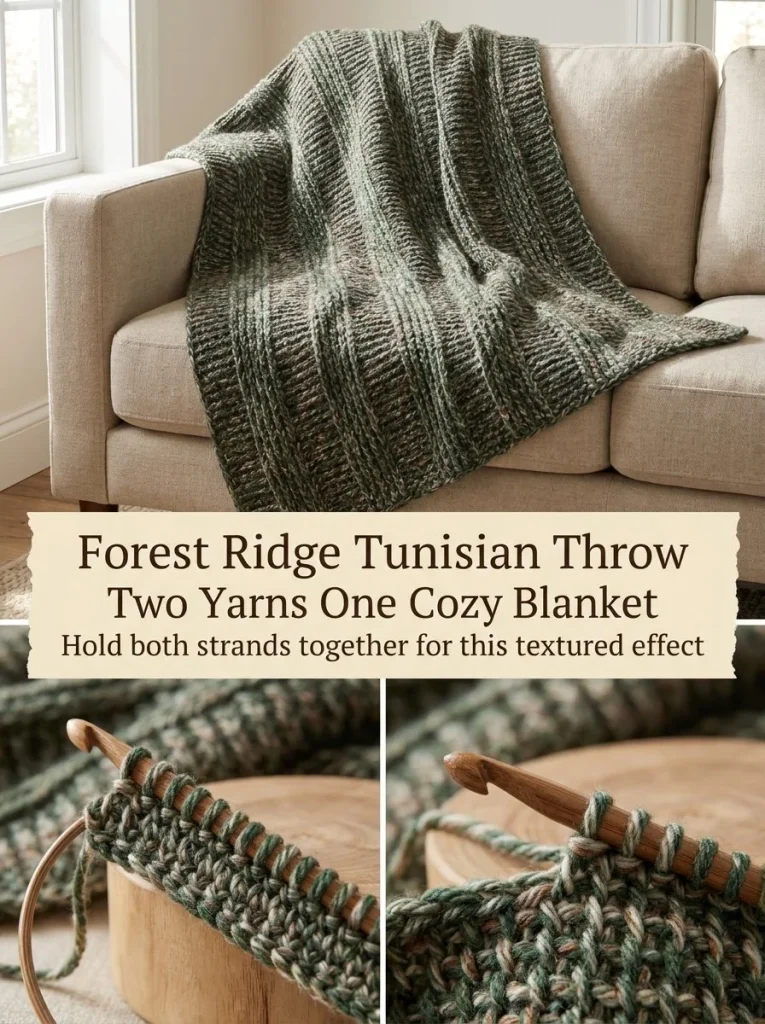
This cozy and visually engaging Tunisian crochet throw combines the rich solidity of a worsted weight forest green yarn with the dynamic color shifts of a DK self-striping yarn, worked simultaneously to create a uniquely textured and striped fabric. Utilizing Tunisian crochet techniques, this throw is designed with a two-stitch texture repeat that weaves front and back bar stitches in alternating blocks, producing a distinctive pattern that catches the light and highlights the interplay of colors in both yarns.
The construction is based on a long rectangular panel, worked from foundation chain through multiple rows, holding both yarn strands together throughout to maintain a consistent gauge and allow the subtle color transitions of the self-striping yarn to emerge naturally. The long cable hook necessary for this project accommodates the wide stitch count, making it manageable to keep all stitches comfortably on the hook. The resulting piece is warm, durable, and generously sized for cuddling on chilly evenings or as a striking decorative accent on sofas or beds.
Because this project uses Tunisian crochet’s signature forward and return passes with a texture stitch combination—and because the strands are held together for color interplay—this throw is both a satisfying technical challenge and an opportunity to expand one’s skills in working vertical bar stitches and alternating stitch textures. The final blocking step is essential to relax the fabric and enhance the drape and dimensions of the throw, providing a smooth, polished finish.
Pattern at a Glance
Skill level: Intermediate (Tunisian crochet experience recommended)
Terminology: US crochet terms (TSS = Tunisian Simple Stitch, TRS = Tunisian Reverse Stitch, SlSt = Slip Stitch)
Construction: Worked in a single large rectangular panel, back-and-forth Tunisian crochet
Finished size: Approximately 45 x 60 inches after blocking
Yarn weight: Worsted #4 for forest green, plus DK #3 self-striping yarn held together throughout
Hook: 8 mm Tunisian crochet hook with long cable to hold 120 stitches
Main stitch: Alternating blocks of 12 Tunisian Simple Stitches (TSS) and 12 Tunisian Reverse Stitches (TRS)
Gauge: Not specified; gauge determined by yarn held double and hook size, approximately based on finished measurements and stitch count
Motifs: None (single textured field with alternating stitch blocks)
Layout: Rectangular panel
Joining: None required (worked in one piece)
Border: 2 rows of TSS at beginning and end, final row of Tunisian slip stitches
Seaming: None
Materials
- Worsted weight #4 forest green yarn: Approximately 2000 yards required. This forms the solid, grounding color of the throw.
- DK weight #3 self-striping yarn: Approximately 2300 yards, held together with the worsted yarn throughout the project. The self-striping yarn introduces subtle color shifts without breaks or joins, as it is not cut but allowed to change naturally.
- 8 mm Tunisian crochet hook with long cable: Needed to comfortably hold the large number of loops (120 chains initially). A standard straight hook would be impractical for this width.
- Yarn needle: For weaving in ends and finishing after completion.
This combination of yarn sizes—worsted and DK held together—creates a thicker fabric with interesting textural and color effects. The forest green worsted yarn anchors the piece with a deep, consistent color, while the self-striping DK yarn adds a lively, softly variegated contrast.
Yarn and Color Notes
When choosing yarns for a project like this, it is beneficial to select fibers that complement each other not only in weight but also in texture and washability. Smooth, firmly spun yarns work best for maintaining clear stitch definition with Tunisian crochet, particularly when working vertical bars and stitch textures. Fuzzy or loosely spun yarns may obscure the stitch pattern and cause snagging on the hook.
Holding two strands together doubles the thickness of the yarn input, so the final fabric will be warm and dense. The self-striping yarn—without cutting between color changes—allows the natural stripes to flow uninterrupted, creating long color gradations that enhance the overall visual interest without complicated colorwork.
If you prefer a different palette or effect, you could experiment with solid worsted yarn plus a variegated or tonal DK yarn, but aim to keep the two strands consistent in fiber content and washing instructions to preserve fabric integrity.
Finished Measurements
- Approximate size after blocking: 45 inches wide by 60 inches long
- This size corresponds to the full rectangular panel worked from 120 foundation chains and approximately 144 rows of the texture repeat, resulting in a generous throw suitable for lap warmth or decorating a bed or sitting area.
The blocking stage is crucial to reach the targeted final dimensions, as Tunisian crochet fabrics especially benefit from a wet block to even out the tension, straighten edges, and produce a softer drape.
Gauge
No explicit gauge measurement is supplied. However, this project’s gauge is effectively controlled by the initial chain count and the number of rows to reach the finished size:
- Foundation chain: 120 stitches
- Rows: Approximately 144 rows to yield about 58 inches length before blocking
- Blocking: Adjusts size to final 45 x 60 inches
Because holding both yarns together yields a thicker fabric, this gauge produces a dense but flexible cloth. If gauge is larger (looser tension), the throw will be wider and shorter; smaller gauge (tighter tension) yields narrower and longer fabric. Gauge is less critical for throws than for fitted garments, but maintaining consistent tension ensures uniform stitch pattern and good final dimensions.
Abbreviations
- Ch: Chain
- TSS: Tunisian Simple Stitch (insert hook under front vertical bar, yarn over, pull up loop)
- TRS: Tunisian Reverse Stitch (insert hook under back vertical bar, yarn over, pull up loop)
- SlSt: Slip Stitch
- Yo: Yarn over
Important Pattern Notes
- Both yarn strands (worsted and DK self-striping) are held together for the entire project, knitted as a single combined strand. Do not separate or cut the self-striping yarn to preserve its natural color transitions.
- The foundation is worked as a chain of 120 stitches, with both yarn strands held together.
- The forward pass consists of pulling up one loop in each stitch or chain across and keeping all loops on the hook (Tunisian crochet characteristic).
- The return pass is worked in the standard Tunisian crochet manner by yarning over and pulling through loops to leave one loop on the hook at the end.
- The stitch pattern consists of blocks of 12 Tunisian Simple Stitches followed by 12 Tunisian Reverse Stitches across the row. On the following row, these blocks are reversed to invert the texture blocks, creating a checkerboard textured effect.
- Repeat this two-row texture repeat approximately 144 times to reach desired length around 58 inches before blocking.
- Finish with 2 rows of TSS for a stable edge, then a final row of Tunisian slip stitches across to close and secure the fabric edge.
- The finish includes wet blocking to adjust size and relax the fabric.
Special Stitches and Techniques
This project uses the following Tunisian crochet stitches:
- Tunisian Simple Stitch (TSS): Insert hook under the front vertical bar of the loop on the hook, yarn over and pull up a loop. Creates the knit-like side of the fabric.
- Tunisian Reverse Stitch (TRS): Insert hook under the back vertical bar of the loop on the hook, yarn over, and pull up a loop. Builds a purl-like texture on the fabric.
- Tunisian Slip Stitch (SlSt): Insert hook as for a slip stitch and pull yarn through loop on hook and stitch on needle simultaneously—a technique for firm edge finishing.
Holding both yarn strands together affects the tension and drape, so familiarity with working thicker threads on a Tunisian hook is helpful.
Understanding the Construction
This throw is worked as a single, wide rectangular piece from foundation to finish without assembly. The wide width requires a long cable hook to accommodate the loops.
The front and return passes in Tunisian crochet build a fabric where the stitch fronts show vertical bars. Alternating TSS and TRS blocks creates an appealing textured surface akin to a checkerboard, enhancing tactile and visual interest.
By reversing the stitch blocks every other row, the throw gains depth and intricacy, making it more engaging than a plain single stitch fabric.
The double strand yarn held throughout adds thickness and enables the self-striping yarn’s colors to flow naturally without interruption or extra finishing at color changes.
Complete Pattern Instructions
Foundation Chain and Forward Pass:
-
Using both the worsted #4 forest yarn and the DK #3 self-striping yarn held together, chain 120 stitches loosely to avoid tightness in the foundation. This forms the base width of your throw.
-
For the foundation forward pass, starting in the second chain from the hook, insert your Tunisian hook under each chain stitch, pulling up one loop per chain. Work across the entire foundation chain of 120 chains, keeping all loops on the hook without dropping any. This sets up the stitches for the return pass.
Return Pass:
- Yarn over and pull through one loop on the hook (this is your turning chain equivalent).
- Then yarn over and pull through two loops repeatedly until only one loop remains on the hook. This completes your first row.
Texture Repeat Rows:
Row 1 of Texture Repeat:
-
Insert the hook under the front vertical bar of the first 12 loops, working 12 Tunisian Simple Stitches (TSS).
-
Then, insert the hook under the back vertical bar of the next 12 loops, working 12 Tunisian Reverse Stitches (TRS).
-
Repeat this alternating pattern of 12 TSS then 12 TRS blocks across the entire row, maintaining the final edge stitch through both edge bars for a neat border.
-
Complete the return pass as before: yarn over and pull through one loop, then yarn over and pull through two loops repeatedly until a single loop remains on the hook.
Row 2 of Texture Repeat:
-
Working on the next forward pass, reverse the stitch blocks from Row 1:
-
Work 12 Tunisian Reverse Stitches (TRS) over the previous 12 TSS sections.
-
Work 12 Tunisian Simple Stitches (TSS) over the previous 12 TRS sections.
-
Continue alternating these blocks across the row, maintaining edge stitches carefully.
-
Perform the standard return pass.
Repeat Texture:
- Repeat these two rows, alternating block textures for approximately 144 rows, or until the piece measures roughly 58 inches in length before blocking.
Border and Finishing:
- After the texture repeats, work 2 additional rows of TSS across the width to create a stable, non-curling edge.
- Follow with a final row of Tunisian slip stitches (SlSt) across the entire width to firmly finish the edge.
- Fasten off securely.
Important Notes:
- Since both yarn strands have been held together throughout, allow the DK self-striping yarn to change colors naturally without cutting or joining, preserving the yarn’s continuous color flow.
- Once complete, block the throw carefully to approximately 45 inches wide by 60 inches long, gently shaping and relaxing the fabric for a polished look.
At this stage, your throw should exhibit a beautifully balanced texture with a checkerboard effect created by alternating TSS and TRS stitch blocks, enhanced by the subtle color variegation of the self-striping yarn combined with the forest green foundation shade.
Checkpoints During Work
- After completing the foundation chain and forward pass, verify your width: It should comfortably accommodate 120 stitches on the hook without tension.
- After 10 texture repeat cycles, the fabric should feel dense but flexible, with visible contrasting stitch blocks.
- Measure length after 72 rows (halfway through repeats); it should be roughly 29 inches (pre-blocking).
- Before beginning final border rows, confirm length around 58 inches.
Assembly
No assembly is required as this is a single piece worked flat.
Finishing and Blocking
- Weave in all ends securely using the yarn needle.
- Soak the throw in lukewarm water gently, then lay flat to dry on a blocking mat or clean surface.
- Pin or shape to the final dimensions approximately 45 x 60 inches.
- Allow full drying to flatten loops and smooth edges, improving fabric drape and fabric balance.
How to Resize This Throw
This pattern’s width is controlled by the foundation chain of 120 stitches. To make a wider or narrower throw, adjust the foundation chain in multiples of 24 stitches (the stitch multiple of 12 TSS + 12 TRS blocks). For example:
- For a narrower throw: chain 96 (4 blocks) or 72 (3 blocks), maintaining stitch multiples.
- For a wider throw: chain 144 (6 blocks) or 168 (7 blocks).
Length is adjusted by the number of texture repeat row pairs worked. Each two-row repeat adds approximately 0.4 inches in length (based on 144 rows totaling approximately 58 inches). Add or subtract repeats to your preferred length.
Useful Variations
- Single Yarn Variation: Use just one worsted yarn held double in a solid or variegated color to simplify colorwork, creating a more uniform textured throw.
- Different Color Combos: Pair contrasting colors such as cream and navy, or complementary earth tones for seasonal effects.
- Scarves or Blankets: Apply the same stitch pattern to smaller or longer projects, like scarves or baby blankets, by adjusting foundation chain and row count.
- One-Row Texture: For a less complex texture, see the modular stitch inspiration from the Alpine Moss One Row Repeat Throw, which showcases a different but similarly engaging Tunisian texture.
Troubleshooting
Why Is My Throw Becoming Wider Than Expected?
Tunisian crochet fabric sometimes relaxes and widens after blocking. To minimize this, crochet with moderately firm tension and avoid excessive oversizing of your foundation chain. Adding a few extra rows of TSS border at edges helps stabilize width.
Why Is My Texture Pattern Not Showing Clearly?
Ensure you insert the hook correctly under either the front or back vertical bars for TSS and TRS. The front vertical bar yields the knit-like (flat) stitch, and the back vertical bar creates the purl-like texture. Mixing these correctly is crucial for the checkerboard effect.
Why Are The Edges Curling?
Edges in Tunisian crochet can curl due to inconsistent tension or missed edge stitches. Maintaining final edge stitches through both edge bars and finishing with 2 rows of TSS plus a Tunisian slip stitch row helps create a flat, stable border.
My Yarn Colors Don’t Transition Smoothly. What Should I Do?
Holding both yarns together allows the self-striping yarn to change color without cutting. Avoid manually cutting the self-striping strand; let it naturally progress to preserve clean color changes.
Frequently Asked Questions
Can I Use Yarn Weights Other Than Worsted and DK?
Yes, but ensure that the two yarns held together are compatible in thickness and fiber. Using two very different weights may cause gauge issues and affect drape.
Can Beginners Attempt This Throw?
Some experience with Tunisian crochet—especially managing forward and return passes and working front and back vertical bar stitches—is recommended. Practicing diagonal moss stitch throws or simpler textures can build skills.
Do I Need a Special Hook?
An 8 mm Tunisian hook with a long cable is essential to comfortably hold all stitches (120 loops) in place.
Is This Throw Reversible?
The texture pattern creates a distinct front and back surface due to stitch types. While not identical on both sides, the back still maintains an attractive textured effect.
How Should I Block This Throw?
Wet block the piece gently, stretch lightly to the target dimensions (45 x 60 inches), and pin edges flat to dry completely.
Can I Make It Larger or Smaller?
Yes. Adjust the foundation chain in multiples of 24 stitches (one full texture repeat block) for width and adjust the number of two-row texture repeats for length.
Optional Related Uses
The alternating block texture and color effect work well beyond throws:
- Pillows: Create smaller squares with the texture for pillows or cushions.
- Scarves: Adapt the stitch pattern for a long, narrow scarf highlighting texture and color.
- Table Runners: Use the rectangular construction without borders for elegant table pieces.
- Baby Blankets: Customize length and width for smaller projects using same stitch knowledge.
Each variant builds on the same principles of stitch texture and yarn interplay.
Final Thoughts
This project centers on holding two strands of yarn together to create a thick, textured Tunisian fabric, alternating blocks of knit-like and purl-like stitches for rich visual and tactile interest. A large foundation chain sets the width, and flipping the stitch types every other row develops the distinctive reversible texture. The natural progression of the self-striping yarn colors alongside a steady forest green worsted yarn adds layered complexity without extra finishing.
The result is a substantial, warm throw that combines technique and color to elevate a classic Tunisian crochet construction. With careful attention to tension, stitch placement, and blocking, the piece will offer both comfort and visual appeal to suit your home or gifting plans.



