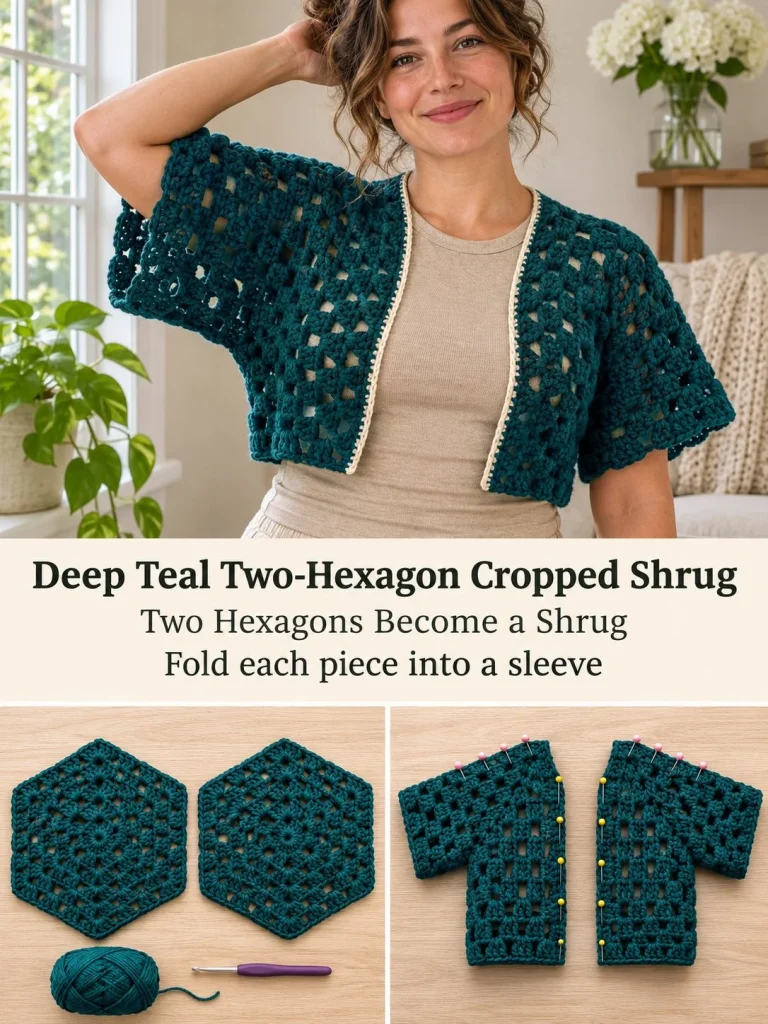
This elegant cropped shrug combines classic crochet motifs with a modern silhouette, creating a stylish layering piece that is both comfortable and eye-catching. Constructed from two identical six-corner granny hexagons in deep teal, the shrug naturally adopts an L-shape fold that forms short sleeves and a cropped body. This unique construction allows for an effortless fit that enhances the shoulder line and provides an open front for versatile styling.
The core technique relies on granny hexagons worked in joining rounds with clusters of double crochets, separated by chain spaces to maintain the geometric shape. The choice of deep teal worsted yarn gives the shrug a rich color depth, perfect for transitional weather layering. Highlighted with a subtle cream single crochet border, the finished garment gains a refined edge that ties the look together gracefully.
This pattern suits intermediate crocheters comfortable with reading instructions for motifs and shaping garments through assembly. Before stitching, testing the fold with paper hexagons and adjusting size to body measurements ensures the best personal fit. For those intrigued by similar color palettes and texture work, exploring the appealing designs of a deep teal envelope crochet pillow cover provides wonderful creative inspiration.
Pattern at a Glance
Skill level: Intermediate
Terminology: US Crochet terms
Construction: Two identical 6-corner granny hexagons folded into L shapes and sewn together
Finished size: Approximately 18–20 inches across flat for each hexagon piece, spanning shoulder to cropped hem and sleeve length (adjustable by gauge)
Yarn weight: Worsted (#4)
Hook size: 5.5 mm (I-9)
Main stitch: Granny clusters (3 double crochets) and chain spaces
Motifs: 2 granny hexagons
Layout: Pairs of folded L-shaped hexagons mirrored to form shrug
Joining: Seamed top/sleeve edges and center-back vertical edges
Border: One or two rows of single crochet in cream around front opening
Seaming: Hand sewn with tapestry needle
Materials
To complete this project you will need:
- Worsted weight (#4) yarn: 950 to 1150 yards in a rich deep teal color. This amount accommodates making two large hexagons plus border and seaming.
- Crochet hook: 5.5 mm (US I-9), ideal for worsted yarn to create balanced fabric drape and stitch definition.
- Tapestry needle: For weaving in ends and sewing seams securely.
- Stitch markers: Helpful for marking corners and joining points, especially to track six exact corners on each hexagon.
These materials ensure sturdy stitches with good body, perfect for a lightweight, cropped layer. Adjust yarn quantity if you work tighter or looser gauge.
Yarn and Color Notes
Choosing the right yarn impacts the shrug’s overall texture and wearability:
- Fiber: Acrylic, wool, or blends are all suitable. Wool or wool blends provide warmth and excellent stitch memory, while acrylic offers easy care and durability.
- Color: Solid deep teal enhances the geometric motif, providing strong color saturation. Avoid highly variegated yarns to keep stitch clusters visually crisp. Pairing with a cream-colored border adds soft contrasting definition.
- Texture: Smooth yarns make cluster stitches stand out sharply; avoid very fuzzy or novelty yarns which may obscure stitch definition.
If you prefer different hues, maintain a bold solid color for the hexagons and a light contrasting hue for the border to mimic the original elegant look. For more inspiration, consider the color harmony found in the deep teal honeycomb texture scarf which uses similar textures and hues effectively.
Finished Measurements
Each granny hexagon should measure approximately 18–20 inches across flat when completed, depending on your gauge and yarn tension. When folded into the L shape, each hex covers both part of the shoulder and the cropped sleeve length. The combined garment spans across the upper body shoulders with a cropped length hem, creating a trendy shrug shape.
Measurements will vary based on:
- Your crochet gauge
- Yarn brand and fiber content
- How tightly or loosely you crochet
Since this shrug is worn folded and sewn, precise measurement is critical. Adjust hex sizes by adding or subtracting rounds while watching the fold on paper templates or a sample swatch.
Gauge
Gauge for this pattern is crucial to ensure the hexagon pieces have the correct dimensions to fold properly and fit the body.
- Gauge is measured by achieving the correct size for the granny hexagon rounds, aiming to reach about 18–20 inches diameter across flat before folding.
- Because motifs are worked in rounds with granny clusters and chain spaces, measure across the hex from one flat side to its opposite side for an accurate width.
- Note that different hook sizes, yarn brands, and tension will affect the diameter of your hexagons.
If gauge is larger (looser tension), the shrug will be bigger, potentially looser and oversize. If gauge is smaller (tighter tension), the shrug may fit tighter or be smaller overall. Adjust hook size to correct gauge before proceeding to complete the full project.
Abbreviations
- ch = chain
- sc = single crochet
- dc = double crochet
- st(s) = stitch(es)
- sl st = slip stitch
- magic ring = adjustable ring used to start rounds
- cluster = here refers to 3 dc worked into the same space
All instructions use US crochet terms throughout.
Important Pattern Notes
- The starting chain 3 counts as the first double crochet in each round.
- The hexagons are worked in joined rounds, joining each round with a slip stitch to the first dc.
- Exactly six corners are maintained by using 3 dc, ch 2, 3 dc clusters in each corner space throughout rounds.
- Side edges consist of 3 dc clusters separated by chain 1 spaces, giving the classic granny hex appearance.
- Stitch markers can help you track corner spaces to ensure a perfect 6-cornered hexagon every round.
- The folded L shape emerges naturally due to the hexagon’s inherent 120-degree corner angles allowing both sleeve and body folds.
- Seaming must preserve sleeve openings for the shrug functionality.
- Final rows of single crochet in cream create a neat, stable edging around the front opening.
Avoid claiming fixed stitch counts in the pattern without measuring gauge first as individual tension influences size significantly.
Special Stitches and Techniques
This pattern uses standard US crochet stitches but includes important techniques worth noting:
- Magic ring: Provides a tight center to start the granny hexagon rounds without holes.
- Granny cluster: Clusters of 3 double crochets worked into designated chain spaces, a foundational granny pattern element.
- Ch 2 corner spaces: Create the angles needed to maintain the hexagonal shape.
- L-shape folding: The natural geometric property of the hexagon creates L-shaped halves without additional shaping, combining sleeves and body seamlessly.
- Hand sewing with tapestry needle: Essential for assembling folded pieces with precision, ensuring durable, clean seams.
- Single crochet edging: Adds a clean, contrasting trim and stabilizes the front edges against stretching.
Understanding the Construction
This shrug is uniquely formed from two large granny hexagons, each shaped with exactly six corners. Each hexagon is worked flat in joined rounds starting from a magic ring, expanding outward with clusters.
Once complete, each hexagon is folded into an L shape—one arm of the L forms a short sleeve, the other arm forms the cropped body front and back. Because the hexagon sides meet at 120°, this folding naturally creates clean sleeve openings without added shaping.
Two such folded pieces are laid mirrored alongside each other:
- The sleeves’ outer edges are sewn from sleeve ends inward toward the shoulder, preserving the sleeve opening.
- The vertical edges at the center back of the body are sewn together, leaving the front open for a cardigan-like effect.
- This method yields minimal seams and uses the motif’s geometry for shaping rather than complex stitch manipulations.
The final pop of cream single crochet around the front edges defines the open front and provides firm structure to the cut edges.
Full Pattern Instructions
Make Two Granny Hexagons
Round 1:
- Begin with a magic ring and chain 3 (counts as first dc).
- Work six groups of 3 double crochet clusters, separated by chain 2 spaces. This creates six corners.
- Join with a slip stitch to the top of the starting ch 3.
Subsequent Rounds:
- In each corner space (chain 2 from previous round), work: 3 dc, ch 2, 3 dc. This maintains the hexagon’s six-corner structure.
- In every side chain 1 space, work a 3-dc cluster. Ch 1 between these clusters.
- Continue rounds in this pattern, carefully keeping exactly six corners.
- Work until the piece measures approximately 18–20 inches across flat, enough to span shoulder, cropped hem, and short sleeve length depending on your gauge and size.
Folding and Assembly
- Fold each hexagon along one diagonal to create an L shape: one leg of the L forms the body, the other forms the sleeve.
- Place the two folded L halves mirrored, arranging so sleeves match and body edges align.
- Sew the top and sleeve seams from the sleeve ends inward toward the shoulders, maintaining sleeve openings for armholes.
- Sew the center-back vertical edges of the bodies together, leaving the front open like a shrug or cardigan.
Front Edging
- Using cream yarn, work one or two rows of single crochet around the front opening edges to add definition and structure.
Important Tips
- To check proportions, test the folding with paper hexagons before sewing. This helps visualize fit and confirms size adjustments needed.
- Adjust your hexagon size by adding or subtracting rounds before folding if the cuff and cropped body length do not align with intended measurements.
- Always verify gauge and fit on actual body measurements rather than relying on fixed stitch counts—personal tension matters.
Checkpoints
- After each round, confirm the hexagon has exactly six corners; if not, adjust stitch placement.
- When the hexagon reaches 18–20 inches across flat, measure carefully before proceeding to folding. This size should allow the folded L shape to fit the shoulder-to-hem and sleeve length properly.
- After sewing sleeve seams, try on the shrug to ensure sleeve openings feel comfortable.
- Before finishing edges, check that the front opening lies flat and the hem is even.
Assembly and Seaming
Accurate assembly transforms the flat hard-edged hexagons into a wearable, sculpted shrug:
- Align the two folded L pieces with their sleeves opposite and mirrored for symmetry.
- Use a tapestry needle to seam gently but securely, working in the same yarn used for the hexagons to blend stitches.
- Start seaming at the sleeve ends, sewing toward the shoulders. Leave the front edges open as in a cardigan style.
- Then seam the center back edges vertically.
- Avoid pulling seams tight; maintain the natural drape and allow the sleeve openings to remain flexible.
Border and Finishing
- To finish, attach the cream yarn at the bottom front corner.
- Work one to two rows of single crochet evenly around the front edges. This border stabilizes the fabric, reduces stretching, and adds visual contrast.
- Weave in all ends carefully to prevent unraveling.
- Blocking is optional but can help smooth stitch definition and ensure even shape before assembly.
How to Resize
Resizing is achieved mainly by adjusting the size of the granny hexagon motifs:
- Add or subtract rounds in the motif to increase or decrease overall size. Each additional round expands the hexagon’s dimensions approximately proportionally.
- Keep the six-corner structure intact by working the established pattern for corners and sides.
- Measure frequently across the hexagon flat side to flat side to ensure folded dimensions fit intended body measurements.
- Use paper templates folded into L shapes with your adjusted measurements to preview fit before sewing.
This method allows scalable customization without changing stitch pattern or construction.
Useful Variations
- Color Blocking: Use two contrasting colors in the hexagons—perhaps one color for rounds 1–4 and another for later rounds—to create dynamic visual interest.
- Two-Color Border: Crochet the edging in stripes or alternating colors rather than a single cream row.
- Longer or Shorter Shrug: Increase rounds for longer cropped length or reduce rounds for a more bolero-like fit.
- Texture Variation: Combine this granny hexagon construction with other textural elements seen in projects like the deep teal envelope crochet pillow cover for coordinated wardrobe or home pieces.
- Use for Accessories: The hexagon motif can be made larger for a wrap or smaller for fingerless gloves adapting sleeve dimensions.
Troubleshooting
Why Is My Hexagon Not Keeping Exactly Six Corners?
Ensure you are consistently placing (3 dc, ch 2, 3 dc) clusters only in the corner chain 2 spaces. Adding corners by mistake will throw the shape off. Watch carefully for chain counts after each round.
Why Does My Fabric Feel Too Tight or Stiff?
Try a larger hook to loosen gauge for better drape. Use yarn blends that have more softness and elasticity.
How Do I Fix Uneven Edges?
Even tension on chain 1 spaces between clusters is important. Blocking after finishing can also smooth minor irregularities.
The Shrug Fits Too Small or Large—What Now?
Adjust motif rounds before sewing to get closer to your size. Paper mock-ups help test adjustments.
Edging Pulling or Rippling?
Keep edging tension relaxed and consistent. Work the cream single crochet border evenly around the opening, avoiding overtightening.
Frequently Asked Questions
Can I use a different yarn weight than worsted?
This pattern is designed for worsted weight for balanced fabric and size. Lighter yarns require smaller hooks and more rounds; heavier yarns may be bulky and need size adjustments.
Will this fit different body sizes?
Yes, as the hexagon size controls fit. Adjust rounds based on measurement and gauge for custom sizing.
Can beginners make this shrug?
Intermediate skills are recommended due to motif construction, shaping, and seaming. Beginners can still try after mastering granny clusters and magic rings.
Do I need special tools beyond standard crochet hooks?
No special tools are required beyond tapestry needle and stitch markers.
How should I block the shrug?
Wet blocking shaped motifs before assembly helps even out stitches and smooth fabric for accurate folding.
Is the shrug reversible?
The front edging provides a defined finish on the open edge, so one side is considered the right side. The back seam is visible but neat.
Optional Related Uses
The granny hexagon structure and joining method work well for coordinated accessories:
- Larger folded hexagons make comfortable ponchos or cardigans.
- Smaller motifs joined flat create textured blankets or throws.
- Crochet hexagons can decorate pillows or cushions for home accents.
- The classic granny cluster stitch shifting into geometric shapes is excellent for textured scarves and cowls.
Each related use shares the elegant knit-like look and well-defined geometry characteristic of this design.
Final Thoughts
This crochet shrug elegantly demonstrates how simple geometric motifs—specifically six-corner granny hexagons—combine with clever assembly to create shaped garments without complex patterning. The natural fold of the hexagon defines the sleeve and body zones, minimizing shaping stitches and maximizing style. Careful attention to gauge, measuring, and folding testing is essential for a flattering fit. With a few rounds of color contrasted edging, the shrug gains polished sophistication.
Whether worn over casual outfits or layered under a coat, this deep teal shrug offers a versatile statement in handmade fashion, blending tradition with modern appeal.



