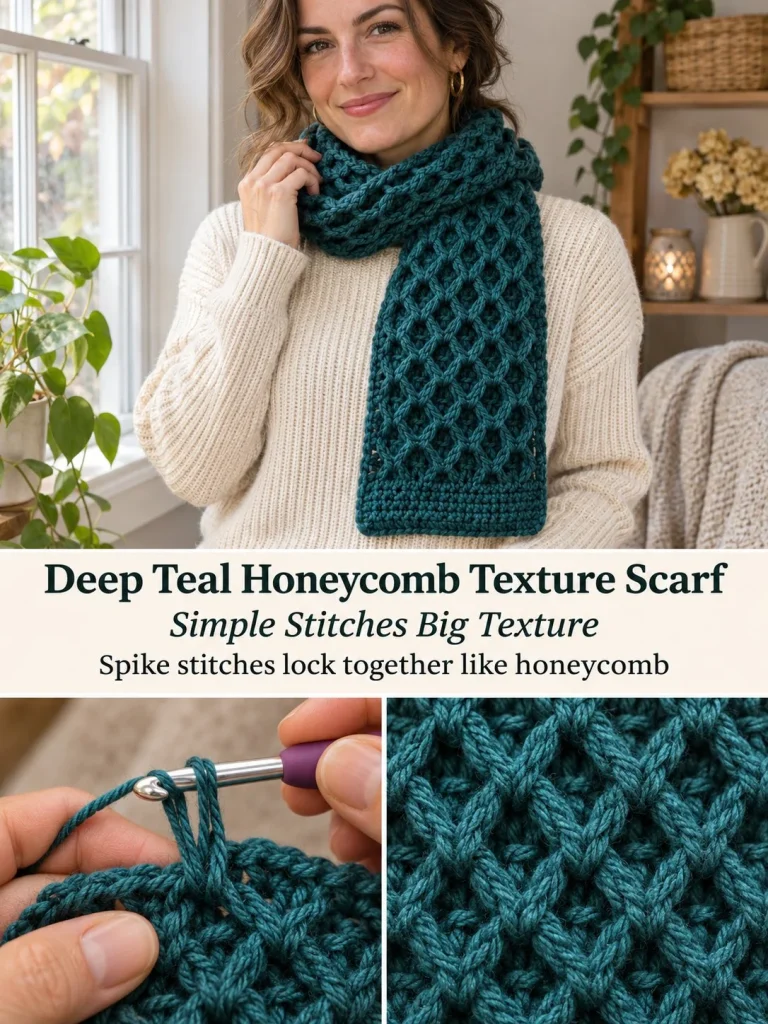
This scarf features a rich deep teal color and a captivating honeycomb texture that brings visual depth and tactile interest to your winter wardrobe. Crafted with a worsted weight yarn and 6 mm crochet hook, the design balances warmth and breathability, making it ideal for layering in cooler weather. The honeycomb pattern creates an intriguing raised stitch effect reminiscent of natural hexagonal shapes, offering a sophisticated yet cozy aesthetic.
Constructed entirely in rows, the scarf starts and finishes with a lemon-peel textured section that frames the central honeycomb motif elegantly. The core technique involves standard single and double crochet stitches combined with elongated single crochets worked into stitches two rows below, forming spikes that contribute to the textured honeycomb appearance. This specialized stitch technique adds a modern twist to a classic scarf shape, presenting a rewarding challenge for crocheters familiar with basic stitches.
The generous length of about 60 inches coupled with a width of approximately 6.5 inches makes this scarf versatile—perfect for wrapping snugly around the neck or draping stylishly. The use of a smooth worsted yarn enhances stitch definition, ensuring the honeycomb texture stands out clearly. For those intrigued by similar textured accessories, you might also appreciate patterns like the Burgundy Leaf Texture Skinny Scarf, which also showcases intricate stitch work in a compact form.
Pattern at a Glance
Skill level: Intermediate (due to textured spike stitches)
Terminology: US crochet terms
Construction: Worked flat in rows
Finished size: Approximately 6.5 inches wide by 60 inches long
Yarn weight: Worsted #4
Hook: 6 mm crochet hook
Main stitch: Single crochet, double crochet, elongated single crochet into stitches two rows below to create spike stitches
Gauge: Not specified; loose tension recommended to avoid puckering
Motifs: Honeycomb texture built across entire width
Layout: Long rectangular scarf with textured ends
Joining: None required (single piece)
Border: Lemon-peel texture at starting and finishing ends
Seaming: Not applicable
Materials
For this project, you will need:
-
Approximately 500–550 yards of deep teal worsted weight yarn (Worsted #4). This yarn weight provides the right balance of thickness and drape suitable for the honeycomb texture and the lemon-peel ends. Choose a yarn with good stitch definition for the honeycomb pattern to truly shine.
-
A 6 mm crochet hook (size J) is recommended to work the yarn at a loose tension. Using a slightly larger hook helps maintain the necessary flexibility in the spike stitches and prevents the fabric from puckering.
-
A tapestry needle for weaving in ends and finishing.
-
Scissors for cutting yarn.
These materials work together to create a soft, durable scarf with a textured surface that holds its shape well.
Yarn and Color Notes
Selecting the right yarn is crucial for both comfort and stitch visibility:
-
Fiber content: A soft wool blend, acrylic, or cotton-wool mix works well. Wool blends offer warmth and elasticity, while acrylics provide easy care. Avoid overly fuzzy or textured yarns, as these may obscure the delicate honeycomb spikes.
-
Color: The deep teal color chosen enhances the three-dimensional effects of the honeycomb texture. Solid colors work best here, highlighting the stitch details without distraction from variegated color changes.
-
Substitutions: You can substitute other worsted weight yarns if needed, just ensure to match yardage and consider fiber behavior since some fibers block differently, which may affect finished texture.
Finished Measurements
The finished scarf measures approximately 6.5 inches wide and 60 inches long, based on working to the recommended length and stitch counts. The width is set by the starting chain and remains consistent throughout due to the stitch count maintenance.
Lengthwise, the scarf includes approximately 8 inches of lemon-peel texture at both the start and finish, framing about 52 inches of the honeycomb pattern. These measurements ensure a balanced design that looks polished while being practical for regular wear.
Abbreviations
- ch: chain
- sc: single crochet
- dc: double crochet
- sts: stitches
- tog: together (as in stitches worked together)
- spike stitch: elongated single crochet worked into stitch two rows below, pulling the loop up to the current row height
Important Pattern Notes
-
The starting chain is 23 stitches; the first sc is worked into the 2nd chain from the hook to establish 22 stitches per row consistently.
-
The lemon-peel texture alternates between sc and dc stitches beginning at the foundation for about 8 inches to create a sturdy and textured edging.
-
The honeycomb pattern involves four-row repeats (Rows A–D) featuring spike stitches worked two rows below.
-
Throughout, maintain loose tension to prevent puckering caused by the elongated spike stitches.
-
The stitch count remains constant at 22 stitches per row throughout all sections.
-
The turning chain is always 1 chain and does not count as a stitch, except when stated otherwise.
-
Right side and wrong side are not differentiated explicitly, but rows turn at each end.
Special Stitches and Techniques
This pattern uses some unique crochet techniques:
-
Lemon-peel texture: Created by alternating single crochet and double crochet stitches in successive rows; on each new row, single crochets are worked into double crochets and double crochets into single crochets.
-
Elongated single crochet (spike stitch): This stitch is worked into the stitch two rows below the current row by inserting the hook under the horizontal loop of the stitch, drawing the yarn up to the height of the current row, and completing a normal single crochet. This creates elongated loops protruding from the fabric surface, forming textured spikes.
-
Pairing spike stitches: In Rows B and D, pairs of spike stitches are closed together by inserting the hook under the inner side loops of two adjacent spikes and completing a single crochet stitch. This joining creates a honeycomb-like lattice.
-
The pattern maintains a consistent stitch count by balancing spike stitch pairs with regular sc stitches.
Understanding the Construction
The scarf is constructed flat in rows with a consistent width throughout:
-
Start with a foundation chain of 23 stitches, establishing a base of 22 stitches.
-
Work about 8 inches of lemon-peel texture for a firm and decorative end section, using alternating sc and dc stitches to build a nubbly fabric texture.
-
Proceed to 2 rows of plain single crochet to transition smoothly into the honeycomb pattern.
-
Work the honeycomb texture in a repeating four-row motif (Rows A–D):
-
Rows A and C generate elongated spike stitches worked two rows below, alternated with normal single crochets.
-
Rows B and D close the spike pairs together using specialized single crochets to form the honeycomb lattice.
-
-
Repeat the honeycomb repeat until the scarf reaches about 52 inches in length.
-
Finish with another 8 inches of lemon-peel texture, mirroring the start for a balanced design.
-
Maintain loose tension throughout to accommodate the texture without puckering.
This modular approach ensures a consistent shape while showcasing a distinctive raised honeycomb effect.
Full Pattern Instructions
Foundation Chain
Ch 23.
Row 1 (Lemon-peel foundation)
Sc in the 2nd chain from hook and in each chain across. You should have 22 stitches.
Lemon-peel texture section (about 8 inches)
-
Row 2: Ch 1, turn. Working across the row, alternate single crochet and double crochet stitches: sc in first stitch, dc in next, alternating to the end.
-
Row 3 onwards: Ch 1, turn. Work single crochet into each double crochet from previous row, and double crochet into each single crochet from previous row. Maintain the sequence for about 8 inches in total length.
After completing this lemon-peel section, work 2 rows of plain single crochet to transition to the honeycomb pattern.
Honeycomb Texture Repeat
The honeycomb pattern consists of a repeating set of four rows (Rows A to D) that create the spike stitches and honeycomb lattice.
Row A (Spike formation)
-
Ch 1, turn.
-
Sc in the first stitch.
-
Work 1 elongated single crochet (spike stitch) into the next stitch two rows below by inserting your hook under the horizontal loop of the stitch two rows beneath, drawing the loop up to the current row’s height; then sc in the next stitch.
-
Repeat the pattern from * to * across until the last stitch.
-
Work 1 elongated single crochet into the last stitch two rows below.
-
You should still have 22 stitches.
Row B (Closing spikes in pairs)
-
Ch 1, turn.
-
Sc in the first stitch.
-
For each neighboring pair of spike stitches from the previous row: insert the hook under the inner side loop of the first spike and the inner side loop of the next spike together, and complete 1 single crochet to close them.
-
Then single crochet in the next top stitch.
-
Continue across the row maintaining 22 stitches total.
Row C (Offset spikes)
-
Ch 1, turn.
-
Work an elongated single crochet into the next stitch two rows below (offset from previous spike placement), then sc in the next top stitch.
-
Repeat the pattern from * to * across the row.
-
Maintain 22 stitches.
Row D (Closing offset spike pairs)
-
Ch 1, turn.
-
Begin with 2 plain single crochets.
-
Close the offset spike pairs similarly to Row B: for each pair, insert hook under the inner side loops of both spikes and complete a single crochet.
-
Maintain a consistent count of 22 stitches.
Repeat Rows A-D
Continue repeating the four-row honeycomb sequence until the scarf reaches approximately 52 inches in length.
Finish with lemon-peel texture
End by working about 8 inches of lemon-peel texture, following the same alternating sc and dc pattern used at the start, maintaining the 22 stitches width.
Final Instructions
-
Work loosely throughout to avoid puckering of the spike fabric.
-
Block the finished scarf gently to smooth and shape the fabric.
Helpful Checkpoints
-
After the initial lemon-peel section, your piece should measure roughly 8 inches in length.
-
After the 2 plain sc rows, the fabric should feel smooth and ready for the honeycomb pattern.
-
During honeycomb repeats, maintain the stitch count of 22 stitches; losing or gaining stitches can distort the honeycomb texture.
-
When the scarf reaches about 52 inches after the honeycomb section, begin the final lemon-peel finish.
Finishing and Blocking
Once complete, gently block the scarf to enhance the honeycomb texture and smooth out any curling edges:
-
Lay the scarf flat on a blocking mat, pinning lightly if needed to edges.
-
Use a spray bottle to lightly mist with water or a steam iron held a few inches above the fabric (do not press directly).
-
Allow to dry thoroughly before wearing or storing.
This finishing step helps the complex stitch detail relax and present well.
How to Resize This Scarf
Width Adjustment
The scarf’s width is determined by the starting chain of 23 stitches, which creates 22 stitches per row. To adjust width:
-
Add or subtract multiples of 2 chains to maintain the honeycomb pattern balance, ensuring the stitch multiples fit the four-row repeat (two spikes and single crochets alternating).
-
Remember to maintain the same stitch count per row through all sections.
Length Adjustment
To lengthen or shorten:
-
Adjust the number of honeycomb repeats (Rows A–D) before starting your finishing lemon-peel texture.
-
Each four-row repeat adds approximately ½ inch (varies by tension), so measure periodically.
Tension and Hook Size
- Tighter tension or stitch definition may slightly reduce the scarf size; going up a hook size can compensate.
Yarn Substitution
-
Use yarn of similar weight (worsted #4).
-
Adjust hook size accordingly to match gauge and preserve the stitch look.
Useful Pattern Variations
-
Using a variegated deep teal or complementary color yarn could add subtle transitions enhancing the honeycomb effect.
-
Try lengthening the lemon-peel texture sections for a chunkier edge.
-
For a more delicate scarf, swap worsted yarn for a lighter weight and use a smaller hook, adjusting length.
-
Pair with coordinating accessories like a textured hat or gloves in similar yarn.
If you enjoy experimenting with textures, consider exploring similar textured scarves like the Cocoa Blake Texture Scarf which offers a different stitch pattern but likewise emphasizes rich tactile detail.
Troubleshooting
Why Is My Scarf Getting Wider?
-
Check that you are maintaining consistent stitch counts each row, especially when working elongated spike stitches.
-
Avoid overly tight or loose tension that can distort edges.
Why Does the Spike Fabric Pucker?
- The pattern requires working loosely to accommodate long loops; try a larger hook or relaxed tension.
Why Are My Spike Stitches Uneven?
-
Make sure you are inserting the hook correctly under the stitch two rows below.
-
Draw up the elongated loop to the height of the current working row for consistency.
Why Is My Stitch Count Changing?
-
Double-check closing stitches in Rows B and D; they combine two spike loops into one single crochet but maintain the overall number of stitches.
-
Count stitches at the end of every row to catch mistakes early.
How Do I Block Without Losing Texture?
-
Use gentle blocking with light steaming or wetting.
-
Avoid pressing down on spike stitches to maintain their raised profile.
Frequently Asked Questions
Can I Use a Different Yarn Weight?
Using a heavier or lighter yarn will change the texture and size. If substituting, adjust hook size and stitches accordingly but note texture may vary.
Can a Beginner Crochet This Scarf?
This pattern is better suited for intermediate crocheters due to elongated spike stitches and stitch manipulation. Beginners may find the spike stitches challenging at first.
Is the Scarf Reversible?
While not identical on both sides, the honeycomb design produces an attractive fabric on both faces, suitable for reversible wear.
How Should I Care for This Scarf?
Care depends on yarn fiber. For wool blends, hand wash or gentle cycle with lay flat drying is recommended. Acrylic blends are machine washable but still should be dried flat.
Can I Make the Scarf Shorter?
Simply reduce the number of honeycomb repeats and proportionally decrease the lemon-peel ends as desired.
Do I Need Special Tools?
Just a 6 mm crochet hook and standard tools; no special hooks needed for spike stitches beyond basic crochet skills.
Optional Related Uses
The honeycomb stitch technique can be adapted for other accessories:
-
A matching cowl using a shorter circumference worked in rounds.
-
Textured wrist warmers by adapting the width and length.
-
A coordinating lightweight throw using wider dimensions and color variations.
-
Decorative winter headbands or ear warmers utilizing the spike texture.
Final Thoughts
This scarf combines classic crochet stitches with innovative spike stitches creating an elegant honeycomb texture that stands out in rich deep teal yarn. From foundation chain to the lemon-peel textured edges, each step builds a structured fabric that is both warm and fashionable. The methodical four-row honeycomb repeat encourages mindfulness and precision, resulting in a scarf with depth and personality.
Working loosely and blocking gently are essential to achieving a smooth honeycomb surface without puckering. Whether for personal use or gifting, this scarf will delight with its intricate texture and wearable size.
For more distinctive textured scarf ideas, exploring the subtle patterns in scarves like the Burgundy Leaf Texture Skinny Scarf may inspire your next project. Happy crocheting!



