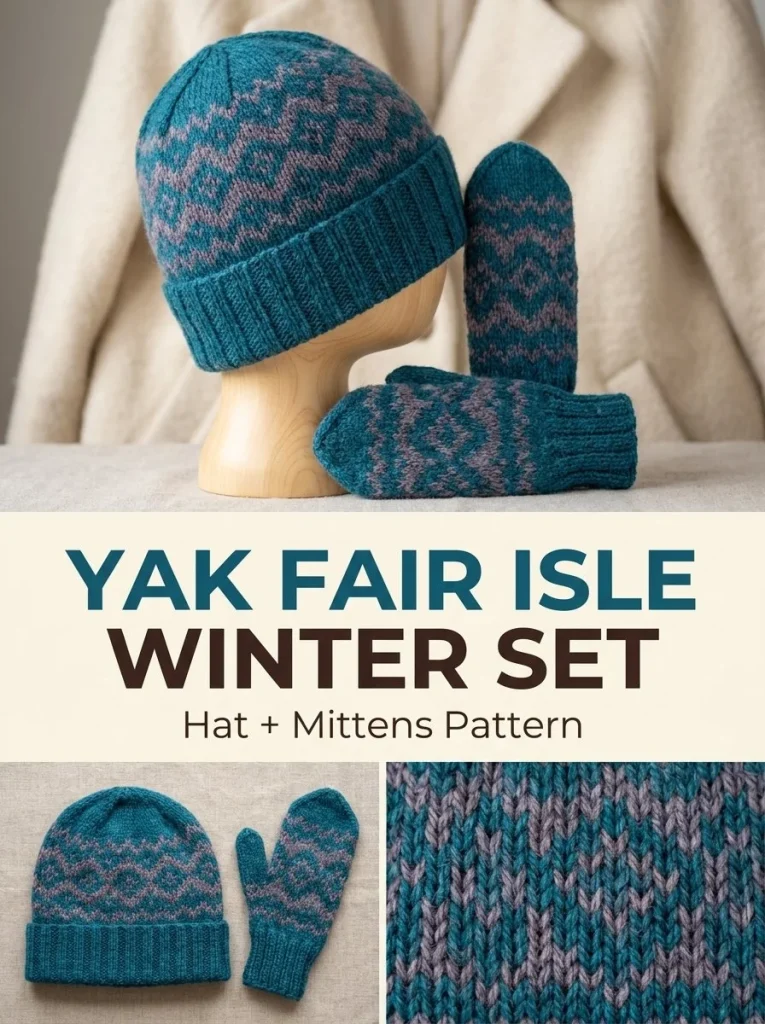
Cozy and timeless, this hand-knit Fair Isle hat and mitten set combines the warmth of merino and yak fibers with the classic charm of stranded colorwork. Crafted in aran-weight yarn, the set features a harmonious blend of deep Poseidon and vibrant Epic hues arranged in an elegant six-round Fair Isle motif. The construction utilizes a mix of ribbing and stranded knitting to create an elastic yet structured fit that keeps you warm through chilly winter days.
The hat is knit from the bottom up in the round, beginning with a stretchy K1, P1 rib that transitions smoothly into the traditional Fair Isle pattern. Six evenly spaced stitch markers guide precise crown shaping through systematic decreases, resulting in a neat, comfortable fit with a finished circumference of approximately 19 inches (48 cm). The mittens complement the hat with a matching color motif striped in six-round repeats, featuring a practical thumb gusset for ease of movement and comfort. Both pieces showcase an approachable stranded knitting technique, making this set an excellent project for knitters looking to explore colorwork with authentic yarn textures.
Beyond the warming functionality, the yak fiber content imbues the garments with a subtle softness and natural temperature regulation, making them ideal for fall and winter layering. The combination of traditional Fair Isle styling with luxurious fiber content and thoughtful construction makes this set a standout winter accessory. For those eager to explore more colorwork techniques, the set is a wonderful companion project to a Fair Isle yoke pullover pattern, offering cohesive styling options.
Pattern at a Glance
Skill level: Intermediate — includes stranded colorwork and shaping techniques
Terminology: Standard US knitting terms
Construction: Worked in the round, top-down shaping for crown and thumb gusset
Finished size: Hat circumference ~19 in (48 cm); mitten circumference ~7 in (18 cm)
Yarn weight: Aran (medium)
Needles: US 8 (5 mm) circular or double-pointed needles for ribbing and decreases; US 9 (5.5 mm) circular or DPNs for colorwork
Main stitch: Stockinette with stranded colorwork motifs; K1, P1 ribbing
Gauge: 19 sts = 4 in / 10 cm in stranded colorwork
Motifs: Six-round repeating Fair Isle pattern for hat and stripes for mittens
Joining: Knit in the round, seamless construction
Seaming: None required
Finishing: Light blocking recommended for best shape and color definition
Materials
For this project, use approximately two skeins of aran-weight yarn, preferably a blend of 70% merino wool and 30% yak for optimal warmth and softness. The suggested yarn is Louise Robert Collection Khullu or a similar yarn offering around 200 meters (219 yards) per 100 grams. Select one skein of Color A (Poseidon, a deep blue-green) and one skein of Color B (Epic, a contrasting rich hue).
Needles include US 8 (5 mm) circular or double-pointed needles for the ribbing sections and crown decreases, providing suitable tension and stitch definition. For the colorwork body, switch to slightly larger US 9 (5.5 mm) circular or DPNs to accommodate stranded yarns without over-tightening the fabric.
Additional tools:
- Two stitch markers for marking sections or thumb placement
- A tapestry needle for weaving in ends
- Waste yarn or stitch holders for thumb gusset stitches
Using the listed materials as intended supports achieving the specified gauge and finished size, contributing to the set’s ideal fit and fabric behavior.
Yarn and Color Notes
Choosing a yarn blend containing yak fibers increases the garment’s insulating properties without excessive weight. Merino adds softness and elasticity, while yak contributes durability and natural moisture-wicking qualities, perfect for winter accessories.
For stranded knitting patterns like this Fair Isle set, yarn smoothness is critical. A smooth, plied yarn enhances stitch definition, making color motifs crisp. Avoid highly textured or fuzzy yarns, which can obscure pattern clarity.
The chosen colorway balances a peaceful Poseidon base with vibrant Epic accents, creating a classic visual rhythm in the repeated six-round motif. When selecting alternative colors, choose two contrasting yet harmonious shades to maintain clear pattern visibility.
For knitters interested in expanding their colorwork skills, this set works well alongside the cozy felted loafer slippers knitting pattern, designed with similarly soft fibers and complementary color motifs perfect for seasonal gift sets.
Finished Measurements
The finished hat comfortably fits a circumference of about 19 inches (48 cm), suitable for average adult head sizes. The ribbing ensures stretch to accommodate a range of head sizes without discomfort.
The mittens have a circumference of approximately 7 inches (18 cm) around the hand, designed for a snug but comfortable fit. Length is proportioned to reach the base of the fingertips, with a shaped thumb gusset allowing freedom of movement.
Accurate measurements depend on maintaining gauge; therefore, careful attention to tension and needle size during knitting is essential.
Gauge
The gauge for the stranded colorwork sections is 19 stitches per 4 inches (10 cm) using stranded colorwork knitting with the larger needles. This precision is important because the pattern’s color motifs rely on consistent stitch counts to manage motif repeats and shaping.
Check your gauge by knitting a swatch in the stranded colorwork motif pattern before starting. Measure stitches across 4 inches of fabric after wet blocking. If your stitches are too loose (fewer stitches per inch), the finished garment will be larger and may appear loose. If too tight (more stitches per inch), the set might be smaller and less elastic.
Since the hat and mittens are fitted apparel, achieving gauge helps ensure the items fit as intended.
Abbreviations
- K — Knit
- P — Purl
- K2tog — Knit two stitches together (right-leaning decrease)
- M1L — Make one stitch left (increase)
- M1R — Make one stitch right (increase)
- St(s) — Stitch(es)
- Rnd — Round
Important Pattern Notes
- The pattern is worked in the round for both the hat and mittens, avoiding seams and providing continuous colorwork motifs.
- Ribbing sections utilize K1, P1 ribbing stitch for elasticity and neat edges.
- Colorwork uses stranded knitting techniques, carrying yarns loosely to avoid puckering and tightness.
- Stitch markers placed evenly aid in systematic decreases and thumb gusset shaping to maintain symmetry.
- The hat’s stitch count is a multiple of 6, aligning with the 6-round motif repeat for perfect pattern flow.
- Thumb gusset shaping on mittens begins after a set number of rounds, increasing carefully to complement hand anatomy.
- Decreases in the crown and mitten tips proceed gradually with accompanying plain rounds to maintain fabric smoothness.
Special Stitches and Techniques
- Stranded (Fair Isle) knitting: Carrying two yarn colors alternately across a row, carefully managing floats to maintain fabric elasticity and flatness.
- K2tog decrease: A standard decrease knitting two stitches together to reduce stitch count and shape the crown and mitten tops.
- M1L and M1R increases: Left-leaning and right-leaning increases flanking a central stitch in the thumb gusset to shape the thumb area.
- Circular knitting: Working in the round on circular or double-pointed needles, eliminating seams for a seamless garment.
- Use of stitch markers: Placing markers at intervals to mark repeats and decrease points for accurate shaping.
Understanding the Construction
Both the hat and mittens are knit seamlessly in the round, ensuring smooth edges and uninterrupted Fair Isle patterns. The hat construction begins with a stretchy ribbing cuff that conforms to the head then transitions to colorwork body before shaping the crown with systematic decreases. The six-round Fair Isle motif is repeated to create a visually appealing and balanced pattern.
The mittens start similarly with ribbing, followed by alternating six-round stripes in Color A and B. The thumb gusset increases from a single stitch marked on the palm to an elegant wedge by strategic increases every other round, then the gusset is set aside, and a stitch is cast on for gap closure to maintain mitten shape. The top is shaped by decreases that carefully reduce stitches while maintaining knit texture.
This construction method is beginner-friendly for knitters acquainted with stranded colorwork and circular knitting, emphasizing smooth transitions between sections and thoughtful shaping for comfort.
Hat Instructions
Foundation Ribbing
- Using Color A (Poseidon) and US 8 (5 mm) needles, cast on 90 stitches (multiple of 6). Join carefully in the round, avoiding twisting the stitches.
- Work K1, P1 ribbing for about 2 inches (5 cm). This creates a stretchy, neat edge that grips without being tight.
Colorwork Body
-
Switch to US 9 (5.5 mm) needles for the colorwork section to allow for comfortable stranded knitting.
-
Work 2 rounds in Color A alone to establish a base before introducing the motif.
-
Begin the six-round Fair Isle motif:
- Round 1: 5 stitches Color A, 1 stitch Color B repeat to end of round
- Round 2: 4 stitches A, 2 stitches B repeat
- Round 3: 3 stitches A, 3 stitches B repeat
- Round 4: 4 stitches A, 2 stitches B repeat
- Round 5: 5 stitches A, 1 stitch B repeat
- Round 6: All stitches Color A
-
Repeat this six-round motif until the hat measures approximately 6.5 inches (16.5 cm) from the cast-on edge. Maintaining even tension on stranded yarns is key here to avoid puckering.
Crown Shaping
- Change back to US 8 (5 mm) needles and Color A only for shaping the crown, ensuring a snug fit at the top.
- Place 6 stitch markers evenly at every 15 stitches to mark decrease points.
- Begin decrease rounds: on each decrease round, knit to 2 stitches before each marker, then work K2tog (knit two together). This reduces stitches symmetrically around the crown.
- Knit one plain round between each decrease round to maintain fabric stability.
- Continue until 30 stitches remain, then switch to decreasing every round to further shape the crown evenly to just 6 stitches.
- Cut yarn, thread through remaining stitches, pull tight to close the crown securely.
Finishing the Hat
- Weave in ends neatly, paying particular attention to floats on the inside of the colorwork body for comfort.
- Block lightly by steaming or wet blocking to even out stitches and set the shape.
Mitten Instructions
Cuff Ribbing
- Using Color A and US 8 (5 mm) needles, cast on 36 stitches. Join in the round carefully.
- Work K1, P1 ribbing for 1.75 inches (4.5 cm), forming a stretchy cuff that fits snugly around the wrist.
Colorwork Stripes
- Change to US 9 (5.5 mm) needles.
- Work 6 rounds in Color A, then 6 rounds in Color B, alternating the yarn carried loosely inside to prevent tight floats. These stripes establish the Fair Isle-inspired color rhythm.
Thumb Gusset
- At approximately 2.5 inches (6.5 cm) from the cuff, begin the thumb gusset. Place a stitch marker at the center palm stitch to mark the gusset.
- Increase around this palm stitch every other round:
- Make one stitch left (M1L) before the marker stitch
- Make one stitch right (M1R) after the marker stitch
- Continue increases until you have 11 gusset stitches.
- Place these gusset stitches on waste yarn or a stitch holder for later use and cast on 1 stitch over the gap created by the gusset to maintain the mitten’s circumference.
Continuing the Hand
- Resume working the alternating 6-round stripes (6 rounds A and 6 rounds B) until the mitten reaches the base of the fingertips.
- Begin shaping the top with decreases: work four evenly spaced K2tog decreases every round until 8 stitches remain.
- Draw the remaining stitches closed tightly to finish the tip.
Thumb Finishing
- Pick up the 11 gusset stitches held on waste yarn plus 2 stitches picked up over the gap for a smooth transition.
- Work stockinette stitch on these stitches, decreasing evenly as you approach the thumb tip, and close off neatly.
Second Mitten
- Repeat all steps for the second mitten but mirror the thumb gusset placement accordingly to create symmetrical mittens.
Blocking
- Block the mittens lightly, shaping carefully to open out the thumb gusset and even the fabric.
Checkpoints
- After ribbing on both hat and mittens, your pieces should feel elastic and measure close to ribbing length specs.
- The Fair Isle motifs should appear even with no puckering or tight pulls; adjust tension if not.
- When placing decrease markers on the hat, verify even spacing for smooth crown shaping.
- At the thumb gusset start, counts and placement of increases should be monitored carefully to avoid twisting or uneven gussets.
- After all decreases, edges should close neatly without gaps or loose stitches.
Finishing and Blocking
Proper finishing enhances the fit and appearance of your knitting:
- Weave in ends carefully on the inside, especially where colorwork floats run, avoiding lumps that could irritate skin.
- Light blocking helps stitch definition and evens out tension differences between stranded yarns. For blocking, soak pieces in lukewarm water, gently press out excess water, then shape flat or over appropriate forms—such as a hat block or hand-shaped form for mittens—and allow to dry completely.
- Avoid aggressive stretching, which can distort motifs.
How to Resize
This pattern is worked with a multiple of 6 stitches for the hat and 36 stitches for the mittens to maintain motif integrity.
- To make the hat larger or smaller: Adjust cast-on stitches in multiples of 6. Each additional 6 stitches will slightly increase circumference by approximately 1.25 inches (3 cm) given the gauge. Adjust ribbing and body length proportionally.
- For mittens: Cast on a multiple of 6 close to your hand circumference based on gauge measured. Adjust thumb gusset placement marked on the palm stitch accordingly.
- Keep in mind gauge consistency and motif repeat continuity when resizing to maintain the pattern’s aesthetic.
Useful Variations
- Experiment with different color pairs to create seasonal palettes such as muted earth tones for autumn or bright pastels for winter cheer.
- Omit the secondary color to make a simplified single-color hat and mittens set while maintaining texture via rib and stockinette stitches.
- Lengthen the ribbing for a longer cuff on mittens or hat brim for added warmth or styling preferences.
- Transform the stranded motif into a matching colorwork scarf or cowl by adapting yarn colors and motifs from the set, creating coordinating accessories for winter wear.
Troubleshooting
Why Is My Fair Isle Colorwork Too Tight?
Stranded colorwork can tighten the knitting if yarn floats are pulled too taut. To fix this, consciously carry the yarn loosely across the back, allowing fabric elasticity. Practice maintaining even tension.
Why Are My Decreases Not Aligning?
Ensure stitch markers are correctly placed every 15 sts on the hat and that decreases occur consistently 2 sts before each marker. Missing a decrease can distort crown shaping; counting stitches regularly avoids this.
Why Is My Thumb Gusset Shaping Uneven?
Check that increases (M1L and M1R) on either side of the marked palm stitch are made exactly every other round. Uneven increases cause twists and misfit. Mark rounds for ease.
Why Does My Ribbing Lack Stretch?
Using needles that are too small can reduce ribbing elasticity. Stick to US 8 (5 mm) for ribbing as specified and check your tension.
Why Are My Color Changes Messy?
When switching colors in stranded knitting, twist yarns properly at the back to avoid holes and snags. Carry the color to be used next loosely across the back rather than cutting.
Frequently Asked Questions
Can I substitute a different yarn?
Yes, but make sure to choose an aran-weight yarn with similar yardage and fiber content for warmth and drape comparable to the suggested merino/yak blend.
Is this pattern suitable for beginners?
This pattern requires familiarity with stranded colorwork and knitting in the round, making it better suited for intermediate knitters, though adventurous beginners can manage with practice.
How should I block the finished items?
Lightly wet block the pieces by soaking, gently pressing out water, and shaping flat or on forms. Allow to dry fully to set stitch patterns.
Can I make a larger size if needed?
Yes, by increasing stitches in multiples of 6 for the hat and adjusting mitten stitch counts proportionally. Maintaining gauge is key.
What if I don’t have circular needles?
Double-pointed needles can be used for all sections, especially smaller circumferences like the mittens and ribbing sections.
How do I carry yarns properly in Fair Isle?
Carry the yarns loosely across the back to avoid puckering, alternately catching strands without pulling tight. Practice tension management.
Optional Related Uses
The stranded colorwork motif and construction technique in this set can adapt well to other winter accessories, such as fingerless gloves, cowls, or even Christmas stockings. The beautiful color blocking and classic Fair Isle rhythm offer many creative opportunities beyond this project.
Final Thoughts
This elegant knit set thrives on simple yet effective stranded colorwork combined with solid construction practices: stretchy ribbing, harmonious color palettes, and thoughtful shaping for both the hat crown and mitten thumbs. The merino-yak yarn blend adds natural warmth and softness to these winter essentials, creating pieces both functional and visually appealing. Approach this project step-by-step, taking time to manage tension and practice color transitions. The warm, cozy result is a timeless accessory perfect for gift-giving or personal winter luxury.



