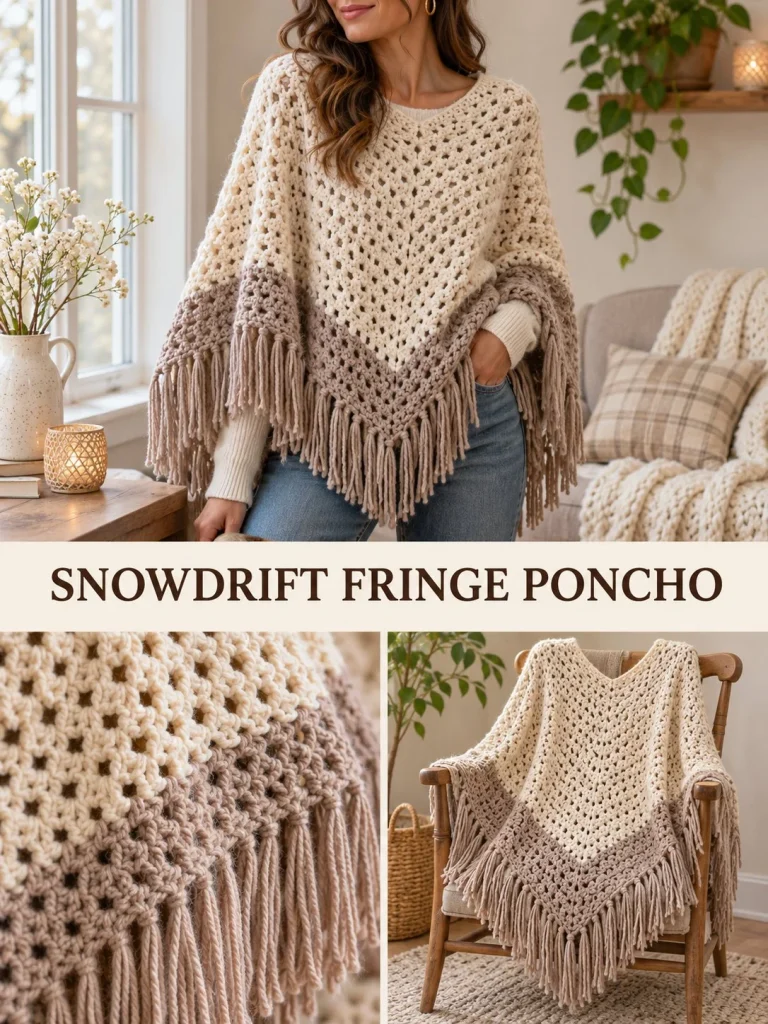
This cozy, oversized poncho combines texture and style with practical warmth, making it a versatile accessory for cool weather. Crafted from super bulky yarn, it showcases the beautiful interplay of a triangular motif enhanced by a charming fringe along the lower edge. The design centers around a simple but effective crochet technique that grows outward from a central triangle, resulting in a gracefully draped garment that can easily complement casual or dressier outfits.
The piece is worked in rows from a small triangular foundation, gradually widening and gaining shape to cover the shoulders and drape comfortably to about hip length. Its construction uses classic double crochet stitches to create a lacier, open look accentuated by strategically placed chain spaces, which also serve as anchor points for the fringes later added. Joining the outer edges at the neck opening creates a collar that balances the poncho’s shoulders and allows for easy wear.
This project’s combination of bulky yarn and relaxed construction makes it suitable for crocheters looking for a satisfying, quicker finish but with enough stitch detail to remain visually interesting. Paired with neutral tones, such as cream and taupe, it carries a natural elegance but also lends itself well to bolder color choices or variegated yarns. The inclusion of fringe adds a playful modern twist reminiscent of bohemian style, enhancing the poncho’s movement and softness.
Whether layered over a winter sweater or thrown on during cooler spring evenings, this fringed poncho is a fashionable outer layer. For those interested in complementary projects, adding matching crochet accessories can create a cohesive wardrobe; for inspiration, consider exploring the design of the Blue Western Fringe Tie Belt Crochet Waist Accessory, which shares thematic elements and fringe details that harmonize beautifully.
Pattern at a Glance
Skill level: Intermediate – Familiarity with double crochet, turning chains, and basic finishing techniques is recommended.
Terminology: Standard US crochet terms
Construction: Worked flat starting from a center triangle, shaped by selective increases and chain spaces; edges joined at neckline
Finished size: Designed to reach from shoulder to approximately hip length (size varies with yarn quantity)
Yarn weight: Super bulky (approx. 6)
Hook: 9 mm (US M/N-13) crochet hook
Main stitch: Double crochet (dc) combined with chain spaces for openwork
Gauge: Not strictly specified; size controlled by number of rows worked
Motifs: One expanding central triangle pattern
Layout: Flat panel joined at neck showing a slight collar
Joining: Slip stitches or whipstitch at neckline
Border: Optional ribbing with front and back post double crochet along lower edge
Seaming: Neckline only
Materials
To complete this poncho, you will need:
- 2 to 4 skeins of super bulky yarn in cream and taupe (or your choice of colors): The yarn quantity varies based on size and length desired, approximately 180 to 280 yards total. Choosing soft yet sturdy fibers like a wool-acrylic blend helps the garment maintain shape while being comfortable and warm.
- 9 mm crochet hook: A larger hook accommodates the bulky yarn, creating a loose, drapey fabric and helping the project grow quickly.
- Tapestry needle: For weaving in ends securely and sewing the neck edges together.
- Scissors: To cut yarn, especially when preparing fringe lengths.
- Optional stitch marker: Useful for tracking center points or stitch repeats, especially in the early rows.
These materials contribute to a quick-to-make, substantial garment that balances warmth without bulk.
Yarn and Color Notes
Super bulky yarn provides a lush, thick texture, perfect for outerwear meant to keep chill away. Choosing a smooth yarn keeps stitches crisp and defines the open chain spaces effectively. Fuzzy or novelty yarns, while cozy, could obscure the pattern’s triangular lace design and the fringe detail. The complementary colors of cream and taupe create a natural, earthy palette that suits autumn and winter wardrobes. However, you can experiment with solids, tonal variations, or contrasting stripes if you want to customize further.
Because this poncho showcases simple stitch repetition with negative space from chain stitches, it offers an ideal canvas for rich textures or subtle color shifts. For a softer drape or warmer feel, you might consider blends with alpaca or mohair. Avoid yarns that are too stiff or scratchy to ensure comfortable wear.
Finished Measurements
The finished poncho’s dimensions depend on how many rows you choose to repeat, making it easily adaptable to individual height and style preferences. It is designed to drape from shoulders to approximately hip length, offering generous coverage and flattering volume. Keep in mind that super bulky yarn and the open stitch design naturally produce a relaxed fit rather than a form-fitting silhouette.
Abbreviations
- ch: chain
- dc: double crochet
- fpdc: front post double crochet
- bpdc: back post double crochet
- st(s): stitch(es)
- sl st: slip stitch
Important Pattern Notes
- The turning chain of 3 counts as the first double crochet of each row.
- Chain spaces created along the center and sides form decorative gaps and are key to the stitch pattern.
- The piece is worked flat in rows starting from a small triangular foundation that widens with each row.
- The neck edge is formed by joining the two outer top edges slightly, creating a slight collar.
- Optional ribbing created with front and back post double crochet stitches helps add structure to the poncho’s lower edge.
Special Stitches and Techniques
This pattern uses several simple but effective stitches and techniques:
- Double Crochet (dc): The primary stitch used to build the fabric.
- Front Post Double Crochet (fpdc): Used optionally to create ribbing on the edge for texture.
- Back Post Double Crochet (bpdc): Paired with fpdc to form the ribbing border.
- Chain Spaces: Between groups of double crochets, chains create the lace effect and places for fringe attachment.
- Joining at Neckline: Slip stitches or whipstitch are used to join edges to form the neck opening.
These methods create distinct texture and openwork that set this poncho apart from basic rectangles or squares.
Understanding the Construction
The poncho starts as a small triangle worked flat, beginning with a simple foundation that creates a motif shaped by chaining and double crochet clusters. From this triangle base, the pattern expands symmetrically by repeating rows with added chain spaces and clusters to widen the piece gradually.
As the fabric grows downward, the shape remains triangular but develops a textured, airy pattern perfect for layering. The two outer edges of the top narrow section are joined lightly to form a stable neck opening, leaving the poncho open on the sides.
Finishing touches including optional ribbing rounds around the bottom edge provide gentle elasticity and a neat border, followed by the addition of fringe evenly spaced across the lower edge to enhance the length and movement.
This construction creates a flattering and comfortable garment that blends simple stitches with elegant shaping and finishing.
Full Pattern Instructions
Foundation
- Chain 3.
Row 1
- In the 3rd chain from the hook, work 3 double crochet (dc) stitches.
- Chain 3.
- Work 3 double crochet (dc) stitches again in the same chain space to form a small cluster.
- Turn your work.
This begins the central triangle with a cluster of double crochets separated by a chain 3 space.
Row 2
- Chain 3 (counts as first dc) and turn.
- Work 2 double crochet (dc) in the first stitch (the base of the previous row).
- Chain 2.
- Into the center chain-3 space of the cluster below, work the following group:
- 3 dc, chain 3, 3 dc.
- Chain 2.
- Work 3 dc in the last stitch of the row.
- Turn your work.
This row expands the triangle along the edges and center by adding double crochet clusters separated by chain spaces.
Row 3
- Chain 3 (counts as first dc) and turn the work.
- Work 2 double crochet (dc) in the first stitch.
- Chain 2, work 3 dc in the next chain-2 space. Repeat from * to * until you reach the center of the row.
- In the center chain-3 space, work the cluster: 3 dc, chain 3, 3 dc.
- Repeat * chain 2, 3 dc in the next chain-2 space* across to the last stitch.
- Chain 2.
- Work 3 dc in the last stitch.
Repeat this row pattern—Row 3—until your piece reaches the desired length from shoulder to just below the hips.
Checkpoint: Periodically measure your piece to ensure that it drapes from shoulder to hip length as you prefer.
Forming the Neck Opening
Once the main triangle has reached the desired length, join the two outer top edges slightly at the neck opening using slip stitches or whipstitch with the tapestry needle. This join creates the neck hole and gives the poncho its form-fitting collar edge.
Optional Ribbing Border
For a polished finish and additional stretch along the lower edge, add 2-3 rounds of front post double crochet (fpdc) and back post double crochet (bpdc) ribbing. Alternate fpdc and bpdc stitches to build a ribbed fabric that lies flat and adds subtle texture.
Adding Fringe
Cut fringe lengths to your preferred size, fold each group of strands in half, and attach them evenly spaced along the bottom edge of the poncho. Attach fringe loops through the chain spaces for clean, even placement.
Assembly and Joining
Joining the neck edges is crucial for the poncho’s fit. Position the two outer edges of the top triangle so that the neck opening forms a comfortable shape that allows the poncho to sit well on the shoulders. Use either slip stitches with the hook or a whipstitch with a tapestry needle and matching yarn to join the edges securely.
Avoid pulling too tight during joining to maintain a relaxed neckline and retain the garment’s drape. If using a stitch marker, mark the center front or back to help position the neckline evenly.
How to Resize
This pattern is highly adaptable:
- To lengthen the poncho, simply continue repeating Row 3 until the piece reaches your preferred length. Keep measuring periodically.
- For a wider fit, consider working additional increases in Row 3 by adding more chain-2 spaces and 3 dc clusters symmetrically on each side of the center cluster.
- Adjust yarn amount accordingly: the approx. 180–280 yards supplied correspond to the range of smaller to larger sizes.
If you prefer a smaller or larger neck opening, alter the amount of joining at the neckline edges accordingly.
Useful Variations
- Two-tone effect: Use cream for the triangle body and taupe for the ribbing or fringe to add visual interest, similar to the elegant contrast seen in the Cocoa Two Tone Poncho Wrap.
- Solid color version: Choose one color for a minimalist, classic look.
- Longer fringe: For a bold, statement piece.
- Add buttons or ties: Attach at the neck to close the poncho partially or fully.
Troubleshooting
Why Is My Triangle Not Laying Flat?
Ensure you are working the chain spaces and clusters as instructed; inconsistently changing stitch counts causes distortion. Always ch 3 to start the row (counts as dc) and maintain symmetry by adding clusters in every chain-2 space.
Why Is the Neck Opening Too Tight?
Check the join at the neckline; if you joined too closely or with tight tension, gently undo and rejoin with a looser seam. You can also opt to join fewer stitches for a larger opening.
Why Are My Fringe Attachments Uneven?
Use stitch markers to mark even intervals along the edge before attaching the fringe, ensuring that groups are consistently spaced, particularly when attaching through chain spaces.
Why Does the Bottom Edge Curl?
Adding the optional fpdc/bpdc ribbing rounds helps stabilize edges and prevent curling. Blocking the finished poncho gently can also help the fabric settle correctly.
Frequently Asked Questions
Can I use a different yarn weight?
Super bulky yarn is recommended for the quick build and drape ratio here. Using lighter yarns will alter the size and fabric fullness, requiring hook and row adjustments.
Can I use cotton yarn?
Cotton can be used but may make the poncho less drapey and warmer — more suited for spring or summer layering.
Is this pattern suitable for beginners?
Intermediate beginners comfortable with double crochet and chaining will find this pattern approachable due to its repetition and simple stitch combination.
How should I block this poncho?
Lightly wet block the finished piece on a flat surface, shaping the triangle and fringe evenly. Use rust-proof pins to hold edges flat without stretching.
Can I make this poncho without fringe?
Yes, omitting fringe gives a cleaner, more modern look. You can finish with just the optional ribbing or a simple sc border.
Can the ribbing be skipped?
Yes, but ribbing helps stabilize the edge and adds a professional finish.
Optional Related Projects
This versatile stitch pattern and construction could inspire:
- A matching cowl or scarf using the same double crochet clusters and chain spaces.
- A wrap or shawl by simply extending rows longer.
- A sleeveless vest top by adjusting the neckline join into armholes.
Final Thoughts
This project revolves around shaping a cozy yet airy triangular panel that becomes a stylish poncho with minimal seaming. The key steps are starting from a small cluster center, expanding evenly row by row to size, gently joining neckline edges, and finishing with textured ribbing and fringe. This approach produces a garment that’s both modern and timeless, perfect for adding warmth and interest to your wardrobe with manageable effort.
The construction, yarn choice, and simple yet striking stitch design offer a satisfying crochet experience. For those looking to enhance or complement this project, consider exploring additional fringe accessories or coordinating garments to build a complete collection.



