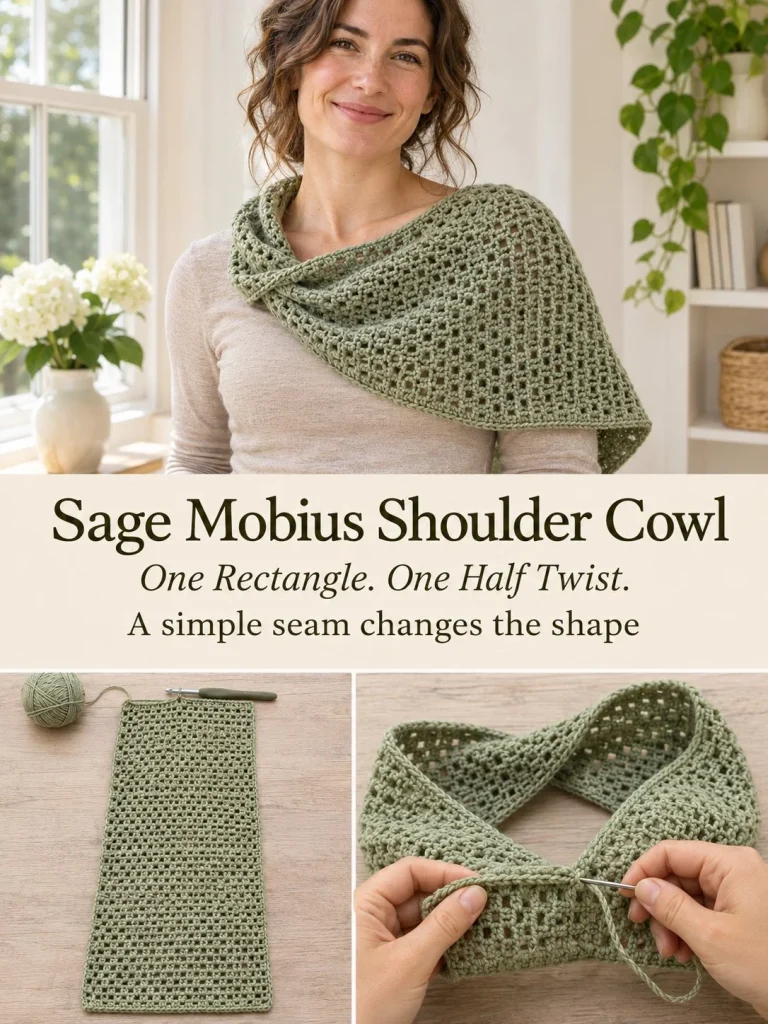
This textured shoulder cowl features a clever Möbius-inspired construction that creates continuous flow and an intriguing drape. Worked flat in a moss stitch, the fabric is airy and supple, making it lightweight yet cozy when worn. The design harnesses the classic half-twist of a Möbius loop—rotating and joining the rectangular panel’s ends in a unique way to form a continuous, one-sided accessory without hidden twists. This unconventional construction allows effortless styling around the shoulders, blending both visual interest and functional warmth.
Crocheted using a worsted weight yarn in a muted sage tone, the fabric highlights the pleasant texture of the moss stitch, a pattern sometimes called linen stitch. This stitch uses alternating single crochet and chain spaces to create a woven appearance with a balanced mix of positive and negative space. The resulting fabric has excellent stretch and breathability, ideal for a draping garment like a cowl. Using a 6 mm hook complements the yarn for a squishy and elastic fabric without compromising stitch definition.
This project fits well within intermediate skill levels due to its unique construction and seaming step, but the core stitch pattern and techniques will be accessible to confident beginners familiar with basic crochet stitches. Alongside the moss stitch foundation, the pattern incorporates a relaxed single crochet edging to secure and finish all panel edges smoothly. For inspiration on similar accessories featuring innovative stitch combinations and shaping, it’s worthwhile to explore the elegant designs found in the Alize shoulder cowl knitting pattern, which also focus on sophisticated neckwear.
Pattern at a Glance
Skill level: Intermediate
Terminology: US crochet terms
Construction: Flat rectangular panel crocheted then joined with a half-twist into a Möbius loop
Finished size: Approximately 14 inches wide x 50 inches long before joining
Yarn weight: Worsted weight (#4)
Hook: 6 mm crochet hook
Main stitch: Moss stitch (also known as linen stitch)
Gauge: Not explicitly given, but approximately 46 chains = 14 inches
Motifs: None; single continuous panel
Layout: Long narrow rectangle turned and half-twisted before joining edges
Joining: Seamed edge to edge after half-twist
Border: Single crochet “relaxed” edging around the rectangle
Seaming: Hand stitching with tapestry needle
Materials
To complete this project, you will need the following materials:
- About 650 to 800 yards of worsted weight (#4) yarn in a muted sage color. A yarn with good stitch definition and moderate elasticity works best to showcase the moss stitch fabric texture.
- Size 6 mm crochet hook to attain recommended gauge and yield an airy yet slightly firm fabric.
- Tapestry needle for weaving in ends and hand stitching the edges together to form the Möbius loop.
- Scissors and stitch markers (optional) for ease of marking the edges when seaming.
This selection balances warm coverage and drape, with yarn weight and hook size optimized for the open woven stitch pattern.
Yarn and Color Notes
Worsted weight yarn provides ample stitch definition, which enhances the moss stitch’s beautiful woven look. Choosing a muted sage color adds a sophisticated, versatile touch perfect for all seasons and outfits. While a smooth yarn is recommended to highlight the structural lines of the stitches, slightly fuzzy yarns may soften the texture but could obscure the pattern detail.
Solid colors work best for this stitch pattern, as variegated or multi-colored yarns may distract from the texture. Muted tones evoke timeless elegance and are easy to style as a shoulder cowl. For a more vibrant version, complementary shades of green, gray, or earth tones would be equally effective.
For those interested in related neckwear projects that feature similar shaping with Möbius construction, the Sage Sheltering Ridge Möbius Cowl highlights alternative yarn choices and textures in the same color family.
Finished Measurements
The main panel before assembly measures approximately 14 inches wide (across the chain foundation) and 50 inches long (number of rows worked). After joining the two short ends with the half-twist, the piece forms a continuous loop designed to sit comfortably on the shoulders and drape gracefully. The relatively generous length allows it to be styled in various ways, either wrapped snugly or worn more loosely.
Final sizing is directly related to gauge and number of rows; therefore, alterations to hook size or yarn may affect dimensions.
Gauge
While exact gauge details are not specified, the pattern’s initial chain suggests:
- About 46 chains create a 14-inch width, indicating roughly 3.3 chains per inch.
- The rows follow the moss stitch pattern repeated until reaching approximately 50 inches length.
Maintaining consistent gauge is important here to keep edges straight and the fabric even for proper joining. Use a 6 mm hook and worsted yarn as indicated, and create a moss stitch swatch to verify that your size matches the given measurements before proceeding.
If your gauge is too tight (smaller stitches), the overall piece might be narrower and shorter, potentially making assembly more challenging and changing drape. Conversely, a loose gauge may cause uneven edges and a more flimsy fabric.
Abbreviations
- ch = chain
- sc = single crochet
- st(s) = stitch(es)
- sp = space
- tog = together (used in seaming)
All stitch terminology uses the US crochet system.
Important Pattern Notes
- Begin with an even number of chains to set the foundation width.
- The chains at the start do not count as a stitch beyond placement for single crochet in the 2nd chain from hook.
- The moss stitch pattern alternates single crochet and chain 1 spaces to achieve texture and stretch.
- Maintain the same stitch count across rows for a rectangular shape with straight edges.
- The edges must remain consistently straight and the same width to allow precise assembly without distortion.
- The joining involves rotating one short end 180° to create the Möbius half-twist before stitching edges together.
- Use a relaxed single crochet edging to finish the panel and prevent curling.
- Weave in ends neatly when completed.
Special Stitches and Techniques
Moss Stitch (Linen Stitch)
This is the primary stitch used to create the fabric:
- Row 1: Single crochet in indicated stitch, chain 1, skip next chain or stitch, single crochet in next chain or stitch. Repeat across.
- Row 2: Chain 1, turn. Single crochet in first single crochet, chain 1, single crochet in next chain-1 space. Repeat across.
This alternating pattern creates a grid-like, woven texture with nice drape and breathability.
Relaxed Single Crochet Edging
A single crochet round worked loosely around all edges to stabilize the panel and add a soft border without pulling the fabric. This edging uses one single crochet stitch in each stitch or chain space evenly along the sides and ends.
Joining with a Möbius Half-Twist
Instead of simply joining the two short ends straight, rotate one end 180 degrees before sewing edges together. This creates a Möbius loop with a single half-twist visible in the finished cowl, giving a striking shape and continuous surface.
Understanding the Construction
The project begins with a single flat rectangular panel crocheted in rows. This panel is worked in the moss stitch to develop a fabric approximately 14 inches wide and 50 inches long.
Once the panel is complete, a relaxed single crochet edging is worked loosely around all sides to stabilize the fabric and prevent curling.
The clever part comes in assembly: the two short edges of the rectangle are aligned but before stitching, one short edge is rotated by 180 degrees—flipping it so the top corner aligns with the bottom corner of the opposite end. Joining these ends with a seam creates a half-twist, transforming the rectangle into a Möbius loop.
This construction yields a continuous circular shape with only one edge and one side, which drapes uniquely when worn as a shoulder cowl.
Pattern Instructions
Foundation
Chain an even number to achieve approximately 14 inches in width at the suggested gauge. This is about 46 chains.
Row 1
- Single crochet (sc) into the 2nd chain from the hook (the first chain does not count as a stitch).
- Chain 1 (ch 1), skip 1 chain, single crochet in the next chain; repeat this pattern across the foundation chain to the end.
This creates the first row of alternating single crochets and chain spaces.
Row 2
- Chain 1, turn the work.
- Single crochet into the first single crochet stitch.
- Chain 1, single crochet into the next chain-1 space; repeat this pattern across the row.
Ensure you maintain a straight edge with the same width by consistently placing single crochets and chains.
Repeat Rows 1 and 2
Continue repeating these two rows alternately until the piece measures approximately 50 inches in length.
Edging
Work a relaxed single crochet edging around the entire rectangle:
- Place 1 single crochet stitch in each stitch or chain space around the edges.
- Add stitches evenly to the row ends to prevent pulling or puckering.
- The edging should be loose enough to keep the fabric flat but firm enough for stability.
Assembly
- Lay the panel flat with the short ends facing each other.
- Rotate one short end exactly 180 degrees so the top corner aligns with the bottom corner of the opposite end, creating a half-twist.
- Sew these two short edges together, edge-to-edge, using the tapestry needle and yarn.
- The seam creates a Möbius-like loop with just one half-twist—no hidden second twist.
- After joining, adjust the cowl on the shoulders to achieve the desired drape and fit.
Checkpoint
At this point, your piece should measure approximately a continuous loop with the full length around 100 inches, forming the Möbius twist with neat edges and a relaxed cowl shape.
Assembly and Joining Details
When stitching the two short ends together, make sure fabric edges line up precisely without stretching. Use an invisible seam technique or whip stitch, sewing through corresponding stitches and chain spaces to maintain consistent tension.
The flexible moss stitch fabric allows you to adjust the seam placement slightly for proper alignment. The seam should be secure but not tightened so much that it distorts the Möbius twist.
Once assembled, weave in all loose ends with the tapestry needle on the inside of the loop.
Border and Finishing
The single crochet edging helps maintain a stable shape and prevents curling, which can be common with moss stitch fabric.
To enhance the border’s flatness:
- Work the edging with a slightly larger hook or loosen tension at the corners to avoid puckering.
- In corners, add extra single crochet stitches as needed to turn smoothly.
- After stitching, gently block the cowl to smooth edges and set the shape.
Blocking with steam or wet block techniques matches well with worsted weight yarn, improving drape and final dimensions.
How to Resize
To make the cowl wider or narrower:
- Adjust the initial chain count in multiples of two to maintain the moss stitch pattern.
- For example, add or subtract two chains to increase or decrease width by about half an inch per two chains (depending on your gauge).
To lengthen or shorten the cowl:
- Change the number of row repeats before edging and assembly.
- Each repetition of Row 1 and 2 adds about 2 inches to length (dependent on gauge).
Keep in mind changing size will affect yarn usage proportionally. Make a gauge swatch to confirm stitch size before resizing.
Useful Variations
- Two-Color Version: Alternate yarn colors every few rows for a striped moss stitch texture.
- Chunky Yarn Version: Switch to a thicker yarn and larger hook for a warmer, bulkier cowl.
- Add Fringe: Attach fringe along the edging for a boho look.
- Use Different Edgings: Try a picot or shell stitch edging for added flair.
- Make a Matching Hat or Mitts: Use the same stitch and yarn for coordinating accessories.
Pairing this project with a similar Möbius cowl like the Sage Sheltering Ridge Möbius Cowl offers inspiration for creating cohesive outfit sets with varied textures and weights.
Troubleshooting
Why Is My Edge Wavy?
An uneven or wavy edge usually means inconsistent tension or skipped stitches. Ensure you place one single crochet or chain-1 space consistently per stitch across all rows. Blocking can help flatten slight waviness.
Why Is My Sewing Distorted?
If the joined edges don’t align properly after the half-twist, double-check that one end is rotated exactly 180 degrees, not less or more. Stretching the fabric while seaming can also cause sagging or puckering; sew gently with even tension.
Why Is the Moss Stitch Pattern Shifting?
Count stitches at the end of each row to keep consistent stitch count. Losing or adding stitches will throw off the alternating chain and sc pattern, leading to unbalanced fabric.
Why Is My Fabric Too Tight or Too Loose?
Gauge affects overall fit and drape. Adjust hook size by going up or down a size and make swatches to reach the recommended gauge (~46 chains = 14 inches width).
Frequently Asked Questions
Can I use a different yarn weight?
You can use lighter or bulkier yarns, but adjust the hook size and stitches accordingly. Gauge swatches are essential to maintain the correct width and length proportions.
Can a beginner make this project?
While the stitches are simple, the half-twist assembly and seaming require careful attention. Confident beginners familiar with single crochet and seaming techniques should be able to complete the cowl.
Is it necessary to half-twist before joining?
Yes, the Möbius twist is integral to this design’s unique shape and flow. Joining edges flat without the twist will create a simple circular cowl instead.
How should I block this piece?
Blocking is best done by gently wetting and stretching the fabric to flatten edges and smooth the seam. Pin to shape on a flat surface and allow to dry completely.
Can I make the cowl larger?
Increase the starting chain and number of rows proportionally, maintaining the moss stitch pattern multiple and ensuring equal width and edge straightness.
Optional Related Uses
The moss stitch panel with Möbius construction can be adapted for:
- Lightweight scarves with a Möbius twist style
- Wraps or shawls using wider or longer panels
- Home decor items like reversible table runners featuring the woven moss stitch texture
For ideas on related wearable accessories with elegant shaping, check out the Alize shoulder cowl knitting pattern with ribbed high neck, which complements this project’s aesthetic.
Final Thoughts
This project involves three main steps: crocheting a textured moss stitch rectangle, finishing all edges with a relaxed single crochet border, and creatively joining the ends with a half-twist to create the Möbius loop. The result is a stunning shoulder cowl with continuous flow and graceful draping.
By following the instructions closely and paying attention to gauge and assembly details, you can craft a unique accessory that combines classic crochet stitches with innovative construction techniques. The muted sage palette and subtle linen-like texture ensure versatile wear throughout the year, making this cowl both a stylish and practical addition to your wardrobe.



