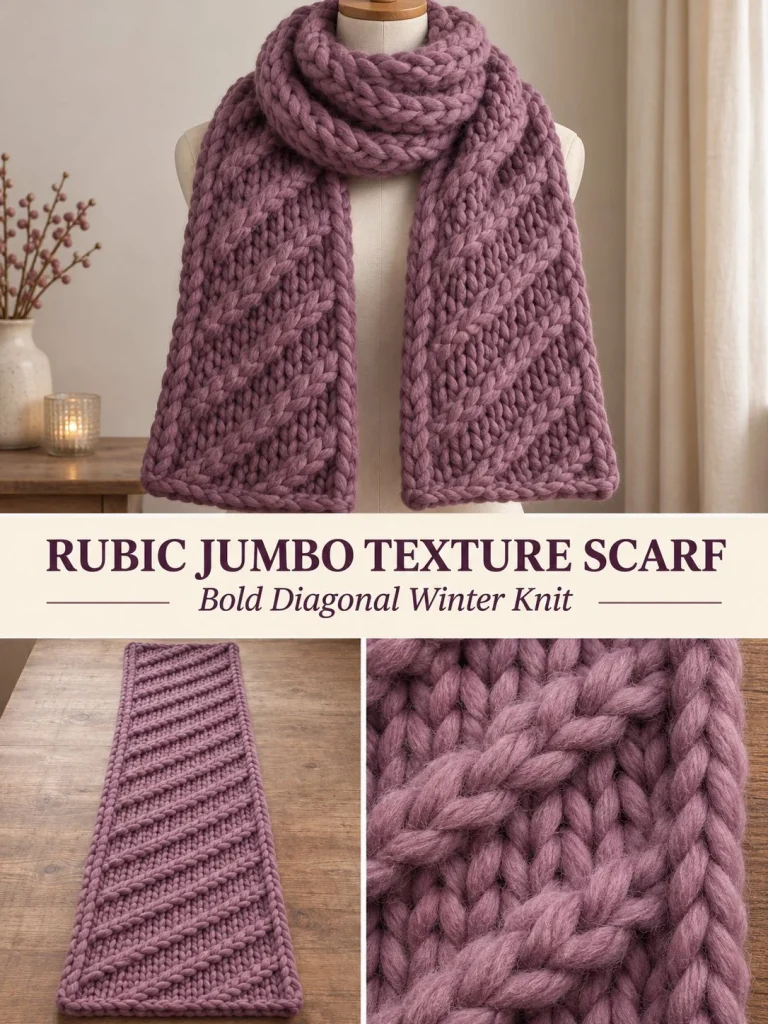
This jumbo textured scarf showcases a bold diagonal herringbone pattern created with a striking travel of a 3-stitch purl band on a smooth stockinette background. The bulky weight yarn and large needles bring out the texture vibrantly, making this an eye-catching accessory that’s both cozy and stylish. Its length and width deliver warmth and drama, perfect for layering in cold weather or making a standout fashion statement. Constructed entirely in knitting with slipped edges and finished with an elegant applied I-cord border, this scarf emphasizes technique and texture rather than color or complicated shaping.
The scarf begins with a simple setup of cast-on stitches and brief knit rows to form a neat edge. Then, the main feature is an 18-row repeating diagonal texture that shifts the purl band incrementally right and then left, creating a dynamic zigzag effect across the stockinette canvas. The slipped selvedge stitches on both edges frame the pattern sharply and prepare for a polished finish. After reaching the desired length, the scarf is bound off loosely to retain flexibility and then trimmed with a sturdy, smooth applied I-cord hand-knit along both long edges, reinforcing the shape and highlighting the bold diagonal lines.
This design is ideal for knitters who appreciate clear textural patterns and appreciate how subtle variations in stitch orientation can create a compelling visual effect. The use of super-bulky yarn and large needles means the scarf knits up relatively quickly while delivering a warm, substantial fabric. Due to its reverse side appearing equally ordered, this scarf is a wonderful statement piece that maintains visual integrity on both faces, although the shaping and I-cord edges add a clear finishing touch.
A similar interesting texture can be explored in other projects, such as the reversible ribbed scarf pattern, which also highlights the importance of edge detail and carefully constructed repeats for a professional finish.
Pattern at a Glance
Skill level: Intermediate — understanding slipped stitches, purl knitting, and applied I-cord techniques.
Terminology: Standard American knitting terms.
Construction: Worked flat in rows with slipped selvedge stitches and an applied I-cord edge on both long sides.
Finished size: Approximately 14 inches wide by 72 inches long after blocking.
Yarn weight: Jumbo / super-bulky (approx. 250 g hanks, total about 750 g).
Needles: US 19 / 15 mm straight needles for main body, plus two US 19 / 15 mm double-pointed needles (DPNs) for applied I-cord.
Main stitch: Stockinette with a traveling 3-stitch purl band creating diagonal herringbone texture.
Gauge: About 6 stitches and 8 rows per 4 inches (measured in stockinette).
Motifs: None (pattern is based on stitch texture and shifting purl bands).
Layout: One long rectangular piece.
Border: Three-stitch applied I-cord worked along long edges after main body is complete.
Seaming: None, project is a single panel.
Materials
- Yarn: Approximately three 250 g hanks of jumbo or super-bulky weight yarn. The sample uses Berroco Macro in the Polar Night colorway, noted for its softness and high stitch definition, important to accentuate the textured repeats.
- Needles: US 19 / 15 mm straight knitting needles — these large needles accommodate the thick yarn beautifully and create an airy yet dense fabric. Two matching US 19 / 15 mm double-pointed needles are required for knitting the applied I-cord edges along the scarf.
- Notions: Tapestry needle for weaving in ends and seaming the applied I-cord onto the scarf edges.
Carefully choose super-bulky yarns with good stitch definition so the bold diagonal ridge stands out clearly without getting lost in fluffiness or fuzziness.
Yarn and Color Notes
Jumbo yarns lend themselves well to showcasing texture because the stitches are large enough to appreciate individual stitch patterns. Smooth wool or wool-blend yarns work best to reveal the crisp edges of the purl bands and slipped selvages, while overly fuzzy or novelty yarns may obscure the intricate shifting pattern. Solid or semi-solid colors highlight the diagonal herringbone effect effectively, whereas variegated yarns may distract from the clarity of the texture.
Dark, rich hues like the Polar Night sample create dramatic shadows within the purl ridges, enhancing the depth and dimensionality. However, lighter tones could also be beautiful and soften the overall effect.
Finished Measurements
The scarf measures approximately 14 inches wide and 72 inches long after a gentle blocking. The width results from starting with 21 stitches and knitting through the pattern repeats designed for that stitch count. The length is achieved by working the 18-row diagonal texture sequence multiple times until the piece is roughly 70 inches before the finishing knit rows and binding off.
These final dimensions make the scarf a substantial wrap suitable for draping and layering. Due to blocking, the exact size may vary slightly depending on yarn elasticity and tension.
Gauge
The gauge is approximately 6 stitches by 8 rows per 4 inches measured in stockinette stitch. It is important to knit a swatch in the diagonal textured pattern to ensure that your stitch and row gauge matches the required measure.
Matching gauge is crucial here not only for size but to maintain the clarity of the diagonal texture, which depends on the stitch size and row height. If your gauge is looser (fewer stitches per inch), the scarf may come out wider and less dense. Conversely, a tighter gauge will make a narrower, denser fabric, potentially distorting the stitch pattern.
Consider adjusting needle size to achieve the gauge by knitting a test swatch.
Abbreviations
- K: Knit
- P: Purl
- RS: Right side (the knit side of stockinette)
- WS: Wrong side (the purl side of stockinette)
- DPN: Double-pointed needles
- Sts: Stitches
- Selvedge: Edge stitches, slipped to create a neat edge
- I-cord: A narrow tube of knitting, used here as an applied border
Important Pattern Notes
- The first and last stitches of every row are slipped as selvedges, which means you pass the stitch purlwise without working it, creating a crisp, clean edge that helps the applied I-cord border lie flat and neat.
- The scarf features an 18-row texture repeat over the center 19 stitches, with the first and last stitches always slipped.
- The traveling 3-stitch purl band shifts one stitch to the right on every right-side row for 9 rows, then reverses direction back to the left for the next 9 rows, forming the distinctive bold diagonal herringbone.
- Wrong side rows are worked "as they appear," meaning you purl the purls and knit the knits, maintaining the integrity of the pattern.
- The pattern is worked to a length of about 70 inches using full 18-row repeats before finishing edges and binding off loosely.
- Applied I-cord edges pick up one edge stitch per I-cord row along each long side, using double-pointed needles to create the border.
Special Stitches and Techniques
Slipped Selvedge Stitches
Slipping the first and last stitch purlwise on every row creates a firm, well-defined edge that minimizes curling and prepares the fabric’s edge for the later applied I-cord, ensuring a polished look.
Traveling 3-Stitch Purl Band on Stockinette
In the middle 19 stitches, the purl band moves diagonally by shifting one stitch each RS row. This creates a dynamic diagonal pattern as the stitches are repositioned in a zigzag motion, producing the bold herringbone texture.
Applied I-cord Edging
Applied I-cord is a finishing technique knitted live onto the edge of the fabric, forming a neat, rounded border without sewing a separate piece. It adds structure and an aesthetically pleasing finish.
Understanding the Construction
This scarf is knit entirely flat in rows, starting with 21 stitches. The first and last stitches of every row are slipped to create a selvedge edge while the 19 stitches in the center form the traveling diagonal purl band within a stockinette base.
The construction is simple but effective — by shifting the purl pattern one stitch at a time right for 9 right-side rows, and then reversing the direction, the scarf’s texture visually zigzags diagonally across the piece. After knitting several full 18-row repeats to reach the intended length, the fabric is capped with a few knit rows for balance and then bound off.
Finally, the applied I-cord is knit with double-pointed needles onto both long edges by picking up one stitch for each I-cord row, wrapping the edges in a smooth finish that both stabilizes and decorates.
This method makes a long, rectangular scarf with a striking texture pattern that is structurally integrated and elegantly finished.
Complete Pattern Instructions
Foundation
- Cast on 21 stitches using your preferred method. This stitch count matches the width and pattern repeat necessary for the diagonal herringbone texture.
- Knit 4 rows in garter stitch (knit every row) to form a firm, attractive edge that prevents curling.
Diagonal Texture Repeat (18 Rows)
This sequence shapes the main diagonal herringbone texture.
- Keep the first and last stitch of every row slipped (purlwise) for clean selvedges.
- The center 19 stitches form the traveling 3-stitch purl band.
How to shape the traveling purl band:
- On every right-side (RS) row, shift the 3-stitch purl band one stitch to the right for the first 9 RS rows. This means on each RS row you slip the first stitch, then knit/purl the center stitches such that the 3-stitch purl band moves one stitch over to the right from the previous RS row.
- On the next 9 RS rows, shift the purl band back one stitch to the left per RS row, retracing the movement.
- On wrong side (WS) rows, knit and purl stitches as they appear, maintaining the fabric’s pattern and ensuring the slipped edges remain consistent.
This 18-row sequence forms one complete diagonal travel cycle.
Repeat the 18-Row Sequence
Continue repeating the 18-row diagonal texture sequence until your scarf measures approximately 70 inches in length. Always finish after completing a full 18-row repeat so the pattern remains symmetrical and balanced.
Finishing the Body
- Knit another 4 rows after completing the length to balance the edges (matching the initial garter rows).
- Bind off loosely to maintain the scarf’s flexibility and neat edge.
Applied I-Cord Edging
- Using the two US 19 / 15 mm double-pointed needles, pick up one edge stitch for each I-cord row along both long edges of the scarf.
- Work a 3-stitch applied I-cord along each long edge. This is done by knitting the I-cord stitches while picking up stitches from the scarf edge to elegantly wrap and finish the fabric without sewing.
- Ensure the applied I-cord lies flat and is snug enough to stabilize the edge without puckering.
Blocking
- Lightly block the finished scarf to a final size of about 14 x 72 inches.
- The block should preserve the bold raised diagonal texture and encourage the selvedge edges and I-cord to lie flat and smooth.
Careful blocking enhances stitch definition and ensures the scarf lays beautifully when worn.
Checkpoints During Knitting
- After casting on and knitting the first 4 rows, your piece should measure approximately 2 inches wide and have a firm base.
- After completing the initial 18 rows of the diagonal texture, verify the traveling purl band has shifted correctly from the starting position to the right edge.
- Around halfway through knitting your scarf, measure lengthwise to confirm you are on track for about 70 inches after finishing.
- After binding off, inspect the edges before I-cord; the fabric should maintain the textured pattern without distortion.
- After working the applied I-cord, check that the edges are neat, even, and do not pull the fabric in.
How to Reshape or Resize the Scarf
This scarf pattern’s width is fixed by the cast-on count of 21 stitches as this matches the diagonal pattern’s requirements to travel precisely without gaps.
- To increase length, simply continue repeating the 18-row diagonal texture sequence until you reach your desired size before finishing edges.
- To decrease length, knit fewer full 18-row repeats but always finish at the end of a complete repeat to maintain pattern integrity.
Changing width would require redesigning the stitch count to keep the diagonal purl band traveling correctly, which is not recommended without thorough testing.
Useful Pattern Variations
- Use a two-color yarn held together or a self-striping jumbo yarn for a multicolored texture effect.
- Substitute the solid color for a seasonal palette to create festive scarves.
- Knit a matching set of 3D textured accessories like coasters using similar techniques, such as the 3D textured pumpkin stitch coaster pattern, to complement this scarf with home decor.
Troubleshooting
Why Does My Diagonal Texture Look Off?
Double-check the shift of the 3-stitch purl band on every RS row. The pattern depends on moving one stitch right for nine RS rows, then one stitch left for nine RS rows exactly. Skipping or adding shifts will distort the diagonal.
Why Are My Edges Curling or Wavy?
Slipped selvedge stitches help reduce curling, but if edges still curl, ensure your bind-off is loose enough and that you block the scarf lightly after finishing. Applying the I-cord too tightly can also cause pulling.
Why Is My Applied I-cord Not Lying Flat?
Make sure you pick up exactly one edge stitch per I-cord row and that tension is even—too tight will pucker the edge; too loose will look sloppy.
Why Is My Scarf Too Narrow or Too Wide?
Check your gauge carefully. Using thicker or thinner needles or changing yarn weight will impact your stitch gauge, altering the width.
Frequently Asked Questions
Can I use different yarn weights for this pattern?
This pattern is designed specifically for jumbo/super-bulky yarn. Using lighter yarns will change the gauge and texture dramatically, possibly obscuring the traveling diagonal effect.
Is this scarf reversible?
While the pattern texture appears on both sides, the slipped edges and applied I-cord finish create a more polished RS and a slightly different WS look. It’s visually interesting on both sides but designed for one side to be the right side.
Can beginners knit this scarf?
Intermediate knitters comfortable with slipping stitches and managing stitch counts will find this pattern enjoyable. Beginners might find the shifting purl band challenging but can attempt it with care and practice.
How do I block this scarf?
Light blocking with steam or wet blocking to approximately 14 x 72 inches is recommended. Avoid overstretching to preserve the texture and shape.
Can I substitute other border finishes?
While you can, the applied I-cord border complements the heavy yarn and diagonal pattern perfectly, stabilizing edges and enhancing the look. Alternative bindings might not provide the same final effect.
How long does this scarf take to knit?
Using jumbo yarn and large needles, this scarf knits relatively quickly compared to smaller needle sizes, making it a great project for those wanting immediate gratification.
Final Thoughts
This jumbo textured scarf is a celebration of texture, simplicity, and bold design. Its construction relies on a carefully balanced interplay of slipped selvedges, a traveling 3-stitch purl band, and stockinette stitch to develop a striking diagonal herringbone pattern. Adding the smooth applied I-cord edging finishes this generously sized piece with flair and sophistication.
By selecting appropriate super-bulky yarn and large needles, knitters can create a warm, stylish scarf that both looks and feels substantial. This scarf’s methodical construction and layered texture nature make it an excellent intermediate project to expand knitting skills while crafting a handsome, wearable accessory.



