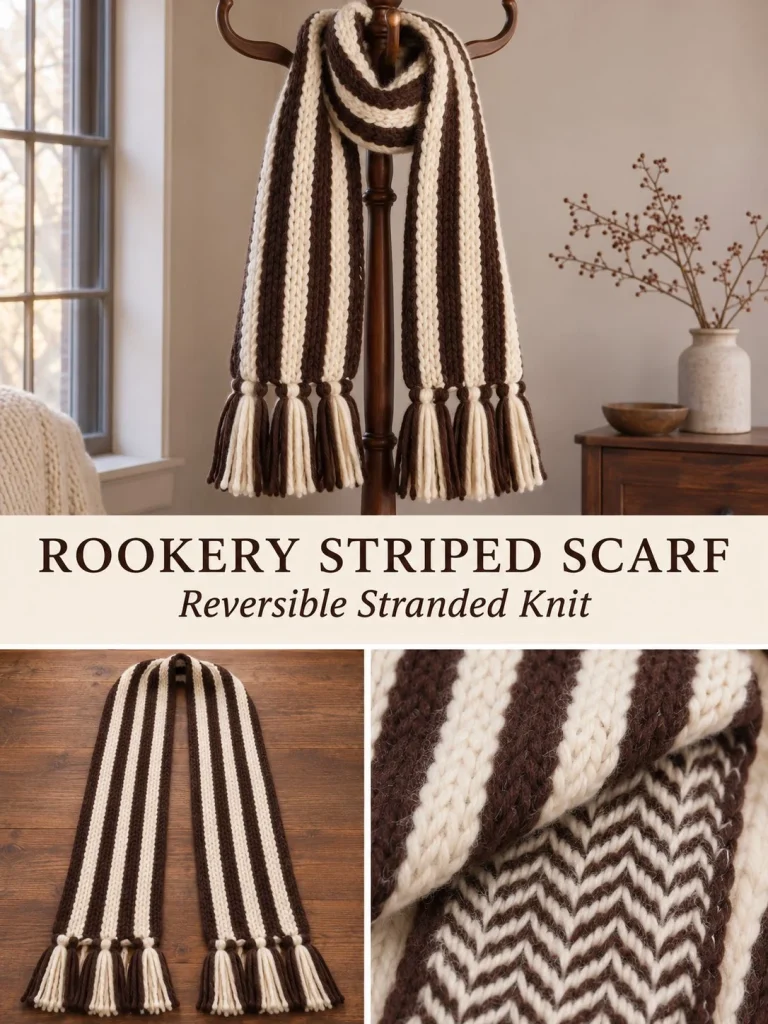
Creating a striking scarf with elegant vertical stripes is both an artistic and technical endeavor, and this pattern delivers exactly that. The scarf is knit flat, using stranded colorwork techniques that produce a reversible fabric with intriguing contrasts on front and back. On the right side, it reveals strong, graphic vertical stripes that command visual interest, while the reverse side displays a subtle feather-like herringbone texture, adding tactile sophistication.
This striking duality in appearance stems from the way two colors alternate across every row of knitting. This not only creates a vivid striped pattern to enhance any outfit but also introduces a unique textural element on the back, ensuring the scarf is beautiful no matter how it’s worn. The classic palette of a deeply warm main color ("Hot Coffee") against a crisp cream ("Heirloom White") amplifies the contrast, making it a versatile accessory for both casual and formal wear.
The construction uses an airy super-bulky yarn that delivers loft and softness, perfect for chilly weather. Due to its bulky weight and use of US 10.5 needles, this scarf knits up more quickly than finer yarn projects, yet it retains substantial warmth and presence. Additionally, the finished scarf extends to a generous length—about 79 inches—allowing it to be stylishly wrapped multiple times or elegantly draped.
This pattern aligns well with knitters who appreciate the blend of technique and aesthetics, exploring stranded colorwork with a focus on neat, consistent color transitions. For those looking for similar reversible texture projects, consider the Tied with a Bow Scarf Knitting Pattern with Reversible Rib, which also plays with contrasting motifs and double-sided interest.
Pattern at a Glance
Skill level: Intermediate (due to stranded colorwork and color management techniques)
Terminology: Standard American knitting terminology
Construction: Knit flat in stranded colorwork, one continuous rectangular panel
Finished size: Approximately 79 in / 201 cm long × 11 in / 28 cm wide (excluding tassels)
Yarn weight: Super-bulky (similar to Purl Soho Pouf)
Needle size: US 10.5 / 6.5 mm knitting needles
Additional Hook: 8-10 mm crochet hook (for tassels)
Main stitch: Stranded colorwork using knit stitches alternating colors every row
Gauge: 14 sts × 16 rows = 4 inches in stranded colorwork
Motifs: Vertical stripes and feather-like herringbone on reverse
Joining: None (single piece)
Border: Bind off worked in pattern
Seaming: None required
Materials
To complete this scarf, you will need:
- Yarn: Approximately 225 yards of Main Color (MC) "Hot Coffee" and 195 yards of Contrast Color (CC) "Heirloom White." Purl Soho Pouf or a similar airy super-bulky blend of alpaca and wool is recommended for its softness, loft, and warmth.
- Needles: US 10.5 (6.5 mm) knitting needles sized to complement the bulky yarn, allowing for balanced fabric density and the desired gauge.
- Crochet Hook: An 8-10 mm crochet hook will be useful for creating the long, two-color tassels that finish the scarf ends.
- Tapestry Needle: For weaving in ends and assembling tassels after blocking.
These materials combine to produce a scarf that feels lofty and plush yet structured, with an even and consistent fabric texture.
Yarn and Color Notes
Using an airy super-bulky blend like alpaca and wool makes a significant difference in the finished scarf. Alpaca provides insulation and softness, while wool adds elasticity and stitch definition, which is crucial for stranded colorwork to hold crisp stripes and clear motifs.
Choosing two high-contrast solid colors improves the visibility of the vertical stripe pattern. The dark "Hot Coffee" and the bright "Heirloom White" create strong graphic lines that pop on the scarf front, while the reverse side reveals a delicate herringbone effect.
Fuzzy or textured yarns are less advisable for this technique because they obscure the clarity of the stranded stitches and complicate floats management. Smooth yarns with good stitch definition produce the best results. When attempting color substitutions, stick to super-bulky yarns with similar gauge so the pattern’s size and drape remain consistent.
For another excellent pattern emphasizing reversible stripes using similar yarn weight but a different stitch motif, you might enjoy exploring the Exact Opposite Cowl Knitting Pattern with Reversible Garter Stripes.
Finished Measurements
The scarf measures approximately 79 inches (201 cm) long and 11 inches (28 cm) wide, not including the two long tassels at each end. These generous dimensions allow for versatile styling—wrapping multiple times for bulk or worn casually over a jacket or coat.
Because of the super-bulky yarn, the fabric will have noticeable loft and a soft hand, contributing to both warmth and texture. The width maintains a balanced stripe width that showcases the vertical design without overwhelming the wearer.
The length is customizable as you knit, but the suggested finished measurement ensures a harmonious ratio of length to width, balancing visual appeal and practical wearability.
Gauge
Gauge is a vital consideration for this scarf due to the nature of stranded colorwork and the bulky yarn. The provided gauge is:
14 stitches and 16 rows = 4 inches (10 cm) in stranded colorwork.
To check gauge:
- Knit a swatch of at least 4 inches square using the two colors in stranded technique.
- Lay the swatch flat without stretching.
- Measure the number of stitches across and the number of rows vertically.
- Adjust needle size if your swatch is too loose or too tight to meet this gauge.
Why gauge matters here:
- Maintaining gauge ensures the scarf reaches the desired width of 11 inches and length of 79 inches.
- Gauge affects the density and elasticity of the fabric, influencing the vertical stripe clarity.
- Incorrect gauge may lead to floats that are too tight or too loose, impacting drape and comfort.
Since scarves are generally more forgiving than well-fitted garments, slight deviations can be tolerated, but aim for as close to gauge as possible to preserve the pattern’s neat colorwork effect.
Abbreviations
- MC: Main Color (Hot Coffee)
- CC: Contrast Color (Heirloom White)
- St(s): Stitch(es)
- Rnd: Round (not used here, but common)
- K: Knit
- BO: Bind Off
Note: Standard American knitting terminology is used throughout.
Important Pattern Notes
- This scarf is worked flat, back-and-forth in rows, not in the round.
- It uses stranded colorwork, carrying both yarns simultaneously and alternating colors every row.
- Floats—the strands of yarn carried across the back between color changes—must be kept relaxed to avoid puckering.
- At all color changes (including at cast-on and bind-off edges), you will cross the new color over the old to secure the strands and prevent loose loops.
- The bind-off is worked in pattern to maintain edge elasticity and appearance.
- Blocking is essential to even out stitches and enhance drape, but blocking must be light to avoid flattening the yarn’s loft.
- Tassels are made long and two-colored to extend the striped rhythm of the scarf into the fringe.
Special Techniques
Stranded Colorwork
Stranded colorwork involves working with two yarns simultaneously, alternating colors on each row to create contrasting vertical stripes. You carry the unused color loosely at the back, known as floats, catching them at color changes without pulling tight.
Crossing Colors at Edges
To create neat edges and prevent floats from sagging or gaps along cast-on and bind-off edges, consistently cross the incoming color over the outgoing color. This technique forms tidy edge stitches and reinforces structural integrity.
Tassel Making
Although knitting is the primary technique, the finishing tassels are created with a crochet hook. This technique makes it easier to attach and assemble long multi-colored tassels that mirror the scarf’s striped design.
Understanding the Construction
The scarf consists of a single rectangular panel knit entirely flat. Each row alternates holding the two colors in stranded colorwork, forming vertical stripes as you knit back and forth.
The front presents strong, defined vertical stripes in alternating colors, while the back shows a subtle herringbone texture where the yarn floats create a feather-like effect. This reversible characteristic makes the scarf visually dynamic and perfectly suited for multiple styling options.
Once the piece reaches the desired length and width, you bind off, block gently, and finally attach tassels made of both colors to continue the stripe motif into the fringe. The binding-off in pattern preserves the elastic, clean edge, complementing the scarf’s overall aesthetic.
Full Pattern Instructions
Foundation — Cast On
Using the Main Color (MC), cast on the number of stitches required to reach the scarf’s 11-inch width based on gauge. This typically involves casting on approximately 39 stitches (14 sts per 4 inches, so about 14 x 11/4 = 39). Use a stretchy cast-on method such as the long-tail cast-on for better elasticity and neat edges.
Row 1 (Right Side)
- With MC as the dominant color and CC as the secondary color, begin stranded colorwork by knitting across the full row, alternating colors per stitch pattern so the right side starts establishing the vertical stripes.
- Maintain stretched but relaxed floats, crossing the incoming yarn over the outgoing at each color change.
Row 2 (Wrong Side)
- Continue with the CC dominant (color alternates every row), knitting across with the alternate color pattern.
- Keep floats loose and consistently cross colors at edge stitches and color changes to maintain pattern continuity and neatness.
Continuing Rows
- Alternate between MC and CC as dominant colors for every subsequent row to develop strong vertical stripes on the front.
- Stranded float crossings should be consistent, relaxed, and clean on every row, including at the edges.
- Maintain your stitch count in each row, verifying the fabric width regularly.
Length
- Repeat alternating rows until the scarf length reaches approximately 79 inches (201 cm).
- At this point, you will have created a richly textured piece exhibiting the dual striped and herringbone effect on opposite sides.
Bind-Off
- Bind off all stitches using the pattern’s dominant color for the current row.
- Bind off in pattern to ensure elasticity and a neat edge, paying careful attention to crossing yarns at edges just as in cast-on.
Blocking
- Block the scarf lightly by steaming or wet-blocking to even out stitches and relax fibers.
- Avoid flattening the loft; the airy super-bulky yarn benefits from retaining volume for softness and warmth.
Tassels
- Use the 8-10 mm crochet hook and both yarn colors to create long, two-color tassels.
- Attach tassels evenly spaced along each short end of the scarf.
- Tassels should mirror the scarf’s striped rhythm to create visual continuity in the fringe.
Checkpoint:
At this stage, the scarf should measure approximately 79 inches long and 11 inches wide, with clean vertical stripes and a reversible feather-like herringbone texture on the back.
Finishing
Weave in all loose ends with the tapestry needle carefully to avoid distortion of the stitches or bulk at edges. Ensure tassels are securely fastened and even in length.
Lightly block again if tassels appear floppy after attachment. By securing them with a crochet hook, you not only speed up assembly but also gain sturdy and uniform fringe finishing.
How to Resize This Scarf
To modify width:
- Cast on more or fewer stitches in multiples of the stitch pattern (here, each stitch represents a stripe segment).
- Keep the ratio of stitches consistent to maintain the stripe pattern’s balance and proportion.
To modify length:
- Simply knit more or fewer rows, maintaining the alternating colorwork sequence.
- Since each row alternates the dominant color, keep track to ensure your rows total maintains stripe rhythm.
Resizing requires maintaining the stranded float technique and consistent crossing at edges for neatness. Always knit a gauge swatch after adjusting to ensure finished dimensions will be as desired.
Useful Variations
- Monochrome Version: Use one color to create a solid scarf that highlights the texture from the stranded technique without contrasting vertical stripes.
- Reversed Color Dominance: Start the scarf with the contrast color as the dominant color on the first row to invert the stripe emphasis.
- Longer Tassels: Attach tassels that are extra long or densely plied for a bohemian twist.
- Different Color Combinations: Try deep jewel tones or pastels against a neutral base to shift the scarf’s mood.
- Use Circular Needles: If preferred, knit flat on circular needles to accommodate the large number of stitches easily.
Troubleshooting
Why Is My Scarf Edging Uneven?
Ensure you consistently cross the new color over the old at the beginning and end of every row, including cast-on and bind-off edges. Skipping this creates gaps and uneven edges.
Why Are My Floats Tight and Puckered?
Floats should never be pulled tight. Allow them to stretch evenly across the back, catching every few stitches if floats risk snagging or getting too long.
Why Is the Herringbone Effect Not Visible on the Reverse?
The feather-like herringbone texture develops naturally from stranded stitches alternating each row. If your tension is inconsistent or the floats are tight, this texture may be flattened or lost. Adjust tension and relax your floats.
Why Does My Yarn Break When Crossing Colors?
Super-bulky yarns are prone to stress at color changes if pulled too tightly. Use gentle tension and cross yarns without twisting harshly to avoid breakage.
Frequently Asked Questions
Can I use a different yarn weight?
You can, but strand colorwork with thinner yarns will change the scarf’s dimensions and texture. A lighter yarn may produce a thinner, softer scarf, but you’ll need smaller needles and potentially more stitches and rows to reach the same size.
Is this scarf truly reversible?
Yes, the pattern is designed to create two distinct, pleasing fabric faces—the strong vertical stripes on the front and a feather-like herringbone pattern on the back.
Can beginners attempt this pattern?
Intermediate knitters with basic stranded colorwork experience will find this scarf rewarding. Beginners should practice managing floats and color changes on smaller swatches before embarking.
How should I block this scarf?
Block lightly to prevent flattening the yarn’s airy loft. Lay flat and gently shape rather than stretching aggressively.
Can I work this on circular needles?
Yes, you can knit flat on circular needles, which can be easier for holding many stitches. Just turn at the end of each row as usual.
What if I want shorter tassels or no tassels?
Tassels are optional finishing touches. You can shorten or omit them entirely, but they add to the scarf’s visual rhythm and charm.
Optional Related Uses
The stranded vertical stripe technique and reversible fabric principle demonstrated in this scarf can also be adapted for accessories like cowls, hats, and mittens, or even home décor items such as cushions and throws. For a project with similar reversible texture play using garter stitch stripes, explore how this technique applies to the versatile, stylish Exact Opposite Cowl Knitting Pattern.
Final Thoughts
This scarf’s construction focuses on a single flat panel of stranded colorwork with rows alternating dominant colors. It is a perfect blend of graphic vibrancy and tactile texture, made possible by a thoughtful color change technique and gentle attention to stranded float tension. By following careful edge crossing methods and finishing with two-color tassels, the scarf becomes a reversible accessory that exudes warmth and style. Whether wrapped or draped, it promises to be a cherished piece both visually and practically.



