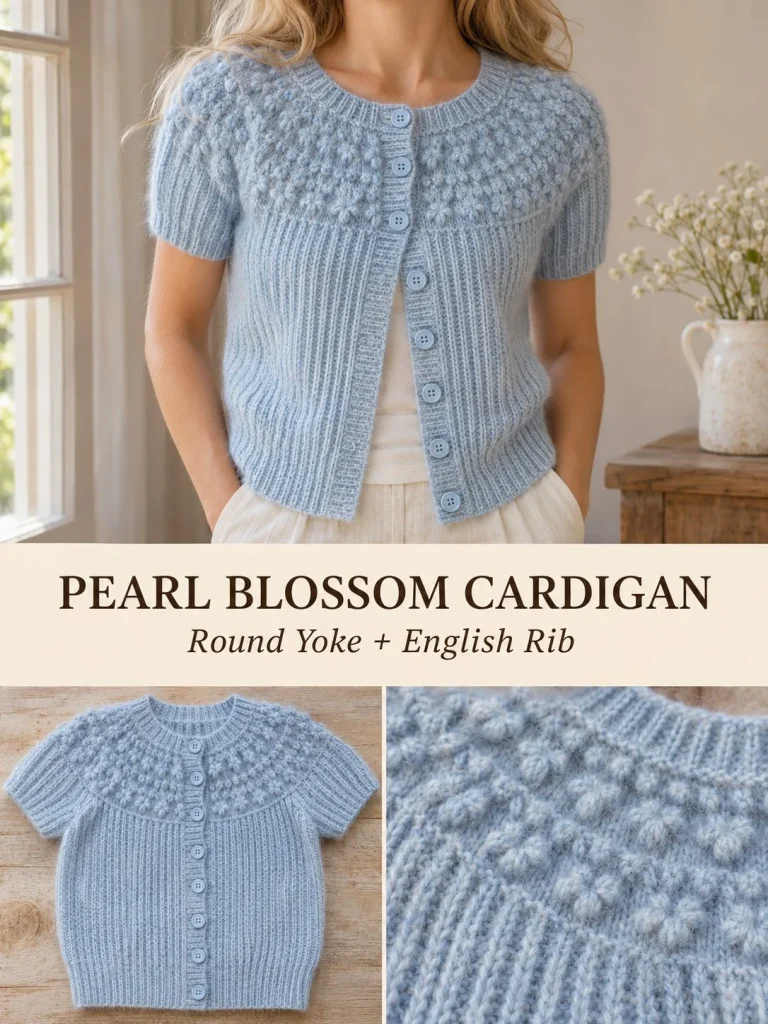
This lightweight textured short-sleeve cardigan blends delicate design with comfortable wearability, making it a versatile addition to any wardrobe. Crafted with a subtle floral-inspired relief motif arranged over a softly sculpted round yoke, its structure gently accents the shoulders and upper torso. The use of an English rib finish along edges adds both elasticity and elegance, framing the garment beautifully. The cardigan’s top-down construction enhances ease of shaping and fitting, suitable for knitters who enjoy working in the round and appreciate meticulous designer touches.
The beautiful interplay of textures, combined with lightweight fibers held double for softness and drape, creates a fabric that is both warm and airy. The short sleeves paired with buttoned front plackets offer a practical yet chic look, perfect for layering over seasonal outfits. This pattern is carefully designed for both skilled and intermediate knitters familiar with round yoke techniques and textured stitch work, providing detailed guidance to achieve a polished finished garment.
Pattern at a Glance
Skill level: Intermediate
Terminology: British knitting terms (as per DROPS standards)
Construction: Top-down circular yoke with short sleeves; separated body and sleeves joined seamlessly
Finished size: Multiple sizes governed by DROPS 273-24 (refer to original size chart)
Yarn weight: Fingering/light sport weight
Needles: 5 mm and 3.5 mm circular needles; matching DPNs or Magic Loop method for sleeves
Main stitch: English rib and relief motif (textured stitch pattern)
Gauge: Swatched with two strands held together, exact gauge per DROPS specifications
Motifs: Relief motifs worked in prescribed yoke positions
Layout: Seamless yoke, separated short sleeves and body, finished with rib bands
Joining: Sleeves separated and worked in the round, no seaming required for main body
Border: English rib finishing bands along front edges and sleeves
Seaming: Button bands sewn on; blocking to finish
Materials
This cardigan requires a delicate combination of two yarns held together throughout to achieve its unique texture and softness:
- DROPS Merino Extra Fine 39 Ice Blue: A soft, breathable merino wool ideal for adding structure and warmth without weight.
- DROPS Kid-Silk 07 Light Sky Blue: A mohair and silk blend that adds airy halo and luxury feel. When held doubled with the merino, it produces a soft yet durable fabric.
Tools:
- Circular knitting needles in 5 mm and 3.5 mm sizes, essential for working different aspects of the pattern (yoke in larger needles, ribbing in smaller needles).
- Matching double-pointed needles (DPNs) or a Magic Loop cable for knitting the short sleeves in the round.
- 8 or 9 DROPS buttons no. 521, chosen according to the cardigan size for classic closure effect.
Yarn amounts and needle sizes are precise to the original size chart included in the DROPS 273-24 pattern series, ensuring exact fit and drape.
Yarn and Color Notes
The combination of a soft merino and a luxurious kid-silk mohair-silk blend creates a beautifully textured fabric ideal for light layering. The dual strands held together produce subtle haze and depth to the solid light blue colors, enhancing the airy elegance of the garment. When selecting yarn substitutions, aim for similar fingering or light sport weight yarns with complementary fibers (e.g., a soft wool with mohair or silk blends) to maintain the same drape and texture.
Solid yarns work best to highlight the intricate relief motifs and English rib texture without visual distraction. Choosing variegated or heavily patterned yarns may obscure stitch definition and the delicate floral-inspired relief pattern.
Finished Measurements
Actual finished size varies depending on the original size worked, which follows the DROPS 273-24 guidelines. The key dimensions include:
- Chest circumference based on the yoke and body stitches post separation.
- Short sleeve length as shaped after sleeve separation.
- Length from shoulder to hem along the body, finished with ribbed edges.
Due to the top-down construction, the measurement development is gradual, and knitters are encouraged to measure throughout the process to ensure comfortable fit.
Gauge
Gauge is critical for garment fit with this pattern.
- Gauge swatch: Worked with two yarn strands held together on larger needles (5 mm), matching fabric construction of the garment.
- Measuring gauge accurately over the main stitch pattern (relief motif and English rib) ensures your cardigan will have the correct dimensions post-blocking.
- A gauge that is too tight will produce a smaller, less stretchy garment; too loose will create a larger, drapier fabric and may alter motif proportions.
Knitters should swatch using recommended needles and yarn strands together, then block their swatch as the pattern advises, to confirm gauge before starting.
Abbreviations
The pattern follows DROPS knitting notation and British terminology:
- k: Knit
- p: Purl
- st(s): Stitch(es)
- inc: Increase
- dec: Decrease
- rnd: Round
- tbl: Through back loop
- RS: Right side
- WS: Wrong side
Familiarity with these abbreviations, especially in the context of textured stitch patterns and circular knitting, will help follow the instructions smoothly.
Important Pattern Notes
- The cardigan is knit from the top down, beginning with the round yoke. This ensures a seamless fit across shoulders and neckline.
- The pattern uses a designer round-yoke shaping that incorporates relief motifs placed at specific, prescribed positions to create an even, floral texture arrangement around the yoke.
- All stitch repeats and increases conform to DROPS 273-24 sizing instructions to maintain proportional shaping across sizes.
- Stitches for short sleeves and the body are separated after completing the yoke, and then worked individually.
- Ending with English ribbing bands along the body edges and sleeves adds flexibility and sharp edging detail.
- The original number of buttons are sewn on as per size specifications, ensuring functional and decorative detail.
- Light blocking is recommended after completion to even out stitches and set final measurements.
Special Stitches and Techniques
This project involves some particular knitting techniques that add texture and form:
- Relief Motif: A textured pattern stitch worked in select yoke locations for a subtle raised blossom effect. This usually involves combinations of knits and purls arranged strategically to pop against the background.
- English Rib: A rib pattern combining knit and purl stitches, worked on smaller needles to create firm yet elastic bands for sleeves and front edges. It ensures neat button plackets and well-fitted ribbing.
- Round Yoke Construction: Shaping stitches carefully increased in the round to form a patterned yoke without seams.
- Sleeve Separation: Removing the sleeve stitches onto holders or spare needles to work body and sleeves separately—this requires a good understanding of top-down sweater construction with set-in sleeves or raglan style.
- Magic Loop or DPNs: Used for working small circumference sleeve rounds after separation.
Understanding the Construction
This cardigan is crafted top-down, meaning you start knitting at the neckline and work downward:
-
Yoke: Worked in the round with double strands to create a soft yet textured fabric. The round yoke includes increases placed methodically to shape the garment while incorporating the relief motif in specific spots to form blossom clusters.
-
Sleeve Separation: Once the yoke reaches the designated length and stitch count, stitches are divided to separate short sleeve sections from the body. Each part is worked separately in the round.
-
Body: Worked from the bottom of the yoke toward the hem with English ribbing for the front edges and button placket.
-
Sleeves: Short sleeves are knit on smaller needles in the round, finished with English ribbing to match the body’s trim.
-
Buttons: Sewn on according to size to complement the button plackets.
-
Blocking: A light blocking helps to relax and set the stitches, improving overall drape and final shaping.
Complete Pattern Instructions
Swatch and Preparation
- Begin by swatching the fabric using both DROPS Merino Extra Fine 39 Ice Blue and DROPS Kid-Silk 07 Light Sky Blue held together on 5 mm circular needles.
- Work the main stitch pattern (relief motif and English rib) to ensure gauge matches that of the original pattern. Adjust needle size if necessary.
Yoke
- Cast on stitches as per size using two strands held together on 5 mm needles.
- Work in the round starting with the round-yoke shaping: this involves increasing stitches at designated points while incorporating the source relief floral motifs exactly in their specified positions on the yoke.
- Continue increasing in rounds according to the DROPS 273-24 size chart until the yoke reaches the proper stitch count and length.
Sleeve and Body Separation
- When the yoke is complete, bind off or put on holders the stitches for the short sleeves.
- Continue knitting the body in the round without these sleeve stitches, maintaining stitch counts and shaping from the original DROPS pattern.
Body
- Work the body rounds down to preferred length using the source English rib stitch pattern, switching to 3.5 mm needles for a tighter, well-defined rib for the button plackets and front edges.
Sleeves
- Using matching DPNs or Magic Loop, pick up the sleeve stitches and knit in the round for a short sleeve length.
- Finish the sleeves with English ribbing using 3.5 mm needles for elasticity and neat edges.
Button Plackets and Buttons
- Sew on 8 or 9 DROPS buttons no. 521 depending on the size chosen, aligning evenly along the front button bands.
Finishing
- Lightly block your finished cardigan to relax stitch texture and set measurements.
- Weave in all ends securely.
Your cardigan is now complete and ready to wear!
Checkpoints
- After completing the yoke, your piece should lie flat with the relief motifs evenly distributed and the round shaping smooth.
- Sleeves and body should match expected stitch divisions with no gaps.
- English ribbing bands should stretch nicely without distortion at edges.
Assembly and Joining
The cardigan is designed to be mostly seamless due to the top-down circular knitting method. The main assembly involves:
- Securing the button plackets neatly by sewing on buttons and finishing edges.
- Aligning sleeve caps properly after separation (handled in the round, so no seaming needed).
- Weaving in ends on wrong side for a clean finish.
Ensure the buttonholes align with the buttons, and that the plackets lie flat and even.
Border and Finishing
The English ribbing at front edges and sleeve hems acts as the border and finishing trim, providing shape retention and stretchability.
Tips for perfect border finishing:
- Knit ribbing on smaller needles (3.5 mm) to create firm fabric edges that resist curling and maintain shape.
- Handle ribbing edges gently during blocking to avoid distortion.
- Weave in ends along the ribs carefully to prevent puckering.
How to Resize
Sizing follows the detailed repeat and increase structure from DROPS 273-24. For resizing:
- Additional increases can be added evenly along the yoke following the increase pattern in the original to accommodate larger sizes.
- Adjust the number of relief motif repeats during yoke knitting to increase or decrease width proportionally.
- Sleeve length and body length can be modified by extending rounds after separation, but maintain stitch counts for the ribbing to preserve edge fit.
- Keep gauge consistent with swatching when changing needle sizes or yarn types.
Useful Variations
- Work the entire cardigan in a single yarn held double for a more uniform texture, reducing a halo effect.
- Substitute the short sleeves for three-quarter length sleeves by extending rounds after sleeve separation.
- Use different solid color combinations for a contrast effect between fiber types.
- For a fully textured fabric experience, incorporate the relief motif into the entire body section in a custom repeat layout.
Troubleshooting
Why Is My Yoke Not Lying Flat?
Ensure you have increased stitches evenly throughout the rounds and maintained the prescribed number of increases as per DROPS 273-24. Uneven increases cause puckering or twisting.
Why Are My Relief Motifs Not Clear?
Check your gauge and needle size. Using needles too large or yarns too fuzzy (less defined fibers) may blur the textured pattern. Hold yarn strands firmly and maintain stitch tension.
Why Is My English Rib Stretchiness Inconsistent?
Switching needle size between the body and ribbing bands is crucial. Use smaller needles (3.5 mm) for ribbing to achieve proper elasticity and crisp edges.
Why Are Sleeves Too Tight or Too Loose?
Adjust sleeve length and stitch counts at separation carefully, referring strictly to size increments given in the official DROPS pattern.
Frequently Asked Questions
Can I Substitute Different Yarn Types?
Yes, but aim for similar yarn weight and fiber characteristics to maintain fabric drape and texture. Combining a soft wool and a mohair blend held double is ideal for this cardigan.
Is It Possible to Make This Cardigan Sleeveless?
Yes. After sleeve separation, set aside the sleeve stitches and continue the body only, adding finishing ribbing for the armholes.
Can I Use Circular Needles Exclusively?
Yes. Use Magic Loop technique with sufficiently long circular needles for sleeves and body if you prefer not to use DPNs.
How Should I Block This Cardigan?
Lightly block flat to even out stitches without overstretching. Focus on setting the round yoke and lightly framing the rib edges.
Can I Make This Pattern Without the Relief Motif?
Though not recommended for the original design balance, you may substitute plain stockinette or another simple texture in the yoke, but ensure increases follow the DROPS 273-24 pattern for fit.
How Many Buttons Should I Use?
Use 8 or 9 buttons, depending on garment size, as per original instructions for balanced closure spacing.
Is This Pattern Suitable for Beginners?
Intermediate knitting experience with circular needles, stitch increases, and textured stitch reading is recommended due to the motif placement and yoke shaping.
Optional Related Uses
The delicate relief motif and English rib techniques can translate beautifully to other projects such as lightweight beanies with double-folded rib brims, scarves combining texture and stretch, or simple cowls that showcase the floral-inspired pattern.
For example, the detailed stitch work seen here is reminiscent of those used in the Elin Textured Rib Beanie knitting pattern, which also uses refined stitch definition and subtle texture balance.
Final Thoughts
This top-down textured cardigan demonstrates the elegant combination of traditional yoke shaping with sophisticated relief motifs and practical finishing touches like English ribbed edges. The interplay of two yarns held double adds softness and visual depth throughout the garment, making it a wearable work of art. By carefully following the stitch repeats, increases, and button placements governed by the DROPS 273-24 series, knitters can create a well-fitted, timeless piece with durable structure and delicate appeal. The construction logic emphasizes seamless wearability and textile beauty while allowing room for personalization within given parameters.



