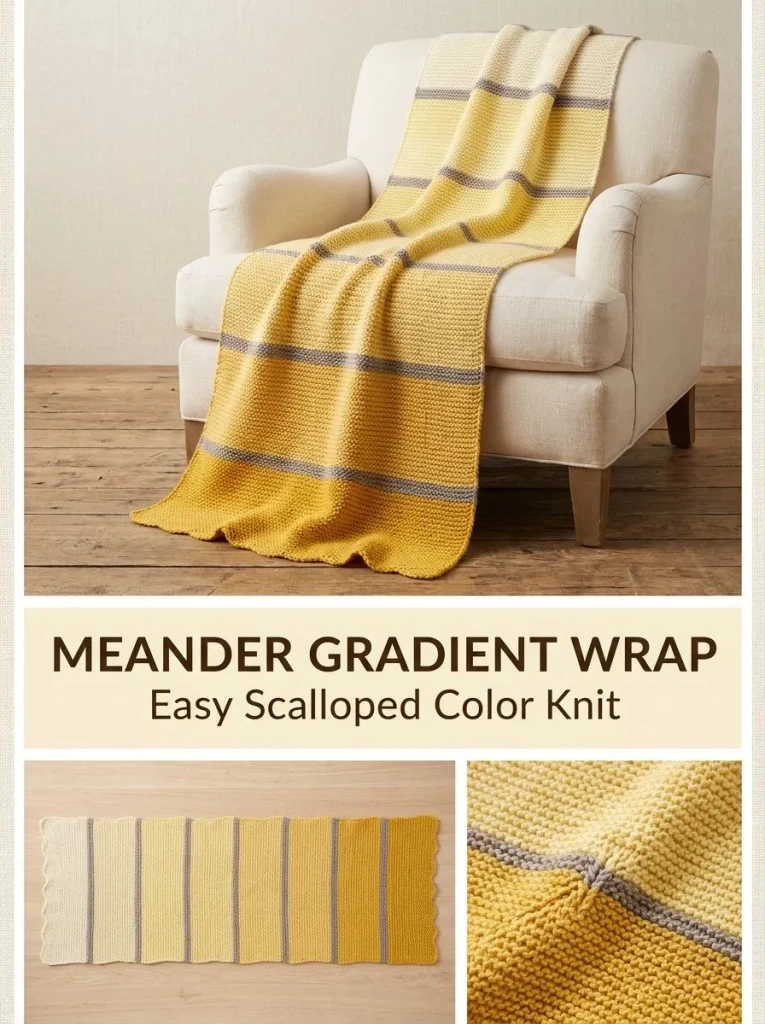
This striking wrap is crafted lengthwise in a gentle gradient that transitions through nine distinct shades, separated by solid-colored bands that emphasize the scalloped edges formed by a clever stitch pattern. The combination of gradient color sequencing and precise stitch manipulations creates a visually engaging fabric with textured stripes and soft scallops at the edges. Constructed entirely in garter stitch with strategic increases and decreases, this lightweight wrap balances color play with classic garter texture, making it versatile for layering and year-round wear.
The fabric’s defining feature is the “meander” row, a rhythmic sequence of decreases and increases that maintains stitch count while shaping the fabric into subtle waves along the edges. The interplay between the gradient hues and the contrasting solid stripes adds depth and interest without complexity, ideal for knitters looking for a pattern that combines ease with visual sophistication. Using circular needles not only accommodates the long length comfortably but also facilitates smooth transitions and consistent tension across the project.
As you work through this pattern, pay close attention to the yarn transitions and the meander row repeats, which are crucial for achieving the piece’s signature scalloped effect. For those interested in expanding their collection of textured wraps, patterns like the Autumn Sampler Wrap with Seven Textures showcase similarly creative use of textures and color gradients, providing excellent inspiration.
Pattern at a Glance
Skill level: Intermediate knitters comfortable with basic increases, decreases, and color changes
Terminology: Standard American knitting terminology
Construction: Worked lengthwise in garter stitch using a stitch pattern repeat that balances increases and decreases to create scalloped edges
Finished size: Approximately 14.5 inches wide by 71 inches long
Yarn weight: DK/light-worsted weight yarn
Needle size: US 7 (4.5 mm) circular needle, 60-inch length
Main stitch: Garter stitch with patterned meander rows (k2tog and kfb combinations)
Gauge: 25 stitches x 30 rows = 4 inches after blocking
Color scheme: Gradated gradient yarn with coordinating solid stripes inserted between color changes
Motifs: No separate motifs; pattern created through stitch manipulation and color changes
Layout: Continuous straight length knitted flat, featuring alternating gradient bands and solid-color stripes
Joining: None required as it is a single-piece construction
Border: Formed naturally by the meander row pattern; no additional edging needed
Seaming: None required
Materials
- Yarn: Approximately 855 yards of gradient yarn covering nine shades, plus 365 yards of a coordinating solid color. A gradient like the Chamomile series is recommended for smooth color changes; the coordinating solid (such as Reed Gray) provides contrast.
- Needles: US 7 (4.5 mm) circular needle, 60 inches in length. Circular needles are preferred for accommodating the long cast-on stitches comfortably and for ease of maneuvering the fabric.
- Notions: Stitch markers to track pattern repeats or rows, a tapestry needle for weaving in ends after color changes, and scissors for cutting yarn.
- Blocking tools: Wet-blocking supplies such as blocking mats and pins are essential to fully open the scalloped edges created by the stitch pattern.
The gradated yarn elegantly transitions across nine different colors, and the solid yarn used between these colors accents the scalloped texture and divides the gradient sections neatly.
Yarn and Color Notes
Choosing yarn for this project requires attention to fiber content and color behavior. Because the wrap is worn close to the skin, a soft yarn with good stitch definition enhances the scalloped and textured stitch pattern. Wool blends or soft merinos are excellent choices.
Avoid yarns with overly fuzzy or halo-like textures, as these can obscure the delicate meander stitch details and the subtle ridges formed by knit and purl rows in garter stitch. Smooth yarns will best showcase the stitch definition and the neat interplay between gradient colors and solid stripes.
The color transitions carry the visual weight of this project. Using a gradient yarn with well-scoped color segments helps accentuate the scalloped shape. The narrow solid-color bands between gradient shades break up the continuity just enough to let each gradient color stand out distinctly. Experiment with other pairs of gradient and coordinating solids for customizable effects.
Finished Measurements
The wrap measures approximately 14.5 inches wide and 71 inches long at completion. The width refers to the measurement across the knitted width (worked lengthwise), and the length corresponds to the knitted length from cast-on edge to bind-off edge.
Because the wrap is worked lengthwise and has a long rectangular shape, the measurements make it ideal for draping around shoulders or wearing as a scarf-like accessory.
These measurements are based on a blocked piece; blocking is essential to open the scalloped edges and set the final shape.
Gauge
Gauge is a critical factor in this project because stitch counts and the scalloped shape depend on precise stitch tension.
- Gauge: 25 stitches by 30 rows = 4 inches in garter stitch, blocked
- Where to measure: Measure gauge in the garter stitch sections after blocking to ensure accuracy.
- Importance: Getting the given gauge will ensure the finished wrap matches the intended dimensions and scallop size. If your gauge is larger, the wrap may be wider and longer, and the scallops may open differently. If smaller, the wrap will be narrower and shorter, potentially distorting the scalloped effect.
Always knit a gauge swatch before starting. Adjust needle size if needed to achieve the recommended gauge.
Abbreviations
- k = knit
- k2tog = knit two stitches together (right-leaning decrease)
- kfb = knit into the front and back of the stitch (increase)
- sts = stitches
- rnd(s) = round(s) (not used here, but standard in knitting)
- yo = yarn over (not used in this pattern)
No chains or purl stitches are required as the pattern is worked entirely in garter stitch.
Important Pattern Notes
- The pattern is worked entirely flat, lengthwise, on circular needles for ease of handling the wide cast-on.
- The stitch count remains constant throughout except for controlled increases and decreases balanced in the meander row to maintain stitch count.
- Color changes occur between gradient shades and solid bands to produce visual contrast and separate the stripes.
- Yarn ends must be woven in carefully due to frequent color changes.
- The "meander row" is the pattern’s key row, repeating a sequence of decreases (k2tog) and increases (kfb) that produce the scalloped ripple effect without altering total stitch count.
- Stitch markers are helpful to mark repeats across the long cast-on.
- Color changes require cutting the yarn; carry yarn tails neatly and weave in securely after blocking.
- Blocking is essential to fully shape and open the scalloped edges.
Special Stitches and Techniques
- K2tog (knit two together): decrease that leans right, reduces stitch count by one. Used in groups of three in the meander row.
- Kfb (knit front and back): increase that adds a stitch by knitting into the front and back of the same stitch. Used in groups of six in the meander row.
- Garter Stitch: knitting every row to create a fabric with pronounced ridges and reversible texture.
- Color Changing: swapping yarn colors at the end of rows for clean transitions between gradient and solid shades.
- Wet-Blocking: soaking and pinning the finished wrap to open scallops and set shape.
No other advanced techniques are required, making this project accessible to knitters who have mastered basic increases and decreases.
Understanding the Construction
The wrap is knit in a single continuous piece worked lengthwise. The fabric consists of alternating bands of gradient colors and solid-colored stripes, with a constant stitch count maintained through clever stitch manipulation.
The hallmark meander row repeats a sequence of three decreases, six increases, and three decreases across the row. This sequence balances shaping to create gentle scalloped edges, allowing the fabric to ripple softly.
Each gradient shade section consists of four garter ridges (rows worked entirely in knit stitches) between each solid band to emphasize color transitions. The solid color bands themselves include knit rows and a meander row to visually frame the gradient sections.
The piece finishes with a total of 52 garter ridges: sixteen solid-color ridges and four ridges within each of the nine gradient shades.
Since the entire wrap is made in garter stitch, it has excellent elasticity and drape, perfect for a wrap that comfortably contours the shoulders with the added visual texture from the meander pattern.
Complete Pattern Instructions
Foundation
Cast on 432 stitches using the lightest gradient shade yarn. This large number allows for the wide dimension of approximately 14.5 inches in the finished wrap and accommodates the scallops.
Row 1
Knit one row across all stitches with the gradient yarn to establish the garter stitch foundation.
Meander Row Pattern
The “meander row” is worked as a repeating sequence across the entire row:
- Repeat the following sequence:
k2tog 3 times (knit two together three times)
kfb 6 times (knit front and back six times)
k2tog 3 times (knit two together three times)
This sequence keeps the stitch count at 432 because the decreases and increases balance each other out.
Following Rows
- Knit 3 rows straight in garter stitch with the same gradient shade.
- Work the meander row again to reinforce the scalloped shaping.
- Knit 1 row to complete the section.
Color Change to Solid Yarn
- Cut the gradient yarn at the end of the last knit row.
- Join the coordinating solid yarn.
Solid Stripe Section
- Knit 2 rows with the solid color.
- Work one meander row with the solid.
- Knit 1 row with the solid color.
Transition to Next Gradient Shade
- Cut the solid yarn.
- Join the next darker gradient shade yarn.
- Work 4 garter ridges (rows of knit stitches) alternating with the same meander rhythm applied every fourth row, following the established pattern.
Continuing the Pattern
- Repeat the sequence of alternating gradient shade sections with the narrow solid-color ribbing in between, working the meander rows as directed.
- Work through all 9 gradient shades in total.
- The finished piece has 52 garter ridges overall, which includes:
- 16 ridges of solid-color yarn
- 4 ridges in each of the 9 gradient shades
Bind-Off and Finishing
- Bind off knitwise to maintain a neat edge.
- Weave in all loose ends securely with a tapestry needle to avoid unraveling.
- Wet-block the wrap by soaking in water and pinning it out to open the scalloped edges fully, enhancing the ripple effect.
Helpful Checkpoints
- After the first meander row, count stitches: you should have exactly 432 stitches.
- Confirm the scalloped edges appear gently and consistently along the length after the meander rows.
- Measure the width after completing the first gradient and solid color transitions; it should approximate 14.5 inches.
- After all 52 ridges are worked, check the total length to ensure it is approximately 71 inches.
- Carefully inspect the smoothness of all color transitions to avoid pooling or sudden color starkness.
Assembly
No assembly is necessary, as the wrap is knit in one piece from edge to edge. Ensure ends from color changes are woven in neatly on the wrong side if possible to keep the wrap’s edges clean and polished.
Finishing
Wet blocking is essential. Soak the wrap fully, then lay it flat on a blocking mat, gently stretching and pinning the scalloped edges to fully open and define their shape. Allow the wrap to dry completely before unpinning.
This shaping step transforms the meander row’s stitch manipulation into a flowing visual ripple, setting both the fabric and the scallop curves.
How to Resize
The width and length of this wrap are controlled by stitch count in cast-on and by the number of garter ridges worked.
- To widen: Increase the cast-on stitches by multiples of 12, maintaining the meander row pattern repeat of (k2tog 3 times, kfb 6 times, k2tog 3 times) per repeat unit. Each repeat contains 12 stitches, so increases must be in multiples of 12 to maintain balance.
- To lengthen: Add more garter ridges in the gradient shades and solids proportionally. For example, increase each color section’s ridges beyond 4 and each solid band beyond the set rows, maintaining the meander row rhythm.
Scaling proportionately keeps the scalloped effect visually pleasing and consistent.
Useful Pattern Variations
- One-Color Version: Substitute gradient yarns with a single solid color and use tonal variations in the same hue for the solid stripes for a subtle alternative.
- Two-Color Version: Use just two contrasting solid colors alternating with the meander pattern for high-contrast stripes with scalloped edges.
- Gradient-Only Version: Eliminate the solid-color bands and knit all stripes in gradient colors only for a continuous fading effect.
- Longer Wrap or Scarf: Extend the length by working more garter ridges per color and solid section without altering the stitch count.
Trying different color sequences or widths can personalize the wrap without changing the core stitch structure.
Troubleshooting
Why Does the Stitch Count Appear to Change?
This pattern’s meander row balances increases and decreases evenly. Make sure you follow the repeat exactly: three k2tog decreases, six kfb increases, then three more k2tog decreases per repeat. Missing or adding a stitch disrupts the scalloped effect and can create unwanted widening or narrowing.
Why Are My Scalloped Edges Uneven?
Inconsistent tension during increases/decreases can cause uneven scallops. Ensure consistent stitch tension and correct execution of k2tog and kfb. Blocking will help even out minor irregularities.
Why Do Color Changes Look Messy?
Always cut yarn between colors and weave ends neatly. Avoid carrying yarn across many stitches to prevent bulk. The frequent color changes require careful management during weaving in.
Why Does My Wrap Curl?
Garter stitch usually lies flat; if curling occurs, check your tension and blocking technique. Wet-blocking as instructed will relax fibers and set the scalloped edges, reducing curling.
Can I Substitute Yarn Weight?
Substituting a different yarn weight can affect gauge, size, and drape. If choosing a thicker or thinner yarn, adjust needle size accordingly and knit a gauge swatch to maintain accurate measurements and effects.
Frequently Asked Questions
Can I use a different needle size?
If you prefer a drapier fabric, try going up a needle size, but knit a swatch first to adjust stitch count and garter ridge count as needed.
Is the pattern reversible?
Yes, garter stitch fabric with this pattern of increases and decreases is reversible, though the scalloped edges will always show prominent shaping on both sides.
Can beginners attempt this project?
Experienced beginners comfortable with basic increases and decreases will enjoy this project. The repeating nature of the meander row makes it easy to memorize.
How should I handle weaving in many ends?
Plan your weaving in as you work, securing yarn tails on the wrong side with a tapestry needle and trimming close after blocking.
Will the colors pool with this setup?
Pooling is unlikely due to working lengthwise and changing colors regularly with solid bands; this creates clean stripes.
Can I add fringe or tassels?
Yes, adding fringe at the ends after finishing can provide extra texture and length.
Exploring Related Wrap Patterns
For knitters inspired by this textured wrap but looking to explore further modular or textured wrap designs, consider the Curator Modular Wrap with 11 Textured Sections. This modular construction differs in layout but shares the concept of textured stripes and tailored shaping.
Final Thoughts
This wrap’s construction revolves around the meander stitch pattern worked lengthwise to produce scalloped edges paired with a striking gradient and solid color striping. Its balanced increases and decreases keep stitch count stable while the color bands add visual interest. The result is a versatile, beautifully textured accessory crafted with straightforward techniques and careful blocking. Whether layered over casual or dressy outfits, this wrap offers elegance through simple stitch mastery and color transitions.



