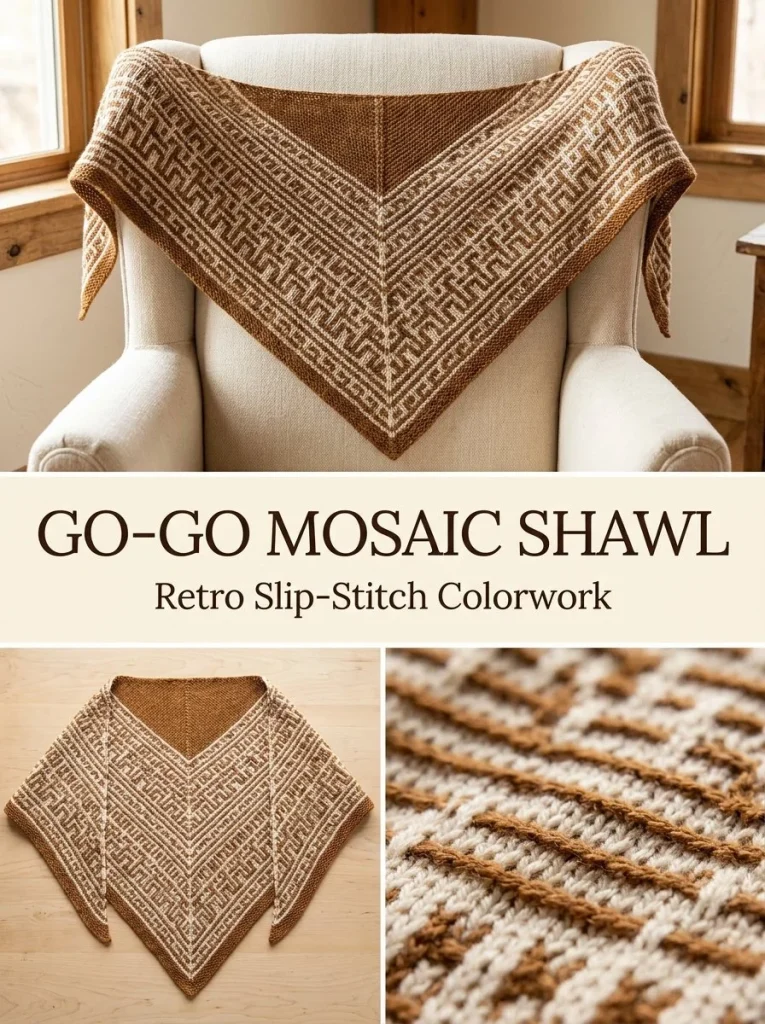
The striking mosaic shawl featured here blends classic geometric slip-stitch colorwork with a retro flair, creating a vibrant accessory that perfectly balances style and warmth. Constructed using an innovative mosaic knitting technique, the pattern showcases two contrasting colors arranged in crisp, symmetrical motifs that expand gracefully across a wide triangular shape. This approach highlights the textural interplay of stitches and colors while offering an accessible method for creating colorwork without complicated stranded knitting or intarsia.
Beginning at the narrow bottom point with a modest cast-on of three stitches, the shawl grows upward through systematic edge increases, maintaining a perfectly symmetrical triangle shape. The beauty of this design lies not only in its visual impact but also in its construction method — employing an 8-row mosaic stitch pattern that uses only one active color per pair of rows. This technique involves strategic slip stitches that carry the yarn along the wrong side, producing a lightweight, flexible fabric with a subtle retro vibe reminiscent of mid-century textile patterns.
Working with worsted-weight wool in a warm bronze and soft pearl color provides durability and drape, making this shawl ideal for chilly autumn days or layering in winter. The generous finished size ensures it can be wrapped or draped comfortably, serving both decorative and practical needs. If you are interested in exploring more slip-stitch colorwork and mosaic knitting designs, consider checking out this autumn drawstring bag knitting pattern that uses similar techniques with a contemporary twist.
Pattern at a Glance
Skill level: Intermediate — familiarity with color changes and slip stitches recommended
Terminology: US knitting terms
Construction: Top-down triangular shawl with symmetrical increases along both edges and center
Finished size: Approximately 64 in (163 cm) wingspan by 29 in (74 cm) depth
Yarn weight: Worsted weight wool
Needles: US 9 (5.5 mm) knitting needles
Main stitch: Mosaic slip-stitch colorwork in an 8-row repeat
Gauge: Not explicitly stated but gauge impacts final sizing due to stitch count and blocking
Motifs: Geometric mosaic pattern formed by slipped stitches and color changes
Layout: Single large triangular piece worked from the bottom point upwards
Joining: None
Border: Bound off loosely purlwise for flexible edge
Seaming: None
Materials
To complete this shawl, gather the following essentials:
-
Worsted wool yarn: Two colors are required for the mosaic effect:
- Color A: Bronze — approximately 275 yards (251 meters)
- Color B: Pearl — approximately 300 yards (274 meters)
-
Needles: US size 9 (5.5 mm) straight or circular knitting needles; length depends on personal preference and comfort when working a large project
-
Accessory: Tapestry needle for weaving in ends neatly
The specified yardage ensures you have sufficient fiber for the entire project, with a slight extra for finishing. The worsted weight yarn offers good stitch definition, highlighting the crispness of the slip-stitch mosaic pattern while maintaining warmth without excessive bulk.
Yarn and Color Notes
Choosing the right yarn and colors significantly influences the look and feel of this mosaic shawl. Sticky, smooth wool yarns with good stitch memory and slight elasticity work best for maintaining the structure while allowing ease of slipping stitches. Avoid overly fuzzy yarns, as they can obscure the intricate pattern detail.
For this project’s vintage-inspired theme, the contrast between the warm bronze and soft pearl colors creates dynamic visual interest. When selecting alternatives:
- Use two colors with strong contrast to maintain clarity of the mosaic pattern. Light and dark shades or complementary tones are ideal.
- Solid colors are highly recommended since variegated or self-striping yarns may detract from the geometric precision.
- Consider fibers with slight halo only if subtle softening of edges is preferred, but remember it might reduce stitch definition.
The reliable two-color technique here offers numerous possibilities for seasonal palettes, similar in spirit to the autumn plaid slip-stitch cowl knitting pattern, which also explores contrast and texture with slip-stitch colorwork.
Finished Measurements
Upon completion and proper blocking, this shawl measures approximately:
- Wingspan (top edge): 64 inches (163 cm)
- Depth (from bottom point to top edge center): 29 inches (74 cm)
These generous dimensions provide ample coverage for wrapping around shoulders or draping elegantly. The size is achieved through 29 repeats of the 8-row mosaic sequence with systematic edge increases, plus a final increase row before binding off.
Blocking is essential to open the mosaic pattern and slightly stretch the fabric, enhancing both drape and dimension. Keep in mind that gauge and blocking technique can influence final measurements.
Abbreviations
- sts: stitches
- RS: right side
- WS: wrong side
- sl: slip stitch (move stitch to right needle without knitting or purling)
- k: knit
- p: purl
Important Pattern Notes
- The shawl is worked flat from the bottom point upward with all rows worked back and forth.
- All increases take place symmetrically near both edges on right-side rows to preserve the triangular shape.
- The mosaic pattern uses an 8-row repeat where only one color is active at a time.
- Slip stitches are held with the yarn consistently on the wrong side for neat floats.
- Edge stitches (first and last stitch of each row) are always knit in a clean manner for tidy edges.
- Binding off is done loosely purlwise to maintain flexibility at the top edge.
- Blocking is critical to reveal the geometric mosaic pattern and correct dimensions.
Special Stitches and Techniques
Mosaic Slip-Stitch Colorwork
This technique alternates pairs of rows worked in a single color, slipping selected stitches from the previous row to create color blocks without stranding yarn across the wrong side. The method simplifies colorwork by avoiding frequent yarn carries, enhancing fabric fluidity.
Edge Increases
Increases occur only on right-side rows near both edges, increasing two stitches each row symmetrically to widen the triangular piece. This control ensures the shawl lays flat and grows evenly in width.
Loose Purlwise Bind-Off
A flexible bind-off worked by purling stitches off the needle permits the top edge of the shawl to stretch gently, complementing drape and wearability.
Understanding the Construction
The shawl starts as a narrow triangle point with only three stitches cast on in bronze yarn. From this point, the fabric grows upward and outward by adding stitches on both edges during right-side rows. This symmetrical growth process creates a perfect triangular shape.
After the initial setup rows, an 8-row mosaic stitch pattern is established. This repeat functions by knitting two rows in one color, slipping specific stitches with the yarn carried behind, then switching colors and repeating the process for another two rows. Alternating colors every two rows ensures the mosaic pattern emerges crisply.
The process continues, repeating this 8-row sequence 29 times, dramatically expanding the stitch count to 243 stitches. A final increase row in bronze raises the stitch count to 245 before the shawl is bound off.
The combination of edge increases and mosaic colorwork results in an eye-catching retro geometric shawl with a textured surface and dimensionally rich pattern.
Complete Pattern Instructions
Foundation
- Cast on 3 stitches using Color A (Bronze).
- This forms the narrow starting point at the bottom tip of the triangle.
Setup Rows
- Begin working right side (RS) rows, maintaining the bronze color for initial setup.
- On each RS row, perform two increases symmetrically near both edges for widening.
- Place the increased stitches near the first and last stitch to maintain clean edges.
- Continue this symmetrical increase until the mosaic pattern repeat can be established.
Establishing the Mosaic Pattern
The mosaic pattern is an 8-row repeat worked as follows:
- Rows 1–2: Work entirely in one color (starting color). Knit and purl as per the established stitch pattern, slipping selected stitches with the yarn held consistently on the wrong side to maintain neat floats.
- Rows 3–4: Switch to the second color and repeat the slip-stitch method on designated stitches.
- Repeat this two-color, two-row sequence to complete the 8-row repeat pattern.
- Always keep the first and last stitch of each row unaltered for neat edges.
- Continue to make paired edge increases on all right-side rows throughout.
Pattern Repeat
- Repeat the full 8-row mosaic colorwork sequence 29 times total.
- This will expand your stitch count to 243 stitches on your needles after completion of the repeats.
Final Increase Row
- Work one last increase row in Color A (Bronze), increasing the shawl to 245 stitches.
- This final increase secures the overall triangular shape and dimensions.
Bind Off
- Bind off all stitches loosely, purlwise in bronze color.
- A loose bind-off maintains the top edge’s flexibility, allowing the shawl to drape gracefully without pulling.
Finishing
- Weave in all ends carefully with a tapestry needle to ensure no loose yarn tails show.
- Block the shawl by wet or steam blocking to open up the mosaic pattern and stretch the fabric gently to achieve the final airiness and measured dimensions.
Helpful Checkpoints
- After setup rows, your stitch count should be increasing by 2 stitches each RS row.
- Once you begin the mosaic repeat, verify your pattern closely matches the 8-row sequence before continuing.
- After completing 29 full repeats, confirm you have 243 stitches.
- After the final increase row, you should reach 245 stitches before binding off.
- Upon blocking, the shawl should measure approximately 64 inches in wingspan and 29 inches in depth.
Assembly and Joining
This shawl is constructed in one piece and requires no assembly or joining after knitting. Once finished and blocked, it is ready to wear or gift.
Finishing Tips
- When weaving in ends, be meticulous to avoid disrupting the clean edge stitches.
- Blocking is essential: soak the shawl gently, then spread it out on a flat surface, pinning carefully to shape the edges and open the mosaic pattern.
- Dry flat in a well-ventilated area.
- Using steam blocking on an iron can be effective but be sure not to press to avoid flattening texture.
How to Resize
To adjust size:
- Make the shawl larger by increasing the number of 8-row mosaic repeats beyond 29. Each repeat adds depth and width proportionally.
- To make it smaller, reduce the total number of repeats but maintain symmetrical increase rows to preserve the triangular shape.
- Always maintain the paired edge increases on RS rows as prescribed to keep the shape correct.
- Changing needle size or gauge will impact measurements; swatching is recommended.
Useful Variations
- Substitute your own favorite contrasting colors to create a personalized color palette.
- Use a different worsted weight fiber for seasonal warmth, such as alpaca blends for softness or superwash wool for easy care.
- Experiment with a one-color version by alternating slipped stitches differently, creating a textured monochrome mosaic effect.
- Add a coordinating fringe or decorative tassel to the bottom point for a boho flair.
Troubleshooting
Why is my shawl not lying flat?
Ensure you are increasing stitches symmetrically on both edges on all RS rows as instructed. Missing increases will cause distortion.
Why do my slipped stitches look uneven?
Hold the yarn consistently on the wrong side while slipping stitches to maintain tension and clean mosaic pattern transitions.
My colorwork floats are tight — how to fix this?
Relax your tension on the slipped stitches or try a slightly larger needle to prevent puckering.
Why does the top edge feel tight after binding off?
Make sure your bind-off is loose and worked purlwise as specified. Too tight a bind-off reduces flexibility.
How do I avoid yarn tangles when switching colors?
Keep the unused color strands loosely hanging at the wrong side without twisting or knitting them in to avoid bulk and tangles.
Frequently Asked Questions
Can I use a different yarn weight than worsted?
Worsted weight is recommended for the correct drape and stitch definition. Using thicker yarn may result in a bulky shawl, while thinner yarn will produce a finer, more delicate fabric with different dimensions.
Can I use cotton yarn for this pattern?
Cotton is less elastic and less warm than wool but can work if you prefer a breathable shawl. Keep in mind the mosaic slip stitches may highlight the yarn’s lack of stretch.
Is this pattern suitable for beginners?
This pattern requires intermediate skills: managing slip stitches, color changes, and increases. Beginners with some experience in colorwork and shaping can attempt it with patience.
How should I block this shawl?
Wet-block by soaking gently in lukewarm water, then pinning flat to shape. Steam blocking also works well; just avoid heavy pressing.
Can this pattern be made reversible?
The design shows a distinct right and wrong side due to slipped stitches, so it is not fully reversible.
Are there recommended color pairings?
High-contrast pairs like bronze and pearl in this pattern enhance the mosaic effect effectively, but jewel tones or autumnal hues work beautifully too.
Optional Related Uses
This mosaic slip-stitch technique lends itself well to various projects such as cowls, scarves, or bags featuring similar colorwork motifs. For instance, you might enjoy adapting the colorwork style for smaller accessories or layering pieces, adding versatility to your knitwear wardrobe.
Final Thoughts
This triangular mosaic shawl is a captivating blend of retro charm and contemporary knitting technique. By starting from a tiny point and increasing symmetrically, the shawl grows elegantly with clean geometric colorwork highlighted through mosaic slip stitches. Its generous size and flexible binding off make it wearable for various occasions while showcasing the timeless allure of mosaic knitting. With proper yarn selection, careful tension, and blocking, this shawl will become a cherished staple that balances visual impact and cozy comfort.



