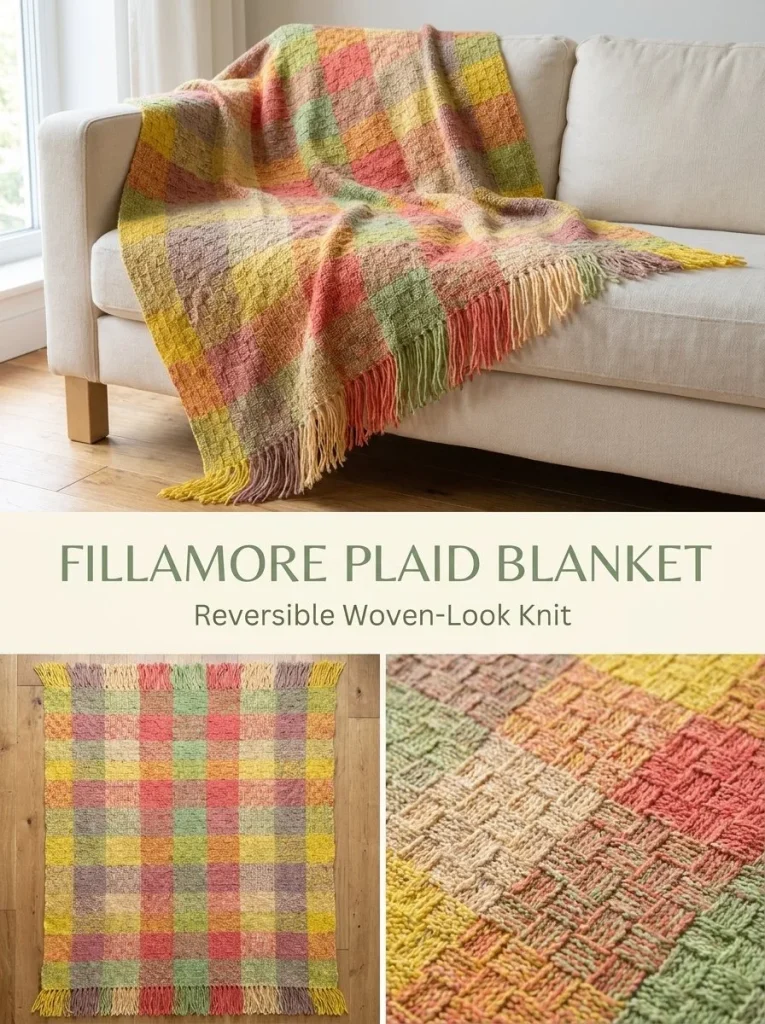
Creating a cozy, visually striking blanket that’s both reversible and richly textured, this plaid blanket knitting pattern employs a clever dual-strand technique. The result is a warm throw featuring vertical intarsia stripes—the “warp” strands—combined with a horizontally-changing single “weft” strand. This interplay produces a basketweave or woven squares texture, reminiscent of artisanal textile craftsmanship. The careful color transitions through five nuanced hues enhance the plaid’s dimensionality, making it perfect for both casual comfort and stylish décor.
Whether draped over a couch or wrapped warmly on chilly evenings, this blanket showcases an inspired construction method that blends colorwork and texture elegantly. Its reversible nature ensures both sides exhibit striking pattern and stitch definition, a feature prized in versatile home accessories. For those interested in textured knitwear accessories, this project shares thematic links with other textured fabric creations such as the autumn plaid slip stitch cowl knitting pattern, which also explores plaid and slip stitch techniques.
Pattern at a Glance
- Skill Level: Intermediate (due to managing multiple yarn strands and color changes)
- Terminology: Standard US knitting terminology
- Construction: Worked flat in one piece using double strands (warp and weft) in intarsia style
- Finished Size: Approximately 39.5 x 54.75 inches (100 x 139 cm), excluding fringe
- Yarn Weight: Heavy fingering / sport weight wool
- Needles: US 8 / 5 mm long circular needle (32 in / 80 cm or longer recommended)
- Additional Tools: Digital scale, 3 mm crochet hook for fringe, tapestry needle
- Main Stitch: Woven squares texture (alternating blocks of knits and purls with slip stitches)
- Gauge: 16 stitches x 26 rows = 4 inches (10 cm) with yarn held double
- Color Palette: Five solid or lightly heathered colors – Sunshine Yellow (A), Mushroom (B), Pale Apricot (C), Coral (D), Green (E)
- Layout: Eleven vertical bands of varying widths alternating colors, layered with horizontally changing weft color
- Joining: None (worked as a single rectangle)
- Border: Not separately bordered; edges bound off loosely
- Seaming: None required
Materials
For this project, select five skeins of heavy fingering or sport-weight wool yarn in solid or softly heathered shades. The sample uses:
- 2 skeins each of Sunshine Yellow (A), Mushroom (B), Pale Apricot (C), Coral (D), and Green (E)
- Each skein approx. 383 yards / 350 meters per 100 g
- Total yardage needed: approximately 3300 yards / 3000 meters (excluding fringe)
Use a US 8 / 5 mm circular needle at least 32 inches (80 cm) long or longer to comfortably hold the 162 stitches and allow turning. A digital scale aids in dividing yarn precisely among the vertical “warp” bands. For finishing, a 3 mm crochet hook is essential to add a neat, evenly spaced fringe on the blanket’s short edges. Finally, a tapestry needle will help with weaving in ends and tidying the work.
Yarn and Color Notes
Choosing wool with some elasticity and defined stitch clarity is important for texture and drape. Heavy fingering or sport-weight yarn works well because it provides enough warmth without excessive bulk. Avoid highly fuzzy or loosely spun yarns, as they obscure the crisp woven squares pattern and may increase snagging risk during the frequent color changes.
Solid or lightly heathered yarns help the plaid pattern stand out through clear, crisp color transitions. The selected palette balances warm and cool tones while cycling through light, soft, and rich hues for visual intrigue. This approach maintains harmony within a multi-color design and replicates the layered plaid effect seen in woven textiles rather than painterly blends.
If you want to experiment with your own palette, consider maintaining the alternating widths of bands and increasing contrast between adjacent colors to accentuate the woven effect.
Finished Measurements
The finished blanket measures roughly 39.5 inches wide by 54.75 inches long (100 x 139 cm), excluding fringe which will add additional length on both short ends. These dimensions result from the cast-on stitch count and row count described below using the specified gauge.
The width comes from knitting 162 stitches at a gauge of 16 sts per 4 inches (10 cm), while the length follows a multi-color changing row count designed for about 54.75 inches total height. Adjusting yarn weight or needle size will affect final dimensions, so always check gauge before embarking.
Gauge
Gauge: 16 stitches x 26 rows = 4 inches / 10 cm, measured with the yarn held double to achieve the necessary fabric density and texture.
Gauge is measured in stockinette-like pattern sections after working a test swatch. The woven squares stitch creates a squarer, fabric-like texture rather than flat stockinette, so measuring the swatch with yarn held doubled is critical.
While perfect gauge accuracy is less crucial for blankets than clothing, maintaining gauge ensures your final piece matches sizing plans and the fabric behaves as expected. Using larger needles or more loosely spun yarn will yield a softer but less structured fabric, while tighter gauge produces denser, warmer texture.
Abbreviations
- K: Knit
- P: Purl
- St(s): Stitch(es)
- Rnd: Round
- Rpt: Repeat
- Yo: Yarn over
- Tog: Together
- Sl: Slip stitch
This pattern uses standard US knitting abbreviations relevant to the woven squares texture and intarsia-style color work.
Important Pattern Notes
- The blanket is knit flat in a single piece, not in sections to be sewn.
- Two strands are worked simultaneously: vertical “warp” yarns for color blocks and a horizontal “weft” yarn held separately across the row.
- Individual vertical bands hold their own warp yarn supply to create clear color blocks (intarsia technique).
- The weft color changes horizontally after specified row repeats to create the plaid’s layered effect.
- Twist warp yarns at each vertical color boundary to prevent holes and improve color transitions.
- The slip stitch purlwise on the first stitch of every row keeps edges neat.
- Color changes only involve switching the weft color horizontally, while warp order remains constant vertically.
- The blanket ends with a loose bind-off and is finished with crochet hook fringe on short edges.
- The fabric is fully reversible due to the woven squares texture, making both sides usable.
Special Stitches and Techniques
Intarsia with Warp and Weft
This blanket employs intarsia colorwork where vertical stripes (“warp” strands) are knit individually and combined with a horizontally working single “weft” strand. The warp strands create well-defined vertical color bands, while the weft changes every 24 rows or so to alternate horizontal color blocks, akin to weaving.
Slip the First Stitch Purlwise
In each row, slip the first stitch purlwise with yarn held in the back to create a tidy, firm selvage edge, reducing curling and providing a crisp line.
Woven Squares Texture
This stitch pattern features blocks of knit and purl stitches alternating in 4-stitch groups forming a checkerboard or basketweave effect.
- Rows 1–6: Slip first stitch purlwise with yarn in back; then alternate blocks of 4 knits (K4) and 4 purls (P4) across the row.
- Rows 7–12: Repeat slipping the first stitch, but reverse the pattern blocks so purl blocks (P4) stack above knit blocks (K4) and vice versa.
This 12-row pattern is repeated to form a textured weave with rich depth and a pleasing tactile feel.
Understanding the Construction
This blanket is worked straight across in one large rectangular piece without seaming or joining separate parts. The key innovation lies in holding two strands of yarn simultaneously per stitch — a warp and a weft:
-
The warp strands are divided by vertical color band, with each band having its own yarn ball. This creates the vertical striped color sections typical of plaid.
-
The weft strand runs horizontally across the entire row and changes color every 24 rows to create the horizontal color bands of plaid.
Imagine weaving fabric: the vertical warp threads remain constant while the horizontal weft threads pass over or under. Just like weaving, this colorwork approach builds a plaid using knit-purl block texture instead of plain color knits alone.
The knitted fabric has a basketweave texture seen as woven squares, reinforcing the plaid’s layered look. Both sides appear equally finished and usable, thanks to the stitch pattern’s reversibility.
Full Pattern Instructions
Foundation: Cast On
Using the color sequence detailed below, cast on 162 stitches on a US 8 / 5 mm long circular needle. The color-width sequence for each vertical warp band is:
- A (Sunshine Yellow): 17 sts
- B (Mushroom): 16 sts
- E (Green): 8 sts
- C (Pale Apricot): 16 sts
- D (Coral): 16 sts
- E (Green): 16 sts
- D (Coral): 16 sts
- C (Pale Apricot): 16 sts
- E (Green): 8 sts
- B (Mushroom): 16 sts
- A (Sunshine Yellow): 17 sts
Hold the appropriate warp strand for each vertical section and a separate weft strand that will be worked across the entire row.
Important: Twist the warp yarn strands at every vertical color boundary to avoid holes and ensure a seamless transition between colors.
Woven Squares Texture Pattern (12 Rows)
Rows 1–6:
- Slip the first stitch purlwise with yarn held in back.
- Alternate blocks of K4 and P4 stitches across the entire row. For example, knit 4 stitches, purl 4 stitches, repeated to the end of the row.
Rows 7–12:
- Slip the first stitch purlwise with yarn held in back.
- Reverse the blocks: alternate blocks of P4 and K4 so that purled blocks stack above knitted blocks and vice versa, creating the woven effect.
Repeat these 12 rows to maintain the woven squares pattern.
Weft Color Changes and Length Control
-
Work the 12-row woven squares pattern twice with weft color A (Sunshine Yellow), totaling 24 rows.
-
Then change the weft strand to the next color in the palette (B, C, D, E), knitting 24 rows with each weft color.
-
Continue cycling through weft colors B, C, D, E, and then back to A, always maintaining the vertical warp arrangement.
-
Repeat this horizontal weft color cycling until the knitted piece reaches about 54.75 inches (139 cm) in length.
Bound Off and Finishing
-
Bind off loosely in pattern to avoid tightening the edging.
-
Using a 3 mm crochet hook, add evenly spaced fringe to both short edges of the blanket to provide a polished finish and to echo the woven aesthetic.
-
Block the blanket flat with steam or wet blocking to even the edges and set the stitches, enhancing the basketweave texture.
This blocking process also accentuates the reversible nature of the blanket, ensuring both sides are equally attractive and usable.
Checkpoints
- After casting on, confirm you have 162 stitches arranged in the specified color sequence.
- After completing the first 12-row woven squares pattern, the texture should appear as alternating knit and purl blocks forming a clear checkerboard.
- After 24 rows with the initial weft color, check that the horizontal color change is smooth without gaps or holes.
- When your length approaches 54.75 inches, measure your work to verify before binding off. Slight variation is acceptable but aim to stay close to maintain balance.
- The edges should remain flat with no curling, thanks to the slip stitch selvage and block texture.
Assembly
No assembly is needed since the blanket is knit flat in one piece. The neat edges and fringe finish complete the project without any seaming or joining.
Finishing
- Weave in all yarn ends from warp and weft strands carefully using a tapestry needle.
- Crochet fringe with the 3 mm hook evenly along both short sides; fringe length can be adjusted but generally about 3–4 inches is visually appealing.
- Block flat to shape and enhance the woven basketweave texture.
Adding fringe not only embellishes the piece but also helps stabilize the edges and balance the tactile elements of the blanket.
How to Resize
To make a larger or smaller blanket:
-
Adjust the cast-on stitch count by adding or subtracting vertical bands in multiples matching the pattern’s color width sequence. Maintain the integrity of the color order and width for plaid balance.
-
For width, each stitch corresponds roughly to 0.25 inch (based on gauge), so adding or removing multiples of 8 to 17 stitches (vertical band widths) affects overall width.
-
To change length, adjust the number of row repeats of the woven squares texture and the number of horizontal weft color changes accordingly, keeping the 12-row pattern repeat consistent.
Because the pattern uses a fixed color-width banding scheme, resizing horizontally must maintain band multiples to preserve the plaid’s appearance.
Useful Variations
- One-Color Version: Work the entire blanket in one yarn color holding double strands for the woven texture. This creates a sophisticated tonal basketweave effect.
- Two-Color Version: Pick two contrasting colors for warp and weft for a bold striped plaid look.
- Seasonal Palettes: Use autumnal shades for cozy fall vibes or pastels for spring.
- Smaller Throws or Baby Blankets: Reduce cast-on stitches by omitting some vertical bands and fewer weft color changes.
- Matching Beanie or Cowl: Explore coordinating accessories using similar plaid or woven patterns, such as the reversible double layer beanie knitting pattern, which can complement this blanket’s aesthetic with its layered texture and dual color approach. See the city reversible double layer beanie knitting pattern for inspiration.
Troubleshooting
Why Is My Blanket Edging Uneven or Stretchy?
Check that you slip the first stitch purlwise with yarn held in back every row. Skipping this can cause uneven edges and curling. Also, ensure the bind-off is loose, or edges may pucker.
Why Are There Holes at Color Boundaries?
Remember to twist warp yarns at each vertical color change by crossing strands to avoid gaps and holes. This step is crucial in intarsia to maintain a neat fabric surface.
My Woven Squares Texture Looks Shifted. What’s Wrong?
Verify you are alternating knit and purl blocks correctly between Rows 1–6 and 7–12, slipping the first stitch purlwise each row. Missing these color changes or stitches will disrupt the checkerboard pattern.
How Can I Manage So Many Yarn Strands Without Tangling?
Separate vertical warp yarn balls on different bobbins or holders. Wind each warp strand from its own small ball or center-pull skein. Keep weft yarns separate and tidy by using yarn bowls or clips. Taking time to arrange tools reduces frustration.
The Blanket Feels Too Large/Small—What Now?
Check your gauge and needle size. Adjust stocking up or down by adding/removing vertical bands or rows as explained in the resizing section to perfect fit.
Frequently Asked Questions
Can I Substitute Acrylic or Cotton Yarn?
While this pattern uses wool for its elasticity and stitch definition, substitute yarns with similar weight can work. Acrylic offers easy care and cotton gives a cooler texture but may alter drape and stretch.
Is the Blanket Truly Reversible?
Yes, the woven squares stitch creates texture visible on both sides, making either the right or wrong side attractive and usable.
How Do I Change Colors Cleanly Without Bulk?
Changing only the weft yarn horizontally minimizes tangled strands. Twist warp strands at vertical boundaries carefully to avoid holes or loose loops.
Do I Need Circular Needles?
Circular needles are recommended due to stitch count and weight, but straight needles with sufficient length could work for smaller versions.
Can Beginners Knit This Blanket?
Intermediate knitters comfortable with intarsia and color changes will find this suitable. Beginners may want to practice smaller colorwork projects first.
How Should I Block the Blanket?
Block flat with gentle steam or wet blocking, pinning edges to dimensions. Blocking evens stitches and enhances the basketweave texture significantly.
Optional Related Uses
The woven squares texture with dual-strand colorwork is adaptable to smaller accessories like scarves, throws, or cushion covers. The same weaving approach can inspire cozy neck warmers and smaller layered pieces, linking nicely to textured knits like the autumn plaid slip stitch cowl, which employs plaid and multi-color detail in a compact knitwear accessory.
Final Thoughts
This blanket’s construction thoughtfully mimics woven fabric through innovative vertical “warp” and horizontal “weft” knitting strands. With a modest palette of five colors and a distinctive woven squares stitch pattern, it offers a warm, stylish plaid with rich reversible texture. Following the pattern’s disciplined color management and stitch repeats guarantees success and a lasting, versatile piece that blends hand-knit artistry with functional home design.



