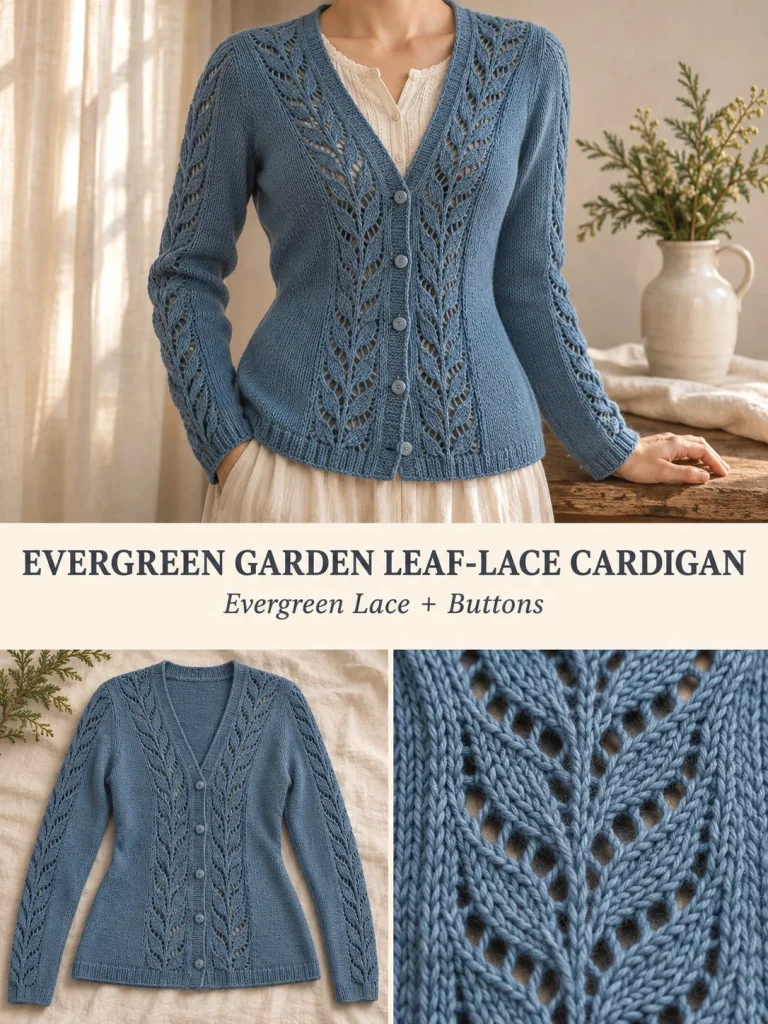
This elegant cardigan offers a delightful blend of classic tailoring and delicate lace artistry, crafted to suit sizes from XS to 5X with a flattering fitted-to-relaxed silhouette. Constructed entirely top-down, the design showcases leaf-inspired lace panels strategically placed along the back center, front edges, and sleeves, creating a cohesive evergreen motif that breathes life into the garment. Using 100% merino DK weight yarn in a serene Lake Blue, this project invites knitters to explore flowing lace patterns that evoke nature’s elegance while being practical and wearable.
The cardigan’s construction eliminates any seaming, progressing seamlessly from shoulders and V-neck shaping to the joined body beneath the armholes, allowing for comfortable adjustment through the waist and hips based on body shaping preferences. Following either designer charts or detailed written instructions ensures that the leaf-like lace motifs remain clear and visually consistent, with precise pairing of yarnovers and decreases that maintain both pattern integrity and garment fit. This approach aligns the pattern with other beautifully textured projects that feature lace motifs, such as a leaf and berry lace cowl, offering inspiration for combining nature-inspired stitches into wearable art.
Pattern at a Glance
Skill level: Intermediate, suitable for knitters familiar with lace techniques and shaping
Terminology: Standard US knitting terms
Construction: Top-down, seamless, joined below the armholes
Finished size: Chest circumference approx. 31.25–63 inches; length approx. 22–25.25 inches
Yarn weight: DK (double knitting)
Needles: US 6 / 4 mm circular needle (32 inches or longer), small-circumference needles or gauge equivalents for sleeves
Main stitch: Leaf-like lace motif combining paired yarnovers and decreases
Gauge: Determined by official designer charts; critical for lace clarity and cardigan fit
Motifs: Repeated evergreen leaf panels in back, front edges, and sleeves
Layout: Central back panel with symmetric front and sleeve lace sections
Joining: Underarm pieces joined seamlessly
Border: Lower edging with buttonholes
Sewing: None—constructed in the round and knit pieces joined during shaping stages
Materials
To create this garment, you will need the following:
- Yarn: Mayflower Easy Care Classic 100% merino DK yarn in Lake Blue (solid color recommended to preserve lace definition). Approximate usage ranges from 8 skeins (XS) to 18 skeins (5X), with each skein providing about 115 yards (50 grams).
- Needles: US 6 / 4 mm circular needle of at least 32 inches length to accommodate the body, plus matching small-circumference needles or interchangeable tips for sleeves worked in the round or flat.
- Notions: Stitch markers for tracking lace repeats and shaping, spare yarn or stitch holders to manage sleeve stitches during body knitting, and a tapestry needle for weaving in ends.
- Hardware: 4 to 6 buttons chosen for style and durability, spaced according to the original pattern’s buttonhole placement guidelines.
Using high-quality merino DK yarn not only adds softness and warmth but provides excellent stitch definition, crucial for lace motifs involving yarnovers and various decreases to remain visible and well-formed.
Yarn and Color Notes
A smooth, solid-colored yarn like the recommended Lake Blue solid color helps maintain the clarity of the lace motifs. Textured or variegated yarns may obscure the leaf detail, making the pattern harder to read. Merino wool offers elegant drape and resilience, balancing warmth with breathability, ideal for layering garments.
When selecting yarn alternatives, choose fibers with similar weight and stitch definition characteristics. Cotton or blends may affect elasticity and drape, while fuzzy yarns can diffuse lace edges. For knitters interested in exploring lace patterns in scarves or cowls, the lace motif used here shares aesthetic qualities with patterns such as the Saroyan leaf-edge lace scarf which employs sideways lace effects and leaf edges.
Finished Measurements
Finished garment dimensions accommodate a broad spectrum of sizes, reflecting chest circumferences from approximately 31.25 inches (XS) to 63 inches (5X), paired with lengths ranging from 22 to 25.25 inches. These measurements allow the cardigan to transition from fitted to relaxed depending on personal preference and ease.
Length to the lower hem focuses on hip coverage without overwhelming, while sleeve length matches typical arm lengths to maintain proportionality. The pattern’s careful shaping and sizing charts support accurate fitting, encouraging real-time try-ons during knitting to adjust the length or ease if necessary.
Gauge
Maintaining gauge is essential to preserving size accuracy and stitch clarity in the lace. Although the exact stitch and row gauge is controlled through the official designer chart, knitters are advised to:
- Measure gauge over the lace pattern sections using a blocking swatch.
- Adjust needle size if necessary to achieve the correct gauge; smaller needles for tighter gauge and larger for looser, but always ensuring lace stitches stay well defined.
- Bear in mind that improper gauge may result in stretched or dense lace, affecting both fit and motif visibility.
For garments, unlike some household items, paying close attention to gauge prevents unwanted size variations and ensures a balanced fabric.
Abbreviations
This pattern uses standard US knitting abbreviations:
- YO: Yarn over
- K2tog: Knit two stitches together (right-leaning decrease)
- SSK: Slip, slip, knit (left-leaning decrease)
- RS: Right side
- WS: Wrong side
- St(s): Stitch(es)
- PM: Place marker
- CO: Cast on
- BO: Bind off
Familiarity with lace reading through charts or written instructions using these abbreviations will facilitate pattern execution.
Important Pattern Notes
- The cardigan is worked top-down in one continuous piece initially (front shoulders, back neck), eliminating the need for seaming.
- The lace panels use paired yarnovers and decreases to maintain stitch count and motif clarity—incorrect pairing can distort the evergreen leaf pattern.
- V-neck shaping begins early and is continued with corresponding shoulder shaping.
- After the armholes are shaped, the front and back are joined below the armholes to knit the body seamlessly.
- Sleeves are then knit either by picking up live stitches or from held stitches as directed.
- Buttonholes and lower edging are finished last, with buttons spaced as per the original pattern.
- The solid Lake Blue colorway maintains lace visibility and design aesthetics.
Special Stitches and Techniques
The pattern involves a lace motif composed of paired yarnovers and decreases that form recurring evergreen leaf shapes. Knitters should:
- Master the technique of maintaining stitch count in lace by pairing each yarn over with an appropriate decrease, critical for pattern symmetry.
- Understand shaping methods including decreasing stitches for shoulders and neckline shaping.
- Work smoothly with circular needles and small-circumference sets for sleeves, handling stitches on holders when necessary.
- Read lace charts and/or written lace instructions confidently, noting repeats and special symbols.
Additional techniques include neatly picking up stitches for sleeves and creating evenly spaced buttonholes along the edge.
Understanding the Construction
The cardigan is crafted entirely in a seamless, top-down manner to allow adjustments on the fly and to fit various body shapes without seaming:
- Start at the shoulders and neckline: Knit the shoulder panels incorporating the leaf lace patterns along the front edges and back center.
- Shape the V-neck fronts: Shaping creates a flattering neckline, balancing the lace design with garment fit.
- Join fronts and back beneath the armholes: This unification allows continuing the body as a single piece, shaping the waist and hips as desired.
- Maintain lace pattern continuity: Throughout the body and sleeves, the lace motif is preserved through meticulous stitch management.
- Work the sleeves: Either pick up stitches from held live stitches or knit sleeves separately as instructed.
- Finish edges: Add the lower waistband edging with buttonholes and attach buttons accordingly.
The construction highlights the lace without interruption, supports size customization, and reduces post-knitting assembly time.
Complete Pattern Instructions
Foundation and Setup
Begin by casting on the designated number of stitches for your chosen size using the US 6 / 4 mm circular needle. The initial rows are worked according to either the written instructions or designer chart for the back center leaf motive and front edge leaf panels.
Mark sleeve and front sections carefully to manage lace pattern continuity and shaping points.
Shoulder and V-Neck Shaping
As you work upwards, shape the shoulders by gradually decreasing in the prescribed pattern, following the leaf lace charts exactly. The V-neck fronts are shaped concurrently by binding off or decreasing stitches as instructed to sculpt the neckline.
Joining Below Armholes
Once shoulder shaping and neckline are complete, join the front and back seamlessly below the armholes. This usually involves placing side stitches on holders and knitting the body in the round or back and forth without picking up previously cast off stitches. Maintain lace repetition carefully as the garment widens to the waist and hips.
Body and Waist Shaping
Continue knitting the body with optional adjustments to waist and hip measurements as charted to accommodate different sizes or personal preferences. Preserve the lace rows by pairing yarnovers and corresponding decreases diligently to maintain motif visibility.
Sleeves
Pick up held sleeve stitches or knit the sleeves as directed in the pattern, continuing with the leaf lace motif on the sleeves. Use small-circumference circular or double-pointed needles as needed for the sleeve circumference.
Edging, Buttonholes, and Button Placement
Complete the lower edge of the cardigan with a matching border that includes buttonholes spaced according to the official spacing guidelines for 4 to 6 buttons depending on size. Sew buttons securely, ensuring alignment with buttonholes for smooth closure.
Checkpoints
- After shoulder shaping: The shoulder width should conform to your size charts. Check the stitch count corresponds with the chart.
- When joining front and back: Confirm the lace motifs line up symmetrically.
- After body shaping: The cardigan should measure approximately 22–25.25 inches in length.
- Sleeve length after finishing: Confirm sleeve length matches your arm measurement or pattern length.
- Buttonhole spacing should be even and correspond to button choice.
Assembly and Joining
Assembly primarily involves joining the front and back beneath the armholes, which is executed seamlessly with no sewing required. Button sewing is the last step; ensure buttons are sewn on the corresponding lace edge of the front panels. Weave all ends thoroughly to avoid unraveling while maintaining the fabric’s softness.
Border and Finishing
The lower edging uses a simple border that complements the delicate lace, finishing the cardigan cleanly. Blocking the finished garment flat with gentle steam will shape the lace motifs and ease the fabric into a professional look. Use pins to hold edges flat and smooth and avoid distortion.
How to Resize
The pattern accommodates size adjustments from XS to 5X with yarn quantities and stitch counts scaled accordingly. To resize:
- Consult the designer’s size chart corresponding to your bust and hip measurements.
- Adjust length by adding or subtracting lace motif repeats in the body section.
- Sleeve width and length can be modified by adjusting the needle size or number of lace repeats.
- Maintaining pattern integrity means all increases and decreases should adhere to the given lace chart guidelines to preserve motifs.
Useful Variations
- Single-color vs Multicolor: While the current pattern uses solid Lake Blue for clarity, experimenting with tonal or gradient yarns can add subtle interest without obscuring the lace.
- Length Adjustments: Extend the body length for a tunic style or shorten for a cropped cardigan.
- Open Front or Zip Closure: Instead of buttons, an invisible zipper or no closure can offer an alternative look.
- Sleeve Length: Convert sleeves to three-quarter or full length by changing the number of motifs worked.
Troubleshooting
Why Are My Lace Motifs Not Aligning?
Ensure that yarnovers are consistently paired with decreases in the correct direction (K2tog vs SSK). Misalignments often arise from skipped decreases or added stitches.
Why Is My Garment Too Tight or Too Loose?
Check gauge carefully before starting and after blocking. Adjust needle size to match gauge specified by the pattern, especially critical for lace garments.
Why Are My Buttonholes Uneven?
Follow the buttonhole spacing exactly as per the pattern. Using stitch markers can help maintain uniform placement.
Why Is the Lace Pattern Hard to See?
Using a solid yarn like Lake Blue and blocking the garment will enhance motif visibility. Avoid variegated or fuzzy yarns.
Frequently Asked Questions
Can I use a different yarn weight?
This pattern is designed for DK weight yarn. Using heavier or lighter yarns will affect gauge and fit. If substituting, swatch carefully.
Can beginners try this pattern?
Intermediate knitting skills are recommended due to shaping and lace combinations, but determined beginners with patience could learn by studying lace charts and tutorials.
Do I need circular needles?
Circular needles are necessary to accommodate the circumference during body and sleeve knitting. Small circumference circulars or double-pointed needles are needed for sleeves.
How should I block this lace cardigan?
Block gently with pins to open lace motifs and shape the garment. Use steam or wet blocking depending on your yarn’s fiber content.
Can I add length to the sleeves?
Yes, by adding more repeats of the lace motif and adjusting yarn amounts accordingly.
Are the lace motifs reversible?
The lace motifs present best on the right side and are part of a shaped garment, so the wrong side may show less clarity.
Optional Related Uses
The evergreen leaf lace pattern lends itself well to other projects such as scarves, shawls, or cowls to echo the garden-inspired theme. Pairing it with accessories can create seasonal coordinated ensembles.
Final Thoughts
This cardigan marries functional garment design with intricate lace motifs, fostering an engaging challenge for knitters ready to explore seamless top-down construction and nature-inspired stitches. Its versatility across a wide size range, combined with the refined aesthetic of leaf lace panels and thoughtful finishing details such as button placement, offers a rewarding knit that feels both timeless and fresh. The top-down, no-sew process streamlines the knitting experience, yielding a wearable work of art to cherish through seasons.
By carefully following the lace charts and construction sequence, maintaining gauge, and choosing smooth yarn, you’ll successfully bring this evergreen garden lace cardigan to life, elevating your knitting skills and wardrobe alike.



