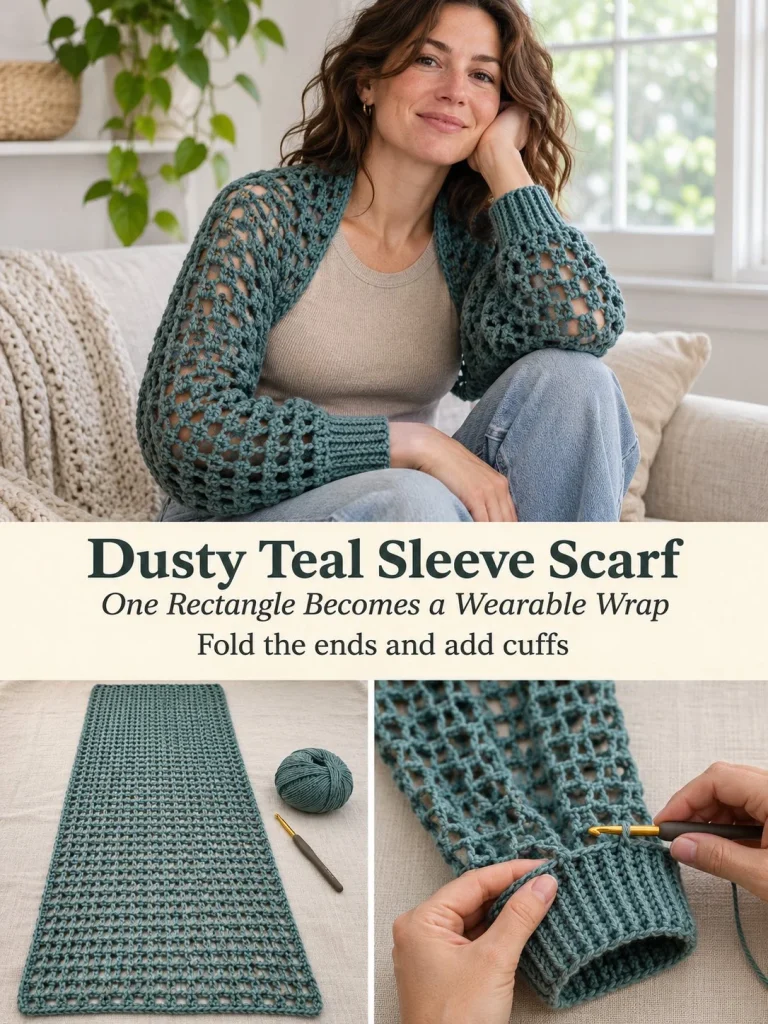
This unique crochet accessory merges the cozy warmth of a scarf with the practical functionality of sleeves, creating an innovative garment that is both stylish and utilitarian. Crafted with a soft dusty teal worsted weight yarn, this piece offers an elegant drape and a soothing color that complements a wide range of wardrobes. Its rectangular construction and cleverly designed sleeve openings allow for easy layering over other clothing while keeping your arms comfortably wrapped and warm.
The design features an airy yet textured stitch pattern that adds visual interest without overwhelming the simplicity of the shape. Constructed primarily using basic crochet stitches with an alternating double crochet and chain mesh, the fabric provides a lightweight yet insulated feel. This combination makes it perfect for transitional seasons or chilly indoor environments.
For those who appreciate versatility in their handmade accessories, this piece provides an excellent balance of form and function. The sleeve structure allows freedom of movement while preventing the scarf from slipping off, a common annoyance with traditional scarves. Additionally, finishing with snug ribbed cuffs ensures the sleeves fit comfortably around the wrists, adding a polished and professional touch to the overall look. For inspiration on matching accessory pieces in the same beautiful hue and style, consider exploring the Dusty Teal Granny Bib Cowl, which pairs beautifully with this garment.
Pattern at a Glance
Skill level: Intermediate—requires familiarity with basic stitches and seaming
Terminology: US crochet terms
Construction: Worked flat as a long rectangle, folded and seamed at short ends to create sleeves
Finished size: Approximately 68 inches long by 16 inches wide before seaming; cuff circumference adjustable for wrist fit
Yarn weight: Worsted weight (#4)
Hook: 6 mm crochet hook
Main stitch: Alternating double crochet posts with chain spaces
Gauge: Not explicitly provided; final dimensions guide fit
Motifs: None; solid fabric with textured stitch pattern
Layout: One long rectangle folded and seamed at ends
Joining: Seams are made along folded edges to form sleeves
Border: Ribbed cuff made with back loops only crochet stitches
Seaming: Whip stitch or mattress stitch recommended for neat edges
Materials
You’ll need approximately 950 to 1100 yards of worsted weight (#4) yarn in a dusty teal shade. A soft, smooth yarn with good stitch definition is ideal to highlight the open, textured stitch pattern without becoming fuzzy or muddled. A 6 mm crochet hook will give the fabric slight drape and drapability appropriate for wearable comfort.
Additional supplies include:
- A tapestry needle for weaving in yarn ends and seaming the sleeves and cuffs.
- Stitch markers to mark key points for assembly, such as sleeve seam locations, preventing counting errors.
- A pair of sharp scissors for clean yarn cutting.
Choosing appropriate yarn fiber content is important; a wool-acrylic blend would ensure warmth and softness with easy care, while cotton yarns will produce a lighter, more breathable fabric suitable for mild climates.
Yarn and Color Notes
The dusty teal color is a muted, elegant shade of blue-green that blends well with neutrals and earth tones. It brings a subtle pop of color without overwhelming an outfit, making it a versatile wardrobe addition.
When selecting yarn, consider:
- Fiber type: Acrylic blends offer durability and easy care; wool offers warmth; cotton and bamboo blends feel breathable but may lack elasticity.
- Texture: Smooth yarns will showcase the stitch pattern; avoid overly fuzzy or textured yarns that obscure definition.
- Color depth: Solid colors highlight the mesh stitch beautifully, while variegated yarns can add visual interest but potentially distract from stitch detail.
For a complementary style, check out the coordinating Dusty Teal Granny Wrap, which uses harmonious color and texture choices to pair perfectly.
Finished Measurements
The finished rectangular piece before assembly measures approximately:
- Length: 68 inches (about 173 cm)
- Width: 16 inches (about 41 cm)
After folding and seaming the sleeve ends (each folded 10 inches inward and seamed along the long edges), the sleeve openings have a circumference roughly designed for comfortable arm insertion without excess fabric. The central portion remains a flat, open panel approximately 48 inches long, which drapes elegantly over the back and chest.
The ribbed cuffs are created to fit snugly around the wrists with about 30 single crochet stitches worked evenly, slightly adjustable by 2 to 4 stitches to accommodate different wrist sizes or preferred fit.
Gauge
Since the project focuses on wearable dimensions rather than strict stitch gauge, the pattern does not specify a precise gauge. However, achieving the approximate size of 68 inches by 16 inches is important for the sleeves and scarf to fit as intended.
- Measure your swatch with the chosen yarn and hook to ensure similar density and drape.
- If your fabric is too tight, the scarf may feel restrictive or shorter than intended; adjust by using a larger hook or looser tension.
- If your fabric is too loose, the scarf may be too long and wide, which affects the sleeve fit and overall silhouette.
Taking time to create a small swatch using double crochet with chain spaces and measuring the width and length will provide useful insight. A reliable measurement helps prevent the frustration of misfit accessories.
Abbreviations
- ch: chain
- sc: single crochet
- dc: double crochet
- BLO: back loops only
- sl st: slip stitch
- st(s): stitch(es)
- tog: together
- inc: increase (not used explicitly here but common)
All instructions follow US standard crochet terminology.
Important Pattern Notes
- The turning chain in Row 2 counts as one dc plus one ch 1, setting up alternating dc with chain spaces.
- The fabric is worked flat in rows, turning at the end of each row with a ch 4 to maintain stitch height and chain spacing pattern.
- The sleeve seams are formed by folding and joining only the ends of the rectangle, leaving the long middle section open.
- Stitch markers are useful to section off the 10-inch segments from each short end for folding and seaming.
- The ribbed cuffs utilize sc worked in the BLO to create textured, stretchy bands around the wrist openings for a clean finish.
Special Stitches and Techniques
- Double Crochet (dc): Standard dc worked into stitch or space.
- Chain (ch): Basic chain to form spaces and turning chains.
- Sc BLO (single crochet back loops only): Working in BLO creates a raised, ribbed texture, ideal for cuffs offering elasticity and snug fit.
- Slip Stitch (sl st): Used to join rounds and move across stitches without adding height.
- Seaming: Seam the folded edges neatly using a tapestry needle and yarn to maintain alignment and durability.
Understanding sc BLO is essential for the cuffs’ stretchy ribbing effect, achieved by inserting the hook only through the back loop and working a sc stitch all around the cuff edges.
Understanding the Construction
The entire project consists of one large rectangular panel made by working back and forth in rows. The stitch pattern creates a mesh-like fabric with alternating double crochet posts separated by chains, giving it subtle texture and breathability.
Once the rectangle reaches the target dimensions, the sleeves and body take shape through folding and seaming:
- Mark 10 inches inward along the shorter ends on both sides of the rectangle.
- Fold these short ends in half along the rectangle’s width so the longer edges match, forming a tube-like shape for the sleeve.
- Seam the edges together exactly over the 10-inch length to create a hollow sleeve section at each end.
- The center portion of approximately 48 inches remains open and flat, forming the scarf part that wraps around the shoulders and torso.
Ribbed cuffs are added to the sleeve openings to finish them, shaped with rounds of sc worked in the back loops only to provide comfortable elasticity at the wrists. The cuffs are worked in the round around the sleeve opening circumference and shaped by short rows using chains and slip stitches to create a 3-dimensional ribbed structure.
Complete Pattern Instructions
Foundation
Start by chaining 49. This foundation chain sets the width of the rectangle.
Row 1
Work single crochet stitches:
-
Begin with sc in the second chain from the hook; continue to sc in each chain across.
-
You should have 48 single crochet stitches at the end of this row.
This creates a solid base row establishing stitch count.
Row 2
Create the textured mesh pattern:
-
Chain 4 (this counts as one double crochet plus one chain 1).
-
Turn your work.
-
Skip the next stitch.
-
Double crochet in the following stitch.
-
Repeat the sequence: chain 1, skip next stitch, double crochet in next stitch across the row.
-
Including the turning chain, there are 24 double crochet posts along this row.
This alternating skip and chain 1 pattern creates an airy design.
Rows 3 Onward
Develop the mesh fabric:
-
Chain 4 (counts as dc + ch 1), turn your work.
-
Work double crochet stitches in each double crochet from the previous row, with a chain 1 between each dc.
-
Repeat this dc-ch1-dc sequence across the row.
Continue repeating Rows 3 until the rectangle measures about 68 inches long and about 16 inches wide. This length is necessary to provide ample scarf length once folded and seamed.
Sleeve Ends
Shape the sleeves by folding and seaming:
-
Mark 10 inches inward from each short end of the rectangle.
-
At one end, fold the fabric widthwise so the two longer edges meet, aligning edges precisely.
-
Seam these edges together along the 10-inch length to create one sleeve.
-
Repeat the folding and seaming on the opposite short end.
After this step, the center portion remains approximately 48 inches long and flat, forming the scarf’s open part.
Cuffs
Finish the sleeve openings with ribbed cuff bands:
-
Join yarn evenly around one sleeve opening.
-
Work about 30 single crochet stitches evenly spaced around, adjusting by 2-4 stitches if needed to fit the wrist comfortably.
-
Chain 8, then work as follows:
-
Sc in the 2nd chain from the hook and next 6 chains.
-
Slip stitch into the next 2 cuff stitches on the band.
-
Turn work.
-
Work single crochet stitches in the back loops only (BLO) across the 7 stitches.
-
Turn and repeat a second row of sc BLO across 7 stitches, then slip stitch into the next 2 cuff stitches.
-
-
Repeat this ribbing pattern around the cuff opening.
-
Seam the ribbing ends neatly.
-
Repeat the entire cuff process for the second sleeve.
Finishing
-
Weave in all ends using a tapestry needle.
-
Lightly block your finished piece to smooth the fabric and shape the sleeve openings and cuffs.
Checkpoints
-
At the end of Row 1, you should have 48 single crochet stitches across.
-
By the end of Row 2, 24 double crochet posts should be clearly visible.
-
When continuing Rows 3 onward, monitor your rectangle’s dimensions carefully to ensure it reaches about 68 by 16 inches.
-
After folding and seaming sleeve ends, sleeves should measure 10 inches along the seam, with an open central scarf panel approximately 48 inches in length.
-
Cuff circumference should comfortably fit a wrist, adjusted by a few stitches if necessary.
Assembly
The rectangular panel is folded and joined only at the edges of the sleeve ends, making the folding and seaming very straightforward and precise:
-
Ensure the right sides of the fabric align when folding and seaming.
-
Use a tapestry needle to whip stitch or mattress stitch the seams for a clean finish.
-
Be careful not to pucker the seams; maintain even tension for a smooth sleeve tube.
-
Attach cuffs by crocheting directly onto the sleeve edges, working evenly spaced stitches to maintain a uniform circumference. The back loops only stitches give stretchy ribbed cuffs that hold their shape.
Finishing
Finishing this piece includes:
-
Securing all loose yarn tails by weaving in with a tapestry needle.
-
Blocking lightly with steam or pins to even the stitches and ensure the scarf and sleeves lay flat and neat.
-
Adjusting the fit of the cuffs as needed before final blocking to ensure comfort.
Effective blocking helps define the lacy double crochet and chain pattern and improves drape.
How to Resize
To adjust the size of this project:
-
Width: Modify the foundation chain length in multiples maintaining the stitch pattern. Since the initial chain is 49 for 48 sc stitches, you can increase or decrease by increments of 2 or 4 chains for a wider or narrower width while preserving the alternating dc and chain mesh stitch.
-
Length: Extend or shorten the number of repeated Rows 3 (dc and ch 1 alternating) until the desired scarf length is achieved before folding.
-
When resizing, keep in mind the sleeve seams remain 10 inches folded lengthwise, so this dimension should correspond to desired sleeve length.
-
Adjust the number of sc stitches around the cuffs slightly to accommodate different wrist sizes as needed.
Useful Variations
-
Use a variegated worsted yarn for a more dynamic color effect on the open mesh stitch.
-
Try different cuff lengths by adding or subtracting rows of the ribbing pattern.
-
Opt for a longer body portion to create a shawl with sleeves effect.
-
Experiment with textured stitches in place of basic dc and chain mesh for added visual interest.
-
Use a softer or bulkier yarn and a correspondingly larger or smaller hook for a cozier, thicker version.
-
Incorporate stripes or color blocks within the rectangle for a colorful fashion statement.
Troubleshooting
Why does my fabric feel stiff or dense?
Check your hook size and tension. Using a smaller hook or crocheting tightly can reduce drape. Loosen up or try a larger hook.
My sleeve seams seem puckered or bulky. How to fix this?
Ensure you are matching stitches evenly along seam edges and sew with consistent tension. Use mattress stitch if possible for flatter joins.
The cuff ribbing is too tight or too loose—what now?
Adjust the number of single crochet stitches worked evenly around the cuff opening. Adding or subtracting 2–4 stitches helps customize fit.
Why does my scarf feel shorter/longer than expected?
Measure your fabric as you crochet to stay close to the pattern dimensions. Differences in gauge or yarn type affect length.
How do I keep my edges from curling?
The stitch pattern with dc and chain spaces typically lies flat. If edges curl, block lightly and ensure turning chains correspond to stitch height.
Frequently Asked Questions
Can I use a different yarn weight?
You can substitute yarn of similar weight, but adjust hook size accordingly and check measurements to maintain proper fit.
Is the pattern suitable for beginners?
While it uses basic stitches, the folding and seaming steps require some intermediate skills.
Can I make this scarf wider or narrower?
Yes, by adjusting the foundation chain in multiples that maintain the stitch repeat, you can customize width.
How do I clean the finished scarf?
Check yarn care instructions. Usually, hand washing and laying flat to dry preserves shape and color.
Is this pattern reversible?
The fabric is textured but does not have a distinct right or wrong side, so it’s wearable on either side.
How tight should the cuff ribbing be?
It should feel snug but comfortable around the wrist without restricting circulation.
Optional Related Uses
This stitch pattern and construction method can be adapted for other wearable accessories:
-
A cozy granny bib cowl using complementary stitch motifs.
-
A wrap-style garment combining open mesh stitches for layered warmth and style.
Both options highlight how the dusty teal yarn and double crochet mesh stitch work well for fashionable layering pieces.
Final Thoughts
This cleverly constructed accessory combines a long rectangular scarf with built-in sleeves, offering warmth and style in one wearable item. The alternating double crochet and chain stitch fabric delivers a lacy yet substantial feel, while the folding and seaming technique transforms a simple rectangle into a functional garment. Comfortable ribbed cuffs complete the look by providing snug wrist fit and neat finishing.
By following precise stitch counts and row repeats, along with careful folding and seaming, you’ll create a stylish, one-of-a-kind piece that is as practical as it is visually appealing. Its adaptable dimensions and classic silhouette make it an excellent addition to any crochet wardrobe collection.



