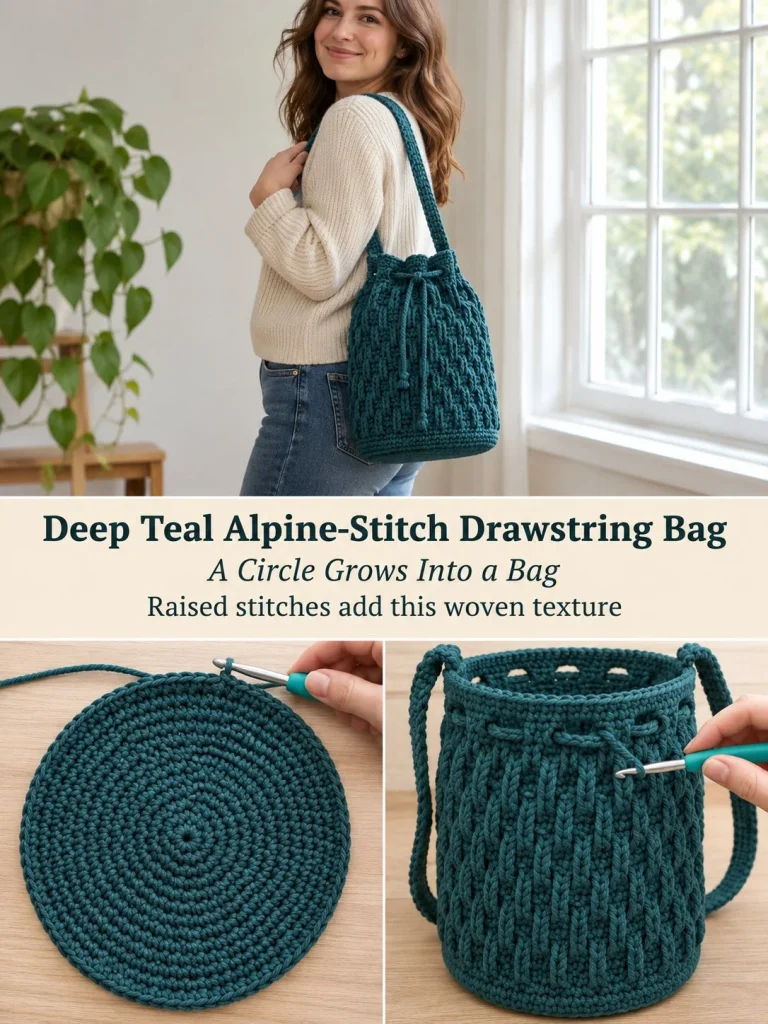
Crafting a drawstring bag with deep teal cotton yarn combines both utility and artistry, resulting in a stylish accessory with practical appeal. This project features a solid base and a textured cylindrical body created using alpine stitch techniques, offering a subtle yet attractive raised pattern. The drawstring closure adds functionality, allowing the bag’s opening to be cinched securely, while the narrow shoulder strap ensures comfortable wear without compromising the elegant streamlined design. The use of worsted weight cotton offers a durable, firm fabric that holds shape well, making it ideal for carrying everyday essentials.
The construction of the bag is continuous and seamless, starting from the flat circular base and working upward into the upright sidewalls, culminating in a structured top channel for the drawstring cord. This coherence in construction avoids unnecessary seams and creates a polished finish. The alpine stitch texture, achieved through alternating rounds of front-post double crochet and single crochet, lends depth and a tactile quality. Whether for casual outings or as a unique handmade gift, this bag embodies both craftsmanship and usability. If you enjoy exploring varied textured crochet techniques, you might also appreciate the soothing effect and technical interest of projects like the autumn drawstring bag that incorporates slip stitch colorwork.
Pattern at a Glance
Skill level: Intermediate due to textured stitch pattern and round shaping
Terminology: US crochet terms
Construction: Worked in continuous rounds from the base up through the body, ending with a top eyelet round for drawstring insertion
Finished size: Approximately 9 inches diameter base × 11 inches height
Yarn weight: Worsted weight (#4) cotton yarn
Hook: 5 mm (H-8) crochet hook
Main stitch: Alpine stitch featuring front-post double crochet (fpdc) and single crochet (sc)
Gauge: Swatch-dependent for firm fabric; base diameter of about 9 inches
Motifs: One integrated cylindrical body with a round base
Layout: Bottom-up circular construction with textural sidewall
Joining: Seamless continuous rounds
Border: Reinforced upper edging with functional eyelets for drawstring
Seaming: None required
Materials
- Yarn: Deep dusty-teal cotton, worsted weight (#4), approximately 520–650 yards. Cotton is chosen for its durability, firmness, and ability to hold textured stitches sharply, which is essential for the alpine stitch pattern.
- Hook: 5 mm crochet hook, providing a balanced tension that creates a firm but flexible fabric. Using the stated hook size helps maintain proper gauge and stitch definition.
- Notions: Stitch markers to mark rounds or pattern repeats, a tapestry needle for weaving in ends, and an optional fabric liner if a smoother or more protective interior is desired (not shown in the pattern).
- Hardware: No metal fittings are included, ensuring a fully crochet-fabricated bag with a soft aesthetic and purity of handmade style.
- Additional: Markers help keep track of round increases and stitch count consistency. A sturdy shoulder strap is crocheted separately and attached securely.
Yarn and Color Notes
The choice of cotton yarn at worsted weight is deliberate. Cotton fibers provide excellent stitch definition, making the alpine stitch’s intricate texture stand out crisply. Cotton also usually softens with use without losing structure, helping the bag maintain its shape.
Smooth spun cotton, as opposed to fuzzy or loosely plied yarns, works best for this texture since it avoids fuzz that can obscure stitch details. Deep teal is a sophisticated, versatile color that can elevate casual wear; it pairs well with neutrals or contrasting brights if used for accents or linings. Solid colors are ideal here because the alpine stitch texture is the main visual focus, and variegated yarns could detract from the stitch relief.
Finished Measurements
The completed bag measures approximately 9 inches in base diameter and about 11 inches tall. These dimensions refer to the cylindrical shape of the bag: the circular base forms the bottom, and the upright sidewall creates the height. The upper 1.5 inches is reserved for the drawstring channel and eyelet row.
Gauge is important since the base must lie flat and the cylinder maintain an even circumference for structural integrity and visual appeal. Adjusting stitch counts closely to the gauge swatch will ensure the bag measures to these specified dimensions and functions correctly.
Gauge
While no explicit stitch gauge (e.g., stitches per inch) is given, it is crucial to begin by swatching both single crochet (sc) and alpine post stitch with the suggested cotton worsted yarn and 5 mm hook. The gauge should be tight enough to produce a firm fabric with little stretch, enabling the base to lie flat and the bag body to stand upright without sagging.
Measuring the base flat diameter during work is the best way to check gauge: the base should reach and hold around 9 inches across before proceeding. If your swatch is wider (looser gauge), reduce hook size; if tighter, increase hook size or loosen tension. Correct gauge is also vital in the alpine stitch rounds to preserve circumference and avoid distortion.
Abbreviations
- ch = chain
- st = stitch
- sl st = slip stitch
- sc = single crochet
- hdc = half double crochet
- dc = double crochet
- BLO = back loop only
- fpdc = front-post double crochet
- rep = repeat
- rnd = round
- RS = right side
- WS = wrong side
Important Pattern Notes
- The bag is worked in a continuous spiral from the base upward to avoid seams.
- The base is formed by increasing in rounds from an adjustable ring, moving increases evenly to maintain a flat circle.
- A round worked in BLO or with a reverse ridge marks the transition from the base to the vertical walls.
- Alpine stitch texture is built by alternating rounds of single crochet with rounds featuring front-post double crochet around previously made posts in a staggered pattern, ensuring the stitch count remains constant and no extra stitches are added.
- The top channel for the drawstring features eyelets created by chaining 1 and skipping stitches regularly, reinforced by surrounding sc and dc stitches.
- The drawstring cord is crocheted separately as a long chain and threaded through the eyelets; it may be reinforced with slip stitches for strength.
- The narrow shoulder strap is crocheted in rows to a custom comfortable length and securely attached on opposite sides of the bag rim below the eyelets, ensuring the drawstring tightening operates independently.
Special Stitches and Techniques
- Adjustable Ring: Used to start the circular base with six sc in the center, preventing a hole in the middle.
- Continuous Spiral Rounds: Worked without joining, spiraling outward and upward for smooth fabrication without seams.
- Back Loop Only (BLO) Rounds: Used to create a ridge marking the floor-to-wall transition, lending a structural edge.
- Front-Post Double Crochet (fpdc): Crocheted around the post of a previous double crochet stitch to create a raised texture typical of alpine stitch patterns.
- Alpine Stitch: A combination of fpdc and regular stitches in alternating rounds creates a staggered, textured pattern resembling alpine cables or ridges.
- Eyelet Round: Created with chain 1 and skip 1 stitch repeats to form small, evenly spaced holes for threading the drawstring.
- Blocking: Used to shape and stabilize the bag upright after completion.
Understanding the Construction
This drawstring bag is built bottom-up as a single integrated piece, starting with a flat circular base worked in continuous rounds using single crochet. The base’s diameter, approximately 9 inches, is achieved by methodically increasing 6 stitches each round and distributing these increases evenly to avoid puckering.
Once the base is complete and flat, a back loop only round or a reverse ridge marks the spot where the bottom meets the side tube. Vertical walls are then crocheted upward in rounds without increasing, maintaining stitch count to form a stable cylinder.
The alpine stitch texture is introduced along the walls for visual interest and added durability, alternating single crochet rounds and rounds with front-post double crochets worked in a staggered pattern around posts of previous rounds’ double crochets. This stitch combination replaces regular stitches rather than adding new ones, preserving the circumference.
The cylindrical sidewall continues until it reaches roughly 11 inches total height. The top 1.5 inches is reserved for sturdy rounds and an eyelet round with small, evenly spaced gaps for the drawstring.
The drawstring cord is crocheted as a long chain in matching teal and optionally reinforced with slip stitches for durability. It is threaded through alternate eyelets at the mouth and secures the bag closure.
Separately, a narrow shoulder strap is crocheted in rows to any comfortable length and attached to opposite rim points below the eyelets, allowing the bag to be worn hands-free without interfering with the drawstring function.
Following completion, the bag is blocked or hand-shaped upright to ensure it maintains the correct shape and smooth circular base.
Complete Pattern Instructions
Foundation: Base
-
Begin by swatching tightly with cotton worsted weight yarn in single crochet (sc) and alpine post stitch to achieve a firm, non-stretchy fabric.
-
Choose a stitch count that will produce a flat circle approximately 9 inches in diameter.
-
Start the base with an adjustable ring, crocheting 6 single crochet stitches into the ring.
-
Work continuous spiral rounds of single crochet, increasing 6 stitches evenly per round to maintain a flat circle (e.g., 6, 12, 18, 24, 30,…).
-
Carefully move increase positions each round to avoid forming sharp corners; this ensures a smooth circular shape.
-
Continue increasing rounds until the base measures about 9 inches flat across and lies completely flat without cupping or ruffling.
Floor-to-Wall Transition
-
On the next round after reaching base diameter, work all stitches in the back loop only (BLO) or create a reverse side ridge. This forms a clean demarcation between the base and the body (the wall).
-
Follow with several rounds of single crochet without increases to build upward walls while maintaining even stitch count around the circumference.
Body: Alpine Stitch Texture
-
To begin the alpine stitch sidewall, work a preparatory round of double crochet evenly spaced across all stitches.
-
Alternate rounds of single crochet with rounds of staggered front-post double crochet (fpdc) worked around the posts of double crochets from previous textured rounds.
-
Maintain stitch count exactly by ensuring fpdc replaces regular stitches rather than adding extra.
-
Repeat the alpine stitch pattern as swatched, extending the textured wall until the bag body reaches approximately 11 inches in total height.
-
Reserve the upper roughly 1.5 inches of height for the top closure channel.
Upper Edge and Eyelets
-
Crochet two sturdy rounds of single crochet across the top, maintaining the stitch count.
-
Create an eyelet round by repeating a pattern of chain 1, skip 1 stitch, anchored into the rounds below with sc or dc as needed. These eyelets must be evenly spaced to facilitate the drawstring threading.
-
Follow the eyelet round with an additional sc round for reinforcement, ensuring the mouth remains structured and eyelets stable.
-
Count the actual holes created, ensuring no oversized gaps or inconsistency in spacing.
Drawstring Cord
-
Crochet a long, matching teal chain that is sturdy enough to pull through the eyelets.
-
Optionally reinforce the chain by working slip stitches over it for extra durability.
-
Thread the cord through alternate eyelets so that both ends come out near the front opening.
-
Test the drawstring by pulling to confirm the bag’s mouth narrows properly and secures closed.
Shoulder Strap
-
Crochet a narrow, sturdy shoulder strap in rows to a comfortable custom length based on personal preference.
-
Attach the strap securely with woven ends at opposite points on the bag rim, positioned well below the eyelet row so that tightening the drawstring does not impact strap attachment.
-
Intensely test the load-bearing capacity of the strap joins to ensure durability.
Finishing
-
Block or hand-shape the bag so it stands upright naturally. Check for the flat circular base and consistent tube circumference.
-
Confirm there is only one seamless base/body, one functioning drawstring, and one shoulder strap — no additional handles, linings, or metal fittings.
Checkpoints
- After base increases, the foundation should lie flat and measure about 9 inches across.
- The bag body must maintain stitch count without widening or puckering as alpine stitching progresses.
- Eyelet holes on the upper edge must be uniform and capable of accommodating the chain drawstring without stretching.
- The drawstring cord must freely pull through the eyelets and secure the mouth closed.
- Shoulder strap attachments must feel secure when loaded.
Assembly
This bag requires no seaming as it is made in one continuous piece. The only assembly involves securely attaching the shoulder strap ends on opposite sides beneath the eyelet round using a tapestry needle for weaving ends tightly inside the stitches. No additional lining or hardware is included, preserving the handmade crochet integrity.
Finishing and Blocking
To ensure a professional finish, blocking the bag upright helps define the cylindrical shape and smoothes the alpine stitch texture. Hand-shaping the base flat assists in maintaining the planar bottom necessary for balance and usability.
All yarn ends should be carefully woven in on the inside or underside of the bag. The drawstring and strap ends likewise should be neatly secured.
How to Resize
Resizing this bag mainly depends on altering the number of stitches in the initial adjustable ring and subsequent increases during base construction. Since the base is constructed by increasing 6 stitches evenly each round, adding or subtracting rounds will control diameter.
For a wider base, continue increasing rounds beyond the 9 inches diameter; for a smaller base, stop earlier. Remember to maintain the alpine stitch repeat and stitch counts around the circumference when working sidewall rounds for consistent pattern texture.
Height adjustment is achieved by adding or reducing the number of alpine stitch rounds. Retain approximately 1.5 inches at the top for the drawstring channel irrespective of bag height.
Always swatch and measure throughout to maintain gauge and proportions.
Useful Variations
- Color changes: Alternate deep teal with lighter or contrasting colors in alpine stitch rounds to highlight texture.
- Lining: Add a fabric or crochet lining for added structure or to protect contents.
- Handle variations: Instead of a shoulder strap, attach short handles if desired, though this changes function and appearance.
- Size adjustments: Make a smaller or larger tote version by modifying the base diameter and height according to the resizing notes.
This bag’s alpine stitch sidewall pattern and drawstring closure could be adapted to related accessories like laptop sleeves, pouches, or even pillows for a cozy, textured touch. For inspiration on textured home accents, explore the deep teal envelope crochet pillow cover which features similarly attractive stitch work.
Troubleshooting
Why Is My Base Not Lying Flat?
Make sure increases are evenly spaced and not clustered in one area. Uneven increases cause puckering or ruffling. If your base cups up, try a slightly larger hook for looser tension next time. If it ruffles, go down a hook size or tighten tension.
Why Does the Bag Flare Out or Become Too Wide?
This indicates unintended stitch increases or stretching. Confirm that fpdc rounds replace normal stitches (do not add). Maintain stitch counts identically on all rounds above the base.
Why Are Eyelets Too Large or Uneven?
Double-check the pattern for the eyelet round, ensuring the chain skips exactly one stitch each time and is balanced with sc/dc anchors. Reinforce immediately with an additional sc round.
Why Is My Drawstring Hard to Pull?
If the cord is too thick or stiff, try a simpler, thinner chain or omit slip stitch reinforcement. Alternately, smooth the cord surface before threading.
How Do I Secure the Shoulder Strap?
Make sure the ends are tightly woven into the fabric several stitches deep. Test pull strength before finishing. Attach well below eyelet row to keep closure independent.
Frequently Asked Questions
Can I use a different yarn fiber?
Yes, but cotton worsted weight is recommended for firmness and stitch clarity. Acrylic or blends may increase stretch or soften the texture.
Can I substitute a different hook size?
Only if necessary to maintain gauge and correct bag size. Changing hook drastically affects base diameter and texture.
How long should the shoulder strap be?
Customize based on your comfort—measure a favorite bag strap and crochet accordingly. Remember to attach securely.
Is this bag suitable for beginners?
Intermediate level recommended due to alpine stitch and round shaping nuances.
Can I add a fabric liner?
Yes, an optional liner can be sewn inside for improved durability or water resistance, though it’s not included in the pattern instructions.
How should I block the bag?
Shape the bag upright, gently flatten the base, and use pins or a form. Light steaming or damp shaping helps set the stitch pattern firmly.
Final Thoughts
This project is a thoughtfully constructed drawstring bag made by crocheting continuously from a flat base into a textured cylindrical body featuring alpine stitch. The process involves careful incremental increases for a flat base, maintaining stitch counts while introducing front-post double crochet texture, and finishing with a functional eyelet drawstring channel and sturdy shoulder strap. The elegant deep teal color and firm cotton yarn create a durable, fashionable accessory that balances form and function neatly.
By understanding the stitch and construction principles, this bag can be swatched accurately, resized comfortably, and customized with ease, resulting in a beautiful piece perfect for personal use or gift-giving.



