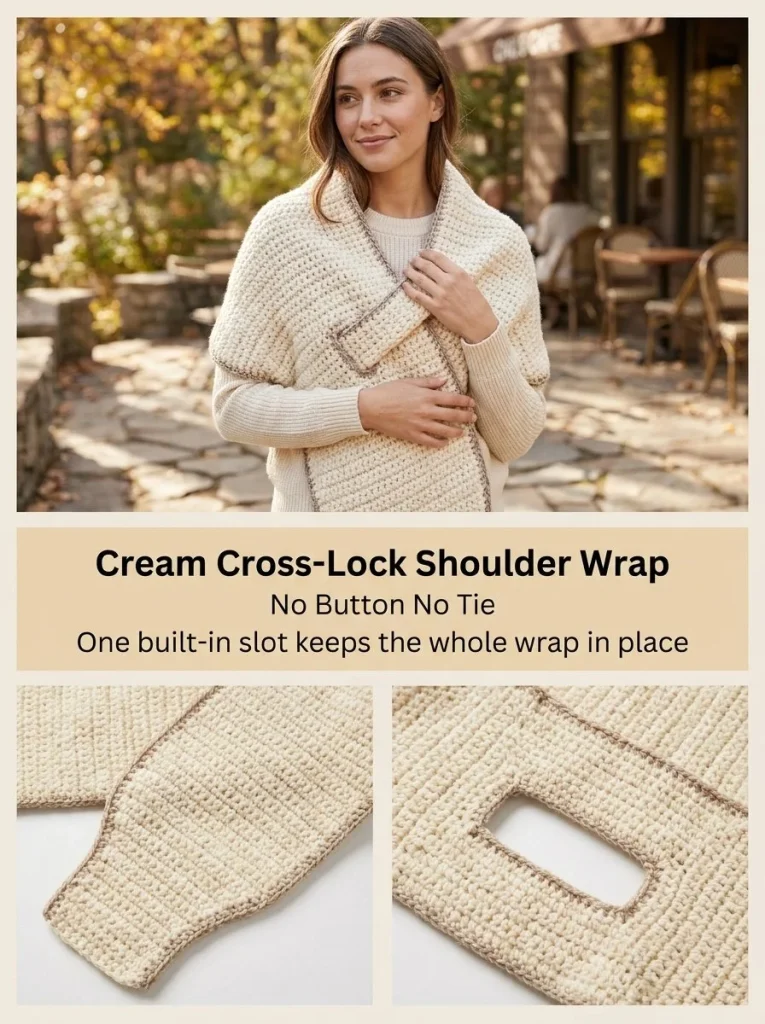
This elegant shoulder wrap is a cozy accessory designed with a modern twist: an integrated slot that secures the tapered end through the wide shoulder section, providing both style and function. Crafted with bulky yarn and built primarily in half double crochet, this wrap balances simplicity and sophistication with its clean lines and subtle texture.
The construction is primarily worked in rows, starting from a narrow foundation that quickly expands before stabilizing in width. The innovative slot, formed by temporarily dividing the stitch count into two separate panels, creates a unique feature that allows the wrap to be worn securely without pins or buttons. Adding a soft, relaxed single crochet edging in a complementary oatmeal or cocoa hue rounds out the design with a gentle contrast and polished finish.
Working with bulky yarn and an 8 mm hook, this project is accessible to adventurous beginners familiar with half double crochet and interested in exploring shaping techniques beyond simple rectangles. The wrap’s thoughtful construction and functional design make it a versatile layering piece suitable for cooler weather and stylish comfort, similar in spirit to other wrap designs like the burgundy buttoned crochet shoulder wrap, which also embraces unique closures for secure wear.
Pattern at a Glance
Skill level: Intermediate — requires understanding of increases, decreases, working partial rows, and rejoining sections
Terminology: US crochet terms
Construction: Worked flat in rows with increasing stitch counts, an integrated slot formed by working two separate sections, followed by taper shaping
Finished size: Approximately 16 inches wide at full width, tapering narrower at one end; slot measures about 4.5–5 inches wide by 4 inches tall
Yarn weight: Bulky (#5) yarn
Hook: 8 mm (approximately US L/11)
Main stitch: Half double crochet (hdc)
Gauge: Approximately 10 hdc stitches x 8 rows = 4 inches
Motifs: None (fabric is created as a solid piece)
Layout: Single rectangular panel with integrated slot
Joining: No assembly beyond working stitch sections separately and joining back at slot
Border: Single relaxed round of single crochet in contrasting color around the entire wrap and slot opening
Seaming: None required
Materials
- Approximately 850 to 950 yards of bulky weight (#5) yarn in a warm cream color for the main body of the wrap
- Approximately 80 yards of bulky weight yarn in oatmeal or cocoa for the edging to provide a softly contrasting finish
- 8 mm crochet hook suitable for bulky yarn to achieve the correct gauge and fabric drape
- Tapestry needle for weaving in ends and finishing edges
Each material plays a key role: the bulky yarn creates a warm, squishy texture with good stitch definition in half double crochet, while the contrasting edging color highlights the wrap’s clean lines and slot opening. The large hook size works well to maintain fabric flexibility and avoid over-density that bulky yarn sometimes produces.
Yarn and Color Notes
Choosing the right bulky yarn is vital for both comfort and appearance. A wool or wool-blend bulky yarn with a soft, slightly lofty texture complements the wrap’s casual luxury. Smooth-yarn fibers accentuate the half double crochet stitches, while a more textured or boucle yarn can add visual interest but may obscure stitch definition.
The warm cream tone used here presents a versatile neutral that pairs beautifully with many outfits. For edging, the oatmeal or cocoa shades add subtle color contrast without overpowering the main body. Solid colors are recommended to maintain the wrap’s minimalist elegance; variegated or heavily textured yarns might compete visually with the stitch pattern and integrated slot feature.
Finished Measurements
- Width at widest point (after increases): approximately 16 inches (40 stitches at gauge)
- Slot dimensions: roughly 4.5 to 5 inches wide and 4 inches tall
- Width at tapered end: approximately 5.5 inches (18 stitches at gauge)
- Length from foundation chain to end of taper: approximately 120 rows, length depending on yarn and tension
The measurements depend on maintaining a gauge of about 10 stitches and 8 rows per 4 inches in half double crochet. Since this project is worn draped and secured through the slot, the overall dimensions create enough fabric to comfortably sit over the shoulders while allowing a flexible, tapered end for threading.
Gauge
Approximately 10 half double crochet stitches x 8 rows = 4 inches (10 cm)
Maintaining this gauge is critical for the wrap’s intended fit and construction of the integrated slot. To measure your gauge accurately:
- Use the specified bulky yarn and 8 mm hook or adjust your hook size to match gauge.
- Crochet a sample swatch in half double crochet at least 4 inches square.
- Measure the number of stitches across 4 inches and the number of rows across 4 inches.
- Adjust hook size if needed to approach the target gauge.
If your gauge is too tight (more stitches or rows per 4 inches), the wrap might end up smaller with a narrower slot; if too loose, it may be larger and possibly less stable in fit. Since this is a wearable accessory, exact gauge ensures the functional parts—especially the slot—work correctly.
Abbreviations
- ch = chain
- hdc = half double crochet
- sc = single crochet
- hdc2tog = half double crochet two stitches together (decrease)
- st(s) = stitch(es)
- row(s) = row(s)
Important Pattern Notes
- The turning chain of 2 at the start of each row counts as the first half double crochet unless otherwise specified.
- The work is done in rows, always turning at the end of each row.
- Stitches are added evenly to both edges during the increase phase, making a gradual width increase.
- The integrated slot is formed by splitting the row into two sections separated by unworked stitches and then rejoining with a chain bridge, creating an opening in the fabric.
- Tapering at the end uses decreases at the edges to narrow the fabric symmetrically.
- The relaxed edging is worked in single crochet around all edges including the slot opening for a smooth finish.
Special Stitches and Techniques
This project uses standard stitches and decreases common in many crochet patterns.
- Half double crochet (hdc): Yarn over, insert hook into stitch, yarn over, pull up a loop (3 loops on hook), yarn over, draw through all loops.
- Half double crochet two together (hdc2tog): Insert hook into next stitch, yarn over, pull up a loop (2 loops on hook). Insert hook into following stitch, yarn over, pull up a loop (3 loops on hook), yarn over, pull through all 3 loops, completing one decrease stitch.
- Chain (ch): Yarn over, pull through loop on hook.
- Relaxed single crochet edging: Single crochet worked loosely around edges, paying attention to keeping fabric flat and smooth, especially around corners and the slot opening.
No advanced specialty stitches are required; this makes the pattern approachable after mastering basic half double crochet and decreases.
Understanding the Construction
The wrap is worked as a single long rectangle with the following phases:
-
Foundation and Increasing: Begin with a short foundation chain of 20 stitches, placing half double crochets across to establish an initial row of 18 stitches. Each subsequent row increases the stitch count by 2 (one increase at each edge) until it reaches 40 stitches at Row 12 (~16 inches wide).
-
Straight Body: From Rows 13 to 32, maintain the 40 stitches, building length without changing width.
-
Integrated Slot Formation: Rows 33 to 40 are worked as two separate fabric sections, divided by a center section of 12 unworked stitches left free to create a gap (the slot). The two side sections of 14 stitches each are worked independently for 8 rows, then joined again in Row 41 with a loose chain bridge of 12 stitches creating the slot opening.
-
Main Body Continuation: Rows 42 through 109 continue working across all 40 stitches, knitting the fabric back into a full panel.
-
Tapered End: Towards the end, Rows 110 to 120 reduce the width symmetrically by two stitches per row via decreases at each edge (hdc2tog at first 2 and last 2 stitches), ending with 18 stitches at row 120. This narrowing tapers the wrap’s end for threading through the slot.
-
Edging: Finally, a relaxed single crochet border is worked using the contrasting oatmeal or cocoa yarn around all edges and the slot opening to soften and stabilize the shape.
The construction logic creates a seamless solution for draping the wrap and ensuring it stays in place without hardware — the tapered end, threaded through the wide shoulder area’s slot, forms a secure, elegant closure.
Complete Pattern Instructions
Foundation
Chain 20.
Half double crochet in the 3rd chain from hook and in each chain across. This creates a total of 18 half double crochet stitches.
Rows 2 to 12 (Increasing Phase)
- Chain 2 (counts as first hdc), turn your work.
- Work 2 half double crochet stitches in the first stitch of the row (increase at edge).
- Half double crochet across the row in each stitch.
- Work 2 half double crochet stitches in the last stitch (increase at edge).
Each of these rows increases stitch count by 2 stitches total, evenly adding one at each edge.
By the end of Row 12, you will have 40 half double crochet stitches and your piece should measure approximately 16 inches wide at gauge.
Rows 13 to 32 (Straight Body)
- Chain 2, turn.
- Work half double crochet across all 40 stitches.
Maintain this stitch count without increasing or decreasing the width for 20 rows.
Integrated Slot Formation (Rows 33 to 40)
This section forms the slot by splitting the row into two working sections, leaving a center gap:
-
For Rows 33 to 40, work these rows as two separate sections:
Section A: Work the first 14 stitches only for 8 rows; fasten off the yarn at the end of Row 40.
Section B: Join yarn at the final 14 stitches, leaving the center 12 stitches unworked. Work these 14 stitches for 8 rows.
The 12 central stitches remain unworked during this section to create the slot opening.
Row 41 (Joining Row)
- Chain 2, turn.
- Work half double crochet across the first 14-stitch section worked in Section A.
- Chain 12 loosely across the open slot space (these chains replace the 12 unworked stitches).
- Work half double crochet across the second 14-stitch section worked in Section B.
There are now 40 stitch positions again, accounting for the slot gap created by the chained 12-stitch bridge.
Rows 42 to 109 (Main Body Continuation)
- Chain 2, turn.
- Work half double crochet across all 40 stitches.
Continue without changing stitch counts for 68 rows, building length.
Rows 110 to 120 (Tapered End)
This section narrows the wrap on both edges:
- Chain 2, turn.
- Work half double crochet two together (hdc2tog) over the first 2 stitches of the row (a decrease).
- Half double crochet across the remaining stitches.
- Work half double crochet two together over the last 2 stitches of the row (another decrease).
Each row decreases stitch count by 2.
By Row 120, the piece will have narrowed to 18 stitches wide.
Slot Size
The integrated slot should measure roughly 4.5 to 5 inches wide and 4 inches tall, providing an ample opening for threading the tapered end.
Edging
- Join the oatmeal or cocoa yarn at any point along the edge.
- Work a relaxed round of single crochet stitches evenly around the entire wrap edge and specifically around the slot opening to create a soft, stable border.
Be sure to keep the edging relaxed to prevent puckering or pulling.
Wearing Instructions
To wear the wrap:
- Lay the wide center of the wrap across your shoulders.
- Pass the tapered end (narrow end) through the integrated slot — this secures the wrap comfortably in place without pins or closures.
For a graceful, functional accessory, the integrated slot creates a neat locking mechanism unique to this design.
Checkpoints During Work
- After Row 12, confirm stitch count is 40 stitches and width about 16 inches.
- During Rows 33 to 40, verify that you maintain two separate sections of 14 stitches each while leaving center 12 stitches unworked.
- After Row 41, check the slot opening created by chaining 12 stitches across the gap. There should not be tension pulling the slot closed.
- By the end of Row 120, the stitch count should reduce to 18 stitches for the tapered end.
- Slot opening dimensions should be approximately 4.5–5 inches wide and 4 inches tall.
Assembly and Joining
No physical seaming or joining beyond the integrated slot construction is required. The piece is worked in one continuous fabric with temporary separation for the slot.
The only finishing assembly is the border worked in contrasting yarn.
Border and Finishing
The border is critical to the wrap’s final polished look. Using a contrasting bulky yarn:
- Work single crochet stitches evenly around all edges, including the slot.
- When working around corners, place 3 single crochet stitches in one stitch to maintain a flat border and avoid curling.
- Around the slot, work stitches carefully to maintain the opening’s relaxed structure without tightening.
- Weave in all ends neatly with the tapestry needle.
Blocking is optional but can help even out edges and improve drape if your yarn permits it.
How to Resize This Wrap
Resizing the wrap involves adjustments to the number of stitches at the foundation and the length worked. Important considerations:
- The foundation chain of 20 stitches corresponds to an 18-stitch foundation row after starting half double crochet in the 3rd chain. To widen the wrap, increase the foundation chain in multiples of 2 stitches to maintain even increases up to the desired width.
- The integrated slot consists of two 14-stitch side sections and a 12-stitch unworked center. Adjusting the slot size proportionally is possible by adding or reducing stitches while keeping the relative sizes balanced.
- Length can be modified by adding or subtracting rows in both the straight body section and the tapered end, keeping the decrease rate unchanged for tapering.
- Maintain gauge by adjusting hook size or yarn weight to keep the wrap’s proportions consistent.
Precise stitch counts need careful recalculation based on gauge and slot proportion.
Useful Variations
- Single-Color Wrap: Use only one bulky yarn color throughout, including edging, for a minimalist effect.
- Two-Color Wrap with Color Blocking: Work the main body in cream and use a sharper contrasting color for edging, such as deep brown or rust.
- Longer Length: Extend the number of rows in the straight body section for a longer wrap that provides more coverage.
- Shorter Taper: Decrease fewer rows at the end for a less tapered edge and larger open end.
- Different Yarn Texture: Try a boucle or wool blend yarn for a soft, nubbly texture similar to this cream boucle wrap.
These variations can be used without disrupting the core structural integrity of the design.
Troubleshooting
Why Does My Stitch Count Not Match After Row 12?
Check that you are correctly increasing two stitches per row—one at each edge using 2 hdc in the first and last stitch of each row. Missing increases will prevent reaching 40 stitches.
Why Is My Integrated Slot Too Tight or Too Loose?
Ensure you leave exactly 12 unworked stitches between the two side sections during Rows 33 to 40. Chain 12 loosely across this gap in Row 41; tension that is too tight or too slack will affect slot size.
Why Is My Tapered End Not Shaping Correctly?
Confirm you are performing hdc2tog decreases correctly at the first two stitches and last two stitches of each taper row from Rows 110 to 120.
Why Is the Border Pulling or Rippled?
Work the border single crochet stitch loosely, especially at corners and slot edges. Add extra stitches (e.g., 3 sc in one stitch) in corners to keep the border flat.
Frequently Asked Questions
Can I use a different yarn weight?
Using yarn lighter than bulky will drastically change the size and drape, requiring recalculation of stitch and row counts. Heavier yarn may make the wrap too stiff. Bulky weight is recommended for best results.
Can I substitute the 8 mm hook for a different size?
To maintain gauge, adjust hook size accordingly. Larger hooks produce looser fabric; smaller make denser fabric. Swatch before starting to match gauge.
Is this pattern suitable for beginners?
Intermediate beginner crocheters comfortable with half double crochet, increases, decreases, and working partial rows should find this pattern manageable with patience.
How should I block this wrap?
Blocking can improve drape and even edges, especially after finishing. Use a wet block or steam carefully according to your yarn fiber content. Avoid over-stretching the slot.
Can I make the wrap longer or narrower?
Yes, see the resizing section. Length is adjustable by adding rows; width by changing foundation chain and increases but maintain the slot proportions.
How do I wear the wrap securely?
Place the wide section across your shoulders and pass the tapered end through the integrated slot to lock it in place without pins or closures.
Optional Related Uses
The construction technique of creating an integrated slot through working split sections with a chain bridge can be adapted for related projects such as:
- Fingerless gloves or arm warmers with integrated thumb holes
- Other wrap-style garments like ponchos with fastening slots
- Fashion scarves with built-in loops for styling
The half double crochet fabric is versatile for many cozy accessories.
Final Thoughts
This shoulder wrap balances minimalism with functional design through a clever integrated slot and tapered styling. Working primarily in half double crochet with gradual width increases, a fabric split for the slot, and final taper decreases results in a sophisticated and practical accessory. Adding a softly contrasting single crochet border completes the piece with refinement.
The design enables a stylish way to wear a wrap securely without extra hardware, embodying elegant simplicity and cozy comfort. Whether chosen for warmth or layering, this wrap offers a modern solution for everyday crochet wearables.



