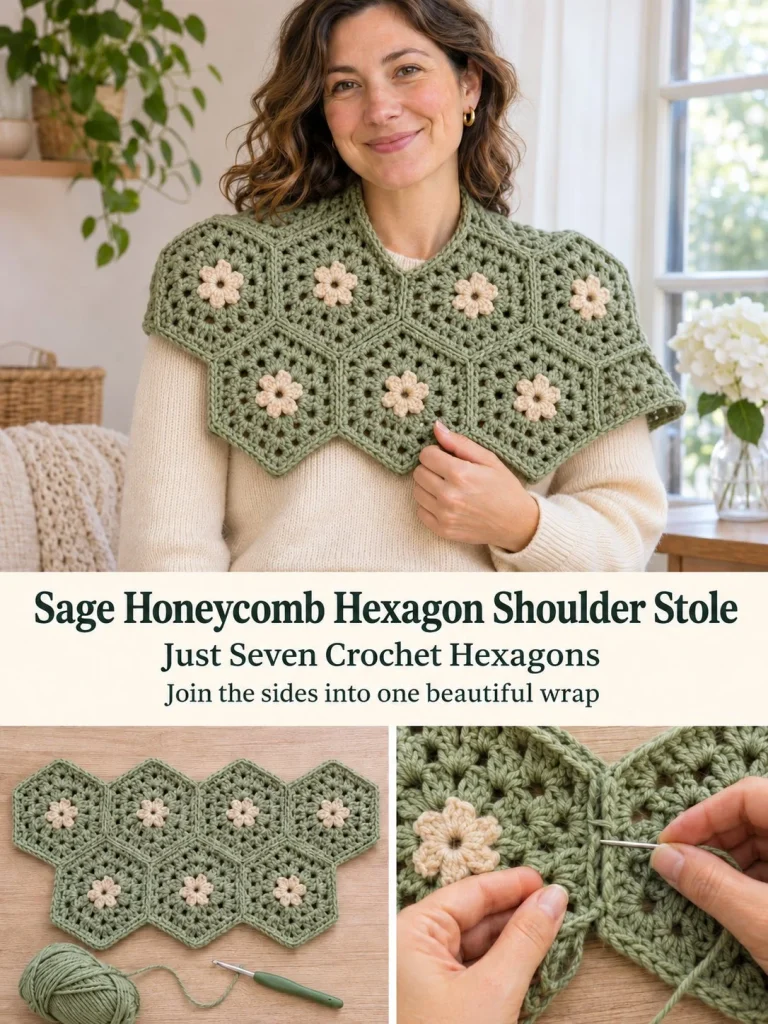
This beautifully crafted shoulder stole features a sophisticated honeycomb layout made by joining seven regular hexagon motifs. Designed to drape elegantly across the shoulders with two open front ends, this piece pairs muted sage and oatmeal tones for a subtle yet textural impact. The focal point of each hexagon is a delicate oatmeal six-petal flower nestled in the center, around which sage granny stitch rounds expand to create a consistent hexagonal shape typical of a honeycomb. This open-ended stole offers lightweight coverage, ideal for layering over a variety of outfits for casual or formal occasions.
The construction primarily uses classic crochet techniques centered on granny stitch motifs. Each hexagon is worked independently before being joined at the edges to form the overall stole layout. The stole’s layout arranges four hexagons in the upper row and three below in a staggered honeycomb pattern, with all motifs aligned so that their side edges touch perfectly. This topical hexagonal joining pattern not only contributes to the elegant geometry of the stole but also allows for a comfortable drape without restricting movement or creating bulky seams.
Creating this stole involves standard worsted weight yarn and a medium 5.5 mm crochet hook, striking a balance between drape and stitch definition. Understanding the construction and how individual motifs combine into the finished stole will help you achieve a polished effect.
In fact, if you appreciate the interplay of texture and subtle color variation, you might also enjoy exploring the detailed construction methods featured in the sage-inspired shoulder cowl design, which emphasizes similar motif joining techniques.
Pattern at a Glance
Skill level: Intermediate
Terminology: US crochet terms
Construction: Seven hexagonal granny motifs joined side-to-side, edged with single crochet
Finished size: Approximately 38–44 inches long × 14–18 inches deep
Yarn weight: Worsted weight (#4)
Hook size: 5.5 mm (I-9) crochet hook
Main stitch: Granny stitch (groups of 3 double crochets separated by chains)
Gauge: Determined by making and blocking test hexagon motif (approx. 8–9 inches point-to-point)
Motifs: Seven hexagons—one small oatmeal flower center and six outer sage granny rounds
Layout: Four motifs arranged in the upper row with three offset motifs below, forming a honeycomb pattern
Joining: Whipstitch or slip stitch along full touching edges only
Border: Single round of sage single crochet edging around assembled outer perimeter
Seaming: Hand-sewn seams join motifs; no circular joining of ends
Materials
To complete this project, gather the following materials:
- Yarn: Worsted weight (#4) yarn in two colors:
- Muted sage: 450–650 yards (main color for hexagons and border)
- Oatmeal: 60–100 yards (used only for the center flower of each hexagon)
- Hook: 5.5 mm (I-9) crochet hook to achieve the ideal gauge and fabric density
- Notions: Yarn needle for weaving in ends and joining motifs, stitch markers to mark rounds or corners and assist with even joining edges
- Blocking tools: Blocking mats and pins to shape hexagons and ensure uniform size and flatness
- Measuring tape or ruler: To check motif dimensions during blocking and assembly
Each material serves a specific purpose: the muted sage forms the majority of the hexagonal motifs and the finishing edge to provide cohesive visual flow. The oatmeal color highlights the small central flower of each hexagon, drawing the eye with subtle contrast. The hook size balances stitch definition with fluid drape.
Yarn and Color Notes
Selecting the right yarn is essential for both the appearance and functionality of this stole. A worsted weight yarn in a soft muted sage shade creates a calm, earthy palette that complements many skin tones and outfits. Its medium thickness allows for the detailed granny stitch texture to be clear and defined, while maintaining enough body to drape nicely without excessive weight.
The oatmeal color used exclusively in the tiny six-petal flower center provides an elegant focal point. Because it interrupts the sage granny rounds, the oatmeal highlights the design’s layered texture and intricate motif structure without overwhelming it.
While a smooth, plied yarn enhances stitch clarity, a softly textured yarn with gentle halo can add depth to the petals and granny rounds. Avoid too fuzzy or very shiny yarns as they could obscure stitch detail or pull focus from the design’s delicate structure.
If you prefer a slightly varied look, tonal yarns in sage or oatmeal including subtle heathering or speckles might complement the honeycomb hexagon pattern nicely without compromising stitch definition.
Finished Measurements
The finished stole measures approximately 38 to 44 inches (96.5 to 112 cm) in length and 14 to 18 inches (35.5 to 46 cm) in depth across the back when laid flat. These measurements reflect the open-ended configuration that allows the stole to drape naturally over the shoulders with two front ends open for styling versatility.
The seven hexagonal motifs each measure about 8 to 9 inches (20 to 23 cm) from point to point once blocked and joined. The arrangement consists of four hexagons in the upper row positioned edge-to-edge, with a lower row of three hexagons offset centrally beneath the upper row to create the honeycomb effect.
Note that exact finished sizing depends on your gauge and blocking technique; it’s important to crochet and block a test motif first. This ensures hexagons are uniform in size and the stole fits comfortably as designed.
Gauge
While the pattern does not provide an explicit gauge number, it emphasizes the critical importance of a gauge test by crocheting and blocking a single hexagonal motif first. The key is achieving six equal side lengths and corners that form a regular hexagon after blocking, measuring approximately 8 to 9 inches point to point.
Gauge matters for:
- Ensuring all seven hexagons match in size
- Maintaining the designed proportions of the stole (length and depth)
- Smooth joining of motifs without puckering or gaps
- Producing the expected drape and fabric behavior
If your motif measures too small, your finished stole will be narrower and shorter, and motifs may stretch unnaturally when joined. If too large, the stole could become wider than intended, and yarn amounts may be insufficient.
Crochet a swatch using the specified yarn and 5.5 mm hook, wash and block it to simulate final fabric behavior, and measure carefully. Adjust hook size if your gauge deviates noticeably.
Abbreviations
This pattern uses standard US crochet terms. The following abbreviations appear throughout:
- ch = chain
- st/sts = stitch(es)
- sl st = slip stitch
- sc = single crochet
- hdc = half double crochet
- dc = double crochet
- sp = space
- sk = skip
- BLO = back loop only
- RS/WS = right side/wrong side
- rep = repeat
Familiarity with these terms will help you follow the instructions smoothly.
Important Pattern Notes
- Start by making a test hexagon to confirm gauge and size before proceeding with the full project.
- The hexagon motifs consist of a center flower in oatmeal and expanded sage granny rounds creating the hex shape.
- The granny rounds always maintain exactly six corner ch-2 spaces; do not add extra corners or change their spacing.
- The motifs are joined together edge to edge, only along full matching sides without overlapping or turning any motifs into altered shapes.
- Joining uses whipstitch or slip stitch along the loops of edges with right sides facing as preferred; avoid joining motifs at corners or tips that do not touch fully.
- Finish with a neat sage-colored single crochet border around the irregular outside edges, placing extra stitches at corners to keep the border flat and prevent curling.
- Blocking is essential for final shaping of hexagons and overall stole flatness.
- The stole is designed as an open-ended wrap, with no closed loop or head opening, which allows free movement and styling.
Special Stitches and Techniques
- Adjustable ring: Used to start the oatmeal six-petal flower center to create a neat, closed starting circle.
- Granny groups: Classic granny stitch clusters consist of groups of three double crochet stitches worked into designated chain spaces.
- Chain-2 corner spaces: Maintain hexagonal shape by creating chain-two spaces at corners to allow turning and expansion evenly around the motif.
- Back loop only (BLO): While not detailed in this pattern, understanding BLO can be useful for borders or adjustments.
- Slipping or whipstitch joining: Hand sewn crochet seam / slip stitch joining techniques to connect motifs neatly without distorting their shape.
No additional complex techniques are required, making this an excellent project for intermediate crocheters comfortable with motifs and seaming.
Understanding the Construction
The stole is composed of seven identical hexagon motifs, each approximately 8–9 inches across, arranged in two offset rows resembling a natural honeycomb:
- Upper row: Four hexagons are joined side by side, edges flush.
- Lower row: Three hexagons are placed below the upper row, centered so that each lower hexagon nestles under the junctions between the upper hexagons.
This arrangement creates a flexible, visually appealing pattern with natural tessellation. Because of the odd number of motifs and the offset layout, the stole forms an irregular outer edge that is delicately framed by a single crochet border.
The motifs begin with the oatmeal-colored six-petal flower centerpiece, followed by expansion rounds worked in muted sage. Once all motifs are completed and blocked, they are joined only along full shared edges, never at points or tips, to preserve the shape and allow the stole to drape comfortably.
The joining is done with right sides facing, using either whipstitch or slip stitch to sew corresponding edge loops from corner to corner, ensuring secure yet flexible seams.
Finally, a single round of sage single crochet works around the outer perimeter to unify the piece, adding structure to the edges while preventing curling or rolling.
Full Pattern Instructions
Step 1: Make a Test Hexagon
Begin by crocheting one full hexagon to check your gauge and stitch consistency.
- Start with the oatmeal yarn. Create an adjustable ring.
- Work 12 single crochet (sc) evenly spaced into the ring. Close the ring and join.
- Work the six-petal center flower by making six small petals, each made by anchoring a short chain-3 and double crochet (dc) petal sequence over two base stitches. These petals are worked directly into the appropriate base loops around the center ring.
- End the oatmeal section after completing all six petals.
This small oatmeal flower forms the center of the motif.
Step 2: Crochet the Sage Granny Hexagon
Switch to the muted sage yarn to begin the granny stitch rounds around the oatmeal flower.
- Join sage yarn in the six equally spaced gaps between oatmeal petals.
- Work the first structural round: around each of the six gap positions, work a group of three double crochets (3-dc granny group). Separate each group with a chain-2 corner space. This step creates the hexagon base with six clearly defined corners aligned to the petal separations.
- In subsequent rounds:
- Into every corner chain-2 space, work (3 dc, ch 2, 3 dc) to maintain corner shape and allow growth.
- Into every straight side chain-1 space, work 3 dc with a chain-1 space between adjacent groups to keep the edges straight and flat.
- Repeat these expansion rounds, always maintaining exactly six corner ch-2 spaces; do not add extra corner spaces or modify the count.
- Continue adding rounds until the hexagon measures approximately 8–9 inches from point to point.
- Finish the motif with one slim round of single crochet (sc) in sage, keeping stitch counts consistent along each edge to maintain shape.
Step 3: Make Seven Matching Hexagons
Complete exactly seven hexagons, all worked with the same number of sage granny rounds and blocked to the same size, ensuring uniformity.
Step 4: Lay Out and Join Motifs
Arrange the motifs as follows:
- Place four hexagons in a straight upper row, edges flush and touching.
- Offset three hexagons in a lower row, centered beneath the junctions of the top row, to create the honeycomb pattern.
- Orient every motif so corresponding edges are aligned; do not overlap or rotate motifs. Avoid turning any into pentagons or altering shape.
- Join only full touching edges by whipstitch or slip stitch with the right sides facing as desired. Start at one corner and sew along adjacent loops to the next corner to join one entire edge at a time.
- Do not sew the ends of the stole into a closed loop, and do not join distant tips or corners that are not fully touching.
Step 5: Finish with Border and Blocking
- Work a neat single round of sage single crochet evenly all around the irregular outside perimeter of the joined motifs.
- Place extra single crochets at outer corner points as needed to prevent curling or ruffling of the border.
- Weave in all ends carefully.
- Lightly block the assembled stole flat on a blocking surface to smooth seams and unify the appearance.
This final step shapes the stole and stabilizes the fabric for elegant draping.
Checkpoints During the Project
- After the test hexagon: Ensure the hexagon forms a perfect regular shape with six equal sides once blocked. Adjust hook size if needed.
- After completing each hexagon: Measure the motif flat to confirm it falls within the 8–9 inch point-to-point range.
- When laying out motifs: Check that edges align perfectly with no gaps or overlaps before joining.
- After joining: The assembled stole should measure approximately 38–44 inches long and 14–18 inches wide.
- After edging: Confirm the border lies flat and smooth, with no curling around corners.
Assembly and Joining Tips
Joining motifs in this honeycomb shoulder stole must be done carefully to preserve shape and ensure comfort:
- Always join with the right sides (RS) facing each other so the seams lie flat and neat on the inside or outside as preferred.
- Use a yarn needle and matching sage yarn to whipstitch corresponding loops along a full edge, going from one corner to the next, securing motifs firmly without puckering. Alternatively, a slip stitch join can be done with the hook, but hand stitching allows finer control over seam tension.
- Do not attempt partial edge joins; join every full side that contacts another motif to maintain structural integrity.
- Avoid joining distant corners or partial overlaps that could deform the hexagons or make the stole uncomfortable.
Finishing inside seams neatly and making sure all join seams stretch comfortably will ensure both durability and ease of wear.
Border and Finishing Details
The single crochet border performs several key functions:
- It visually unifies all the joined hexagons around their irregular assembled perimeter.
- By placing extra single crochets at the sharp outer corners, the border avoids curling and rolling, keeping a flat edge.
- The border also reinforces the edges, preventing distortion or stretching over time.
To keep the border neat:
- Maintain even tension; do not pull too tight or leave it loose.
- Work the edging in rounds without turning to create a smooth finish.
- Weave in yarn ends as you go to avoid extra bulk or snagging later.
Light blocking after edging will enhance the final drape and fabric hand.
How to Resize the Stole
To adjust the size of the stole, consider the motif-based construction:
- Add or remove motifs:
- Adding a motif to each row increases width/depth by about 8–9 inches per motif along that dimension.
- For a longer stole, increase the number of rows of hexagons before joining.
- Adjust number of granny rounds in hexagons:
- Adding extra granny rounds will enlarge each hexagon, requiring recalculations in motif layout to maintain hex shape and alignment.
- Maintain consistent motif size: To ensure smooth joining, keep all hexagons the same size and round count.
- Gauge consistency: Larger hexagons require more yarn and longer blocking times for uniformity.
Because the stole is built from discrete motifs, resizing is modular and flexible while preserving overall style and construction logic.
Useful Variations
- Single color version: Crochet the entire stole in muted sage or oatmeal for a tonal look without the two-color center flower contrast.
- Different color scheming: Substitute the oatmeal center flower with a contrasting bright or metallic yarn for a bold focal point.
- Larger stole: Increase motif count, for example 5 motifs in the upper row and 4 in the lower row, for extended coverage.
- Scarf length: Create a longer scarf-like stole by adding more rows of hexagons without changing motif construction.
- Scrap yarn version: Use various worsted weight yarn scraps for a patchwork hexagon effect, keeping the oatmeal center consistent for cohesion.
Each variation retains the core technique while allowing personalized style choices.
Troubleshooting
Why Are My Hexagons Different Sizes?
Make sure to block each hexagon flat to check size after finishing granny rounds. Crochet all motifs with the same number of rounds and consistent tension. If motifs vary, adjust hook size or tension and re-block.
Why Is My Stole Edge Curling?
Insufficient or uneven border stitches can cause curl. Place extra single crochet at sharp corners and ensure even, firm tension in the border round. Light blocking after finishing also helps relax the fabric.
Why Don’t My Motifs Join Neatly?
Check that all hexagons have exactly six corner chain spaces and the same stitch count along edges. When joining, align edges edge-to-edge carefully without twisting or overlapping. Joining only full sides prevents puckering.
Why Does the Fabric Feel Too Dense or Loose?
Gauge must be adjusted by changing hook size if the fabric feels stiff or drapey. Achieving the hexagons’ recommended size ensures the correct balance of texture and drape.
Frequently Asked Questions
Can I use a different yarn weight?
This pattern is designed for worsted weight (#4) yarn; using thinner yarn will result in smaller motifs and a lighter fabric, requiring resizing and adjustment of motif count.
Can I substitute colors?
Yes, but keep the center flower in a contrasting lighter shade to maintain the design’s visual integrity.
Is this suitable for beginners?
Intermediate crochet skills are recommended due to motif shaping, joining, and blocking. Familiarity with granny stitches and motif joining is beneficial.
How should I block motifs?
Wet or steam block flat on a blocking surface, pinning edges and points to ensure accurate hex shape and size uniformity.
Can I join motifs as I crochet?
This pattern calls for joining motifs after completion to maintain size consistency and alignment.
How do I avoid twisting motifs during assembly?
Layout all seven hexagons on a flat surface in the honeycomb pattern and align edges visually before joining.
Optional Related Uses
The honeycomb hexagon motif and joining method lend themselves well to other creative projects such as:
- Lightweight summer shawls
- Decorative lap blankets
- Scarves or cowls with varied hexagon counts
- Home decor items like cushion covers or table runners
- Layered accessories combining hexagons with other motif shapes
Mastering this honeycomb hexagon technique opens possibilities beyond the shoulder stole.
Final Thoughts
The construction of this elegant shoulder stole hinges on crafting seven uniform hexagonal motifs featuring a charming oatmeal-colored petal center surrounded by sage granny rounds. Joining the motifs with precise edge alignment creates a honeycomb pattern that drapes naturally and comfortably. Meticulous blocking and finishing with a simple single crochet border unify the piece and define its gentle contours. The result is a versatile stole that enhances any ensemble with subtle texture and timeless geometry—perfect for intermediate crocheters looking to combine motif work with thoughtful assembly.
Every stitch and join contributes to a fabric that celebrates crochet’s potential for elegant, architectural design in wearable art.



