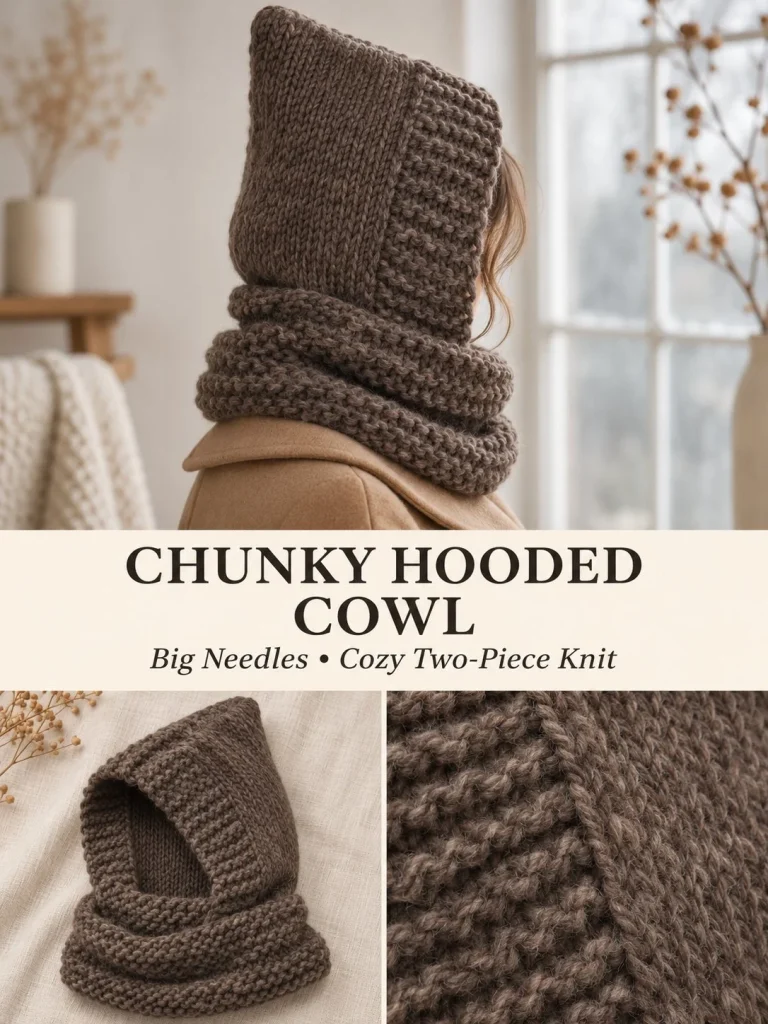
This cozy hooded cowl brings together the warmth and visual appeal of chunky wool yarn with a smart two-piece knit construction. Designed for everyday wear in cooler seasons, it frames the face with a softly knitted hood that seamlessly transitions into a snug cowl wrapped around the neck. The pattern employs large 15 mm needles to produce a lofty, inviting texture that’s perfect for layering over a jacket or parka. The interplay of garter and stockinette stitches adds subtle dimension, while the one-size design ensures a comfortable fit for most head and neck sizes.
Unlike a traditional scarf, this hooded cowl isn’t a single piece but consists of carefully knit flat panels that are joined together to form a hood and an attached neck warmer. This construction enhances both style and function; the hood fits comfortably without bulk, and the cowl stays close to the neck without excess length. The knitting method is straightforward, using only knit and purl stitches, making it accessible even for knitters eager to try working with chunky yarn on large needles. Since it’s worked flat and seamed strategically, assembly is neat and rewarding.
Using just three balls of Katia Love Wool in a soft colorway allows for a lavishly thick fabric without excessive yarn consumption, making it both economical and sustainable for those who want cozy headwear without the heavy bulk of an oversized scarf. The project avoids crochet techniques, focusing purely on knitting skills for those interested in building garment-like accessories with impressive results. For detailed stitch counts, panel shapes, and seaming instructions, the official Katia PDF pattern offers indispensable guidance.
This versatile design is suitable for knitters who want to create something unique and functional without hours of knitting or complicated stitch patterns. The bold, chunky texture and warm wool blend work together to keep the chill away in style.
Pattern at a Glance
Skill level: Beginner to Intermediate knitters comfortable with knit and purl stitches
Terminology: Standard knitting terms (US)
Construction: Knit flat panels joined by seaming to form a hood and cowl
Finished size: One size fits most (hood and neck dimensions adjusted via seaming)
Yarn weight: Chunky (Love Wool by Katia)
Needles: 15 mm / US 19 straight knitting needles
Main stitches: Garter stitch and stockinette stitch
Gauge: Provided in the official PDF (important for accurate sizing)
Motifs: None (solid panels)
Layout: Separate flat sections for hood and cowl knit in specific stitch sequences
Joining: Seaming along designated edges only
Border: None specified – raw edge or natural edge from knitting
Materials
This project uses:
- Yarn: 3 balls of Katia Love Wool, sample color 103. This thick, chunky wool creates a lofty knitted fabric that is soft, insulating, and quick to knit up. (Each ball provides sufficient yardage for the entire one-size project when using 15 mm needles.)
- Needles: Straight knitting needles size 15 mm / US 19. The very large needle size is crucial for getting the desired loose, airy yet dense fabric characteristic and the right gauge for the pattern.
- Notions: A tapestry needle is required for sewing the knit panels together cleanly and invisibly. Seaming is done only along specified edges to shape the hood and cowl.
- Additional equipment: While not necessary, stitch markers may be useful to track pattern sections or weaving in ends.
These materials are specifically chosen to produce a thick, lofty knit fabric that keeps warmth locked close to the skin without feeling overly bulky.
Yarn and Color Notes
Katia Love Wool is a chunky yarn made from a wool-rich blend offering softness, warmth, and a slight halo that enhances the finished texture. Its fuzziness helps smooth out stitches yet preserves stitch definition for the alternating garter and stockinette panels. Since the hooded cowl is a relatively small project, the smoothness and consistency of the yarn ensure even stitches and an attractive finish.
The chosen sample color 103 is a muted, versatile tone that suits multiple wardrobes and styles, but this pattern lends itself well to other neutral or rich solid shades. Due to the simplicity of the stitch pattern, variegated or lightly tweeded yarns would also provide subtle interest without competing with texture.
Avoid overly glossy or slippery yarns, as they may not hold seams well or produce the right fabric density at the bulky gauge used here.
Finished Measurements
The project is designed as a one-size design primarily, with dimensions suitable for most adults. The key points measured include:
- Width and depth of the hood: Designed to frame the face comfortably without gaping or tightness.
- Circumference and drop of the attached cowl: Fits snugly around the neck to protect from drafts while allowing freedom of movement.
Exact finished measurements depend on gauge and the tightness of your seams. The official Katia downloadable PDF includes detailed dimensions and stitch counts for reference.
Gauge
Gauge is critical with this chunky yarn and large needles. The gauge reflects the number of stitches and rows per 10 cm (4 inches) and is measured over the garter and stockinette stitch sections as indicated in the PDF.
- How to measure: Use a ruler or gauge swatch tool on the knit fabric after blocking and resting it for accurate measurement.
- Why gauge matters: Accurate gauge ensures the hood and cowl fit as intended, and that the seam lines up properly during assembly. If stitches per inch are too few, the project may become too loose and oversized; too many stitches per inch result in a smaller, tighter fit.
Always knit a gauge swatch before starting this project to verify your tension with the recommended needles and yarn.
Abbreviations
This pattern uses basic knitting abbreviations which include:
- K = Knit
- P = Purl
- St(s) = Stitch(es)
- RS = Right side (the “public” side of the fabric)
- WS = Wrong side (the “inside” of the fabric)
- CO = Cast on
- BO = Bind off
No complex or special stitches are used aside from garter and stockinette stitch.
Important Pattern Notes
- Flat knitting: The panels are worked back-and-forth in rows, never in the round.
- Use of garter and stockinette stitch: The individual panels alternate these stitches for texture and to control the fabric’s elasticity and drape.
- Seaming: Only edges specified in the pattern are seamed, to maintain the intended shape of hood and cowl. Seams should be sewn with care to avoid puckering or gaps.
- One-size construction: Designed for an average adult head and neck size, with some natural stretch from the stitch patterns.
- No crochet stitches: The project is purely knitted, so all instructions refer to knitting terminology and techniques.
Special Techniques
This pattern uses standard knit and purl stitches arranged in garter stitch and stockinette stitch panels:
- Garter stitch: Knit every row, creates a squishy, stretchy fabric with ridges.
- Stockinette stitch: Alternate knit and purl rows, produces a smooth “V” pattern on the RS.
- Seaming using tapestry needle: Join panels using mattress stitch or your preferred invisible seaming method for a clean finish without bulky seams.
The large needle size makes stitches visible and quick to work but requires gentle handling to avoid dropped stitches.
Understanding the Construction
The hooded cowl is composed of flat rectangular panels arranged to form a three-dimensional shape once seamed:
- Hood panel: Designed to frame the head and face, this section is knit in a combination of garter and stockinette stitches for texture and stretch.
- Cowl panel: Attached along the bottom edge of the hood, it wraps around the neck snugly.
- The panels are not connected during knitting but assembled afterward by seaming along designated edges only, creating a seamless transition from hood to neck warmer.
- This is not a long scarf or separate neck tube but a single wearable entity with shape inherent in the panels and seams.
This construction method lets you focus on knitting simple rectangular panels while trusting the final assembly will create the three-dimensional piece.
Complete Pattern Instructions
Foundation
- Cast on the required number of stitches as specified in the Katia PDF using 15 mm / US 19 needles and Katia Love Wool yarn. Work the flat panels one at a time according to stitch counts and row numbers.
Rows for Panels
- Garter stitch sections: Knit every row for the specified number of rows. This produces a softly textured, squishy fabric ideal for areas needing stretch and shape retention.
- Stockinette stitch sections: Alternate knit and purl rows to get a smooth fabric section. These are worked as instructed to shape the panel and add structure.
Detailed stitch counts, repeats, and row numbers for the panels are given in the official downloadable PDF pattern, which must be followed carefully to get the correct panel shapes.
Assembly
- After all panels are complete, use a tapestry needle to seam the edges as directed. Only join the edges marked in the pattern to form the hood’s open face frame and connect the cowl to the lower edge of the hood.
- Take care to align stitches evenly during seaming to avoid puckers or gaps.
Your assembled project should now have a defined hood space and an attached neck cowl section.
Checkpoints
- After knitting each panel, lay it flat and measure against the pattern’s schematic to confirm length and width.
- Once seamed, try the hood on to check the face opening fits comfortably without tugging or looseness.
- Check cowl circumference for a snug but non-restrictive fit.
Assembly and Joining
The assembly is the key to turning flat pieces into a wearable garment:
- Pin the panels together with right sides facing each other.
- Sew the edges slowly and evenly using mattress stitch along the specified seam lines.
- The seam shapes the hood so it frames the face neatly, and the cowl sits comfortably around the neck.
- Avoid tight seams that might distort the edges; the goal is to keep the natural stretch and shape of the knit fabric.
Finishing
Finishing mostly involves weaving in yarn ends from the cast-on and bind-off edges plus the seams:
- Use the tapestry needle to weave ends into the fabric on the wrong side.
- No blocking is strictly required due to the chunky yarn, but a gentle steam block can help even out edges and seams.
- Avoid harsh pinning or tight blocking to prevent stretching the soft fabric.
How to Resize
Given the pattern is constructed from rectangular panels knit flat, resizing is straightforward:
- To make a larger hooded cowl, increase the number of cast-on stitches and rows for each panel, maintaining the stitch multiple from the official pattern.
- To make smaller versions, reduce cast-on stitches and rows proportionally, preserving the stitch pattern repeat.
- Keep the ratio between hood panel and cowl panel dimensions consistent for best fitting.
Custom sizing requires knitting test swatches to match gauge and adjusting stitch counts accordingly.
Useful Variations
- Monochrome option: Knit the entire piece in one solid color for a minimalist look.
- Striped texture: Alternate between garter and stockinette stitch panels in different colors for dynamic visual interest.
- Scrap yarn version: Use leftover chunky yarn scraps, changing yarns at pattern repeats but maintaining gauge.
- Shorter cowl: Knit fewer rows on the neck section to create a more compact neck covering.
- Longer hood: Add rows to the hood panel for more coverage or a slouchy effect.
Troubleshooting
Why Is My Edge Wavy?
Uneven tension or changing needle size can cause edges to ripple. Maintain consistent needle size and try blocking lightly to flatten edges.
Why Is My Fabric Curling?
Stockinette stitch naturally tends to curl at edges. The garter stitch sections help balance this. Ensure panels are blocked gently to relax the curl.
Why Don’t My Seams Match Up?
Miscounted stitches or rows lead to uneven seams. Always measure panels before seaming and add or remove rows if needed for alignment.
Why Does My Hood Not Sit Properly?
Check seam tension and ensure you seamed the exact edges specified in the pattern. Uneven or tight seams can distort shape.
Why Is The Neckline Too Tight?
If the cowl feels restrictive, check gauge or try adding rows to the cowl panel for extra circumference.
Frequently Asked Questions
Can I use a different yarn weight?
The pattern is designed for chunky yarn and 15 mm needles. Thinner yarns will change fabric density and size, requiring gauge adjustment and pattern resizing.
Can beginners make this?
Yes. The pattern uses only knit and purl stitches with simple seaming. Beginners should review seaming techniques and gauge swatching.
Can I use circular needles instead of straight?
Straight needles are recommended for flat panels. Long circular needles for flat knitting could work but may be less comfortable for this bulky yarn.
How should I block the finished cowl?
Light steam blocking is sufficient to shape and relax the panels without stretching. Avoid wet blocking to maintain yarn loftiness.
Is the pattern reversible?
Because of the mix of stockinette and garter stitch and the seaming, the inside shows seams and purl fabric, so it is not designed as reversible.
Can I make this larger for a tight-fitting hood?
Yes, but larger sizes require careful gauge checks and maintaining stitch pattern repeats. Adjust number of stitches and rows proportionally.
Optional Related Uses
The garter and stockinette stitch panel technique and the seaming method here could be adapted to knit similar cozy accessories like:
- A hooded neck warmer for children using fewer stitches and rows
- A matching chunky knit cowl with no hood for extra warmth
- A simple knit beanie built from a rectangular panel shaped into a cap
- A cozy knit shawl with sections seamed for shaping
For knitters who enjoy hooded accessories, exploring these project variants with the same textures can be rewarding.
Final Thoughts
This hooded cowl combines simplicity of knitting with thoughtful construction, turning chunky yarn into a stylish, functional winter accessory. The two-piece flat panel design allows knitters to achieve three-dimensional shaping through careful seaming. The choice of Katia Love Wool and large 15 mm needles delivers a quick knit and a cozy, textured fabric perfect for cold weather. By following the official pattern’s precise stitch counts, stitch pattern sequences, and seam placements, knitters will create a flattering, comfortable hood and cowl combo that keeps the chill at bay.
For knitters looking for a similar yet distinct style, consider exploring the Sophie Hood knitting pattern for a cozy hooded neck warmer, which offers different construction ideas for hooded neck accessories.



