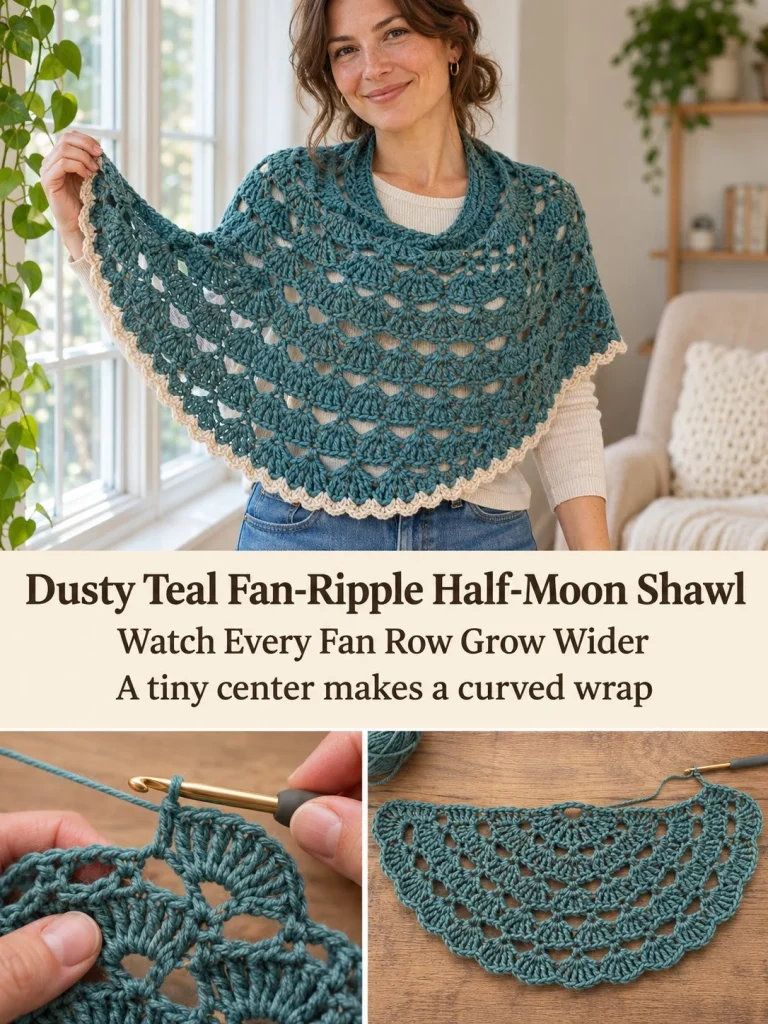
This half-moon shawl presents a graceful accessory showcasing a beautifully textured fan ripple stitch in a dusty teal shade, accented by a delicate oatmeal scalloped border. Its semi-circular shape ensures it drapes elegantly over the shoulders, offering both warmth and style. Constructed with a classic crochet technique, the shawl’s distinctive fan motifs create a rhythmic ripple effect that captures light and shadow, making the piece visually dynamic and tactilely pleasing.
The shawl’s construction begins from a tiny central ring at the top center, gradually expanding outward through carefully placed increases to create a smooth, half-circle form. This shape differs from a traditional triangular shawl by offering a wider, more enveloping drape that folds comfortably around the upper body. The design balances openness and warmth by working open 5-double crochet (dc) fans in dusty teal with a contrasting narrow oatmeal edging, giving the shawl a subtle yet refined finish.
Crocheters drawn to lacework and graceful garment accessories will appreciate the blend of structured fan motifs with the laid-back elegance of this shawl—a piece both decorative and practical. The crafting process offers engaging shaping techniques to control the curvature, making it an excellent project to deepen one’s understanding of garment shaping with crochet fans and open lace textures, as well as half-circle garment geometry. Visitors interested in the interplay of stitch texture and color contrast will find this pattern rewarding.
Pattern at a Glance
Skill level: Intermediate (due to shaping and fan stitch management)
Terminology: US crochet terms
Construction: Top-down, half-circle shawl worked in turned rows
Finished size: Approximately 56 inches wide across the upper span and 23 inches deep at the center
Yarn weight: DK (#3)
Hook size: 5.5 mm
Main stitch: 5-double crochet open fans
Gauge: Swatch required; fan spacing varies by gauge
Motifs: 5-dc fans arranged in eight radial sectors
Layout: Expanding half-circle with fan stitch shaping
Joining: None (single-piece construction)
Border: Narrow, restrained single round sc/scallop edging in oatmeal
Seaming: None, ends woven in
Materials
To create this shawl, gather the following materials:
- Yarn:
- Dusty teal DK (#3), 650–800 yards for the main fan stitch body.
- Oatmeal DK (#3), 40–60 yards reserved for the final scalloped border.
- Hook: 5.5 mm crochet hook, balancing stitch definition and drape.
- Notions:
- At least eight stitch markers to mark radial sectors and key increase points.
- A tapestry needle for weaving in ends and finishing.
These materials combine to produce a lightweight yet cozy garment with a delicate texture and good drape. The color pairing of dusty teal with oatmeal provides gentle contrast without overpowering the stitch detail.
Yarn and Color Notes
This shawl is best suited to smooth DK weight yarns that offer stitch clarity while allowing for fluid movement. Acrylic, wool, or blends that block well are ideal, as blocking is necessary to achieve the half-circle shape and open fan definition. Avoid extremely fuzzy or heavily textured yarns, as they can obscure stitch detail and complicate increase placement.
The dusty teal color creates a rich, versatile backdrop that flatters many skin tones and outfit palettes. The oatmeal border acts as a subtle frame, highlighting the fans’ contours without harsh contrast. Alternating color only on the edging keeps the focus on the textured fans.
For color customization, consider these tips:
- Solid yarns showcase the fan stitch best.
- Variegated or self-striping yarns may obscure the fan’s structure.
- Using a yarn with a soft halo can soften the ripple effect but reduce stitch definition.
Finished Measurements
This half-moon shawl is designed to measure approximately:
- Width across the upper neckline arc: 56 inches
- Depth from neck down to the center bottom edge: 23 inches
These dimensions ensure ample coverage for comfortably wrapping around the shoulders with a flattering semi-circular profile. Final size depends on achieving the suggested gauge and can be adjusted by continuing or reducing the number of rows worked. The wide upper span combined with a shallower depth distinguishes this shawl from traditional triangular shapes.
Gauge
Gauge is crucial for shaping and final fit in this shawl. While an exact stitch count per inch is not specified due to the handcrafted shaping nature, it is recommended to:
- Work a swatch of the 5-dc fan stitch in dusty teal.
- Wash and dry the swatch as you will the finished item to check drape and texture.
- Adjust hook size or yarn tension to achieve a drape that is neither too stiff nor overly loose, ensuring fans lie flat and expand smoothly.
Proper gauge ensures that the fan ripple repeats spacing produces the intended expanding half-circle shape and that increases yield smooth arcs rather than unwanted ripples or points.
Abbreviations
This pattern uses standard US crochet terminology:
- ch = chain
- sl st = slip stitch
- sc = single crochet
- hdc = half double crochet
- dc = double crochet
- sp = space
- st = stitch
- sk = skip
- rnd = round
- RS = right side
- BLO = back loop only
- rep = repeat
Important Pattern Notes
- All work is done in turned rows, expanding from a small central ring to form a half-circle.
- The fan stitch shaping relies on balanced increases across eight marked radial sectors to maintain a smooth, curved edge and prevent V-shaped points.
- Chains used in turning do not count as stitches unless explicitly noted.
- Equal numbers of fans and increases are maintained on the left and right halves for symmetry.
- The outermost border uses a single round of single crochet and scallop stitches in a contrasting oatmeal color, applied only along the curved edge.
- Stitch markers function to identify radial sectors and aid in precise placement of increases and fans.
- Gauge swatching in the fan stitch pattern is mandatory to ensure correct drape and shape formation.
- This pattern is a drafted, untested construction guide and should be adjusted to fit individual gauge and preferences.
Special Stitches and Techniques
5-double crochet fans: Each fan comprises five double crochet stitches worked into designated chain spaces in the lace fabric, creating an open fan shape. The five individual double crochet posts remain clearly visible to give texture and structure.
Fan-shaped increases: Instead of the typical V-shaped increases at center points, increases are distributed evenly across eight imaginary radial sectors marked on the fabric. This method expands the shawl evenly to maintain a half disc shape rather than a triangular or full circle.
Single crochet/scallop edging: The border uses restrained single crochet stitches combined with scallop formations (small shell-like stitches) to closely hug the fan arcs and prevent puckering.
Understanding the Construction
This shawl is worked as one continuous half-circle piece, starting from a small central ring at the top center of the neckline. The construction expands the piece symmetrically outward and downward by working rows of fan motifs, each row increasing in width with evenly spaced fan placements and chain bridges between them.
Unlike triangular shawls, this pattern’s shaping focuses on creating smooth curves on the outer edge with a wider upper span. The design avoids central V-shaped increases, instead distributing increases in eight designated radial areas to maintain the half-disc shape.
Markers are used to establish these sectors, guiding balanced fan placement and preventing skewed edges or uneven growth. The shawl grows by working turned rows that open progressively with each increase round, controlling the shape carefully as fans acquire room to expand.
Once the main body reaches the desired size, the crocheter switches to a contrasting oatmeal color to add a narrow, neat scalloped single crochet edging that frames the piece and tidies the curved edge.
Complete Pattern Instructions
Foundation
-
Begin by working a 5-dc fan swatch using the dusty teal yarn, ensuring it drapes nicely and fans open properly. This step is crucial as fan spacing and gauge strongly impact shaping.
-
Chain 4 and join with a slip stitch to form a small starting ring.
Row 1 (Initial semicircular foundation)
-
Work approximately 8 double crochets (dc) evenly into the starting ring, leaving the lower arc of the ring free, forming an initial half-circle foundation row.
-
Chain 3, turn the work to set up for the next row.
Rows 2 and on (Fan-shaped increases)
-
In the subsequent rows, begin to spread increases evenly in a fan-shaped pattern, starting with about eight increases per row.
-
This increases the width gradually left and right without creating a sharp central V.
-
Designate and mark eight approximate radial sectors between the upper center and the outer curved edge with stitch markers.
-
Establish the fan lace in turned rows: place a 5-dc fan motif in each designated chain space, anchoring between fans with single crochet (sc) or short chain bridges.
-
Repeat symmetrically across each row, ensuring the five double crochet posts within each fan remain visible and separate.
Maintaining the structure (rows after initial setup)
-
For each successive row, work into the existing chain openings rather than arbitrary gaps to maintain stitch integrity.
-
Add additional fan positions in balanced sector locations as needed to accommodate fabric growth; this helps counter fabric cupping or ruffling.
-
If ruffling occurs, reduce increases on the following row.
-
Importantly, do not add a central single V increase in the middle.
-
Keep the outer edge a smooth, rounded arc, with a slight flattening on the upper span to fit comfortably around the neck and shoulders.
-
Ensure equal counts of fan placements and increases on the left and right halves of each row for symmetry.
-
Measure your piece flat every 3–4 rows to confirm the half-disk shape is keeping its form instead of drifting into triangular or full-circle shapes.
Size guidelines
- Continue working rows with fan increases until the shawl measures approximately 56 inches wide across the upper neckline span and 23 inches deep from the neck center to the bottom edge.
Edging
-
Switch yarn to oatmeal DK weight only for the last round.
-
Crochet a restrained single round of single crochet and scallop edging along the outer curved edge.
-
Space increases carefully to follow the fan arc without puckering or distortion.
-
Do not add wide oatmeal bands or edge the entire body—only the narrow outer scalloped outline is desired.
Finishing
-
Weave in all yarn ends securely with a tapestry needle.
-
Wet-block the shawl flat to smooth out the fans and curves, shaping it clearly into a symmetric half-moon.
-
Check that the finished shawl settles evenly over both shoulders.
-
Note: since this is a drafted pattern, you may need to prototype and adjust the fan increase schedule over the eight sectors to perfect the fit before treating it as a final published stitch-by-stitch pattern.
Helpful Checkpoints
-
After the initial fan swatch, verify desirable drape and visibility of fan stitches.
-
Upon completing the foundation semicircle, confirm the half-circle shape with no pinch or sharp V point at the center.
-
During shaping rows, measure the piece when it reaches about 12 inches across and 6 inches deep, ensuring the curvature matches expectations.
-
Every 3–4 rows afterward, measure width and depth to ensure balanced growth.
-
After the oatmeal edging round, confirm that the border lies flat without ripples or puckers.
Assembly and Joining
This shawl is constructed in one piece, so no assembly, seaming, or joining of separate components is required. The shaping and edges are integrated as you work, with edges finished by the narrow oatmeal scalloped border.
Finishing Tips
-
Take care when weaving in ends on fans and edging to avoid distorting stitches.
-
Blocking is critical to open the fans fully and achieve the half-circle drape. Use pins to smooth curves symmetrically during blocking.
-
Be cautious not to overstretch during blocking as fans may lose their definition.
How to Resize
To resize this shawl, work on adjusting the number of fan increases per row and the total number of rows:
-
Width: Adding more increase points evenly across the eight radial sectors per row can widen the shawl.
-
Depth: Continue working more rows until the desired depth is reached, maintaining balanced fan placement.
-
Maintain symmetry by keeping equal increases and fan placements on each side.
-
Swatch and adjust gauge accordingly to ensure shape remains a smooth half-disc.
Useful Variations
-
Single-color shawl: Work the entire piece in dusty teal for a monochromatic look, omitting the oatmeal edging.
-
Different contrast edges: Use a brighter or metallic yarn for the scallop border to add visual pop.
-
Varying yarn weights: Try fingering or sport weight yarn with a smaller hook for a lighter shawl; be mindful of how increases affect drape.
-
Longer or shorter depth: Adjust rows worked to achieve a longer or shorter pendulous effect.
-
Complementary accessory: Pair with matching fingerless gloves or a hat using the same fan ripple stitch pattern for a coordinated set, such as those similar to the dusty teal basket weave shoulder wrap shown elsewhere.
Troubleshooting
Why is my shawl curling or cupping?
This often indicates imbalance in increase placement or incorrect fan spacing. Verify that increases are evenly distributed within the eight marked sectors and avoid adding too many fans in one area.
Why are my fans not defined?
Check your gauge and hook size. A hook too large may cause floppy fans; too small, and the fabric stiffens. Swatching and adjusting tension helps.
Why does the border pucker?
The oatmeal edging should follow the fan arcs carefully. Adjust the number of increases in the edging if puckering arises. Avoid edging the entire body to minimize imbalance.
Why does my shawl feel too narrow or short?
Add more increases per row and continue working more rows, making sure to balance both sides equally.
How do I keep symmetry as I work?
Use stitch markers to consistently mark sectors and count increases carefully on each side.
Frequently Asked Questions
Can I use a different yarn weight?
Yes, but adjustments to hook size and stitch counts will be necessary. A lighter yarn will produce a more delicate shawl, while heavier yarns increase bulk.
Can I substitute the hook size?
Yes, but changing the hook size affects gauge and drape. Always swatch to confirm fan stitch appearance.
Can I omit the oatmeal border?
Yes, but the narrow border adds a clean, finished edge and color contrast enhancing the design.
Is this pattern suitable for beginners?
It is recommended for those comfortable with reading patterns and managing shaping as it requires attention to symmetry and increases.
How should I block the shawl?
Wet block using pins placed at fan tips and outer edges to open fans and shape the half-moon curve without overstretching.
Can the pattern be worked top-down in rounds?
This pattern is designed for worked in turned rows to maintain the flat half-circle shape.
Final Thoughts
This fan-ripple half-moon shawl offers a spellbinding balance of texture, shape, and subtle color contrast. Its innovative shaping through multiple radial sectors creates a sleek curved silhouette that drapes beautifully, setting it apart from typical triangular wraps. With carefully placed fans and a restrained oatmeal scalloped border, it becomes both a statement accessory and a comforting layer. The journey to this elegant finish involves swatching, symmetrical increases, and patient shaping—a fulfilling project for intermediate crocheters eager to expand their skill set with lace fan stitches and garment shaping.



